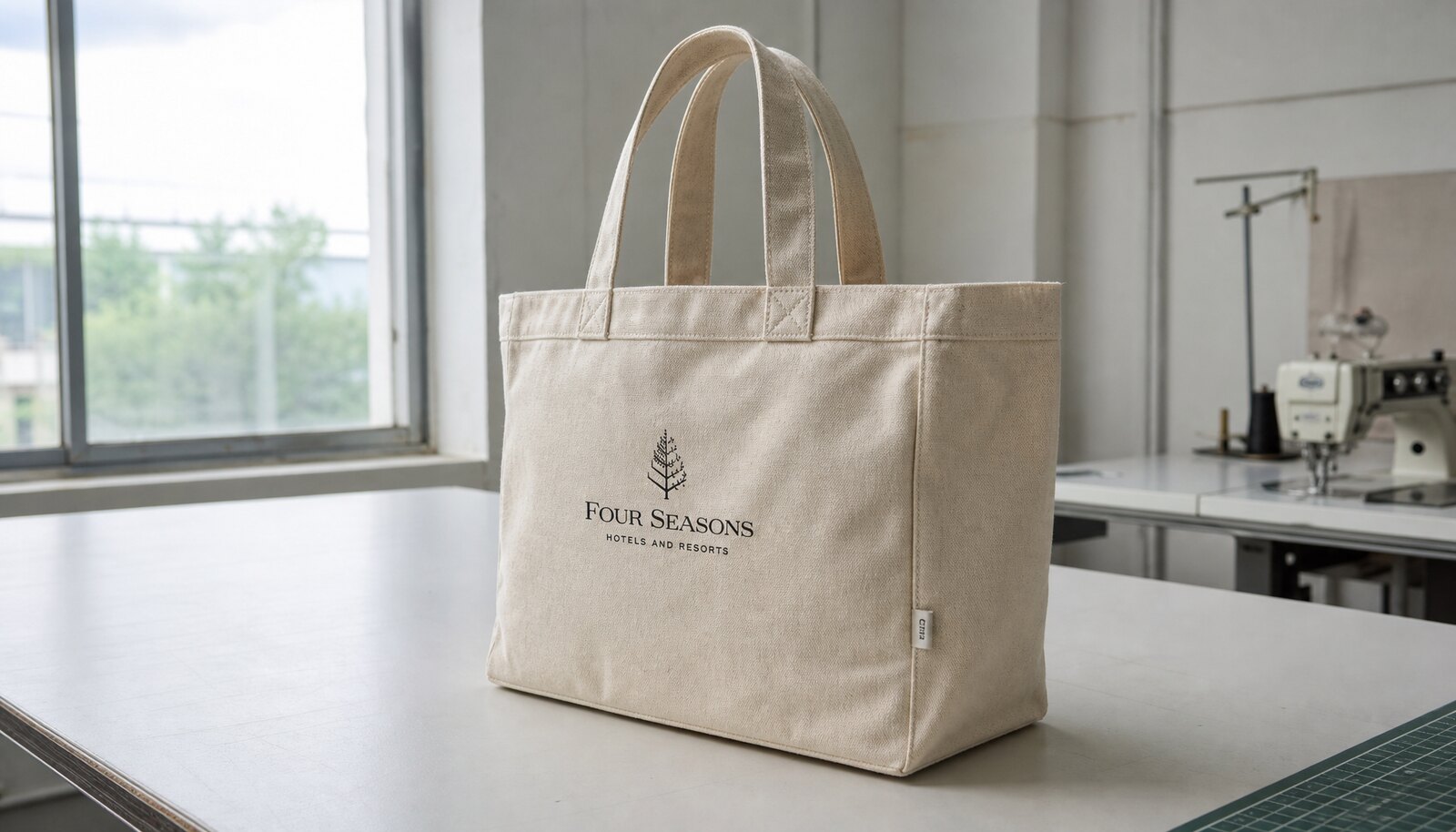
Why hotel giveaway totes fail when the bag spec is too vague
For hotel event giveaway planning, the tote is rarely just a bag. It is part of the check-in experience, the sponsor handoff, the room welcome moment, and sometimes the only physical item the guest keeps after the event. That means procurement cannot treat it as a generic promotional accessory. If the RFQ only says “recycled canvas tote,” suppliers will fill the gaps differently. One factory may quote a light fabric with a simple print. Another may assume reinforced handles, heavier cloth, and more careful packing. Those are not comparable offers, even if the quote line looks similar.
The common failure mode is usually not catastrophic. It is subtle and expensive. The tote arrives with a droopy body, a logo that reads too small from a normal viewing distance, or handles that feel weak once the brochure stack or amenity kit is inside. Because the event date is fixed, there is no practical time for a second production round. By the time the issue is visible, the only choices are accept it, rush a replacement, or change the event distribution plan.
That is why the bag specification needs to behave like a working procurement document rather than a marketing brief. Buyers need enough detail for suppliers to quote the same product and enough detail for QC to judge pass or fail. If the standard is missing, the team ends up comparing samples and sales promises instead of sourcing on the basis of real production terms.
The most useful way to frame the tote is by use case. A bag for room keys, a map, and a welcome card has a very different requirement from a bag that must hold a water bottle, paper program, and a sponsor insert. Likewise, a tote handed out at a conference registration desk should be quick to pack and easy for the guest to carry immediately, while a VIP welcome bag can justify a more structured build and more careful finish. The bag spec should reflect that difference before anyone asks for pricing.
A hotel procurement team also needs to decide who the tote is serving. In some programs the buyer is optimizing for guest perception. In others, the purpose is operational: the tote needs to be easy for staff to fill, easy for the property to store, and consistent enough to ship to multiple locations. These are not the same target. If the spec does not name the priority, the supplier will optimize for whatever seems most obvious from the file, which may not match the business need.
A useful RFQ should therefore lock three things at the start: what the tote carries, where it will be distributed, and what the buyer is willing to trade off. If the answer is speed, the design may stay simple and stock-based. If the answer is brand presentation, the buyer may accept a higher MOQ and a longer lead time for a cleaner result. Once that decision is made, the rest of the sourcing process becomes easier to compare and easier to approve.
- Define the actual event use, not just the bag type.
- Specify the contents the tote must hold.
- Set the approval owner and escalation path before sampling starts.
- Do not compare quotes until the geometry and print standard are fixed.
Recycled canvas sourcing: what the claim really means and what proof buyers should request
The recycled part of recycled canvas totes for hotels event giveaway planning is where many RFQs become too loose. In supplier language, recycled canvas can mean pre-consumer recycled cotton, post-consumer recycled cotton, a cotton-poly blend with recycled content, or a general recycled fiber blend. Some suppliers use the term accurately and can document it. Others use it as a positioning phrase. For a hotel brand that wants to talk about sustainability, that difference matters because the guest-facing claim and the internal compliance record must line up.
A better RFQ separates three items: the actual fiber composition, the proof that supports the claim, and the language the hotel is allowed to use in brand materials. Ask for the exact percentage of recycled content and whether that content is pre-consumer, post-consumer, or mixed. If the supplier only says “eco canvas” or “recycled look,” that is not enough for a buyer who needs traceability. A procurement file should show whether the claim is material fact or just descriptive packaging.
Useful documents to request include a fabric composition statement, a mill specification sheet, a supplier declaration on recycled content, and, if your organization uses traceability programs, the relevant certificate or chain-of-custody record. The point is not to over-audit the supplier’s entire system. The point is to avoid buying a sustainability story that cannot be supported if marketing, legal, or ESG reporting asks for evidence later. A clear document set also helps if the hotel group needs to reuse the same tote on a future event and wants the same claim to stay valid.
It helps to be explicit about what counts as acceptable proof. For some buyers, the supplier declaration is enough if the factory has a known relationship with the mill. For others, especially larger hospitality groups, the file needs to include the document owner, the production site, and the date range of the material batch. If the supplier cannot identify where the fabric came from or which process created the tote, the claim is too soft for a serious procurement decision.
Claims can also drift in artwork and copy. “Eco bag,” “sustainable tote,” and “recycled canvas tote” do not mean the same thing. If the hotel wants to print or advertise the recycled-content story, the wording should be approved separately from the purchase order. That keeps the product spec, the legal claim, and the guest messaging aligned.
One practical rule: if the supplier cannot explain the difference between a recycled-content claim and a recycled-style appearance, do not assume they are the same. A bag may look responsible and still fail the documentation standard. For procurement, the strength of the claim is not the color of the fabric; it is the evidence attached to the order.
- Ask whether the recycled fiber is pre-consumer, post-consumer, or mixed.
- Request a mill spec or composition statement rather than a verbal claim.
- Confirm which documents can accompany the sample, quote, or shipment.
- Approve guest-facing sustainability language separately from the product spec.
- Do not use “eco” wording as a substitute for recycled-content proof.
Fabric, weight, weave, and finish: the real performance drivers
For hotel giveaways, the practical fabric range is usually around 8 oz to 10 oz, or roughly 270 to 340 GSM. That range covers the majority of useful applications. Below it, the tote can feel too soft, collapse too easily, and show the outline of the contents. Above it, the bag can look more substantial but may add stiffness, sewing cost, and freight volume. The right answer depends less on fashion and more on what the bag has to carry and how long the guest is expected to use it.
Weight alone does not tell the whole story. Two 8 oz fabrics can behave very differently if one is tightly woven and the other is loose and open. A tighter weave usually helps with print clarity and gives the bag a more composed shape. A looser weave can look more rustic, but it may show irregularity, make fine text harder to print cleanly, and present a less premium surface under bright hotel lighting. If the artwork contains small copy, thin rules, or a detailed logo, ask the supplier to print on the actual fabric, not just on a lab swatch.
Finish changes both appearance and procurement risk. A natural undyed bag is usually the simplest route and often the most flexible for repeat orders. It can support sustainability messaging without custom dye costs. But the buyer should expect natural variation, yarn flecks, and slight lot-to-lot shade differences. A dyed bag gives more color control and can look more intentionally branded, but it adds approval steps, possible dye minimums, and longer lead time. For hotel groups that need consistency across properties, the finish with fewer weak points is usually the better commercial choice.
Handle design should be chosen with the use case in mind. Self-fabric handles create a coherent look and often keep the bag economical. Webbing handles or mixed-material handles can improve carry comfort or durability, but they also change the visual language and may change the supplier pool. The buyer should confirm not only handle length but handle drop, width, and attachment method. A handle that looks elegant in a flat lay can feel too narrow once the bag is loaded with brochures, a water bottle, or a boxed amenity set.
For event giveaways, the simplest questions often matter most: does the tote stand up when loaded, does it keep its shape in a guest hand, and can staff pack it quickly without extra adjustments? If the answer is no, the issue is usually fabric weight, weave, or reinforcement—not the logo. That is why buyers should test the bag with the actual contents before they sign off on the final sample.
- 8 oz is usually better for brochures and flat inserts.
- 10 oz is usually better for welcome kits and heavier loads.
- Tighter weave often improves logo clarity.
- Natural finish is easier for repeat orders; dyed finish can improve brand consistency but adds time and cost.
- Test the tote with the real insert set, not an empty sample.
Spec sheet essentials: what every buyer should lock before quoting
A useful quote begins with a useful spec sheet. For custom recycled canvas totes, the supplier needs more than a logo file and a broad size target. The spec should read like production instructions. Include finished dimensions, gusset depth, handle length, fabric weight, recycled-content requirement, print placement, and packing format. If any of those fields are missing, the factory will fill them in with its own default, and the buyer may not notice the mismatch until the event is close.
The easiest way to make quotes comparable is to standardize the geometry. If the tote must hold an A4 brochure, a welcome card, and a small amenity pack, say that directly. Better still, specify the contents or minimum internal space required rather than using a vague label like “medium tote.” Many disputes start when the buyer imagines one shape and the supplier quotes another. The bag may be technically acceptable, but operationally awkward. That usually appears at the registration desk or room-packing station, not during the sales conversation.
The spec should also say what cannot change without reapproval. If the finished size shifts, even slightly, the cutting layout, fabric consumption, carton count, and freight estimate can all move. If the hotel event is tied to a fixed date, those changes are not minor. They trigger re-quoting, artwork recheck, and potential schedule compression. In procurement terms, the fastest order is often the one with the fewest unknowns.
If the order serves several hotel properties, create one master spec and note the only allowed variations. In most cases, the tote body should stay identical while the insert card, barcode label, or destination sticker changes by property. That keeps the sewing run stable and reduces inventory confusion. A buyer who allows too many tote variants usually ends up with fragmented stock, different reorders, and a harder reconciliation process after the event.
This is also the place to document approval ownership. Marketing may care most about appearance, operations may care most about packability, and procurement may care most about landed cost. If all three groups are involved, define who signs off on fabric, artwork, and packing. Otherwise the supplier can receive conflicting comments and the project loses time in revision loops. A clear spec sheet is not just a factory tool; it is the easiest way to keep internal approvals from drifting.
- Finished dimensions with tolerance, not just an approximate size.
- Fabric weight, weave, and handle build in the same document.
- Print area, placement reference, and color standard.
- Packing method, carton count, and destination split rules.
- List the exact contents the tote must hold.
Comparing supplier quotes: how to avoid false like-for-like pricing
Quote comparison only works if the quotes describe the same product. In tote sourcing, that is more difficult than it sounds. One supplier may quote a stock blank with printing only. Another may quote a custom sewn bag. A third may quote a bag that is smaller or lighter than the others. On paper, the unit price may vary a lot. In practice, the bags may not be equivalent enough to compare. Procurement should resist the urge to choose the lowest number before checking the assumptions underneath it.
The most reliable discipline is to send one RFQ sheet and reuse it for every supplier. Ask each supplier to confirm fabric weight, composition, bag dimensions, handle construction, print method, packing, and shipping terms. If they cannot state where the bag is produced and what happens in-house versus outsourced, the quote is too vague for a serious award decision. Hidden outsourcing is not always a problem, but hidden process ownership makes quality accountability much harder when a defect appears.
A quote should also separate the visible cost from the hidden cost. The headline unit price may be low, but setup charges, artwork preparation, sample fees, repacking, carton charges, or special labeling can change the real value. This matters especially on mid-sized hotel event orders where the production run is not large enough to absorb every overhead line. Ask for a breakdown so the buying team can see whether the cost is coming from fabric, sewing, printing, or packing complexity.
Lead time should be reviewed with the same care as price. A lower ex-works number can become the expensive option if the event date is fixed and the supplier needs rush production or air freight to deliver on time. Buyers should compare landed cost and time-adjusted cost, not only the factory line. If one supplier can meet the event date with a clean production plan and another needs a rescue shipment, those quotes are not equal even if the bag price is similar.
For hotel event planning, the consequence of a late tote is often greater than the consequence of a slightly higher tote price. A tote that misses the registration day can force the team to switch to a secondary giveaway or distribute the bags after the event. That can weaken the guest experience and create internal explanation work. The cheapest quote is only cheap if it arrives when needed, with the right print and the right count.
- Use one RFQ sheet across all suppliers.
- Break out unit price, setup, sample, packing, and freight assumptions.
- Require the same logo size, same side, and same artwork version on every quote.
- Ask for the real production site and process ownership.
- Compare landed and time-adjusted cost, not only ex-works price.
Sourcing routes for hotel event totes: direct factory, trading company, or local print shop
Different sourcing routes fit different buying situations. A direct factory is usually the strongest choice when the tote needs sewing control, repeatability, and standardized packing for hotel groups or event series. The buyer can inspect the production line, negotiate the construction details, and reduce the risk of multiple layers of margin. The tradeoff is that the buyer has to manage the spec carefully, because the factory will expect clear instructions and timely feedback.
A trading company or sourcing agent can be useful when the hotel team is coordinating several items at once or does not have bandwidth to manage factory follow-up. The upside is convenience and broader product coordination. The downside is transparency. If the agent is not willing to identify the actual production site, the buyer may lose visibility into where the sewing, printing, and packing really happen. For procurement, that matters because the quality risk sits where the tote is made, not where the purchase order is issued.
A local print shop can be a practical option for a small or urgent event, especially if the bag is stock and only the logo changes. But once the order involves recycled-content proof, custom cut-and-sew, packing by hotel property, or repeat orders, a print shop may not offer the same level of end-to-end control. The question is not just cost. It is how many links in the chain the buyer must trust without seeing them.
For recurring hotel programs, the best sourcing route is usually the one that can repeat the same result months later. A low quote that cannot be replicated on the next event creates inconsistency in guest experience, inventory, and reporting. Standardization matters because hotel giveaways often move through multiple stakeholders and multiple delivery points. The route that looks easiest on one order may not be the best route for the next season.
One helpful decision rule: if the order requires document proof, repeatability, and property-level distribution, lean toward a direct factory or a very transparent agent with factory disclosure. If the order is small, local, and urgent, a print shop may be enough. The buyer should match the source route to the level of control the event actually needs.
- Direct factory: best for control, repeat orders, and detailed QC.
- Trading company: useful when coordination matters more than process visibility.
- Local print shop: workable for small, urgent, or stock-bag programs.
- Ask every route to identify the real production site and who owns sewing, printing, and packing.
Printing and branding: choosing the method that matches the artwork and the budget
For most hotel giveaway programs, 1-color screen print is still the most practical branding method. It suits solid logos, event names, and simple hospitality marks, especially on 8 oz to 10 oz canvas where the surface can hold ink cleanly. Screen print is usually cost-effective at volume and gives a clean brand impression when the buyer wants something legible, durable, and easy to approve. The key is to make sure the artwork is set up for the fabric and not resized casually from a digital file.
Transfer print is useful when the artwork has multiple colors, fine type, or a more complex graphic. But it is not a universal upgrade. The buyer should ask how the print will hold up on rough use, whether there is a visible film or layer, and whether the supplier has proven results on canvas rather than only on smoother materials. A transfer that looks perfect on a proof can still fail a production test if the adhesive, temperature, or pressure settings are not right for the fabric texture.
The print area should be defined with measurements from the top edge and the seam, not described as simply “front logo.” On hotel event tables, bags are often lined up in rows, and a small placement shift can make the batch look uneven even when the artwork itself is correct. If the bag will be packed with a card, amenity, or bottled item, check that the print does not interfere with folds, top closures, or handle spacing.
If the logo is small, ask the supplier to produce the actual scale before bulk begins. Small text is one of the fastest ways to expose weak print control. Thin lines can fill in, and pale ink on natural canvas can disappear from normal viewing distance. The sample should be judged in the same lighting and use scenario as the event, not only under a sales desk lamp. Procurement buyers do not need a graphic arts lecture; they need a method to catch unreadable artwork before it becomes a warehouse problem.
For some hotel programs, a sewn label or woven patch may be the better branding choice. It usually costs more and needs longer lead time, but it can support a more premium guest feel and avoid some print durability questions. The decision should be based on how the bag will be handled, not only on the artwork file. A simple conference tote and a high-touch VIP gift bag do not need the same decoration strategy.
- Best for simple branding: 1-color screen print.
- Best for detailed artwork at moderate volume: transfer print, if the factory has proven results on canvas.
- Best for premium feel: sewn label or woven patch, with longer lead time and higher cost.
- Measure print placement from fixed edges or seams, not by eye.
MOQ, color variants, and what really drives the minimum
MOQ is rarely a single number in tote sourcing. It is usually driven by fabric color, print color, sewing setup, and whether the bag is a stock shape or a custom pattern. A natural canvas tote with one logo often has the most workable economics because the factory can run a cleaner batch. Once the buyer adds custom-dyed fabric, multiple logo versions, or property-specific event names, the order fragments and the minimums move up.
This is especially relevant in hotel procurement because event teams often want variety: one tote for VIP arrivals, another for conference attendees, another for staff use. That can make sense operationally, but it also multiplies setup and inventory risk. If the tote body can stay the same and only the insert card, ribbon, or hangtag changes, buyers can often save money and reduce stock complexity. In many programs, the smartest move is not to create more tote versions. It is to standardize the tote and vary the content.
If multiple artwork versions are unavoidable, ask the factory to quote the base tote and then the incremental cost for each new print version. That helps the buyer see whether the real cost is fabric, printing, or packing. It also helps decide whether the hotel truly needs different tote bodies or whether one standardized bag would serve the same purpose. One consistent tote usually creates a cleaner receiving process and fewer fulfillment errors.
MOQ also acts like a timing lever. Lower MOQs are useful when the event is still awaiting approval or the headcount is not final, but they usually come with a higher per-unit price. Larger runs reduce unit cost, but only if the hotel can actually use the quantity without storage issues or stale branding. Buyers should match the MOQ to the event’s consumption rate, not to an abstract best-price target. Buying too many cheap bags can be more expensive than buying fewer well-timed bags.
For repeat event calendars, the buyer should also ask whether the supplier keeps the same pattern and print settings on file. If the next order is expected to be a reorder rather than a redesign, the minimums may be less of a concern than the supplier’s ability to reproduce the same result without a new setup cycle.
- One style, one color, one logo version is the easiest MOQ structure.
- Multiple properties or sponsor versions usually raise setup cost.
- Custom dyed fabric usually means longer lead time and tighter minimums.
- Ask what change actually triggers the MOQ instead of accepting the headline number only.
Sample approval and QC: operational checks that prevent expensive misses
Sample approval is where procurement saves the most money, because it is the last point where a mistake is relatively cheap to fix. But the sample has to be a true pre-production sample. If the factory makes it from substitute fabric, a different print method, or a rushed sewing line, then the sample is only a presentation piece. For hotel event giveaways, that is not enough. The tote must represent what will actually arrive at the registration desk or in the guest room.
A good sample review is practical, not cosmetic. Load the intended contents into the bag. Check handle comfort and seam stress. Fold the bag if it needs to fit in a welcome kit box. Look at the logo from a normal standing distance. The tote should not only look right; it should work in the event flow. If it is being packed by staff, verify whether it can be filled quickly without distortion. If it is being handed to guests at check-in, verify whether it opens cleanly and sits well in the hand.
QC should also be written in measurable terms. AQL 2.5 is commonly used for major visual defects, while AQL 4.0 is often acceptable for minor cosmetic issues, but the buyer should state the standard in the PO or QC plan. Defect classes need to be clear. Wrong size, wrong artwork, missing handle, open seam, or unreadable recycled-content wording should be treated as major or critical. Loose threads, minor wrinkles, or slight fabric shade variation may be minor if they do not affect use or presentation. If those definitions are not written down, the factory will use its own standard to defend the shipment.
The most useful tests are simple and repeatable. Check stitch density and handle reinforcement on the first off sample. Do a light dry rub and a moderate wet rub after print curing. Measure finished dimensions against the approved tolerance. Inspect random units from multiple cartons, not only the top layer. If the order is packed by destination hotel, verify carton counts against each destination label before sealing the shipment. These are not bureaucracy for its own sake. They are the controls that stop a bad event-day surprise.
For a hotel program, QC should also include approval control. Keep the approved artwork version, PMS or CMYK reference, and print placement drawing with the production file. Many tote problems are not manufacturing failures at all; they are version-control failures. One old artwork file, one changed placement note, or one unapproved color swap can create a shipment that is technically well made and still wrong for the event.
- Use the same fabric, same sewing line, and same print method for the sample and bulk order.
- Set a sampling ratio and AQL level in writing before production starts.
- Treat wrong size, wrong artwork, open seam, and missing handle as major defects.
- Check print rub, handle stress, and carton count before dispatch.
- Keep the approved artwork version and placement drawing in the production file.
Packing, labeling, freight, and property-level distribution planning
Canvas totes are bulky by nature, so freight can change the economics more than buyers expect. A tote that folds loosely may seem harmless, but if the carton is oversized, the shipment volume rises and the freight quote rises with it. If the bag is over-compressed, the print can crease or the body can lose shape. The right packing plan balances product protection with cubic efficiency, which is why carton size should be discussed during quoting, not after production.
For hotel event giveaways, bulk packing is often the best option when the receiving team can distribute the bags on site. It keeps carton volume lower and simplifies factory packing. Individual polybags make more sense if the totes are going to retail shelves, long-term storage, or environments where dust protection matters. If the bags will be split across multiple properties or conference venues, destination packing can save time at receiving, but it needs strict carton labels and count control.
This is where event planning and procurement meet. If the hotel group is shipping to more than one property, create a destination map before production starts. List the hotel name, contact, carton count, and whether each destination needs a separate packing list. Ask the factory to print destination codes on both the carton and the shipping document. That prevents re-sorting at the warehouse and reduces the chance that a carton intended for one property ends up at another.
Freight should be estimated early using real carton dimensions and gross weight. If the event date is fixed and the production calendar slips, the team may be forced into air freight even if sea would have been cheaper. That is why lead time and freight need to be managed together. A low factory quote can become the expensive option once rush shipping is added. Procurement should compare the delivered bag, not the warehouse bag.
There is also a hidden labor cost at the hotel end. Poorly labeled cartons slow down receiving, especially when multiple events or properties are involved. If the bags are split by venue, sponsor, or room block, ask the factory to label cartons consistently and include the same destination code on the packing list. Small labeling discipline usually saves more time than it costs.
- Ask for carton dimensions and gross weight before PO award.
- Use bulk packing for back-of-house event distribution whenever possible.
- Use individual polybags only when retail display or storage protection matters.
- Label cartons by hotel, venue, or destination code if the order is split.
- Build a destination map before production starts if the order ships to multiple properties.
Specification comparison for buyers
| Decision area | Option A | Option B | Buyer tradeoff and risk | What to request in the RFQ |
|---|---|---|---|---|
| Recycled-content proof | Fabric with mill spec, composition statement, and traceability support | A recycled-style bag with only a marketing description | Option A supports sustainability reporting, internal compliance, and guest-facing claims; Option B may be cheaper or faster but is weak if a hotel brand team asks for evidence later | Fiber composition, source type (pre-consumer/post-consumer/mixed), and document list that will be attached to sample or shipment |
| Fabric weight | 8 oz / about 270 GSM | 10 oz / about 340 GSM | 8 oz is lighter, lower freight, and often enough for brochures; 10 oz gives a fuller hand and more structure for welcome kits or bottle inserts | Finished weight, tolerance, weave type, and fabric width |
| Bag shape | Flat tote | Gusseted tote | Flat totes are simpler and cheaper, but gusseted bags hold event kits, amenity packs, and bottles more cleanly | Finished dimensions, gusset depth, and whether the bag must stand upright when loaded |
| Handle build | Self-fabric handles with reinforcement | Webbing handles or mixed-material handles | Self-fabric looks cohesive and can be economical; webbing can improve comfort and load durability but changes appearance and cost | Handle width, drop length, stitch pattern, and reinforcement method |
| Branding method | 1-color screen print | Transfer print or multi-step decoration | Screen print is usually strongest for simple hotel logos; transfer can suit complex art but needs clearer durability checks | Artwork file, print size, placement reference, color standard, and rub/adhesion expectation |
| Supplier route | Direct factory | Trading company or sourcing agent | Direct factory gives clearer control over cutting, sewing, and packing; an intermediary may simplify coordination but can blur accountability if production issues appear | Factory name, production address, process map, and who owns sewing, printing, packing, and final inspection |
| MOQ structure | One style, one color, one logo version | Multiple property versions or multiple colorways | One version keeps setup cost and inventory risk lower; variants multiply minimums, changeovers, and leftover stock risk | MOQ by color, print version, and any surcharge for alternate artwork or destination labeling |
| Packing format | Bulk packed by style and destination | Individually polybagged and labeled | Bulk packing reduces volume and freight; individual packing helps retail handling and dust protection but adds labor and carton count | Packing method, label format, units per carton, and destination split plan |
| QC approach | AQL inspection plus load, print, and stitch checks | Visual-only approval | AQL plus simple performance checks catches weak stitching, poor print cure, and size drift; visual-only checks can miss failures that show up on event day | Inspection level, defect categories, test method, and acceptance criteria |
Buyer checklist before sampling
- Confirm the event use case first: guest welcome kit, conference handout, sponsor giveaway, staff distribution, or retail-style guest purchase.
- Lock the finished size, gusset depth, handle length, and intended load so every supplier quotes the same geometry.
- State whether you need a recycled fiber claim, a recycled-content percentage, or only a recycled-style look; these are not interchangeable.
- Ask for fabric weight in GSM or oz plus a tolerance range, not just a marketing phrase like heavy canvas.
- Specify print method, number of colors, print area, and exact placement reference from seams or edges.
- Require a sample made from production fabric with the final print process, not a substitute sample or generic stock sample.
- Request separate pricing for bag unit cost, print setup, sample fee, packing, cartonization, and any special labeling.
- Ask for carton dimensions, gross weight, and units per carton so freight can be estimated before award.
- Build in time for one sample correction cycle if artwork is complex or if hotel brand approvals are slow.
- Clarify whether bags will ship bulk packed, polybagged, barcode-labeled, or packed by destination property.
Factory quote questions to send
- What is the exact fiber composition of the canvas, and can you provide a mill spec or composition statement for the recycled-content claim?
- Is the recycled claim supported by chain-of-custody, transaction certificate, supplier declaration, or another document, and can you attach it to the quotation?
- What is the finished fabric weight in GSM or oz, and what tolerance do you hold at incoming inspection?
- Are you quoting a cut-and-sew tote or a stock blank, and what steps happen in your own factory versus subcontracted facilities?
- What is the MOQ by fabric color, print color, and artwork version, and does MOQ change if we choose natural canvas versus dyed canvas?
- What handle reinforcement do you use at the attachment point, and is it bar-tack, X-box, double-stitch, or another method?
- What print method do you recommend for this artwork, what curing method will you use, and what rub performance can you expect on the chosen canvas?
- Can you provide a pre-production sample made from production fabric with the final print and the same sewing line that will be used in bulk?
- What carton size, gross weight, and packing quantity do you recommend for this tote size, and how many cartons fit on a pallet if needed?
- What inspection standard do you use before shipment, and can you share AQL level, sampling ratio, and defect categories?
Quality-control points to confirm
- Fabric GSM verification: measure incoming fabric against the approved target and accept only within the agreed tolerance, commonly ±5% unless the spec sheet states a tighter control.
- Composition verification: confirm the recycled fiber declaration matches the approved quotation and sample, and reject any unexplained substitution.
- Proof document check: keep a copy of the mill spec, supplier declaration, and any traceability document linked to the purchase order number before bulk approval.
- Cutting check: inspect the first cutting lay for size, grain direction, and panel alignment before the full production run continues.
- Stitching check: examine handle attachment, side seams, bottom seams, and corner reinforcement for skipped stitches, puckering, loose threads, or seam damage.
- Functional load check: perform a practical carry test with the expected insert weight; the tote should hold the load without visible handle distortion, seam opening, or bottom sag beyond the approved appearance standard.
- Print adhesion check: after curing, apply a light dry rub and a moderate wet rub on the sample print area; reject visible smearing, peeling, or color loss.
- Print position check: measure logo location from the seam or top edge on random units from different cartons; do not rely on visual alignment only.
- Color and shade check: compare canvas and print shade to the signed-off sample under consistent light; separate any mixed shade lots before packing.
- Needle-hole and contamination check: reject bags with oil stains, dark marks, broken needle holes, or thread contamination in visible areas.