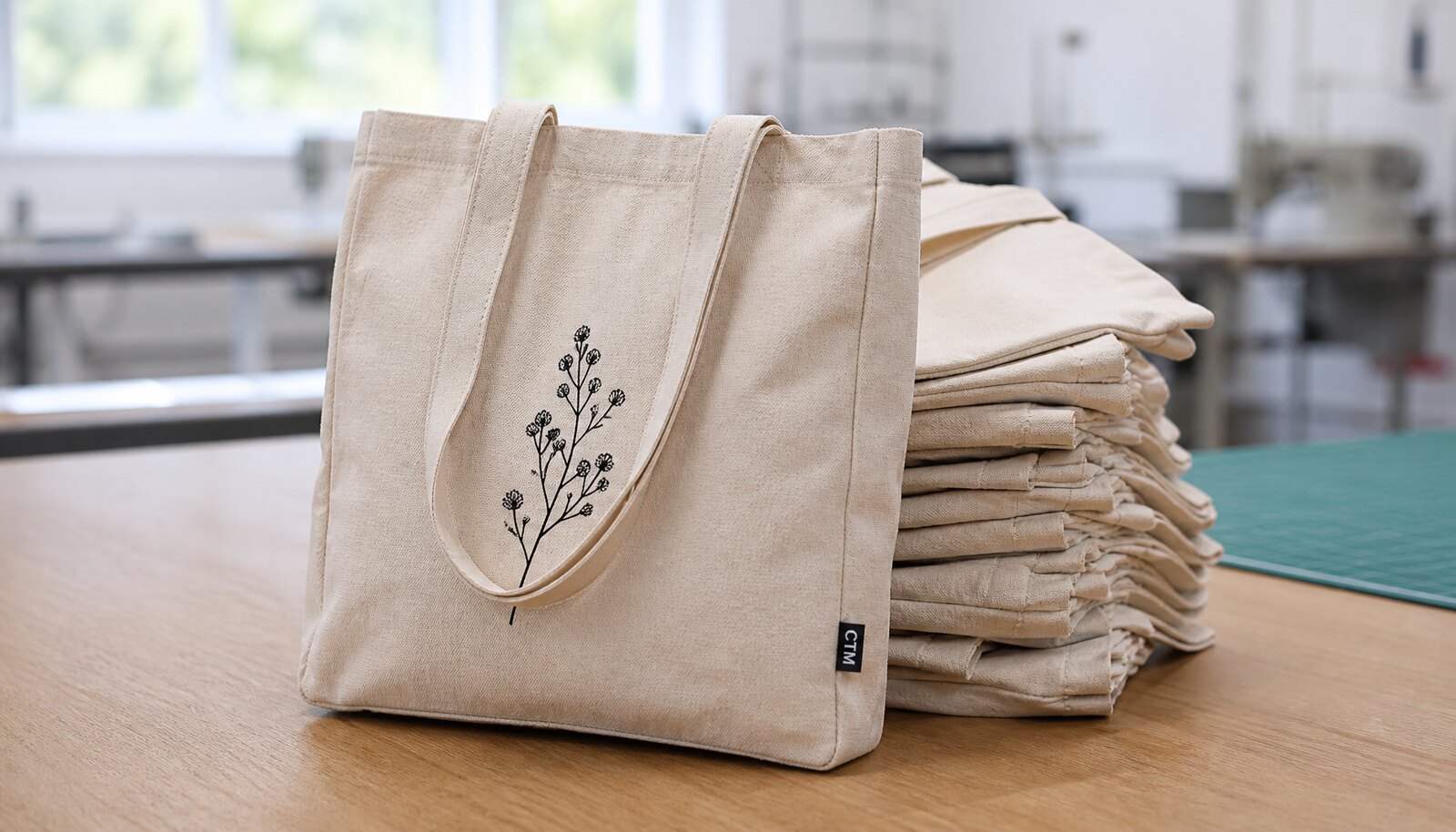
1. What gift shop buyers actually need from a recycled canvas tote
A recycled canvas tote for a gift shop has a different job than a promo bag. It needs to hold up on a retail floor, feel clean in hand, and price into a margin that still leaves room for display, markdowns, and seasonal replenishment. If the bag looks too promotional, it becomes a giveaway item. If it is built too heavy or over-decorated, the unit cost usually leaves the buyer with no room to retail it profitably.
For bulk pricing planning, start with the end use: souvenir purchases, museum store impulse buys, local destination branding, or multi-item carry. That choice drives the right fabric weight, print method, and packing format. For most gift shops, the best starting point is a simple recycled canvas tote in a standard retail size, one-color print, and a structure that stays upright enough to display but not so rigid that sewing cost climbs unnecessarily.
- Retail-friendly size range: 12 x 14 in. to 15 x 16 in. is usually easier to price and stock.
- If the tote carries apparel, books, or boxed souvenirs, consider a gusset; if not, a flat body keeps cost down.
- Avoid over-specifying lining or zipper closures unless the product line clearly needs them.
2. Fabric weight and recycled content: where the bulk price moves
The first real price lever is fabric weight. In recycled canvas, 12 oz is a common commercial starting point for gift shop bags because it balances body, print quality, and sewing efficiency. Moving to 14 oz gives a firmer retail feel and better durability, but the material cost and labor usually rise together. Below that, 10 oz may look acceptable on a spec sheet yet feel too soft for retail display unless the bag is small and lightly loaded.
Ask the supplier whether the quoted GSM or ounce weight refers to finished fabric after weaving and finishing, not a theoretical fabric basis. Recycled canvas can vary by mill, and buyers often compare quotes that are not using the same weight basis. If one quote includes recycled cotton content and another includes a recycled cotton-poly blend, the handfeel, shrink behavior, and print response may differ enough to affect shelf appeal and QC acceptance.
- 12 oz recycled canvas: usually the best price-to-finish balance for standard gift shop SKUs.
- 14 oz recycled canvas: better stand-up feel, better perceived value, higher cost.
- Recycled content should be stated clearly as a percentage or material claim; vague wording creates compliance and marketing risk.
3. Print method choices that protect margin
For bulk pricing, print method matters more than buyers expect. Screen printing is usually the most economical route for one-color or two-color logos at scale because setup is straightforward and coverage is strong on canvas. If the art has fine gradients, many small type elements, or multiple colors, print cost rises quickly because each color adds screens, setup time, and registration risk.
Digital printing can be useful for short runs or highly detailed artwork, but it is not always the best answer for a gift shop tote that must be repeated season after season. A practical buyer should ask whether the logo can be simplified into a retail-friendly print with one spot color, especially if the tote will sit next to other souvenirs on a shelf. A cleaner print often sells better than a complicated one.
- Best bulk route: one- or two-color screen print on a pre-approved blank tote.
- Use heat transfer only when the artwork complexity justifies the added process risk.
- If the logo sits close to the seam or handle, confirm print placement before production starts.
4. Supplier route comparison: factory direct vs trading vs local converter
Gift shop buyers often get three types of quotes: direct factory, trading company, and local converter or decorator. The cheapest number is not always the safest. Direct factory pricing usually gives the best visibility on fabric, stitching, and packing, which matters when you need to protect repeat orders. Trading companies can make communication easier, but the buyer may have less control over the actual mill, sewing line, and print house used behind the quote.
Local converters can be attractive for small reorders or urgent domestic delivery, but they often sit on top of imported blanks or outsource part of the work. That can add flexibility, yet it can also reduce visibility into actual recycled content, fabric lot consistency, and carton efficiency. For a bulk pricing plan, compare not just unit price but also what is included in the quoted route and where the hidden costs will appear.
- Direct factory: strongest for repeatable specs, best when you need price stability and process control.
- Trading company: useful if you need broader sourcing help, but ask who owns sample approval and QC.
- Local converter: can reduce transit risk on urgent replenishment, but unit cost and margin may be weaker.
5. Bulk pricing logic: how order size changes the quote
Recycled canvas tote pricing usually falls in steps, not in a smooth curve. The main cost buckets are fabric, cut-and-sew labor, print setup, packing, and cartonization. When you move from a pilot order to a larger run, the setup cost gets spread across more units, so the price drops. But if you add a second print color, a woven label, or individual polybagging, the per-unit cost can rise again even at a higher volume.
A useful buying method is to request three price breaks: sample or pilot quantity, mid-volume, and bulk volume. That lets you see where the real threshold lies. If the supplier quotes a sharp price drop only at a very high MOQ, the buyer can decide whether to simplify artwork or reduce accessories to reach a more efficient cost point. The goal is not the lowest quote on paper; it is the lowest quote that still meets display, QC, and packing needs.
- Ask for separate pricing by quantity band so you can compare true scaling behavior.
- Confirm whether setup fees are one-time or charged again for repeat orders after a time gap.
- Watch for hidden additions such as carton marks, barcode stickers, and inner polybag fees.
6. MOQ strategy for gift shop programs
MOQ should be negotiated around the real product configuration, not just the tote body. If you quote one size, one color, one print location, and one packing method, MOQ is usually easier to hit. Add a second color, a second artwork placement, or a special label and the supplier may split production into separate work orders. That split can double setup time and make the quote look cheaper than it will be in actual execution.
For first-time gift shop programs, a sensible approach is to lock one core SKU and one backup SKU. For example, keep one natural recycled canvas tote in a standard size, then test whether a second colorway or seasonal print makes sense after sell-through data is available. If the product is for a chain, the buyer should also ask whether the supplier can reserve fabric lots for reorder consistency, because a different batch can change shade and handfeel enough to create retail inconsistency.
- Best first order structure: one size, one fabric weight, one print position.
- If the assortment needs variants, group them under one shared base spec to reduce split MOQ pressure.
- Ask whether reorder MOQ is lower than first-order MOQ, especially if the same screens and dies are reused.
7. Sample approval: what should be locked before bulk production
The sample is not just a visual reference. It is the agreement on fabric feel, stitch quality, print placement, and packing behavior. For recycled canvas totes, the buyer should test the tote with actual gift shop merchandise, not just by hand. A tote that looks fine empty may distort once books, boxed items, or ceramic products are loaded. That matters if the bag is meant to be an add-on sale at checkout.
Approve the sample only after checking dimensions, handle drop, seam alignment, print registration, and whether the tote folds cleanly for retail display. If the final packaging includes a barcode sticker, hangtag, or tissue wrap, those should be included in the sample too. Otherwise the bulk run can pass fabric approval but fail shelf readiness when it arrives at the store.
- Measure opening width, body height, gusset depth, and handle length against the sample sheet.
- Confirm print sharpness on the actual fabric color, not on paper proofs.
- Load-test the tote with real merchandise weight before signing off.
8. Packing and carton rules that affect warehouse cost
Packing is often where gift shop buyers lose time and money after the shipment lands. Flat packing usually gives the best carton efficiency and the cleanest shelf presentation, but the fold method should be specified so the print does not crease in an awkward place. If the totes are to be sold online as well as in-store, a polybag or dust protection layer may be necessary, but it adds labor, material, and carton volume.
Ask for carton dimensions in the quote, not just unit quantity per carton. Freight is heavily influenced by carton size, and a tote that is slightly too bulky can move the shipment into a more expensive cubic bracket. If the buyer uses barcode scanning on receipt, carton labels should show SKU, color, size, and quantity clearly. Mixed cartons may look flexible on paper, but they often create receiving delays and shrink reconciliation problems.
- Common carton strategy: 50 or 100 pcs per export carton, depending on bag thickness and carton size.
- Specify whether the tote should be folded with handles inside or outside the fold line.
- Require clear master carton marks if the order will be split across multiple stores or DCs.
9. Lead time risk: where schedules slip
Lead time for recycled canvas totes is usually driven by fabric availability, artwork approval, and sewing line capacity. If the fabric is already in stock, a sample can often be turned in about 7 to 10 days and bulk in roughly 25 to 35 days after sample approval. But if the tote requires custom fabric shade, special recycled yarn sourcing, or accessory changes, the schedule stretches quickly. Buyers should not treat the first date the supplier gives as the final one.
The biggest schedule risk is late artwork revision. A small logo change can mean a new screen, new sample, and new approval round. Another common slip is packing detail changes after bulk cut approval, which can force rework at the end of production. The buyer should freeze artwork and packing spec before bulk fabric cutting starts, not after the sample is already approved.
- Freeze artwork before the sample is signed off.
- Keep one person responsible for sample feedback to avoid conflicting revision notes.
- Build a time buffer for pre-shipment inspection, carton labeling, and booking delays.
10. Landed-cost comparison for a gift shop buying plan
A useful bulk pricing plan compares the landed cost of three routes: a stripped-down tote, a standard retail tote, and a more premium retail tote. The stripped-down version may look cheapest, but if it lacks enough body or feels too promotional, sell-through can suffer. The standard route usually gives the best balance for gift shops: recycled canvas, one-color print, normal flat packing, and a simple label. The premium route adds heavier fabric, better finishing, and extra branding, which can support a higher shelf price but also raises freight and reject risk.
When comparing quotes, isolate the components that truly change with volume. Fabric weight, print setup, label sewing, packing method, and carton size are the most common drivers. A buyer who asks for a line-by-line quote can see whether the supplier is discounting the bag or merely hiding cost in packaging or decoration. That kind of breakdown is what protects margin when the retail team starts planning promotions or restocking.
- Compare ex-factory price, internal packing cost, freight basis, and duty impact separately.
- Do not compare a flat-packed tote with a polybagged tote as if they were identical quotes.
- If the tote must hit a retail price point, work backward from target margin before finalizing GSM and decoration.
Specification comparison for buyers
| Spec decision | Recommended option | When it fits | Buyer risk to check |
|---|---|---|---|
| Fabric weight | 12 oz or 14 oz recycled canvas for most gift shop programs | Best for daily retail carry, local souvenir use, and medium product loads | Too light can feel cheap; too heavy raises landed cost and slows sewing |
| Handle construction | Self-fabric handles with reinforced X-box stitching or cross-stitch | Best when the tote must feel premium but still stay on price | Thin handle tape or weak stitch density leads to breakage complaints |
| Print method | 1-color or 2-color screen print for volume orders | Best for clean logos, city names, museum stores, and repeat SKUs | Multi-color art with fine lines may need higher screens, slower production, or artwork simplification |
| Branding route | Woven label or small side label plus print | Best when gift shop buyers want a more retail-ready product without full decoration cost | Extra labels can raise MOQ and sewing steps; confirm placement and fold behavior |
| Supplier route | Direct factory with recycled fabric sourcing and in-house decoration | Best for better price control and fewer handoff errors | Trading companies may offer easier communication but less visibility into sewing, print, and fabric lots |
| MOQ strategy | Start with one core color and one artwork position | Best for first-time programs or seasonal tests | Too many colorways or sizes can split MOQ and increase unit cost sharply |
| Packing format | Flat packed 50 or 100 pcs per export carton with inner poly by requirement | Best for gift shops that need fast shelf replenishment and barcode application | Loose packing can crease print, complicate count accuracy, and slow receiving |
| Lead time model | Sample in 7 to 10 days, bulk in 25 to 35 days after approval | Best for normal programs when fabric is available and artwork is final | Custom yarn-dyed fabric or imported trims can extend the schedule |
| Cost control route | Keep dimensions standard and avoid complex lining, zippers, or gussets unless necessary | Best when the goal is retail margin protection on a gift shop tote | Feature creep often adds sewing time, carton volume, and defect risk |
Buyer checklist before sampling
- Confirm final bag size, gusset, handle drop, and usable loading weight.
- Specify fabric type, GSM/oz weight, color tolerance, and shrinkage expectations.
- Send vector artwork and define logo size, print position, and Pantone references.
- Ask for sample photos plus one physical pre-production sample before bulk approval.
- Agree carton packing, barcode or hangtag needs, and shipment marks before production.
- Record inspection checkpoints for stitching, print adhesion, stains, and quantity count.
Factory quote questions to send
- What recycled canvas weight are you quoting, and is that finished fabric weight or greige fabric weight?
- Is the print screen count based on my final artwork, and what setup fee applies per color and per side?
- What is your MOQ for one color, one print position, and one packing spec, and how does it change if I add a woven label?
- Can you quote separate pricing for sample, pilot run, and bulk run so I can compare landed cost accurately?
- What carton size, carton quantity, and packing method did you use for the quote, and does it fit my warehouse receiving rules?
- What QC points are included before shipment: stitch check, print alignment, measurement tolerance, and needle detection if required?
Quality-control points to confirm
- Fabric weight tolerance should stay within an agreed range, commonly plus or minus 5 to 8 percent from the approved sample basis
- Handle stitch density should be even, with no skipped stitches, loose thread bundles, or visible seam twisting at the load point
- Print registration should keep artwork centered within the approved placement window and avoid smudging, pinholes, or uneven ink coverage
- Bag dimensions should match the preproduction sample within a practical retail tolerance, especially opening width and handle drop
- Carton counts should be verified by lot, with inner pack consistency and clear SKU labeling to reduce receiving errors