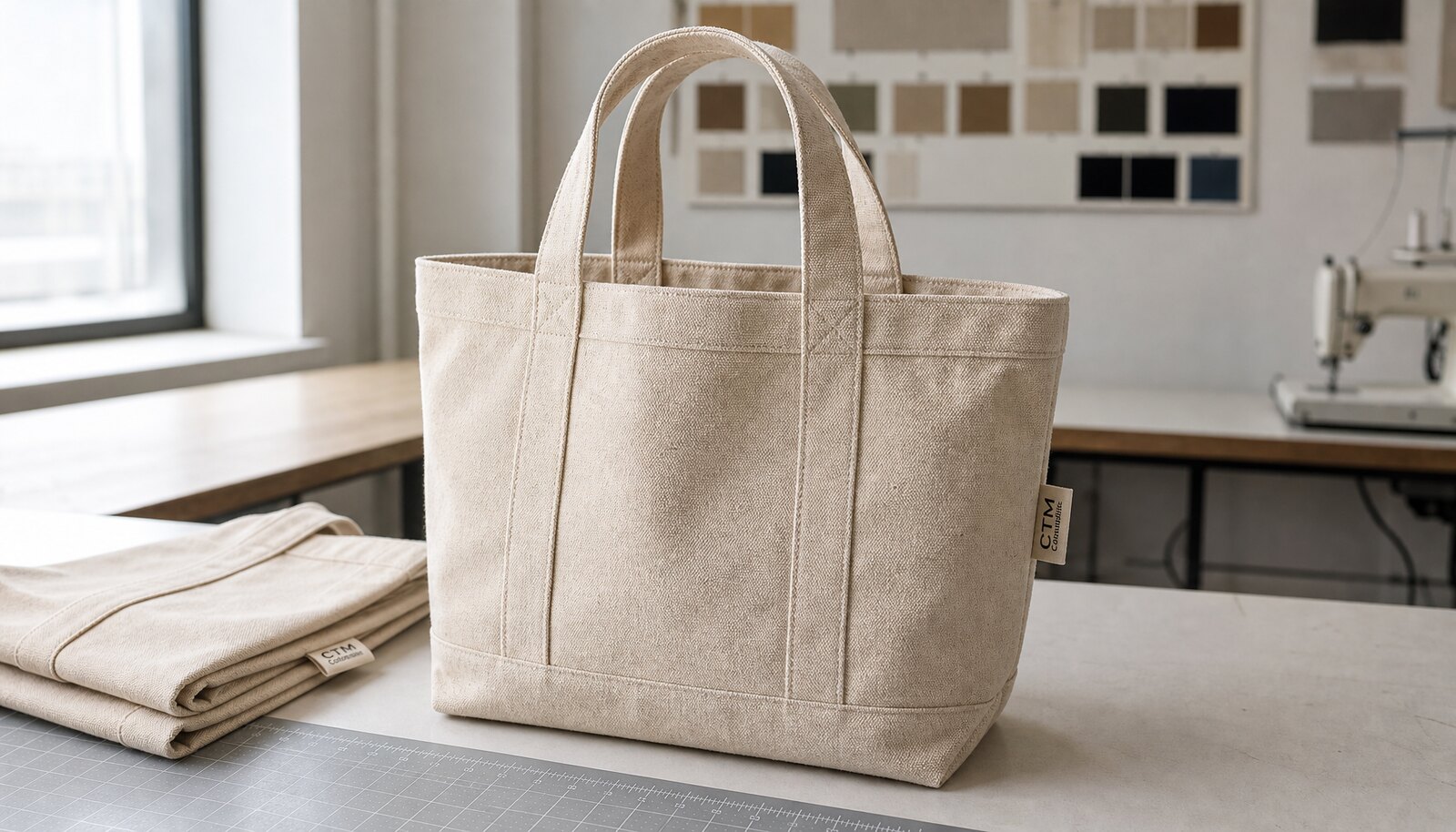
Define the retail job before you define the tote
A farmers market tote can be a utility bag, a souvenir item, a checkout add-on, or a seasonal SKU that supports brand visibility after the market visit ends. For procurement, that distinction matters because each use case changes the spec. A tote sold at a booth for impulse purchase can tolerate a simpler finish and a shorter approval cycle. A tote placed in a grocery or garden-center retail plan needs better shelf presentation, more consistent pack-out, and tighter repeatability across replenishment. If the bag is meant to sit next to premium food or lifestyle goods, it also needs to look intentional from a few feet away and hold its shape after repeated use.
The first buying decision should be commercial, not decorative: what is the target retail price, target landed cost, and expected margin? A tote that must retail at a value price cannot carry the same material weight, decoration, and packaging as a premium launch. Buyers should also decide whether the tote is a hero product, a brand add-on, or a seasonal test SKU. That choice determines how much spend can be justified on recycled content proof, finish quality, and carton presentation. The factory can only quote correctly once the buyer defines the job the tote must do in store and in the customer’s car or kitchen.
- Set the sales channel first: farmers market booth, local retail, grocery, garden center, or online add-on.
- Lock target retail price and target landed cost before sending the RFQ.
- Decide whether the tote must feel premium, utility-first, or seasonal.
- Treat the bag as a retail SKU, not as a giveaway item with loose specs.
Choose fabric weight, structure, and recycled-content proof together
Fabric weight is the main cost and performance lever, but recycled-canvas buyers should not stop at GSM or ounces. Many launch programs land in the 8 oz to 10 oz range when price sensitivity is high and the bag is mainly for light market carry. A 10 oz to 12 oz tote is a common middle ground when the buyer wants better body, a more premium hand feel, and a bag that can carry produce, jars, or a few grocery items without looking thin. Heavier weights above that can make sense for premium merchandising or long-term reuse, but the cost impact quickly shows up in both fabric and freight.
The procurement issue is not only weight, but proof. Recycled-content language can mean different things: recycled fiber claim, recycled yarn claim, fabric claim, or a supplier declaration based on upstream paperwork. Ask the supplier what exactly is being claimed and what document backs it up. If recycled content is part of the brand message or a retailer requirement, request the mill name, the fabric source, and the document trail that connects the approved swatch to bulk fabric. If the supplier cannot explain where the fabric came from, treat the recycled claim as unverified until documented. Buyers should also ask whether the sample fabric came from the same mill lot as the bulk fabric, because a visually similar sample can still differ in hand feel or shade once production starts.
Construction has to match the use case as closely as the fabric does. For example, a flat tote may work for a booth shopper who carries light goods, while a 4-inch or 5-inch gusset makes more sense for a retail tote that needs a more stable base on shelf or in the hand. Handle length, handle width, and reinforcement matter as much as body size. Cotton webbing handles can improve comfort and durability, while self-fabric handles can keep the design cleaner and lower the cost. If the bag needs to stand upright on shelf, say so in the spec. If it needs to fit bottles, jars, or produce boxes, say that too. The factory should be quoting the intended use, not guessing at it.
For first-order launches, the useful spec range is usually narrow: the buyer should define size, gusset, handle, seam reinforcement, and recycled-content basis in writing. That prevents the factory from offering a cheaper substitute that looks similar in a photo but performs differently in retail.
If the bag is going to be reordered, the spec should be repeatable without redesigning the product line after the first shipment.
- Use 8 oz to 10 oz for lighter retail programs with tighter price targets.
- Use 10 oz to 12 oz when you need a more balanced retail hand feel and better shelf presence.
- Specify whether recycled content is a fiber, yarn, or fabric claim and request the document trail.
- Define gusset depth, handle length, and reinforcement method in measurable terms.
Choose the decoration method by durability, not just appearance
Decoration on a canvas tote is not a one-time display decision; it must survive folding, abrasion, and repeated use. Screen printing is usually the most practical starting point for a farmers market retail launch because it handles simple logos well, keeps setup manageable, and is repeatable across replenishment orders. For a one-color or two-color logo, it often provides the best balance of cost and durability. Buyers should still ask how the ink behaves on the exact recycled canvas being quoted, because an ink that looks sharp on one weave can look dull or slightly broken on another.
Other decoration options have a place, but each one changes both cost and risk. A woven label or side label can carry brand identity cleanly and reduce the size of the print area. Embroidery can look premium, but it adds stiffness and can distort thinner canvas if the stitch density is too high. Heat transfer may work for short-run custom orders, but buyers should be cautious if the tote will be folded repeatedly or sold as a daily-use item. If the bag is meant to stand up in a retail environment, a simpler print plus a well-placed woven label often looks more premium than an overly busy front panel. The right question is not “Which decoration looks best?” but “Which decoration survives use, reorders well, and still fits the target margin?”
For field-tested launch planning, it helps to think in use scenarios. A farmers market booth item often needs strong logo visibility from a distance. A retail tote in a grocery checkout may need a cleaner front face and less graphic coverage. A seasonal holiday launch may tolerate more decoration, but a replenishment SKU usually benefits from a simpler print system that can be repeated without color drift or extra setup.
- Use screen print for simple logos and repeatable retail volume.
- Use a woven side label or sewn label when you want cleaner brand visibility without heavy print coverage.
- Reserve embroidery for small marks or premium lines where the added cost is recoverable.
- Avoid methods that crack, peel, or blur after repeated folding or abrasion.
Compare supplier routes with a spec-and-risk table, not a route slogan
The cheapest quote is rarely the safest answer for a retail launch. For recycled canvas totes, the buyer should compare supplier routes by material proof, QC control, MOQ, and replenishment fit. A direct factory with a recycled-canvas program gives the most control over fabric source, print consistency, and repeat ordering, but it also requires the buyer to manage approvals carefully. A trading company can simplify multi-category buying, yet it adds another layer between the buyer and the actual factory. Stock blank plus local decoration can be the fastest way to test demand, but it narrows choices on shade, handle length, and recycled-content documentation. The right route depends on whether the order is a pilot, a seasonal launch, or a replenishment program.
For a first retail launch, the question is often whether to prioritize speed or repeatability. A small-batch craft supplier can be suitable for a boutique run where unit cost is not the dominant issue. A high-volume export vendor is better when the tote needs to support a wider rollout and stable replenishment. A cut-and-sew factory with in-house printing often gives the cleanest control-to-cost balance for moderate customization. What matters most is that the buyer matches the sourcing route to the selling plan. A pilot route should not be mistaken for a scale route, and a scale route should not be forced into craft-level flexibility at no cost.
- Direct factory: best for repeatable spec control and lower long-run risk.
- Trading company: useful when one contact must manage multiple bag categories.
- Stock blank plus decorator: fast for pilots, weaker on exact spec control.
- High-volume vendor: strong for rollout, less forgiving on late changes.
Read the quote line by line and compare landed cost, not just unit price
A useful quote should break out bag construction, decoration, packing, sample charges, and shipping assumptions. When all of those elements are rolled into one number, the buyer cannot see where the real cost sits. One supplier may be cheaper on fabric and more expensive on setup; another may have a higher unit price but better carton efficiency. Ask each supplier for the same spec at MOQ and at a higher reorder quantity. That reveals whether the pricing is based on true production economics or just a first-order quote that expects margin recovery somewhere else.
Landed cost is the only comparison that matters at approval stage. One quote may be FOB, another ex-works, and another DDP. Those are not directly comparable until freight, export handling, duty, brokerage, and local receiving charges are added back in. This is especially important when the tote is light enough that packaging and carton dimensions affect the cost nearly as much as the bag itself. Ask for carton size, units per carton, inner pack assumptions, and any moisture protection requirement. A competitive quote can become uncompetitive once the packing structure needed for retail presentation is included.
Buyers should also separate the economics of the first order from the economics of replenishment. For a new retail tote, the setup burden is often highest on the first run. If the factory can show a lower reorder price for the same approved spec, that is a strong sign the program can scale. If the reorder price barely changes, the supplier may be hiding overhead in the initial quote or may not have a clean repeat process.
- Request the same spec at MOQ and at a realistic reorder quantity.
- Separate bag cost, print setup, packing, testing, and freight assumptions.
- Compare quotes only after converting them to the same incoterm.
- Ask for carton dimensions and pack count because they affect shipping cost.
Approve the sample against measurable acceptance criteria
The pre-production sample is where launch risk becomes visible. A good sample lets the buyer check the feel of the recycled canvas, the behavior of the gusset, the way the handles sit under load, and whether the print lands correctly on the actual weave. This is also where problems show up that are easy to miss in a photo: weak seam ends, handle misalignment, print opacity that drops on textured canvas, or a bag shape that collapses instead of standing neatly on a shelf. Do not approve by email photo alone. Compare the physical sample to the spec sheet and to a signed reference sample kept by the buyer.
The most useful acceptance criteria are the ones that can be checked quickly and consistently. Buyers should define dimensional tolerances, print alignment limits, seam quality expectations, and packing presentation. For example, a small variance in body dimensions may be acceptable if the bag still merchandizes correctly and carries as intended. But the buyer should decide that in advance, not after the first inspection. If the artwork depends on sharp edges or a centered logo, then print placement tolerance must be tighter. If the tote has a large front graphic, the print needs enough opacity and cure to avoid cracking or rubbing through after folding. The point is not perfection; it is repeatable approval based on measurable thresholds.
This is also the right stage to confirm the factory’s documentation discipline. Ask for photos of the sample construction, material labels if used, and the exact packing method the bulk order will use. A good supplier should be able to tell you what changed, if anything, between sample and bulk. If a fabric substitution, trim change, or label swap is planned, it should be approved before production starts.
- Measure body size, gusset, and handle length against the spec sheet.
- Inspect print registration, opacity, and cure on the actual canvas.
- Check seam strength, reinforcement stitching, and loose thread trimming.
- Store one signed sample as the reference for bulk inspection.
Set QC tolerances that a factory and inspector can actually use
Good QC is specific enough to stop arguments but practical enough to use on the line. For recycled canvas totes, that means writing tolerances and acceptance criteria into the PO or inspection instruction. A buyer should not ask for “good workmanship” and expect consistent outcomes. Define what counts as acceptable on dimensions, stitch quality, handle alignment, print placement, label position, and carton packing. If the tote is sold as a premium retail item, the visual standards need to be stricter than if it is a casual market bag.
A simple QC plan should include more than visual checks. Confirm fabric weight against the approved sample or an agreed reference. Inspect seam construction for a consistent stitch count and reinforcement style. Verify handle attachment points so both handles are aligned and anchored evenly. Ask the inspector to check for loose threads, skipped stitches, and puckering around seam junctions. For print, require a check on registration, opacity, and abrasion resistance after folding and rubbing. For packed goods, review the fold style, carton count, inner pack count, and carton marking. If the tote is intended for retail display, check whether the packed unit looks clean enough to go directly onto a shelf or hook after receiving.
Buyers should also include a basic carton handling test. A simple drop test on representative cartons—corners, edges, and faces—can reveal whether the fold shifts, print transfers, or carton protection is insufficient. That matters because a tote that looks perfect at packing can still arrive with crushed corners or damaged print if the carton spec is too weak for the shipping route. The goal is not lab-level testing; it is practical acceptance that prevents avoidable chargebacks and repacking labor.
The most useful way to write acceptance criteria is to make them visible on the buyer’s checklist: what will be inspected, what tool or method will be used, and what happens if the result is outside tolerance. That makes the discussion easier with the factory, the inspector, and the receiving team.
- Write tolerance bands for dimensions instead of relying on visual approval.
- Check stitch density, reinforcement type, skipped stitches, and seam alignment.
- Require print adhesion and abrasion checks after folding and rubbing.
- Use a carton drop/pack test on pilot cartons before release.
Build packing for retail display and replenishment movement
Retail packing is not just shipping protection; it is part of the sellable product. A tote for a farmers market retail launch often needs to arrive folded neatly, with the brand mark visible, barcode readable, and any hangtag or care label in the correct position. If the bag is sold loose rather than bagged, the fold must be consistent enough to support a clean shelf face. If the retailer wants individual wrapping, decide whether paper wrap, tissue, loose fold, or a polybag is acceptable. The wrong pack format can add waste, slow receiving, or force a store team to repack the tote before it hits the floor.
Master cartons need the same level of attention. Ask the supplier to state units per carton, carton dimensions, carton gross weight, and the carton mark format. These details affect freight, warehouse handling, and receiving accuracy. If cartons are too large, the product can arrive crushed or inefficient to ship. If they are too small, labor costs rise because receiving and shelf prep take longer. For replenishment programs, carton consistency matters because the store or DC should be able to receive the same way every time. If the first carton is neat but the second run is packed differently, the program quickly becomes harder to manage.
For recycled-content buyers, packaging can also touch the sustainability story. If the customer-facing claim includes recycled materials, the buyer may want to avoid unnecessary plastic and ask whether paper-based or lower-plastic packing is available. The key is not to over-specify eco packaging without thinking about shelf presentation or damage risk. The best packing format is the one that protects the bag, supports retail display, and can be repeated by the same supplier at reorder.
If the tote is a retail SKU, ask the factory to show one fully packed unit and one carton before bulk shipment. That single step catches a surprising number of alignment and count errors before they become receiving problems.
- Define the fold style and packed size before bulk production starts.
- Specify hangtag, barcode, care label, and side label placement in the RFQ.
- Ask for carton count, inner pack count, and carton mark format.
- Require pack-out photos from the factory before shipment release.
Manage lead time as a chain of approvals, not a single production number
Launch schedules fail when buyers treat lead time as a single factory promise. In reality, a custom recycled canvas tote moves through a chain: artwork confirmation, sample making, sample revision if needed, bulk material allocation, cutting and sewing, printing, packing, carton labeling, and freight. If the fabric is already available in the supplier’s stock or in a committed mill order, the schedule is easier to protect. If the buyer needs a specific recycled-canvas weight, a particular natural shade, or a custom label, the timeline becomes much more sensitive to approvals.
The safest launch plan works backward from the shelf date and protects the steps that are hardest to compress. Sample approval is one of them. Artwork and barcode instruction are another. Carton label corrections and final pack changes can also cost more time than buyers expect. For that reason, a launch calendar should include buffer not just for sewing, but for communication and rework. If the campaign date is fixed and the factory lead time is long, a split freight approach may make sense: sample and some opening stock by air, replenishment by ocean. That is not ideal on cost, but it can protect a launch window when the tote is tied to a seasonal market or opening promotion.
For replenishment procurement, ask the supplier how long they can hold the approved fabric or trim spec and whether the same material can be repeated without rematching from scratch. That matters after the first sell-through report comes in. A successful farmers market tote can become a steady retail SKU only if the second order behaves like the first one. The lead time question should therefore include both the first launch and the second-order path.
- Allow extra time if the recycled fabric is not already committed by the supplier.
- Budget time for at least one revision cycle on artwork or label placement.
- Use air freight only when margin and launch timing justify it.
- Keep a replenishment plan ready before the first shipment leaves the factory.
Use a first-order workflow that supports a clean reorder later
The strongest first-order workflow begins with a one-page spec sheet, not with the artwork file alone. The buyer should state the channel, target retail price, target landed cost, fabric weight, size, decoration method, packing format, and delivery basis in one brief. That gives the supplier less room to quote a generic tote and more room to price the actual item. When quotes come back, compare them on the same basis and push back on any missing assumptions. A quote that looks low but omits sample revision, carton labeling, or freight assumptions is not a real comparison.
The first order should be designed as if the second order will matter—which it usually does. Ask how the supplier would repeat the bag at the same spec, what reorder quantity improves pricing, and what documents or reference files they will hold for the next run. For farmers market and retail launch programs, the best suppliers are the ones who can keep the approved sample, the material reference, and the carton plan aligned without reopening the entire product from scratch. That is what turns a launch SKU into a replenishment SKU instead of a one-time project.
A clean workflow also helps internal stakeholders. Merchandising, QA, and procurement can all read the same brief, approve the same sample, and align on the same retail presentation. That reduces the chance of last-minute changes that look small in email but are expensive in production. The stronger the first-order documentation, the easier the line extension, seasonal color update, or second replenishment run becomes.
Use the first order to build a repeatable buying file: spec sheet, approved sample photo, mill or fabric proof, packing photo, carton spec, and reorder price. That file becomes the shortest path to the next PO.
- Send one RFQ spec sheet with size, fabric, print, packing, and delivery basis.
- Compare quotes on the same incoterm and same pack-out assumptions.
- Do not approve bulk until sample, carton, and label plan are aligned.
- Ask for reorder pricing before you place the first PO.
Specification comparison for buyers
| Source route | Material and proof | MOQ and cost profile | QC and buyer risk |
|---|---|---|---|
| Direct factory with recycled-canvas program | Can specify GSM/oz, recycled-content basis, mill source, and finish details directly | Usually best for repeat runs and controlled landed cost; MOQ often better than trading layers | Ask for mill traceability, approved sample retention, inline photos, and final carton photos |
| Trading company or sourcing agent | May consolidate bag, print, and packaging quotes, but material proof can be one step removed | Convenient for multi-category buys; unit price can include markup on bag, decoration, and freight | Verify factory identity, sample origin, and whether recycled claims are backed by supplier documents |
| Stock blank plus local decorator | Fastest route for a pilot or shelf test, with limited control over blank fabric and handle spec | Lowest setup complexity for small launches, but less efficient on repeated replenishment | Check blank bag source, consistent shade, decoration adhesion, and whether the same blank can be reordered |
| Cut-and-sew factory with in-house printing | Good balance of control, speed, and cleaner production flow | Often efficient for moderate customization and mid-size MOQs | Confirm ink type, curing method, seam construction, and print durability after folding |
| Small-batch craft supplier | Useful for boutique launches and premium retail tests | Higher unit cost is common; packing efficiency may be lower | Inspect stitching consistency, carton count accuracy, and whether manual finishing affects repeatability |
| High-volume export vendor | Best for chain rollout and stable replenishment planning | Strong on scale, usually less flexible on late changes | Require exact fabric, trim, and print match to the approved sample, not a lighter substitute |
| Domestic decorator with imported blanks | Fast if lead time is the priority and customization is limited | Can be competitive for short lead times, but blank cost may compress margin | Check imported blank origin, recycled-content documentation, and reorder consistency |
| Multi-category bag supplier | Useful when one vendor must cover totes, pouches, and related SKUs | Convenient for consolidated buying, but tote pricing may be less optimized | Demand tote-specific QC photos and written approval for this SKU, not generic bag approval |
Buyer checklist before sampling
- Lock the retail channel first: farmers market booth, gift shop, grocery aisle, garden center, seasonal market, or online add-on.
- Set target retail price and target landed cost before requesting quotes.
- Choose fabric weight in GSM or oz and require recycled-content documentation if the claim is on-pack or in marketing.
- Define body size, gusset depth, handle length, and whether the tote must stand upright on shelf.
- Specify print method, print area, number of colors, and whether a woven label, side label, or hangtag is needed.
- Ask for a pre-production sample and keep the approved sample with a signed spec sheet.
- State carton pack count, inner pack format, barcode placement, and any retail hangtag or care label needs.
- Ask for lead time at both quoted MOQ and your expected reorder quantity.
- Get every quote in the same incoterm so freight and duty can be compared consistently.
- Request the second-order price before placing the first PO so replenishment math is visible from day one.
Factory quote questions to send
- What recycled canvas GSM or oz are you quoting, and what is the actual fabric source or mill name?
- How is recycled content being verified—fiber claim, yarn claim, fabric claim, or supplier declaration—and what documents can you provide?
- Is the quoted price for the same sample construction, or will bulk use a different fabric, handle, lining, or seam finish?
- What is the MOQ per color and per print version, and what happens to unit price at 2x or 3x MOQ?
- What print method are you including, how many colors are included, and what are the setup charges?
- Are sample charges deductible from the bulk order, and how many revision rounds are included?
- What are the pack-out details: fold method, polybag or paper wrap, barcode, hangtag, inner pack, and carton count?
- What is the production lead time after sample approval and deposit, and what events commonly delay it?
- What QC documents can you provide with bulk goods, such as inline photos, final inspection records, or carton photos?
- What incoterm are you quoting, and what freight, export, or local charges are excluded from the unit price?
Quality-control points to confirm
- Confirm actual fabric GSM or oz against the approved sample and reject lighter substitute fabric unless the change was approved in writing.
- Measure body width, height, and gusset with a practical tolerance band written into the PO; do not rely on visual matching alone.
- Check handle length, attachment point placement, stitch density, and reinforcement style (box stitch or X-box) for consistency across a lot.
- Inspect seam allowance consistency, loose thread trimming, and whether the tote sits square on a flat table when lightly loaded.
- Verify print registration, opacity, cure, and abrasion resistance after folding and rubbing the print area against itself.
- Check recycled-content documentation, mill traceability, and whether the supplier can tie the bulk fabric back to the approved swatch or sample lot.
- Review label placement, barcode readability, care label text, and any hangtag alignment before shipment is released.
- Count packed units per inner pack and carton, then compare the result against the packing list and carton mark.
- Check for odor, staining, oil marks, moisture damage, crushed corners, or print transfer inside cartons.
- Run a simple carton drop and pack test on a pilot sample: drop on corners and faces, then confirm the bags still fold and present correctly for retail.