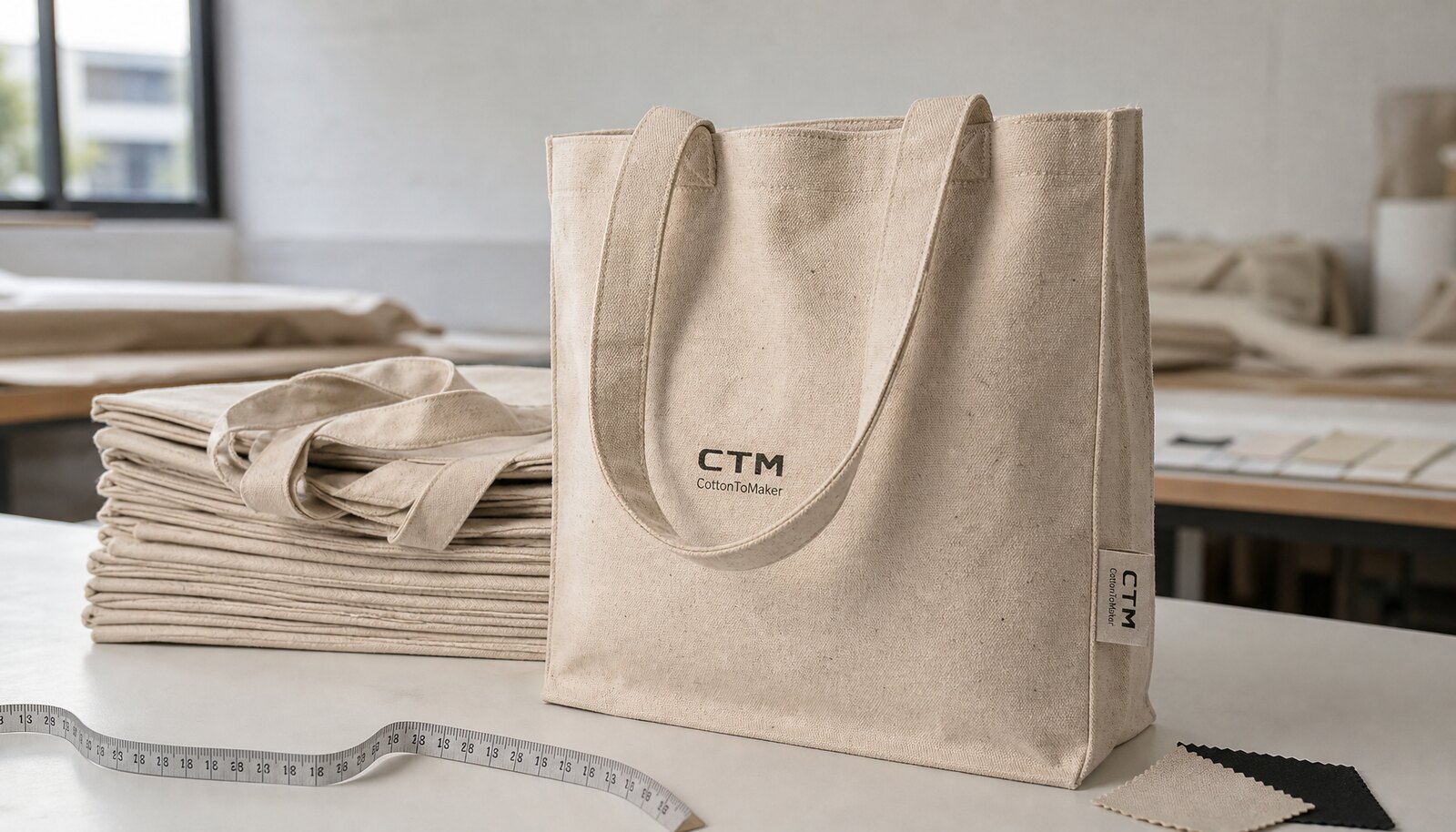
1. Start with the commercial job the tote has to do
A recycled canvas tote can be a merch item, a shipping insert, a retail add-on, or a branded packaging component. Those are different jobs, and they do not justify the same spec. Procurement gets better quotes when the RFQ explains the job first, because factories can then choose the right fabric body, print method, packing style, and QC intensity instead of guessing from a sketch.
If the tote will be resold, the buyer cares about hand feel, shelf appearance, and defect consistency. If the tote is going into a mailer or box, flat packing, carton efficiency, and low crease risk matter more. If the tote is a premium add-on, branding finish and label placement may matter more than the lowest possible unit price.
The key is to define the tote as a commercial object, not as a generic bag. That single change reduces quote noise and makes supplier comparisons more realistic.
- Resale tote: prioritize appearance, print durability, and packed presentation.
- Insert tote: prioritize flat pack efficiency, carton count, and low damage risk.
- Retail add-on: prioritize feel, label finish, and a repeatable premium look.
2. Write a spec sheet that a factory can actually price
A useful spec sheet is not long; it is precise. It should tell the factory exactly what to quote and what to ignore. At minimum, include finished size, fabric weight, handle length, handle width, construction style, print method, label type, and packing target. If you leave any of these open, the supplier may fill in the gap with its own standard, which makes the quote harder to compare.
For recycled canvas totes for ecommerce brands, the biggest specification mistake is using vague labels like “heavy canvas” or “premium natural look.” Those phrases are commercial language, not production language. Factories need measurable inputs. Give them both the desired appearance and the measurable build spec behind it.
A one-page spec plus artwork reference is usually enough for the first quote round. If you expect multiple suppliers to bid, make sure every supplier receives the same file set and that the version date is visible. This prevents silent quote drift.
- Finished size with tolerance, not approximate dimensions.
- Fabric weight in oz or GSM, plus any composition requirement.
- Handle and label specs with placement measurements.
- Print file, Pantone references, and print area dimensions.
- Packing method, carton count, and outer mark requirements.
3. Treat recycled-content verification as a sourcing task, not a marketing line
The phrase recycled canvas can mean different things in different factories. It may refer to recycled cotton content, recycled fiber blended into new cotton, or a yarn/fabric claim supported by a certificate from the material supplier. Procurement should not assume the words on the quote are enough. Ask what recycled input is being claimed, where it comes from, and which document supports that claim for the actual production lot.
This is where a lot of buying teams lose time. A trading company may quote recycled canvas quickly, but if you ask for proof of the source, chain-of-custody, or the actual factory name, the answer becomes vague. That is a sign you need to verify whether the quote is coming from the true production site or from a reseller building a margin on top.
You do not need to demand every certificate in the first email. But you should require the supplier to name the document type they can provide: fiber declaration, recycled-content statement, certificate of conformity, or material traceability note. If the supplier cannot identify the document path, the recycled claim is not yet procurement-ready.
- Ask what recycled input is used and how it is documented.
- Confirm whether the recycled claim applies to the fabric lot or only to a parent material source.
- Request the actual production site name, not just the sales company name.
- If the supplier is a trader, ask who owns weaving, cutting, printing, and packing.
4. Compare fabric weight with structure, not with marketing language
Fabric weight is important, but weight alone does not tell the whole story. Two recycled canvas fabrics at the same oz or GSM can behave differently because of weave density, yarn thickness, finishing, and dye or wash treatment. That is why a quote that simply says “300 GSM recycled canvas” is not enough for procurement. Ask how the fabric was measured and whether the quoted weight is before or after finishing.
For a buyer, the real decision is whether the tote needs to stand, fold, or simply carry a light insert. A lighter fabric may reduce freight and unit cost, but it can also show wrinkling, collapse in retail display, or seam strain if the handle load is concentrated. A heavier fabric may feel more premium, but it can raise stitching difficulty, carton weight, and shipping cost.
A practical sourcing rule is to judge the tote by use and structure. If the tote is a brand add-on or packaging insert, a moderate fabric weight with a controlled weave may be enough. If it is a consumer-facing reusable bag, ask for a firmer body and a sample under realistic fill weight.
- Ask for both oz and GSM if the supplier can provide them consistently.
- Confirm whether weight is measured before finishing or after finishing.
- Judge structure with a filled sample, not an empty flat lay.
- Compare quote weight against carton gross weight and freight impact.
5. Choose the print route by artwork complexity and reorder plan
Print choice affects more than appearance. It changes setup cost, lead time, defect risk, and the number of future reorder problems you will face. For simple logo work on recycled canvas, screen print is often the easiest route to standardize because it is relatively repeatable and cost-efficient at scale. For low-volume or detailed artwork, transfer methods may be acceptable, but they should be tested for texture, adhesion, and wear.
If the design has fine text, tight registration, or gradient elements, the buyer should ask whether the factory can reproduce the artwork cleanly on textured recycled canvas. Many quotes fail at this point because the seller assumes the art will look the same on cotton paper, on a digital mockup, and on rough woven canvas. It will not.
The right question is not “what print method is cheapest?” It is “what print method still looks acceptable after folding, handling, and fulfillment, and can be reproduced on the next reorder without a new surprise?”
- Screen print: stable for one- to two-color logos and repeat programs.
- Heat transfer: useful for short runs or more complex graphics, but test durability.
- Embroidery or woven label: premium look, but check puckering, density, and placement.
- Ask the supplier to quote artwork revisions as a separate line item.
6. Compare supplier types before you compare unit price
A direct factory quote, a trading company quote, and a ready-stock quote may all arrive on the same day, but they are not comparable until you know who is actually making the bags. Direct factories are usually best when the program is repeatable and the buyer wants tighter control over material, packaging, and QC. Trading companies can be useful when procurement needs coordination support or access to multiple product categories, but they often blur the real production source unless pressed.
Marketplace or ready-stock sellers are a different animal again. They can be useful for tests or urgent launch windows, but the buyer gives up some control over color consistency, packing style, and the ability to align the item with brand-specific requirements. That tradeoff is acceptable only if speed matters more than precise spec control.
A serious quote review should identify the supplier route first. Once you know whether you are comparing factory-direct, trading, or stock inventory, the rest of the numbers make more sense.
- Direct factory: strongest for repeatability and custom packing.
- Trading company: strongest for coordination, but check the margin stack.
- Ready-stock seller: fastest, but the weakest for exact spec control.
7. Build MOQ strategy around setup cost, not only unit cost
MOQ is rarely just a number pulled from the air. It usually reflects setup labor, color or fabric booking, print screens or plates, sewing line efficiency, and packing cost. If you know what drives the MOQ, you can often negotiate the program in a smarter way. For example, one print position is easier to price than two, and one body color is easier than a mixed color set.
When an ecommerce brand wants several variations at once, the quote often becomes misleading. A factory may offer a low price for the base tote and then add charges for extra colors, alternate labels, or special polybags. That is why buyers should ask for pricing at MOQ, at a doubled quantity, and at a likely reorder level. You want to see where the cost curve improves and where it stops helping.
If the supplier refuses to break out setup costs, the quote is less useful for procurement. It may still be a valid offer, but it is not a good comparison tool.
- Request unit pricing at MOQ, 2x MOQ, and reorder volume.
- Keep the first order simple: one body color, one print version, one packing method.
- Ask for separate charges for artwork change, label change, and packaging change.
- If you need multiple SKUs, ask whether common components can be shared.
8. Use samples to prove function, not only visuals
A good tote sample must prove three things: it looks right, it behaves right, and it can be repeated. Visual approval alone is not enough. The sample should confirm that the tote opens correctly, the handles sit evenly, the seams are straight, and the print still reads clearly on textured recycled canvas. If the bag is for ecommerce use, the sample also needs to show how it folds and how it fits into the intended packing flow.
The most useful sample review is a quick functional test. Measure the finished size, confirm handle drop, check the print placement against the approved file, and load the bag with something close to the real use weight. If the tote distorts, tips over, or pulls at the handle joins, that is a production issue, not just a sample issue.
For larger programs, ask for a pre-production sample and then verify the first bulk output before full shipment release. This is not extra ceremony; it is the cheapest place to catch a wrong label, a weak handle, or a fabric shade that is too far from your approved sample.
- Approve the pre-production sample, not only the digital proof.
- Measure finished size after sewing, not on cut panels.
- Load-test the sample with a realistic product weight.
- Use the first bulk piece as a reference against the signed sample.
9. Write QC criteria in measurable terms the factory can follow
QC language like “good workmanship” or “high quality” does not help a buyer compare factories. The factory needs measurable acceptance criteria. For recycled canvas totes, that means stating how big the bag can be, how much shade variation is acceptable, where the print must sit, and what defects count as major versus minor. The more commercial the order, the more important this becomes.
A practical QC checklist should cover fabric, sewing, print, trims, and packing. Fabric checks should include weight and obvious defects such as holes, weaving errors, or unacceptable contamination. Sewing checks should focus on skip stitches, seam alignment, loose thread, and handle symmetry. Print checks should cover registration, centering, opacity, and legibility. Packing checks should confirm count accuracy and carton integrity.
If you want a serious supplier comparison, ask each factory to describe its inspection method. Some may do only final random checks. Others may inspect at cutting, in-line, and final packing. Ask which AQL reference they use for final inspection and whether a third-party inspection is available for critical programs.
- State size tolerances for finished bags and handles.
- Set a clear print alignment tolerance and visual approval standard.
- Define major, minor, and critical defects before bulk starts.
- Ask for the inspection method and AQL basis in writing.
10. Normalize quotes to landed cost before making the award
The cheapest ex-factory quote is not necessarily the cheapest purchase. Procurement needs to normalize all offers to the same basis so the numbers are comparable. That means adjusting for fabric weight, print method, labels, packing, carton size, sample charges, and freight terms. If one supplier includes cartons and another does not, the lower quote may not be lower at all.
A useful normalization worksheet has a simple logic: start with unit price, add sample and tooling if they are amortized into the program, add packing material and carton cost if not included, add inland and export-side charges if quoted separately, and then convert the result into a landed unit cost using the actual freight scenario you expect. If the program ships multiple cartons, carton volume and gross weight matter as much as the bag itself.
For ecommerce brands, this step often changes the winner. A slightly higher unit price from a cleaner factory quote can win once you include lower rework, better carton counts, fewer receiving disputes, and fewer print rejects. That is the real procurement decision, not the headline price alone.
- Compare all suppliers on the same fabric, print, and packing basis.
- Amortize tooling or setup only if the charge is truly one-time.
- Use carton volume and gross weight when estimating freight.
- Include rework risk and receiving labor if a supplier’s packing is inconsistent.
Specification comparison for buyers
| Supplier / quote type | Best use case | What the quote usually includes | Main sourcing tradeoff | Quote questions that expose hidden cost |
|---|---|---|---|---|
| Direct tote factory | Repeat ecommerce programs, custom packing, tighter QC control | Fabric, cut/sew, print, labels, carton packing, and production schedule | Best transparency if you can write a precise spec; weaker if the factory is stretched across many programs | What is the actual production site? What is included in setup, labels, and carton packing? Which QC checkpoints are internal? |
| Trading company / sourcing agent | Multi-category sourcing, smaller procurement teams, language support | May bundle factory cost plus service margin; inclusions vary by buyer relationship | Faster coordination, but the real factory and cost stack may be less visible | Who is the actual factory? What service fee or margin is embedded? Can you share factory audit records or certificates? |
| Marketplace / ready-stock seller | Urgent launches, promo tests, very low quantities | Usually stock bags, basic logo printing, and standard cartons | Fastest path, but color, size, and packing consistency can be weaker | Is the stock already in inventory? What exact bag lot will ship? Can carton count and print placement be controlled? |
| Material | 8-12 oz cotton canvas, 120-220 gsm cotton, recycled cotton, or blended fabric selected by use case and target price | Before price comparison | Different cloth weights, backing, or certification claims make quotes hard to compare | |
| Construction | bag size, gusset, handle drop, seam allowance, stitch density, reinforcement patch, and loading expectation | Before sampling | Weak stress points create returns and failed inspections | |
| Decoration | screen print, heat transfer, embroidery, woven label, or hangtag matched to fabric texture and brand durability needs | Before artwork approval | The wrong method can crack, bleed, pucker, or fail on the chosen fabric | |
| MOQ | Base MOQ plus change drivers | During quote review | Custom colors, trims, and packing can change minimums | |
| Sample | Physical sample with close-up photos | Before bulk cutting | Photo-only approval can miss hand feel and seam issues |
Buyer checklist before sampling
- Lock the use case first: resale product, shipping insert, retail add-on, or branded insert with no resale. The use case determines acceptable fabric body, print durability, and packing style.
- Write the spec in measurable terms: finished size, handle length, handle width, handle drop, fabric weight, seam allowance, print size, and label type.
- Ask for recycled-content evidence before discussing price: fiber declaration, material origin statement, and any third-party certificate that applies to the claimed recycled input.
- Define acceptable visual variation: shade range, slub level, weave irregularity, print edge sharpness, and whether small nep marks are acceptable or rejectable.
- Request quote lines that are separated: fabric, cut/sew, print setup, labels, packaging, carton marks, sample fee, testing fee if any, and freight term.
- Ask for pricing at more than one quantity: MOQ, a realistic reorder quantity, and a projected annual volume so you can see whether the unit curve is meaningful.
- Confirm whether the tote must stand upright, fold flat, or stay soft; this changes fabric body, gusset spec, and carton packing efficiency.
- State carton requirements: inner pack count, master carton count, carton dimensions, gross weight target, and any barcode or SKU sticker placement.
- Require the factory to identify what is internal and what is outsourced: weaving, dyeing, printing, sewing, labels, and packing.
- Ask for a pre-production sample, a size-approved golden sample if available, and a production sample from the first bulk output before shipping permission.
Factory quote questions to send
- What is the exact recycled canvas construction you are quoting, including composition, weave type, and weight in both oz and GSM if available?
- Is the quoted fabric weight measured before or after finishing, and what lot-to-lot variation should we expect in production?
- What recycled content claim are you making, and what document supports that claim for this specific lot or material source?
- Is the factory the actual production site for weaving/cutting/sewing/printing, or are any steps subcontracted? Please name the site used for our order.
- Can you share your most recent factory audit, social compliance audit, or customer audit summary if available for the production site?
- What is the minimum order quantity by style, by color, and by print version, and what changes if we reduce colors or simplify packaging?
- What is included in the quoted unit price and what is not included: labels, hangtags, barcode stickers, inner bags, master cartons, and palletizing?
- Which print method is included, how many colors are included in the base quote, and what is the surcharge for extra colors or revised artwork?
- What sample types do you offer: paper proof, strike-off, pre-production sample, and top-of-production sample? What is the cost and timing for each?
- What are your lead times split by stage: material booking, sample approval, cutting, printing, sewing, final inspection, and packing?
Quality-control points to confirm
- Fabric weight tolerance: agree a usable production tolerance rather than a vague pass/fail. For procurement comparisons, ask the factory to state the target weight and acceptable variation lot by lot; then verify random rolls or panels against the same basis before sewing.
- Finished size tolerance: check the sewn bag after seam allowance is applied, not only the cut panel. A common working threshold for buyer approval is ±0.5 cm for smaller tote dimensions and ±1.0 cm for larger bodies, unless your spec needs tighter control.
- Handle specs: measure handle length, width, and handle drop on the approved sample and on first production output. Ask the factory to confirm symmetry between left and right handles and to keep visible misalignment within a stated tolerance, often 0.5 cm or better for premium programs.
- Stitch density: require a measurable stitch count, such as stitches per inch or stitches per 3 cm, for handles, side seams, and stress points. For heavy-use totes, buyers often ask for tighter stitching at handle joins and bartacks at load points rather than relying on general workmanship language.
- Seam strength: define stress areas that must be checked, including handle attachment, bottom corners, and side seams. If the tote is expected to carry meaningful weight, request pull-test or load-hold testing on sample units, and state a minimum load target based on actual use rather than a marketing claim.
- Load target: set a practical load test tied to your application. For an ecommerce insert tote, the test may be moderate; for a reusable retail tote, ask the factory to demonstrate a higher hanging or fill load without seam failure, handle distortion, or excessive elongation.
- Print quality: check centering, registration, opacity, and edge crispness against the approved artwork. On recycled canvas, textured surfaces can distort fine type, so state a minimum line thickness or type size that must remain readable after printing.
- Ink durability: request a rub or flex check on the approved sample so the print does not smear, crack, or shed excessively after handling. If the bag will be folded in transit, check the print after repeated flexing, not just after a visual inspection.
- Fabric defect criteria: define what is acceptable on recycled canvas, such as slubs, neps, yarn knots, color flecks, or shade variation. Buyers should state whether these are part of the look or whether they are restricted to a limited percentage of units.
- Sewing defects: reject skipped stitches, loose thread ends at stress points, crooked topstitching beyond the agreed tolerance, untrimmed thread tails, and handle attachment offsets that affect symmetry or function.