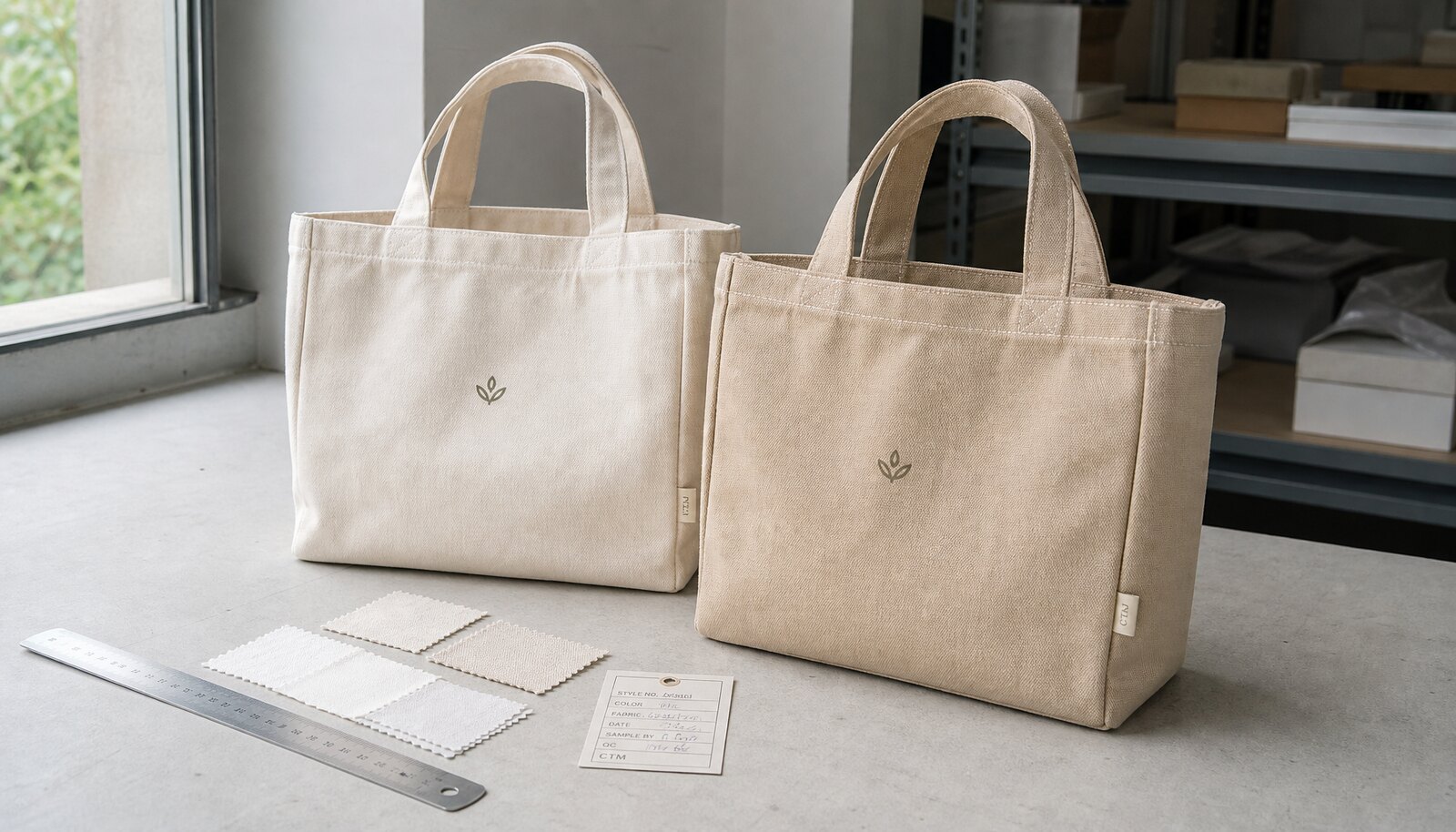
1. Why recycled canvas totes are different at cosmetic retail launch
A cosmetic brand tote is not just a reusable bag. For a retail launch, it has to support brand image, survive handling in store, and fit the economics of a new SKU or campaign bundle. That creates a three-way tension: the tote must look premium enough to sit beside skincare, fragrance, or makeup, yet remain simple enough to quote, manufacture, and replenish without wrecking margin. Recycled canvas is a strong option because it communicates durability and lower-waste positioning, but the material is not uniform. Two suppliers can both say “recycled canvas” and still deliver very different fabric body, surface texture, print performance, and sewing behavior.
The most common sourcing problem is imprecise brief writing. Buyers often request a “structured eco tote” or “premium recycled canvas bag” and expect the factory to infer everything else. One supplier may picture a light open-top bag with simple stitching and bulk packing. Another may quote a 16 oz lined tote with reinforced base, heavier handles, and retail-ready barcode labeling. Those are materially different products. In procurement terms, the bag should be treated as a finished retail SKU with a defined use case, not as a promotional giveaway with a logo added at the end.
For cosmetic launches, the tote often plays one of four roles: gift-with-purchase, checkout add-on, limited seasonal item, or standalone accessory SKU. Each role changes what matters most. Gift bags can prioritize speed and cost, while a standalone item needs better shape retention, cleaner print finish, and more consistent packing. If the buying team does not define the role first, the quote comparison becomes misleading and the supplier may optimize for the wrong outcome.
- A launch tote must balance shelf appeal, customer carry comfort, and landed cost.
- Recycled canvas can vary significantly in handfeel and visual texture even at the same GSM.
- Retail buyers should define the bag as a SKU, not as a generic “eco tote.”
- The best quote is the one that names construction, print, packing, and QC scope in one place.
2. Start with the retail use case before choosing the fabric
The first sourcing decision is not the print method or the price; it is what the bag must do in the retail environment. If the tote is a checkout add-on, a gift-with-purchase, or a seasonal campaign bag, a 12 oz recycled canvas may be enough because the bag is not expected to carry a heavy daily load or to hold a premium shape over time. For a standalone retail accessory, the fabric usually needs to move up to 14–16 oz so the bag has enough body to stand, fold cleanly, and photograph well on shelf or in e-commerce images.
For procurement teams, the practical way to specify fabric is to request both GSM and ounce weight, then force the supplier to state whether the number refers to the cloth itself or the complete finished bag. In this category, the difference matters because mills, converters, and traders do not always describe canvas the same way. A bag quoted as 12 oz may still feel much lighter or denser depending on weave construction, yarn twist, and finishing. That is why a good RFQ must name the actual expected feel and performance, not only the label.
As a working guide, 12 oz / 340–360 GSM fits lighter retail or campaign use. 14 oz / 400–430 GSM is the most balanced choice for many cosmetic launches because it usually offers acceptable body without pushing sewing labor too far. 16 oz / 450 GSM and above is better when the tote needs stronger shelf presence, more shape retention, or a higher perceived value. But thicker is not automatically better: if the bag becomes too stiff, handle comfort and unit cost can suffer, and the tote may feel closer to a work bag than a beauty accessory.
- 12 oz / 340–360 GSM: better for seasonal retail or gift programs.
- 14 oz / 400–430 GSM: a balanced option for most cosmetic launch SKUs.
- 16 oz / 450 GSM and above: better structure, higher perceived value, higher sewing load.
- Ask the supplier to confirm whether the quoted GSM is for finished cloth only or for the complete bag spec.
3. Decide what “premium” means in measurable terms
The word premium is often used in tote discussions, but it is too vague for procurement use. A premium-looking recycled canvas tote can be defined with measurable details: heavier fabric, tighter weave, reinforced seams, cleaner print registration, lined interior, shaped base, or a higher-grade closure. Buyers should decide which of those attributes actually matter for the launch. Otherwise, the factory may add cost in the wrong place—for example, a closure or lining that looks nice in the sample room but does not improve sell-through or warehouse handling.
For cosmetic brands, premium usually shows up in three practical places. First is fabric body: the tote should hold its silhouette rather than collapsing into a soft pouch. Second is finishing: top hem, side seams, and handles should look neat from both the outside and inside. Third is pack presentation: the bag should arrive clean, countable, and scannable. If those three areas are strong, the tote often reads as a higher-quality retail item even without expensive trims.
A useful procurement move is to set a visible benchmark. For example, if you want a retail-forward tote, define minimum fabric weight, minimum handle width, handle drop, number of bartacks, and whether the bag must include a lining or not. This prevents the quote from drifting into subjective language and helps the supplier understand where quality must be protected during bulk production.
- Replace “premium” with measurable decisions: GSM, lining, base depth, closure, and finishing.
- Use visible retail cues: body, stitching, fold behavior, and pack presentation.
- Do not add trims unless they improve sales appeal, handling, or retailer compliance.
4. Compare supplier types before comparing prices
For a cosmetic retail launch, the sourcing route matters almost as much as the tote spec. Factory-direct sourcing is usually the best fit when the buyer wants control over fabric, cutting, sewing, print placement, and final packing. Fewer handoffs generally reduce the chance of a logo shift, inconsistent fold, or carton label mismatch. The tradeoff is that the buyer must manage the brief more carefully, because the factory will expect clearer specifications and fewer midstream changes.
A trading company or sourcing agent can be useful if the buyer wants one point of contact for several product categories or needs help consolidating different finishes into a single shipment. That convenience may be worth the extra layer, but the buyer should still verify who actually makes the tote, who controls print quality, and where final inspection happens. Without that visibility, the quote can look competitive while hiding another margin layer or an unclear subcontracting chain.
A local print house paired with a sewing partner is usually only practical for smaller runs or urgent test launches. The arrangement can be flexible, but it introduces more risk because print handling, fabric stretching, and sewing consistency may differ between parties. This route can work for a trial style or a one-off promotion, but procurement teams should treat it as a controlled exception rather than the default retail solution.
- Factory-direct: best for repeat launches, better cost control, fewer handoff errors.
- Trader: useful for coordinated packaging or lower internal sourcing capacity, but verify the real maker.
- Local print house: practical for very small runs, but inspect print adhesion and color on actual canvas.
5. How to read a quote without getting trapped by the unit price
A tote quote can look cheap until you separate the actual cost drivers. Fabric weight, weave density, printing method, number of print colors, lining, closure, labels, packing, and carton preparation all affect the landed unit price. One quote may include only the sewn bag and one-color print, while another includes barcode labels, individual polybags, inner inserts, and master carton marks. Those are not comparable offers. Procurement teams should force each supplier to state what is included and what is excluded.
The cleanest way to compare is to request the pricing in layers. First, ask for the base bag price. Then separate print setup and per-color charges. After that, add packaging services, label application, extra inspection, and any special cartonization. This approach exposes where the supplier is building margin and where the real cost sits. It also helps the buyer decide whether to simplify the spec, change the packing rule, or move from a trader to a factory-direct source.
A low quote should trigger questions, not celebration. If one supplier is dramatically below the rest, check whether the GSM is lower than requested, whether reinforcement is omitted, or whether the “retail pack” is actually a loose bulk pack. The biggest quote risk in this category is not that the supplier is dishonest; it is that the buyer and supplier are not quoting the same product.
For launch planning, it is also useful to estimate the cost drivers that matter most. The most common ones are print complexity, sewing labor, packing labor, and freight weight. Lining and closures usually add more cost than buyers expect because they require additional material handling and sewing steps. That is why many cosmetic brands keep the first launch bag simple: one color body, one print side, open top, standard label, and controlled carton count.
- Compare base bag cost separately from print, packing, and freight prep.
- Watch for hidden charges on screen setup, color matching, label application, or carton marks.
- If a quote is much lower than the rest, check whether GSM, stitching, or packing scope is missing.
- Ask the supplier to state whether the quote includes inspection, folding, polybagging, and master carton packing.
6. Print method decisions that survive retail handling
For recycled canvas totes, screen printing remains the most practical route when the logo is simple and the order quantity is meaningful. It gives strong ink deposit and generally holds up well on thicker canvas, especially when the design is one or two colors with bold shapes. For cosmetic branding, that usually covers the most common retail artwork: wordmarks, monograms, and simple line graphics. The supplier should still test print on the actual fabric color because recycled canvas texture, absorbency, and slub can change the final look.
Water-based inks can create a softer, more natural appearance, which may suit earthy or clean-beauty branding. But the supplier must control ink penetration, curing, and color density carefully. On heavy canvas, a print that looks refined in the sample room can still appear washed out or uneven after production if the ink load is not controlled. For buyers, that means asking for a pre-production sample on the exact fabric lot and checking coverage in natural light, not just on a screen.
Heat transfer and digital methods are tempting for small runs or artwork with fine detail, but they are not always the right retail choice on thick recycled canvas. Transfers can crack, lift, or look over-processed if the bag is folded repeatedly or handled frequently in store. Digital approaches can work for limited runs, but buyers should weigh whether the bag is meant to sell through as a long-life retail item or simply support a short promotional window. If durability and consistency matter, simpler artwork and a well-controlled screen print usually win.
The procurement rule is simple: the artwork should be designed for the fabric, not forced onto the fabric later. If the brand wants intricate artwork, full-bleed graphics, or photographic complexity, it should be clear that the tote may need a different construction or a different selling strategy. For most cosmetic retail launches, a strong one-color or two-color screen print is the safest commercial choice.
- Screen print: best for simple logos, better durability, lower unit cost at volume.
- Water-based print: good for a softer look, but test coverage on recycled canvas.
- Heat transfer: useful for small runs, but inspect fold and wear resistance carefully.
- Always approve print on the actual fabric color and actual weave texture.
7. MOQ strategy for a first retail order
A realistic MOQ for a custom recycled canvas tote launch often starts around 1,000 to 3,000 pieces per style and color when the order includes custom print and production packing. Smaller quantities are possible, but the unit price usually rises because setup, cutting waste, and print preparation are spread across fewer bags. That is not automatically a bad deal if the tote is being tested as a new SKU. It only becomes a problem if the buyer expects a low-MOQ price and a retail-grade finish at the same time.
For launch planning, the best way to reduce MOQ friction is usually to simplify the first version. One body color, one print side, standard open top, and one label position are easier to quote, sample, and replenish. Once sell-through is known, the brand can expand into additional colors, lining, closures, or a more complex pack format. If the first order tries to include every possible option, the factory may quote cautiously and the schedule may stretch.
MOQ also needs to match the commercial channel. A tote sold as a standalone accessory may need a larger first buy because retailers expect depth of stock and replenishment. A tote used as gift packaging or checkout add-on may need only enough volume for the launch campaign or store opening period. In both cases, the buyer should ask whether the supplier can hold the spec stable for a reorder, because a low initial MOQ is not useful if the second batch requires a new sample cycle or a different fabric lot.
One more point: if the supplier offers mixed colors or mixed designs within one MOQ, ask how cartons are packed. Mixed cartons may be acceptable for factory efficiency, but they can slow warehouse receiving and store allocation. Procurement should decide whether mixed cartons are worth the operational complexity before accepting the offer.
- Lower MOQ usually means higher setup cost per piece or a simpler spec.
- One body color and one print side is the easiest launch structure.
- If a quote allows mixed colors, confirm whether cartons are mixed or SKU-separated.
- Protect the first launch by keeping the spec stable enough for a reorder.
8. Packing, labeling, and carton data are not afterthoughts
Retail intake problems often start with packing, not with the tote itself. A bag that ships loosely packed may be acceptable for wholesale, but it can arrive wrinkled, dusty, or scuffed when a cosmetic brand expects a clean shelf presentation. For a launch that will go through a distribution center or retail receiving team, it is usually safer to specify individual polybags, SKU labels, barcode labels, and a clear master carton mark format. That is especially important if the retailer scans items on receipt.
Carton count affects labor, freight density, and the chance of damage in transit. A standard carton pack of 50 or 100 pieces can work, but the carton size should protect the tote shape rather than crush it. If the bag includes a cardboard insert, hangtag, tissue, or closure component, the packing count may need to drop to avoid bending the bag body or transferring print scuff onto adjacent units. The buyer should ask the supplier to confirm the final carton dimensions and gross weight, not just the piece count.
For procurement, label discipline matters as much as pack count. Define label size, barcode placement, SKU naming convention, and carton mark format before bulk production. This prevents rework at the warehouse and reduces the chance that the factory ships a carton that must be relabeled on arrival. If the brand or retailer has a receiving standard, the tote supplier should be informed early so the packaging solution is built around that standard rather than patched later.
A well-written packing spec should say whether the tote is folded flat or in a retail display fold, whether a polybag is required, whether the bag has a moisture barrier, and whether the master carton needs a printed color box or simple shipping marks. These details seem small, but they directly affect the launch schedule and receiving efficiency.
- Use a packing spec that protects the print face from scuffing.
- Require carton marks with SKU, color, quantity, and carton number.
- If using barcode labels, define label size, placement, and scan grade in advance.
- Confirm fold style and carton dimensions before approving bulk production.
9. Supplier verification: proof of capability matters more than promises
Cosmetic brand procurement should verify the supplier’s capability before assuming the quote can be executed. A convincing email is not the same as a capable factory. Ask for evidence that the supplier actually handles the relevant processes: current factory photos, business registration, process list, sewing line photos, printing equipment details, and examples of packing output. If they claim in-house production, ask them to show how fabric moves from cutting to sewing to print to packing without leaving the site. The more handoffs there are, the more likely the launch becomes vulnerable to delay or inconsistency.
Document checks are also important. A buyer should request the factory license or business registration, quality management documentation if available, and a clear explanation of subcontracting. If the supplier is a trader, ask who the actual factory is and whether you can see an audit summary or recent capability proof. If they say they cannot share any evidence, that is a sourcing risk, not a privacy issue. The goal is not bureaucracy; it is to confirm that the party quoting your tote can actually make it to the approved spec at the required timeline.
Capability proof should be matched to the actual product. For recycled canvas totes, that means checking the supplier’s experience with heavy woven fabric, logo printing on textured surfaces, bartacked handles, and retail packing. A supplier that mainly makes lightweight promotional bags may still be able to produce a cosmetic retail tote, but the buyer should not assume the same process discipline automatically carries over. The safest approach is to request a sample portfolio that is close to your target fabric weight, print type, and pack format.
When the supplier is shortlisted, ask for a pre-production schedule that shows when fabric is reserved, when samples are approved, when bulk cutting starts, and when final inspection happens. The schedule itself can reveal whether the factory understands launch logistics or is simply quoting from memory.
- Request factory photos, process flow, and proof of who handles sewing, printing, and packing.
- Ask for business registration or equivalent company documents and clarify subcontracting.
- Match supplier capability to the actual bag: heavy canvas, print on textured fabric, bartacked handles, and retail packing.
- Do not accept vague “we can do it” answers without evidence of similar production capability.
10. QC checkpoints and acceptance criteria for bulk production
QC for recycled canvas totes should be concrete enough that both buyer and supplier can inspect the same thing the same way. Start by defining fabric acceptance. The weave should be even, the canvas should not show obvious thin spots, and the material should match the approved handfeel and body level. Next, define size tolerance. A small variation is normal, but the bag should remain within the agreed width, height, and base-depth band so it fits packaging, shelf display, and warehouse handling. If the tote has a structured profile, the buyer should also check whether the bag stands and folds consistently rather than collapsing into a misshapen bundle.
Print QC should cover more than color. Inspect placement relative to the centerline, edge sharpness, ink coverage, and curing consistency. A logo that is slightly off-center may be acceptable for a promotional bag but not for a cosmetic retail item that needs a cleaner branded presentation. If the artwork has fine lines or small text, set a readability threshold in advance and reject filled-in details or broken characters. For repeat orders, also compare production lots so color drift does not appear across replenishment batches.
Construction QC should focus on stress points. The top hem, side seams, bottom seam, and handle bartacks are the areas most likely to fail or look messy. Acceptable bags should have clean stitch density, no skipped stitches in visible load-bearing areas, and no raw edge exposure where the customer will see it. Handles should be attached evenly, without obvious twist or unequal length. If the tote includes lining, closure, insert, or pocket, check that these components do not distort the shell or create excess bulk at the seam lines.
Packaging QC is just as important as sewing QC. Confirm that the fold style matches the retailer’s intake requirement, the barcode label scans correctly, the carton count is accurate, and the master carton marking is legible. For pilot production, open at least one carton from the middle of the batch and inspect random pieces, not only the top layer. This is where many issues show up: loose threads, dust, print scuffing, wrong label placement, or inconsistent folding. If a retailer uses AQL or a customer-specific inspection standard, the supplier should know that standard before production starts, not after shipment.
- Fabric: even weave, no obvious thin spots, and consistent body against the approved sample.
- Print: placement, coverage, edge sharpness, and cured finish must match the approved standard.
- Stitching: no skipped stitches in load-bearing seams, neat bartacks, and trimmed loose ends.
- Packing: correct fold, barcode scan, carton count, and carton marks.
- Inspection: open random cartons from the batch, not only the top layer, before release.
Specification comparison for buyers
| Buying route or spec choice | Typical use case | Commercial tradeoff | Buyer risk to check |
|---|---|---|---|
| Factory-direct tote maker | Retail launches needing tighter control over sewing, print, and packing | Usually the best balance of cost and coordination if the factory truly owns the process | Verify in-house sewing, printing, and carton packing instead of assuming it |
| Trading company or sourcing agent | Brands that need a faster RFQ cycle or multiple product categories coordinated together | Convenient, but the quote may include an extra margin layer and less transparency | Ask who actually prints, who sews, and whether any step is subcontracted |
| Local print shop plus sewing partner | Very small runs or urgent test launches | Can be flexible, but handoffs increase consistency risk | Check whether the fabric is handled correctly and whether print color stays stable across batches |
| 12 oz recycled canvas / about 340–360 GSM | Gift-with-purchase, seasonal promo, lower-cost retail entry | Lower cost and lighter freight, but less body and more chance of slouching | Too soft can look promotional rather than retail-ready |
| 14 oz recycled canvas / about 400–430 GSM | Most cosmetic retail launches | Good balance of structure, print clarity, and cost | Confirm the supplier is quoting finished bag weight, not only fabric weight |
| 16 oz recycled canvas / about 450 GSM or above | Higher perceived value, premium gift sets, or standalone retail SKUs | Better structure, but more sewing load and higher cost | Check seam strength, handle reinforcement, and carton weight |
Buyer checklist before sampling
- Define the retail role of the tote before requesting quotes: checkout add-on, gift-with-purchase, bundled kit, shelf-ready accessory, or standalone SKU.
- Lock the fabric spec in both GSM and ounce weight, and require the supplier to state whether that number refers to raw fabric or finished bag build.
- Choose one primary bag structure for the first launch: unlined open-top, lined open-top, or lined with a closure. Avoid mixing all three unless the retailer requires it.
- Approve the print method on the actual recycled canvas color, not only on white paper proofs or a digital render.
- Specify handle length, handle width, bartack count, seam allowance, and the target loaded-use expectation in practical terms.
- Request a sample that includes the final fabric, print, label, fold style, and pack format—not a partial prototype.
- Ask the supplier to identify which processes are in-house and which are subcontracted: weaving or fabric sourcing, cutting, sewing, printing, packing, and carton labeling.
- Set measurable acceptance tolerances for size, print alignment, stitch quality, color variation, and packing count before bulk approval.
Factory quote questions to send
- What exact recycled canvas construction are you quoting, and is the spec based on finished bag weight or fabric only?
- What GSM and ounce range do you recommend for this use case, and why?
- Is your sewing, printing, and packing done in-house? If not, which steps are outsourced and to whom?
- What are the MOQ and price breaks by style, body color, print color count, and packing configuration?
- What setup fees apply for screen printing, extra colors, woven labels, hangtags, or custom packing?
- What is the sample lead time for a physical pre-production sample, and is the sample fee credited against bulk?
- What carton pack count, polybag spec, barcode label service, and master carton mark format are included in the quote?
- What tolerance do you hold for finished dimensions, logo placement, and print color variation across lots?
- What production lead time is realistic after sample approval, and what approval or material steps could delay shipment?
- What inspection standard do you use before shipment, and can you share the QC checklist or AQL target?
Quality-control points to confirm
- Fabric weight should be measured and matched to the approved spec, with the buyer and supplier using the same reference basis and tolerance range.
- Check whether the weave is even and dense enough that the tote keeps shape after folding and unpacking; a loose weave can make the bag look cheap and can distort print edges.
- Inspect the logo print under natural light for edge sharpness, coverage, and color consistency. Thick canvas can cause ink spread, so artwork should remain readable after curing and folding.
- Measure handle attachment strength by checking bartack placement, stitch density, and whether the handle join lifts cleanly without puckering or seam opening.
- Review seam allowance consistency at side seams, bottom seam, top hem, and handle join. Reject bags with skipped stitches, exposed raw edges in critical areas, or excessive loose thread trimming.
- Verify finished dimensions against the approved sample, especially width, height, gusset or base depth, and handle drop. Minor variation is normal; out-of-band drift can affect retail presentation and packing fit.
- If a lining, closure, pocket, or insert is included, inspect whether it lies flat and does not twist, pull the outer shell, or show uneven trimming through the body fabric.
- Check fold marks, scuffing, odor, dust, and carton count before approval of the bulk lot. Cosmetic retail buyers often need cleaner presentation than general promotional buyers.
- Open at least one carton from pilot production or pre-shipment stock and inspect random pieces from the middle and bottom of the carton, not only the top layer.
- Confirm barcode labels, SKU codes, carton marks, and pack counts before shipment so warehouse receiving does not have to relabel or recount the order.