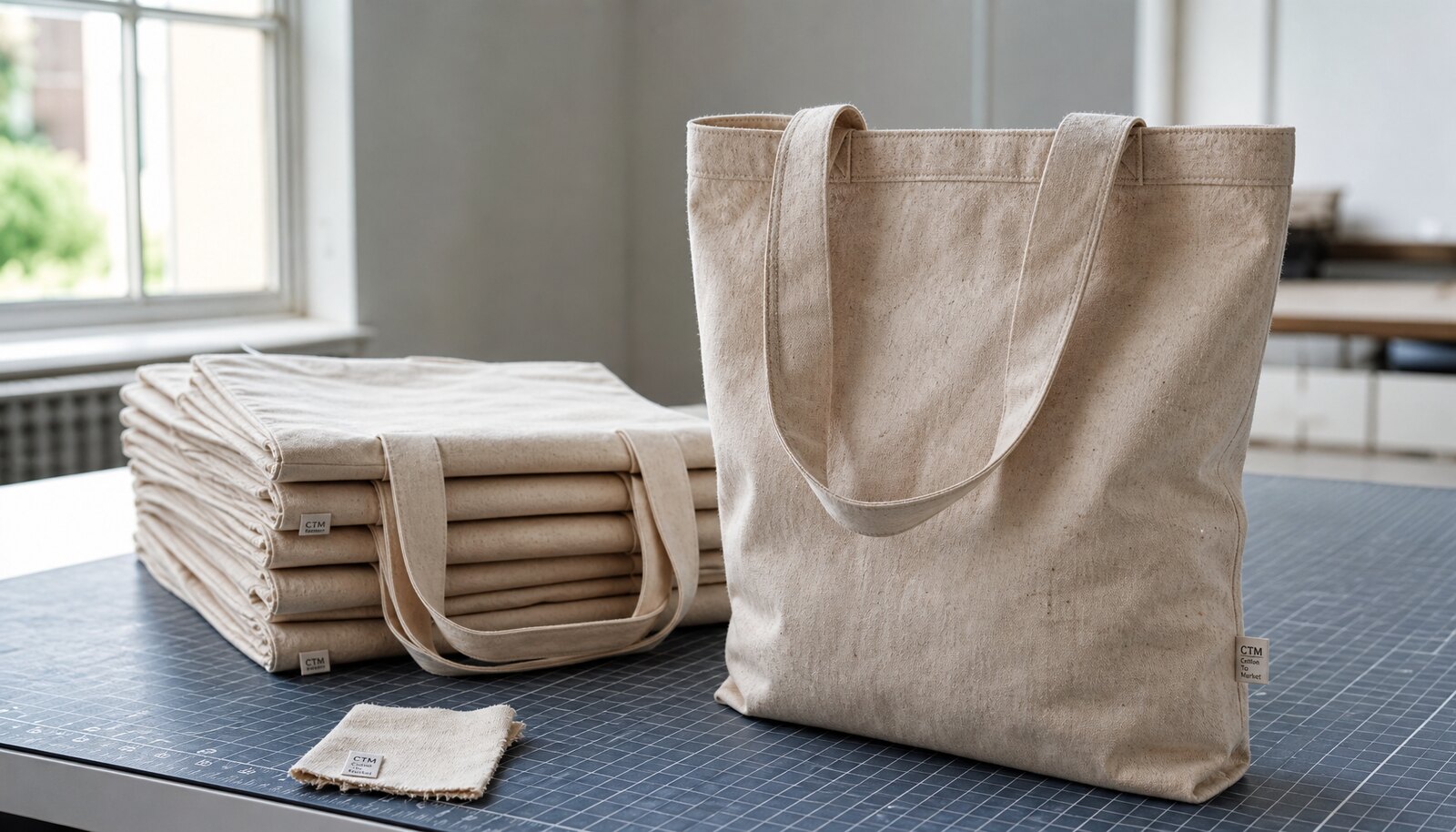
Why Recycled Canvas Tote Sourcing Needs Procurement Discipline
For cosmetic brands, a recycled canvas tote is not just a packaging add-on. It sits at the intersection of branding, product protection, freight efficiency, and launch timing. If the tote is part of a gift-with-purchase program, it has to hold the planned set without tearing or collapsing. If it is sold at retail, it has to look finished enough to carry a price point. If it is bundled into a PR mailer, it has to arrive clean, flat, and on time. That is why tote sourcing should be handled like a controlled item in the supply chain, not like a last-minute promotional extra.
The practical procurement challenge is that tote quotes often look simple while the production reality is not. The same “recycled canvas tote” line can hide different fabric weights, different seam construction, different handle reinforcement, different print setup costs, and different packing standards. A buyer comparing only unit price can easily miss the fact that one supplier quoted a plain bag, while another quoted a packed, labeled, and sample-approved component ready for a retail or export program. The more specific the brief, the better the commercial comparison.
This category also rewards early control because tote changes can ripple through the whole cosmetic launch. A late artwork tweak can trigger a new screen, a new label, or a new fold instruction. A small size adjustment can change carton count and freight cube. Even a decision as simple as switching from screen print to woven label can move MOQ and lead time. For procurement teams, the tote is one of those items where a minor-looking decision becomes a schedule and landed-cost decision.
- Treat the tote as a controlled purchase item with a spec sheet, approved sample, and reorder record.
- Do not compare suppliers until the use case, packing format, and decoration method are all fixed.
- Assume any variation in size, artwork, or label may change both MOQ and lead time.
Fabric Weight, Recycled Content, and Bag Structure: What Actually Changes the Product
Recycled canvas is a broad sourcing term, not a single material spec. Buyers usually need to know three things: the GSM, the visual finish, and the construction method. For cosmetic use, the useful GSM range is often about 300-380gsm. Around 300-320gsm can work for lighter promotional use, small accessory kits, or handout bags that do not need to hold much weight. Around 350-380gsm is usually a better fit when the bag must carry boxed skincare, heavier jars, or a more premium retail presentation. Below that range, the tote can feel limp. Above it, cost, sewing time, and stiffness all rise.
Construction matters as much as weight. A tote can be made with a simple open top or with a gusset that gives it volume and shape. It can have self-fabric handles, folded handles, or reinforced handles with cross-stitch or bar-tack support. It can be finished with raw edges, turned edges, or cleaner top-stitching. The quote should state not only the fabric and size, but the exact build logic. In a cosmetic program, that detail affects whether the bag looks neat on shelf, sits flat in a carton, and survives repeated use after the brand event is over.
For this category, a buyer should also ask whether the supplier is quoting based on raw fabric or finished fabric. Recycled materials can show natural variation in surface texture and shade, and that is acceptable if the buyer is expecting a recycled look. What is not acceptable is for the factory to use that variation as a reason to ignore consistency. If the approved sample has a certain texture, color tone, or hand feel, the bulk should stay within that commercial window.
- Use 300-320gsm for lighter cosmetic packs and lower-cost promotional programs.
- Use 350-380gsm when the bag must carry heavier products or support retail positioning.
- Ask whether the quoted GSM is finished fabric weight and whether recycled-content expectations are documented in the spec.
- Request seam allowance, gusset depth, and handle build details in writing, not just in a drawing.
MOQ Drivers: Why One Tote Quote Becomes Three Different Minimums
MOQ in tote sourcing is often misunderstood because suppliers do not always describe it the same way. Some quote a minimum per design, some per color, some per print side, and some per total run only if the bag body stays unchanged. Once the buyer adds a second colorway, a different handle length, a woven label, or another packing format, the real MOQ may rise even if the sales quote still shows one neat number. For cosmetic buyers, the useful question is not “what is the MOQ?” but “what changes the MOQ?”
The main drivers are easy to identify. Fabric sourcing may require a minimum cut length or dye lot. Screen printing usually adds a setup threshold. Woven labels and embroidery often have their own minimums because the maker wants a longer run to absorb setup cost. Packing also matters. If the buyer wants a barcode sticker, retail tag, polybag, fold-insert, and carton mark all applied at factory, the minimum may rise because the factory now has more labor per unit. The more variation in the order, the more likely the quote will split into several hidden minimums.
A realistic purchasing conversation should therefore separate three things: base bag MOQ, decoration MOQ, and packing MOQ. That helps the buyer decide where to simplify. For example, a cosmetic brand might keep one tote size and one fabric weight but change only the front logo for different campaigns. That can preserve order efficiency. By contrast, asking for multiple bag sizes, multiple art positions, and different retail pack styles in one order is an easy way to push the minimum beyond what the launch actually needs.
- Ask the supplier to state MOQ by size, by artwork, and by packing style.
- Separate the tote body minimum from the label, screen, or embroidery minimum.
- Reduce variation before bargaining on price; fewer variants usually produce a better MOQ.
- If the order is small, use one size and one decoration method rather than asking for a “flexible” minimum.
Lead Time by Stage: A More Realistic Planning Model for Cosmetic Launches
Lead time should be reviewed stage by stage, not as one single promised date. A realistic tote timeline usually begins with sample development, moves through pre-production approval, then bulk production, and finally shipping or receiving. If the supplier already has suitable recycled canvas in stock and the artwork is simple, the front end can move fast. But once the order needs new screens, labels, or special packing, the schedule expands. Cosmetic buyers often underestimate how much time is spent confirming the final version, not just sewing the bag.
A practical stage breakdown looks like this: sample preparation can take roughly 5-10 days if materials are ready and the buyer answers quickly; pre-production sample or golden sample approval can take another 5-10 days if artwork, label, and packing need review; bulk production often takes about 20-35 days for a straightforward order, and longer if the line is busy or the order includes multiple variants. Transit, customs clearance, and warehouse receiving sit on top of that. Holiday shutdowns, festival peaks, and carrier booking issues can easily add more time. None of this is unusual; it is simply the real schedule.
The procurement lesson is to work backward from the launch date. If the tote is part of a seasonal skincare set or a retail campaign with a fixed launch day, the supplier should be given a realistic approval window and a specific cut-off date for artwork changes. Buyers often lose time because the cosmetic product packaging is finalized later than the tote. Once the tote becomes the last unresolved item, it can hold the launch. A better method is to freeze the tote spec early, even if the broader campaign still has moving parts.
For critical launches, build a small buffer into the plan. If the tote must arrive at a distribution center, do not rely on the factory's earliest promise. Ask what happens if the sample is rejected once, if the print needs a second pass, or if the carton mark needs correction. Those are normal production events, not exceptional ones, and the schedule should already assume one corrective loop where reasonable.
- Break the timeline into sample, approval, bulk, transit, and receiving rather than using one total lead-time number.
- Set an artwork freeze date before the supplier starts screens or label production.
- Add buffer for holiday shutdowns, port congestion, and warehouse appointment delays.
- Ask the supplier to tell you the longest likely scenario, not only the best-case scenario.
What a Useful RFQ Must Contain for Recycled Canvas Tote Quotes
A tote RFQ should be detailed enough that two suppliers can quote the same item on the same basis. That means the buyer needs to state the finished dimensions, the gusset, the handle length or drop, the target GSM, the expected recycled-content position, the logo method, the print colors, the decoration area, and the packing format. If any of those are left vague, the factory will fill in the gaps with its own assumptions, and the quotes will stop being comparable. The cleaner the RFQ, the lower the risk of late surprises.
A strong RFQ also forces commercial clarity. Ask the supplier to show what is included and excluded. Is the quoted price for bag only, or does it include screen setup? Is the barcode applied? Is the fold flat or retail-ready? Are master cartons export-grade or just transport cartons? Does the quote include one sample or two? Cosmetic buyers frequently get tripped up by quotes that appear cheap because they exclude the items that actually matter to launch readiness.
If your team is comparing multiple suppliers, use the same RFQ structure for all of them and do not allow side emails to change the basis. A revised handle length in one quote and not the others will distort the comparison. A different packing spec will distort freight cost. A different print area will distort the look of the finished item. For procurement, discipline in the RFQ is often more valuable than aggressive price haggling later.
- State finished size in millimeters and include tolerances if your brand requires a tighter fit.
- Specify artwork files, print side, number of colors, and whether the supplier must confirm print placement with a marked sample.
- Ask for line-item pricing for bag body, print setup, labels, packing, and shipping assumptions.
- Insist that every quote names the same incoterm and carton assumption.
Supplier Comparison Table: How to Judge the Route, Not Just the Unit Price
The most useful comparison is not a generic “three suppliers, three prices” exercise. Procurement buyers need to compare the supplier route, because route determines control. A direct factory is usually stronger on repeatability, construction control, and line ownership. A trading company can help if the tote is only one piece of a broader cosmetic kit, but it can also hide responsibility if the underlying maker changes. A stock supplier can be very useful when timing is urgent, but it offers less freedom on recycled canvas quality, handle build, and brand-specific packing.
A real comparison table should therefore test the variables that matter to launches: who owns production, how stable the MOQ is across variants, how long the lead time is once artwork is frozen, and how much risk exists around packing or repeatability. The decision contrast below is the one buyers usually need when they are choosing between a faster but less controlled route and a slower but more dependable one.
The main takeaway is simple: compare suppliers on the same spec, then compare routes on risk. A slightly higher unit price can still be the better procurement choice if it avoids a second sampling loop, a late carton correction, or a hidden MOQ increase when artwork changes. For cosmetic brands, that often matters more than a small theoretical unit saving.
- Use route comparison to understand control, not just cost.
- Compare all suppliers against one locked spec sheet and one packing assumption.
- Treat repeatability as a commercial value, not only a quality topic.
How Packing, Carton Design, and Warehouse Handling Affect the Final Cost
Packing is one of the easiest places for tote sourcing to drift away from the buyer's actual need. A tote that is loosely folded, overfilled into a carton, or packed without clear marks can cause warehouse delays and freight inefficiency. For cosmetic brands, packing often has to balance three priorities at once: the bag must arrive clean, the carton cube must stay efficient, and the unit must still be ready for shelf or kit assembly. If the supplier does not understand that balance, the quote may be technically correct but operationally weak.
The common packing formats are flat pack, folded pack, or product-insert pack. Flat pack is usually the simplest and best for shipping efficiency. Folded pack can be cleaner for retail or kit use if the fold direction is controlled. Product-insert packing is the most complex because the tote has to fit another item or sit inside a finished set without wrinkling the print or distorting the seams. Each format affects labor, carton count, and receiving effort. That is why the buyer should define packing up front rather than treating it as a warehouse detail.
Carton design should also be part of the sourcing discussion. Ask for carton dimensions, unit count, gross weight, and whether the cartons are double-wall or standard. If the tote is going by air or mixed freight, cube becomes a cost driver very quickly. If the tote is going to a distribution center, carton marks and barcode accuracy matter because incorrect labeling slows receiving. A procurement team should think of packing as a cost control and damage prevention issue, not a cosmetic afterthought.
- Define unit folding direction and carton count before the quote is final.
- Ask for carton dimensions and gross weight so freight can be estimated properly.
- Confirm whether the carton is retail-safe, export-safe, or warehouse-only.
- Verify barcode and carton marks against the PO before shipment release.
QC Checklist for Cosmetic Brand Tote Orders: What to Inspect and What to Reject
Quality control should be tied to the tote's actual use, not just to appearance. The first check is dimensional control. Measure width, height, gusset depth, and handle drop on several units from the pre-production sample and again on bulk output. If the tote is supposed to hold boxed skincare, a few millimeters of drift can change fit and presentation. A practical buyer expectation is usually around ±5 mm on key dimensions unless the supplier has agreed to tighter control and can show that it is repeatable.
The second check is seam and handle integrity. Look at seam allowance consistency, stitch density, and whether the handles are reinforced with cross-stitching or bar-tacks. For a cosmetic tote, a handle that looks fine but opens under load is a real failure because the bag may be used by consumers more than once. A useful inspection method is to load the bag with the planned product weight or an equivalent dummy load and watch for top-edge distortion, handle stretch, seam opening, or bottom sag. That gives a much more honest result than a quick hand test.
The third check is decoration quality. Screen print should be crisp, placed correctly, and fully cured. A simple rub test should not produce flaking, smearing, or transfer that would mark the fold or surrounding packaging. If the tote is dyed or has color accents, ask for basic colorfastness evidence or at least a sample check under dry rub. Cosmetic brands often care more than other buyers about odor, lint, and surface cleanliness because the tote may sit beside skincare, fragrance, or wellness packaging. Loose threads, stains, and strong chemical smell are acceptable reasons to reject or rework units before shipment.
The last check is packing and carton control. Open random cartons and verify count, fold consistency, barcode placement, carton marks, and moisture protection. A carton that looks fine outside but contains mixed fold directions, missing labels, or scuffed units is a receiving problem waiting to happen. The buyer should also confirm that the approved sample, artwork version, and packing method are the same references used in bulk. If they are not, the approval is incomplete.
- Measure several bulk units against the spec sheet, not only the sample image.
- Check seam allowance, stitch consistency, and handle reinforcement on both sample and bulk output.
- Use a load test with real or equivalent product weight to check handle and seam behavior.
- Require a rub check for print and review odor, lint, and stains before shipment release.
- Inspect cartons for count accuracy, fold consistency, label accuracy, and moisture protection.
Common Sourcing Pitfalls in Cosmetic Launches and How to Avoid Them
One common mistake is asking for too many custom variables at once. A buyer wants recycled canvas, one size, two print zones, three colorways, woven label, barcode sticker, belly band, and gift-set packing, then expects an unchanged MOQ and fast delivery. In practice, each added variable creates setup time and commercial friction. The simplest way to keep the tote commercially viable is to reduce variation before the RFQ goes out. One bag body and one decoration method usually produce a far better quote than a complex program with multiple small exceptions.
Another frequent mistake is approving a sample that does not match the final production spec. Sometimes the sample looks good, but the label is temporary, the fold is different, the artwork placement is not final, or the carton spec has not been locked. That creates false confidence. For cosmetic brands, the sample has to be a genuine production reference, not a visual concept. If the supplier cannot produce a pre-production sample with final packing details, then the approval is only partial and should be treated that way.
A third issue is underestimating how launch timing interacts with tote lead time. Tote orders are often placed after the primary cosmetic packaging is already moving, which leaves too little time to correct issues. The brand then starts asking for rush production, and the cost of the tote goes up right when the team is trying to control spend. The cleaner approach is to freeze tote decisions early, even if the broader campaign still has open items, and to keep a reorder file so future programs can reuse the same approved details.
- Avoid over-customization if the launch timeline is tight.
- Do not treat a temporary or incomplete sample as final approval.
- Freeze the tote spec earlier than the rest of the campaign whenever possible.
- Keep a reorder file with spec sheet, golden sample, and approved artwork.
A Practical RFQ and Approval Sequence for Procurement Teams
For B2B buyers, the best process is usually sequential. First, define the use case and size range. Second, choose one fabric weight band and one construction approach. Third, decide the decoration method and artwork count. Fourth, ask suppliers to quote on the same packing assumption. Fifth, compare quotes on base price, setup cost, MOQ, sample terms, and lead time. Sixth, approve a real sample with measurements and load testing. Seventh, release bulk only after the sample, artwork, and carton spec are aligned. That sequence reduces the chance of later commercial friction.
This approach also creates cleaner internal handoff. Marketing can approve the visual direction, but procurement should own the spec control and supplier comparison. Operations should confirm carton and warehouse fit. If everyone signs off on different assumptions, the first shipment becomes a test of memory rather than process. For cosmetic tote sourcing, that is a bad way to run a launch. A simple control sheet, a signed sample, and a clear PO attachment solve a lot of future problems.
For repeat orders, the sequence becomes even more valuable. A buyer can compare the reorder against the original golden sample and see immediately whether the supplier has changed anything. If the quote is cheaper because a label was removed or the carton spec was simplified, that should be visible before approval. Procurement value is not just getting a bag made; it is keeping the bag stable enough that the second and third order behave like the first one.
- Run the sourcing process in a fixed order: spec, quote, sample, approval, bulk.
- Use one owner for spec control so marketing, ops, and procurement do not create mismatched assumptions.
- Keep signed references for sample, artwork, and carton pack so reorders remain stable.
Specification comparison for buyers
| Supplier route | Typical MOQ profile | Typical lead time profile | Best-fit cosmetic use case | Buyer risk to check |
|---|---|---|---|---|
| Direct factory, in-house sewing and printing | Often 300-1,000 pcs per color/design for a simple tote; lower is possible only for stock fabric and limited decoration, while multi-variant orders usually push the minimum up | Sample 5-10 days, pre-production 5-10 days, bulk 20-35 days before transit; add time if labels, new screens, or special packing are required | Repeatable retail totes, launch kits, and GWP programs where the brand needs control over GSM, handle reinforcement, and packing | Verify the factory really controls cutting, sewing, decoration, and carton packing rather than subcontracting each step |
| Trading company / sourcing agent | Can look flexible at 200-500 pcs per design, but the real MOQ often sits with the underlying factory and can change by fabric or print complexity | Sample coordination can be quick, but approval loops may be longer if the trading side has to relay changes back and forth | Multi-item cosmetic kits or buyers who need one contact for tote plus other packaging items | Check who owns the spec sheet, who signs off samples, and whether the quoted factory can repeat the same construction on reorder |
| Stock tote with light customization | Lowest starting order, sometimes 100-300 pcs with simple logo print or label add-on | Fastest option, often 7-15 days if stock exists and artwork is simple | Urgent event handouts, short promotional runs, internal launches, or test marketing | Stock consistency, blank-bag color variation, print location limits, and whether the bag is actually recycled canvas or a blended stock fabric |
| Premium custom tote with woven label or embroidery accent | Usually 500-2,000 pcs because setup, label weaving, and decoration efficiency need a longer run | Sample and approval often take longer; bulk may run 25-45 days plus transit depending on label and decoration schedule | Retail bags, PR boxes, premium skincare sets, and limited launches that need a more finished presentation | Confirm whether the label MOQ, embroidery setup, and thread color count are separate from the tote MOQ |
| One-color screen print on a single tote size | Commonly the most MOQ-friendly custom option, often 300-1,000 pcs depending on fabric sourcing and packing | Usually the shortest custom lead time because screens are simple and production is straightforward | Most cosmetic brand logos and campaign totes where clean branding matters more than decorative complexity | Check print coverage, color count, curing, and whether the supplier charges extra for each artwork side or screen |
| Multi-artwork or multi-color tote program | MOQ commonly rises per design or per print color; three colorways or two placements can multiply the effective minimum | Lead time extends because each artwork variation needs setup, approval, and line scheduling | Collection launches or segmented retail programs with different messages or SKU-specific bags | Separate MOQ by design, by color, and by packing style so the quote cannot hide complexity in one line item |
| Flat-packed retail tote with barcode and carton mark | Packing MOQ is usually not the issue; instead the supplier may impose minimums on packing configuration or label application | Packing adds a few days if each unit needs folding, barcode application, and master carton verification | Warehouse distribution, retail replenishment, or export shipping where carton efficiency matters | Check unit count per carton, fold method, barcode placement, and carton dimensions against freight constraints |
| Repeat reorder against a signed golden sample | MOQ can stay stable if the spec is frozen; changes in label, size, or packing often reset the minimum | Lead time is usually shorter than first order if the factory can reuse screens, patterns, and packing instructions | Seasonal cosmetic programs and replenishment orders | Do not assume the reorder is identical unless the spec sheet, sample, and PO all match exactly |
Buyer checklist before sampling
- Define the tote's job first: retail sale, gift-with-purchase, event handout, PR mailer, or kit insert, because use case drives fabric weight, construction, and packing
- Lock finished width, height, gusset depth, handle drop, and target load before requesting any pricing
- State the recycled canvas GSM requirement and whether you need finished fabric weight, pre-wash weight, or tested production weight
- Choose one decoration route up front: screen print, woven label, embroidery accent, or mixed decoration, then lock artwork color count and placement
- Ask the supplier to quote MOQ separately for tote body, print screen, label, and packing configuration
- Request a measurement sheet and a signed sample, not only product photos, before approving bulk
- Confirm packing format, fold direction, barcode sticker placement, inner pack count, master carton count, and carton mark requirements
- Record the approved artwork file, sample date, QC limits, and shipping assumption in the purchase order so later changes do not create disputes
Factory quote questions to send
- What is the exact GSM of the recycled canvas, and is it based on finished fabric after finishing, not just yarn or base cloth weight?
- What is your MOQ by size, by color, by print design, and by packaging format? Please separate those minimums if they are different.
- Which processes are in-house and which are outsourced, including sewing, screen printing, embroidery, woven labels, folding, barcode labeling, and carton packing?
- Please quote the sample fee, pre-production sample fee, and any tool or screen charges separately, and state which charges are refundable against bulk.
- What finished measurement tolerance do you work to for width, height, gusset, and handle length? If you do not have a formal tolerance, please state your standard range in millimeters.
- What seam allowance do you use on the body and handle attachment, and how many stitch rows or stitches per inch are standard for this tote?
- What print tolerance do you accept for registration, placement, color variation, and curing? Please confirm whether your quote includes one or two print sides.
- What load test, pull test, or handle reinforcement test do you use before shipment, and what is the failure criterion?
- What packing format is included in the unit price: flat fold, polybag, tissue, barcode sticker, insert card, retail tag, or master carton only?
- Which incoterm, carton count, and carton dimensions are assumed in your quotation, and what gross weight do you expect per carton?
Quality-control points to confirm
- Measure finished width, height, gusset depth, and handle drop on at least five bulk units per lot, then compare against the approved spec sheet; a practical cosmetic tote target is usually within ±5 mm on key dimensions unless the supplier states a tighter control
- Inspect seam allowance on the body and handle attachment; the sewn edge should be even and stable, with no obvious wandering that creates bag asymmetry or weak corners
- Check stitch density and reinforcement: a useful buyer reference is consistent straight stitching with no skipped stitches, and handle ends should use cross-stitch or bar-tack reinforcement rather than a single weak seam
- Perform a handle pull check on sample and first bulk cartons: load the tote with the intended cosmetic pack or an equivalent weight and observe whether handles stretch, stitch lines open, or the top edge distorts
- Review print quality for sharp edges, proper ink opacity, and correct placement; a simple rub test should not produce flaking, smudging, or transfer to the fold surface under normal handling
- Ask for basic colorfastness evidence if the bag is dyed or colored; if the tote is intended for premium cosmetic retail, verify that color does not visibly bleed onto hands, packaging, or adjacent units under dry rub
- Check for odor, lint, oil spots, loose threads, recycled-fiber clumps, and visible contamination; recycled character is acceptable, but retail sale should not tolerate dirt or strong chemical smell
- Verify label and barcode placement against the approved drawing, not the sample memory; carton labels should match SKU, quantity, and destination markings exactly
- Open cartons at random and confirm unit count, fold consistency, moisture protection, and that the bags are not over-compressed or scuffed by careless packing
- Review carton condition at receipt: no crush damage, no broken tape, no re-used dirty cartons, and no missing shipping marks; carton dimensions should match the booked freight plan so cube does not expand unexpectedly