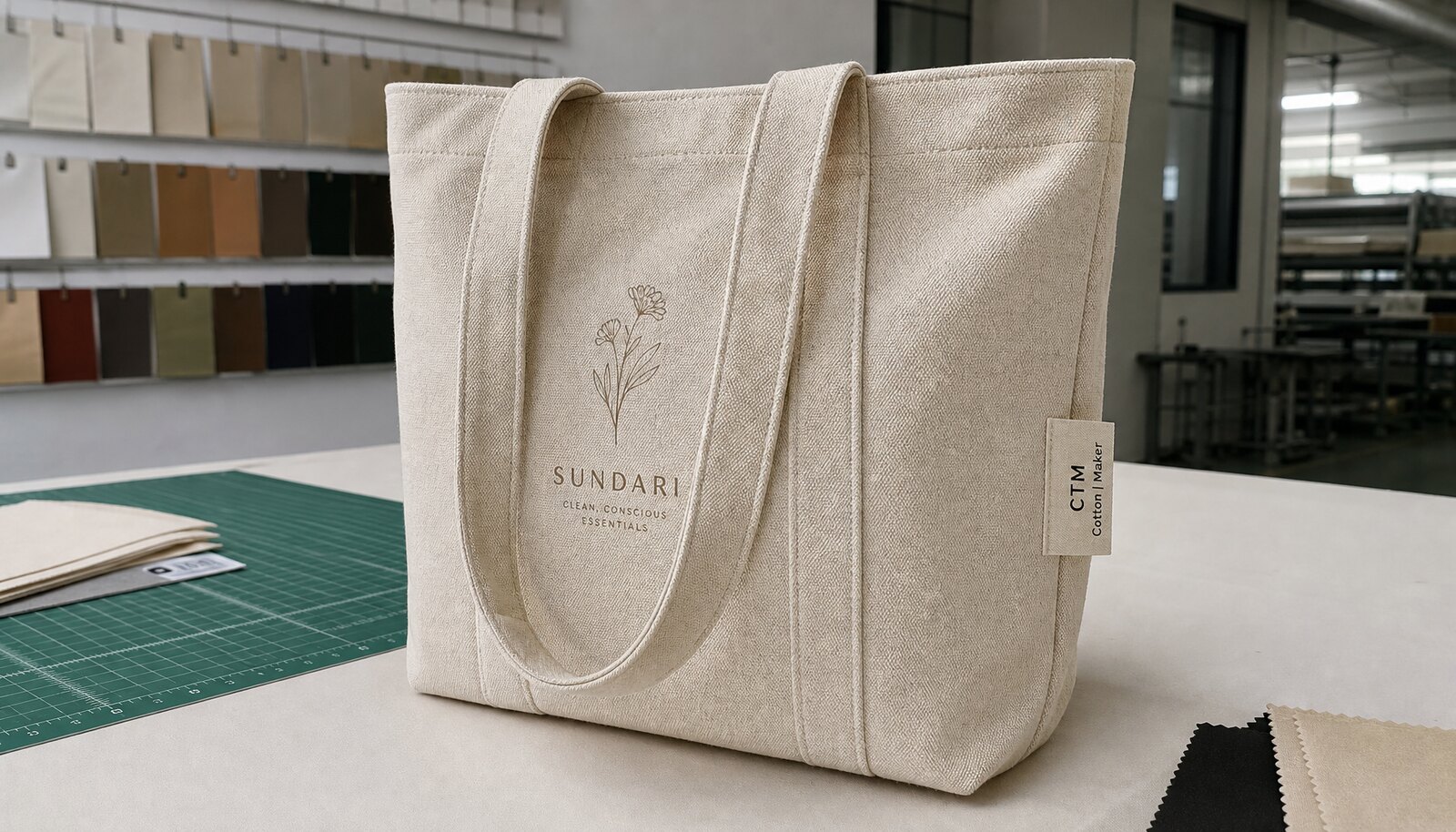
Why cosmetic brands need a different tote spec
Cosmetic buyers usually want the tote to do more than carry product. It has to look clean on shelf, protect samples or boxed skincare, and still feel premium after the customer takes it home. That changes the spec. A tote that works for a trade show giveaway can fail in cosmetics if the fabric looks too rough, the print bleeds, or the bag holds odor from recycled fiber processing.
The main buying mistake is treating recycled canvas like a generic promo bag. For beauty brands, the tote is part of the brand presentation. It sits beside jars, tubes, and boxed items that already compete on visual polish. The canvas must therefore balance recycled character with a controlled surface, stable color, and predictable print results.
- Use the tote as part of the product experience, not only a carrier.
- Choose recycled canvas with enough body to stand upright on retail counters or inside gift sets.
- Specify odor control and clean finishing if bags will ship with cosmetics or skincare.
Fabric selection: what recycled canvas weight actually changes
For recycled canvas totes, the weight choice is the first cost and quality decision. In practice, 10 oz works for lighter promotional use, 12 oz is the common retail-safe middle ground, and 14 oz gives a more premium handfeel and better shape retention. If the tote will hold boxed foundation, skincare jars, candles, or bundled gift items, the extra body of 12 oz or 14 oz usually pays back through fewer complaints and better shelf presentation.
GSM and ounce weight are often quoted loosely, so the buyer should get the exact measurement basis in writing. Some factories quote fabric before wash, after wash, or based on blended yarn variation. On recycled canvas, that difference matters. Ask for the weave type, finished weight, and whether the fabric is enzyme-washed, bio-washed, or simply calendared. Each treatment changes appearance, dust level, and print behavior.
- 10 oz: lower cost, lighter body, better for inserts, sample kits, and short campaign bags.
- 12 oz: balanced choice for most cosmetic retail programs and gift-with-purchase sets.
- 14 oz: premium look, stronger drape control, better for heavier boxed sets and longer reuse.
Recycled content, shade control, and what buyers should request in writing
Recycled canvas is not a single material class. The fiber source, yarn blend, and finishing route can all differ. A procurement team should not rely on the phrase “recycled canvas” alone. Ask for the recycled-content description, whether the yarn is pre-consumer or post-consumer, and what supporting factory or mill statement will accompany the shipment. If your brand makes sustainability claims, the paper trail matters as much as the bag construction.
Shade control is another area where first-time buyers get surprised. Recycled fiber batches can carry natural flecking, tone variation, or slight grayness. That is not automatically a defect, but it must be aligned with the brand aesthetic. For minimalist cosmetic brands, a clean natural tone with limited speckling is usually easier to sell. For earthy or eco-led brands, visible recycled character can work as long as the buyer approves a clear standard sample.
- Write recycled-content wording into the quote request.
- Approve one physical shade standard before bulk production.
- Define acceptable flecking or slub appearance if the brand wants a natural recycled look.
Print method choice: match the artwork to the fabric surface
On recycled canvas, the print method should follow the art, not the other way around. Solid logos with one or two colors usually print best with screen printing because the ink sits well on the fabric and gives strong opacity. For detailed cosmetic artwork, gradients, or photographic elements, digital print or heat transfer may be more practical. Embroidery looks premium on small marks, but it is rarely the right choice for large face graphics because it adds cost and can distort on thick canvas.
The buyer should compare setup cost, color stability, and waste rate. Screen printing may be economical for repeat runs, but every color adds preparation and risk. Digital print reduces plate setup, which helps when you have several SKUs or seasonal artwork. For cosmetic brands, the most common failure is choosing a print process based on artwork mockups instead of fabric behavior. Recycled canvas is textured; thin strokes, reversed text, and tight registration need a test print on the final cloth color.
- Screen print for bold logos, simple icons, and high-opacity branding.
- Digital print for multicolor art, gradients, and short seasonal runs.
- Embroidery for small premium marks, not for large detailed front panels.
Supplier route comparison: direct factory, trader, or mixed-category source
For most cosmetic brand programs, the best sourcing route is the one that gives you control over material and print details without creating too much overhead. Direct factory sourcing usually provides the best visibility on fabric weight, stitching method, and packing. A trader can help when the order includes multiple packaging items, mixed materials, or smaller quantities that would not justify a factory-only setup. The tradeoff is transparency: if the supplier cannot state the actual construction details, the quote becomes hard to compare.
Buyers should compare the route based on repeatability, not only first-order price. Cosmetic brands often reorder the same tote for seasonal kits, retail launches, or distributor programs. If the supplier cannot hold the same recycled canvas tone, print placement, and handle reinforcement on the second batch, the first low quote becomes expensive. Stable specs are more valuable than a one-time discount.
- Direct factory: best for repeat orders, tighter spec control, and better production communication.
- Trading company: useful for mixed SKUs, lower first-order complexity, or bundled sourcing.
- Regional converter: helpful when you need speed, local compliance support, or small replenishment volumes.
What a real tote quote should include so you can compare suppliers
A useful quote for recycled canvas totes should separate the spec choices that move price. If the supplier only gives one unit price, it is almost impossible to compare vendors. The quote should show size, fabric weight, print method, number of colors, handle length, lining status, packing method, and carton load. Without that breakdown, one supplier may be quoting a 10 oz bag with loose packing while another is pricing a 12 oz bag with reinforced seams and retail-ready fold standards.
Use the quote to build landed-cost logic, not just unit-cost logic. Freight cube, carton count, and print setup charges can change the real cost by more than the visible bag price. For example, a slightly heavier fabric may raise the unit price but reduce returns, improve shelf value, and lower the risk of damage in transport. For cosmetic brands, the correct comparison is the one that reflects the full supply chain from production to shelf.
- Ask for two quotes on the same design: promo spec and premium retail spec.
- Separate setup costs from recurring unit costs.
- Confirm carton count and outer carton dimensions before you approve the price.
MOQ logic: why color and print splits raise the real minimum
MOQ on recycled canvas totes is usually driven by fabric preparation, printing setup, and sewing line efficiency. Buyers often hear one total MOQ number and assume it applies no matter how many colors or print variants they want. In reality, MOQ rises when you split by color, artwork, or size because each variant can trigger separate material cutting, ink setup, or production scheduling. A 5,000-piece order can become operationally difficult if it is divided into five styles of 1,000 pieces each.
Cosmetic brands with multiple retail channels should plan MOQ by version, not by campaign. If one tote goes to direct-to-consumer gift-with-purchase, another to wholesale sets, and another to distributor packs, the supplier may need separate labeling, different folding rules, or alternate carton counts. Clarify whether the MOQ applies per artwork, per color, or per shipment. That avoids late-stage price changes and partial production surprises.
- Confirm MOQ separately for fabric color, print color count, and tote size.
- For smaller test runs, expect higher unit price or setup allocation.
- If launching multiple versions, consider one base tote with variable inserts or tags instead of multiple sewn styles.
Sample approval: the checks that matter before bulk order release
The first sample should not be treated as a formality. It is the best chance to catch problems that are expensive in bulk: handle length that feels awkward in hand, print placement that looks too high or too low, recycled fabric that appears darker than expected, or seams that pucker under load. A cosmetic brand should test the sample with realistic product weight, not an empty bag photo on a desk. The tote needs to look balanced with bottles, boxed sets, or sample kits inside.
A strong approval process also includes finish details. Check the inside for loose threads, odor, fabric lint, or rough seam edges that could transfer to packaging. If the tote will touch sealed cosmetic cartons, rub resistance matters. If it will be sold retail, fold style and surface presentation matter. Approve the sample in the same condition it will be shipped: folded, packed, labeled, and boxed. That is the closest preview of what your warehouse or customer will receive.
- Measure actual body size, not just nominal size on the spec sheet.
- Inspect print alignment, edge sharpness, and any cracking on folded areas.
- Load the sample with the intended product weight before sign-off.
Packing, carton loading, and shelf-readiness for beauty programs
Packing is a sourcing detail that becomes a merchandising problem if ignored. A tote that looks good individually can still arrive with crushed handles, dusty panels, or wrinkled print if it is packed loosely or overloaded in carton. For cosmetic brands, clean presentation is often part of the product value. Flat packing is common, but the folding method, interleaf sheet, polybag use, and carton stack height should match the final channel. Retail programs may need a neater fold and label placement than promotional shipments.
Freight also reacts to packing efficiency. A well-packed tote can lower carton volume and reduce landed cost, but over-compression can create deep fold lines that are hard to recover from. The buyer should ask the supplier for carton dimensions, units per carton, gross weight, and whether master cartons are marked for retail distribution or only export handling. If your distribution center uses barcode intake, make sure carton marks and inner labels are aligned with warehouse procedures before production starts.
- Specify fold direction and whether handles should be tucked inside or laid flat.
- Define inner polybag use only if needed for shelf cleanliness or moisture control.
- Request carton dimensions early to estimate freight and warehouse cube.
Lead time, risk points, and the sequence that prevents schedule slippage
Lead time on recycled canvas totes is usually shaped by fabric availability, print setup, sample approval, and packing. If the buyer changes artwork after sample sign-off, the schedule can move more than expected because the printer may need a new screen or transfer setup. If the tote uses a special color or custom dye, fabric lead time can become the longest part of the order. That is why the most reliable production plan locks the base fabric, print method, and packing standard before confirming the shipment date.
The safest workflow is to separate approval milestones: sample approval, pre-production confirmation, bulk start, in-line inspection, and final packing approval. Cosmetic brands should build a buffer when the bags are tied to product launches or seasonal campaign dates. Even a few days of delay on a tote order can affect a retail set, because the packaging, cartons, and shelf plan may all depend on it. A supplier that provides a realistic production calendar is usually more valuable than one that promises the shortest date without explaining the steps.
- Lock artwork before sample approval if you need reliable lead time.
- Build buffer time for recycled fabric shade matching and print setup.
- Separate production milestones in the order confirmation so delays are visible early.
Specification comparison for buyers
| Spec decision | Recommended option | When it fits | Buyer risk to check |
|---|---|---|---|
| Fabric weight | 12 oz recycled canvas for retail; 10 oz for lighter promo use; 14 oz for premium carry | Brand launches, boutique retail, gifting programs, and cosmetic kit bundles | Too-light fabric can look wrinkled and distort with heavy product loads; too-heavy fabric raises unit cost and freight |
| Yarn content | Recycled cotton canvas with clear recycled-content declaration from the mill | Sustainability-led beauty brands and packaging programs with ESG messaging | Recycled claims need written support; vague wording creates label and marketing risk |
| Color base | Natural, off-white, or dyed recycled canvas with controlled shade tolerance | Minimal cosmetic branding, print-first designs, and premium clean-pack presentations | Recycled fibers can vary in shade and fleck; color inconsistency can affect brand approval |
| Print method | Screen print for solid logos; heat transfer or digital print for complex graphics; embroidery only for small logos | Most cosmetic brands need logo clarity on a textured substrate | Fine gradients, thin strokes, and metallic colors can break on rough canvas or shift between production lots |
| Handle build | Self-fabric handles with reinforced X-box or bar-tack stitching; 25-30 cm drop length for hand carry | Retail counters, event gifting, and product sample bags | Short handles reduce usability; weak stitch count causes failure at the seam under product weight |
| Inner structure | Unlined for low-cost promo; light cotton or recycled lining for premium retail handfeel | Higher-end cosmetics, subscription kits, and gift-with-purchase programs | Lining adds cost and lead time; unlined totes can show print bleed, seam fray, or inside fiber shedding |
| Supplier route | Direct factory for repeat programs; trading company only if you need mixed categories or smaller first orders | Brands that need stable specs and repeatability | Middlemen can hide actual fabric weight, construction method, and packing details |
| MOQ logic | Plan MOQ by color + print + size, not just total units | Multiple SKUs, seasonal art changes, or retailer-specific packs | Low total order count can still trigger high MOQ if each variant needs separate fabric dyeing, plate setup, or sewing line change |
| Packing method | Flat packed with measured carton count and inner poly if required by retail standard | Wholesale distribution, e-commerce fulfillment, and warehouse intake | Loose packing increases scuffing and dust; overpacking raises cube and freight cost |
Buyer checklist before sampling
- Confirm final bag size, gusset, handle drop, and usable loading weight.
- Specify fabric type, GSM/oz weight, color tolerance, and shrinkage expectations.
- Send vector artwork and define logo size, print position, and Pantone references.
- Ask for sample photos plus one physical pre-production sample before bulk approval.
- Agree carton packing, barcode or hangtag needs, and shipment marks before production.
- Record inspection checkpoints for stitching, print adhesion, stains, and quantity count.
Factory quote questions to send
- What exact recycled canvas weight are you quoting, and is that before or after printing and washing?
- Is the recycled content sourced from post-consumer or pre-consumer fiber, and can you state the mill declaration in the quote?
- What is the MOQ by size, color, and print method, and which cost items change when we split variants?
- Which print method do you recommend for our artwork, and what are the setup charges, plate charges, or color charges?
- What carton pack count, carton size, and gross weight are you planning for this tote?
- What are your sample lead time, bulk lead time, and approval milestones before production starts?
- Which quality checks do you perform in-line and before shipment for stitching, dimensions, print accuracy, and odor?
- Can you quote two options: basic promo spec and premium retail spec, so we can compare landed cost?
Quality-control points to confirm
- Fabric weight tolerance should be agreed before production, especially if the order uses recycled yarn blends.
- Stitching at handles and side seams should be checked for skipped stitches, loose thread ends, and seam puckering.
- Print registration should stay within the approved tolerance on all visible panels, with no smudging or peeling after curing.
- Bag opening, body dimensions, and handle drop should be measured against the approved sample, not against a loose factory interpretation.
- Smell and dust level should be controlled on unlined totes, especially for beauty products and retail shelves.
- Carton packing must prevent handle crushing, surface rubbing, and moisture exposure during sea shipment.
- Sample should be tested with realistic fill weight so the buyer can see how the tote hangs, stretches, and carries.
- Final inspection should include random unit count, carton mark accuracy, and barcode or label placement if retail requires it.