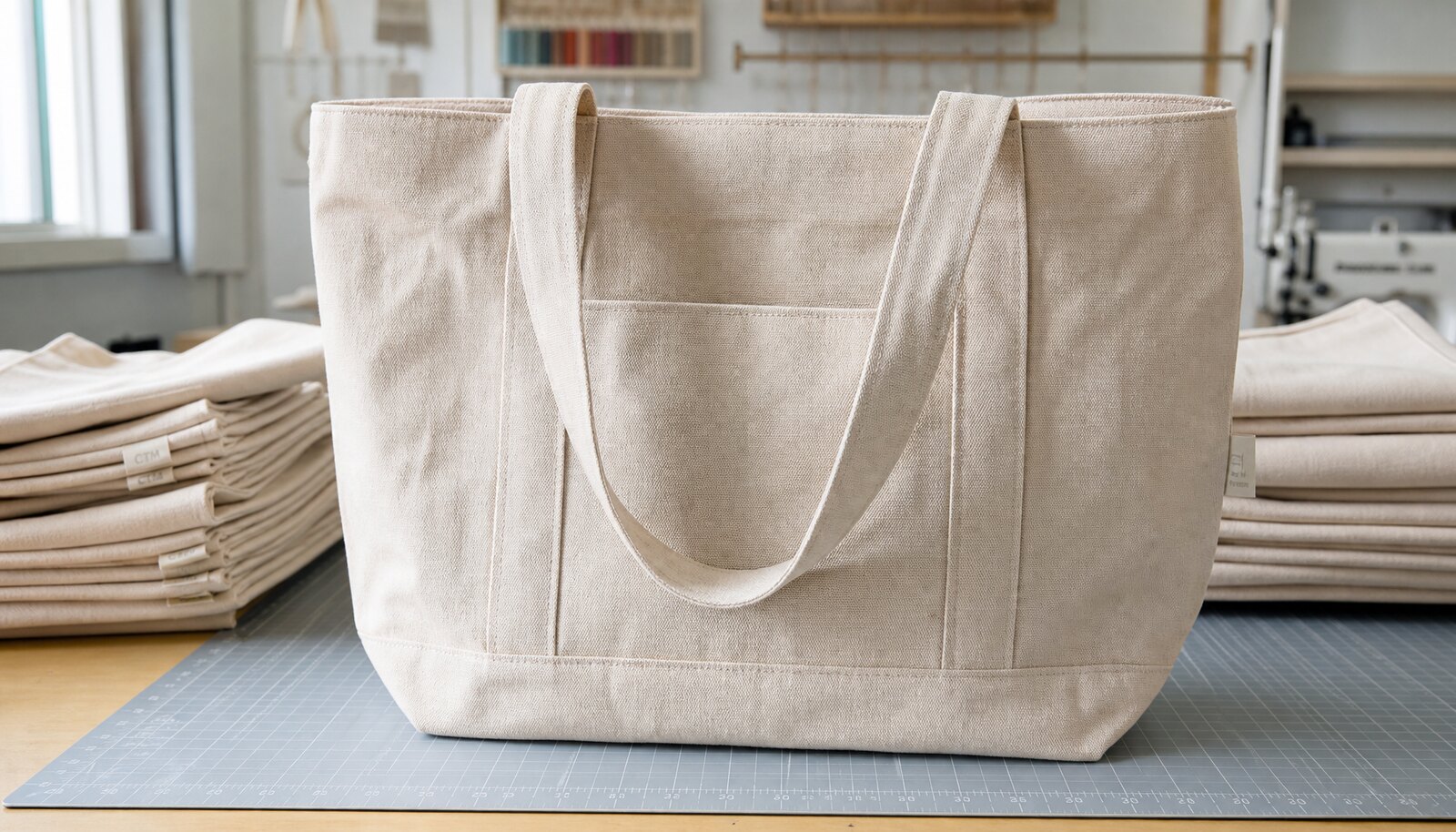
Why recycled canvas tote pricing varies so much for cosmetic programs
For cosmetic brands, recycled canvas totes are usually bought for one of three reasons: retail resale, gift-with-purchase, or brand campaign packaging. The quote looks simple until the buyer writes down the actual requirement. A tote that only needs to carry a lipstick card and sample sachets is a different product from one that must hold serum bottles, boxed skincare, and a pouch. That difference changes fabric weight, handle reinforcement, print area, and carton packing immediately.
The price gap usually comes from these hidden variables: GSM, handle type, print setup, lining, trim sourcing, and how the bags are packed for export. If two quotes both say recycled canvas tote, they may still be 15% to 40% apart because one is based on 10 oz fabric with one-color print and bulk pack, while the other uses heavier fabric, reinforced handles, a cleaner inside finish, and individual polybagging. A buyer who compares only unit price will miss the real landed-cost driver.
- Write the tote’s job first: carry, display, gift, or retail resale.
- Anchor the quote to fabric weight, print method, and pack method.
- Treat recycled content as a spec item, not a price label.
Build the spec around the cosmetic load, not around the catalog photo
Cosmetic packaging puts different stress on a tote than apparel or event giveaways. Bottles and jars create point load, and boxed skincare creates edge pressure. For that reason, a recycled canvas tote in the 10–12 oz range, or roughly 340–410 GSM, is often the practical starting point for bulk buying. Below that range, the bag may still look good in a photo but will collapse or distort when loaded with product sets.
Handle length also matters. Brands often choose a longer shoulder-drop handle for retail convenience, but if the tote is intended to carry rigid boxes, the handle attachment must be reinforced with X-box stitching or equivalent bartacks. When you specify only “cotton handles” without reinforcement detail, suppliers will price a lighter construction that may pass a visual check but fail in use.
- For light beauty kits: 10 oz recycled canvas can work if the load is controlled.
- For premium cosmetic sets: 12 oz is the safer buying point.
- For repeated retail use: require handle reinforcement and seam tolerance in writing.
How the bulk pricing plan should be structured in your RFQ
A useful bulk pricing plan separates the quote into fabric, sewing, print, packing, and logistics assumptions. When those items are bundled into one number, buyers cannot compare suppliers on equal footing. Ask for a unit price at one quantity tier, then a stepped price at the next two tiers so you can see whether the factory is using real scale or just a low opening price to win the order.
For recycled canvas totes, MOQ is often tied to more than quantity. It may be tied to one fabric color, one print method, or one artwork version. That is why a 5,000-piece order with four colorways can sometimes cost more per bag than a 5,000-piece single-SKU order. If your brand needs multiple shades or seasonal artwork, ask whether the factory can consolidate quantities under one base fabric and vary only print and label.
- Request tiered pricing at 1,000 / 3,000 / 5,000 / 10,000 pieces or the factory’s real breakpoints.
- Separate setup cost from recurring unit price.
- State whether the order will repeat, because repeatability changes the factory’s willingness to absorb prep cost.
Supplier route comparison: factory-direct, trading company, or hybrid sourcing
The cheapest-looking quote is not always the cheapest route. Factory-direct sourcing can be the best option when you need stable spec control, especially on recycled canvas weight, print registration, and sewing consistency. Trading companies can be useful when you need faster communication across multiple product types or when you are consolidating several gift items into one shipment, but the price often includes an extra control layer.
A hybrid route can work if the trading partner has a real production line relationship and can prove the mill, sewing workshop, and packing arrangement. The buyer’s job is to identify who actually owns the fabric decision, who approves the print plate or screen, and who signs off the packed carton list. If those answers are vague, the quote comparison is not meaningful.
- Use factory-direct when repeat orders and spec discipline matter most.
- Use a trading layer only if it shortens coordination without obscuring production ownership.
- Avoid comparing delivered prices unless all suppliers quote the same Incoterm and carton assumptions.
What to compare in supplier quotes beyond unit price
A proper quote comparison should show what you get for the money. One supplier may quote a lower unit cost but omit inner polybags, carton dividers, or side labels. Another may include those items, which makes the headline price look high but the landed cost lower after packaging and repacking are counted. Cosmetic buyers should compare the quote as a finished shelf-ready item, not as a sewing job alone.
Use the same evaluation frame for every supplier: fabric GSM, print colors, bag size, handle length, stitch reinforcement, packing format, and production lead time. Once those items are fixed, ask for a shipping-basis quote and compare it against the forecast freight, customs, and warehouse handling. That is the only way to understand whether the bag will still fit the target margin once it arrives at your distribution center.
- Check whether the quote includes sample shipping, screens, plates, or digital proofing.
- Confirm if carton labels and barcode stickers are included or chargeable.
- Ask for the quote validity period; recycled fabric and print inputs can move quickly.
Product-specific comparison table for sourcing routes and cost control
This table compares common sourcing routes for recycled canvas totes used by cosmetic brands. The point is not to rank them universally, but to show where each route creates cost control, quality risk, or schedule risk. Use it when you are balancing repeat order stability against a first-season launch with tight buying windows.
Define the measurable checks around fabric weight, size tolerance, handle pull, seam strength, logo rub, stains, loose threads, and carton count verification. Add tolerance ranges only where the buyer truly cares, and ask for photos that show the measurement point, not just a finished product overview.
- Write decisions in measurable language, not only descriptive wording.
- Ask for sample photos plus one physical approval sample for important orders.
- Keep quotation, sample approval, and inspection notes tied to the same spec version.
Sample approval: the stage that prevents the most expensive mistakes
For recycled canvas totes, the sales sample is not enough. A sales sample often uses available fabric and approximate print settings. The sample that matters is the pre-production sample made with final fabric weight, final logo placement, final handle material, and final pack format. If the supplier cannot repeat the sample conditions in bulk, the sample has limited value.
Approvals should focus on the details that affect resale and warehouse handling: finished size, handle drop, print contrast, seam alignment, and whether the tote stands or slouches as intended. Cosmetic brands often need the bag to look clean on shelf and inside a mailer. If the side seam or top hem is not straight on the sample, it will become more obvious in production, not less.
- Measure the finished sample against your spec sheet, not against a photo.
- Open and close the bag repeatedly to catch handle twist or seam strain.
- Approve print on the exact bag panel where the final artwork will sit.
QC thresholds buyers should put in writing before mass production
A good supplier can still make a bad lot if the acceptance limits are vague. For recycled canvas totes, the buyer should set a realistic tolerance for finished size, stitch quality, print position, and carton count. Cosmetic bags are often judged by appearance at shelf level, so minor defects that might be acceptable in a warehouse tote can become commercial problems in retail packaging.
Ask the factory to confirm the acceptable defect rate for visual and functional issues. You do not need to over-engineer the document, but you do need clear lines on what is rejected. If the seller does not want to discuss acceptable tolerance ranges, that is a sign the quote may not be built on a disciplined production process.
- Reject loose threads at load-bearing seams.
- Reject print bleed, visible misregistration, and obvious shade mismatch across the same SKU.
- Reject cartons with wrong pack counts, mixed styles, or unlabeled inner packs.
Packing and carton planning for importers and distributors
Packing decisions affect freight cost, warehouse labor, and damage rates. Bulk packed totes are usually cheaper to make and ship, but they may need repacking at destination if the customer expects shelf-ready presentation. Individual polybags protect the bag and improve presentation, but they add material cost and increase carton volume. For cosmetic brands, the right answer depends on whether the tote is sold as a standalone product or used as packaging inside another order flow.
Carton design should match how the buyer receives the goods. If you distribute to multiple retail accounts, consider SKU-sorted inner packs and barcode labels on each inner bag. If the totes go to a fulfillment center, use master cartons with clear count labeling and a pack list that matches the PO line items. The more SKUs you carry, the more important carton discipline becomes.
- Specify inner pack count by SKU and artwork version.
- Confirm whether polybags must be printed, clear, recycled, or omitted.
- Ask for the gross carton weight to avoid freight surprises.
Lead time risk: where recycled canvas orders slip and how to protect the schedule
Lead time on recycled canvas totes is usually affected by fabric availability, print slot booking, sample approval speed, and carton sourcing. A supplier may quote a short production window, but if the recycled fabric needs dye matching or the print requires screen setup, the actual timeline extends. The safest planning method is to build in time for sample revision, not just mass production.
If the order has a fixed campaign date, avoid placing the whole schedule on one approval gate. Ask for photo approval on fabric shade, then physical sample approval for final production, then a packed-carton pre-shipment check. That sequence reduces the chance of discovering a problem after the bags are already sewn and packed.
- Do not treat sample approval as a formality; it is part of the schedule.
- Reserve extra time if the order uses multiple print colors or multiple SKUs.
- Build buffer for carton printing, labeling, and export documentation.
Specification comparison for buyers
| Spec decision | Recommended option | When it fits | Buyer risk to check |
|---|---|---|---|
| Fabric weight | 10–12 oz recycled canvas, usually 340–410 GSM | Best balance for cosmetic retail totes, gifting programs, and branded resale | Too light can distort under product weight; too heavy raises cost and slows sewing |
| Handle construction | Self-fabric or cotton webbing handles with reinforced X-box stitching | When the bag carries skincare sets, jars, or boxed cosmetics | Short stitch length or weak bartacks fail after repeated retail use |
| Print method | 1–2 color screen print or heat transfer for small runs; full-color transfer only when artwork demands it | Simple logos, ingredient-driven branding, and controlled bulk pricing | Complex art can increase setup cost and cause registration issues on textured canvas |
| Lamination or lining | Unlined for low-cost giveaways; thin lining for premium cosmetic retail bags | When product protection or cleaner interior finish matters | Lining can hide stitching issues and adds lead time if not quoted clearly |
| MOQ route | Factory-direct standard MOQ with a color-and-print minimum | For repeat orders and private label programs | MOQ may be split between fabric color, print color, and carton count |
| Packing method | Bulk pack with carton divider or polybag + master carton by SKU | For distributors and importers optimizing freight and warehouse handling | Loose packing increases scuff risk; individual polybags raise cost and plastic volume |
| Sample type | Pre-production sample after fabric and print approval | For brand owners who need color and finish control before mass order | Sales samples often differ from production fabric lot and trim source |
| Supplier route | Factory with in-house cutting, printing, sewing, and packing control | When you need stable repeatability and fewer handoff errors | Trading-layer quotes can look cheaper but hide rework, delay, and spec drift |
| Shipping basis | FOB or ex-works quote plus separate freight estimate | For importers comparing landed cost across countries or ports | A low unit price can lose once cartons, palletization, and inland fees are added |
Buyer checklist before sampling
- Define the tote use case: retail purchase bag, gift-with-purchase, event giveaway, or product carrier for cosmetic sets.
- Lock the fabric target in GSM/oz, not just the word recycled canvas.
- State bag size, handle length, seam allowance, and whether the bag must stand upright on shelf.
- Separate print method from artwork: number of colors, print size, placement, and whether ink must be low-odor or water-based.
- Confirm carton pack, polybag rules, and whether SKU sorting is needed for multiple artwork versions.
- Request a production sample made with final fabric, final print method, and final trim source.
- Ask for landed-cost inputs: unit price, setup, packaging, inner carton, outer carton, and freight basis.
Factory quote questions to send
- What recycled canvas GSM did you quote, and is it yarn-dyed, piece-dyed, or greige with post-treatment?
- How many print colors are included in the unit price, and what is the repeat setup cost per color?
- Is the MOQ tied to one artwork, one fabric color, or one total order quantity across variants?
- Will the sample use the same sewing line, same handle webbing, and same carton spec as production?
- What is the accepted tolerance for size, print registration, and stitch count per seam?
- How do you pack by inner quantity and master carton, and what is the carton gross weight?
- What is the realistic lead time after sample approval, and what can extend it?
Quality-control points to confirm
- Fabric weight must stay within the agreed range, with no major thin spots, slubs, or uneven dye streaks visible at arm’s length.
- Handle reinforcement must hold a straight pull without seam opening, twisting, or visible puckering.
- Print registration should remain aligned within a practical retail tolerance; no blur, pinholes, or cracking at the fold line.
- Cut size and finished size should be within agreed tolerance so the bag fits inserts, boxed cosmetics, or shelf display requirements.
- Cartons must match the ordered pack count, barcode label, and SKU mix; no mixed artwork unless approved in writing.
- The approved sample should match the production lots for fabric handfeel, logo placement, and stitch appearance.