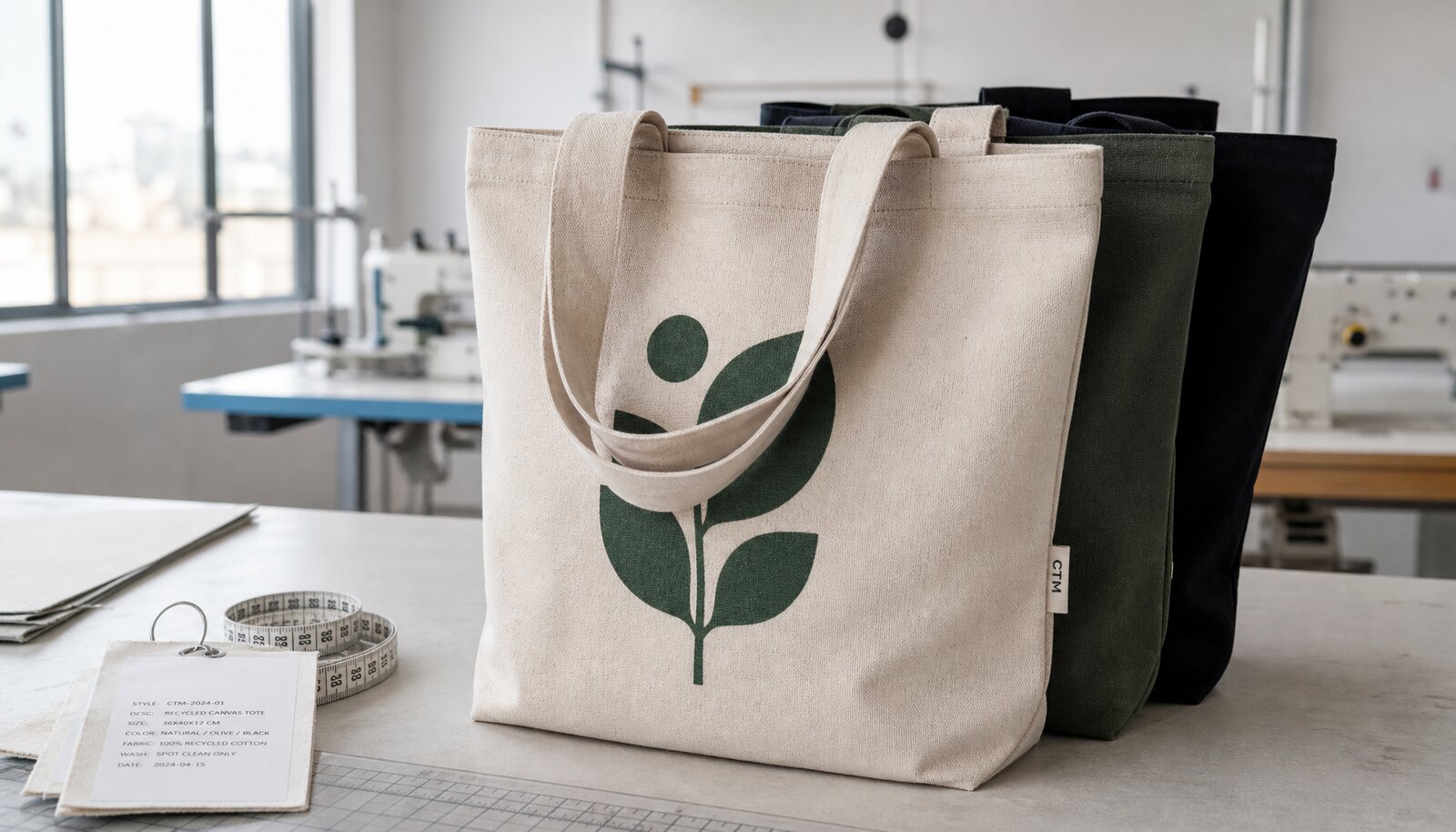
What a corporate-event tote needs to do in real life
The buying brief for recycled canvas totes changes once the bag is tied to a corporate event. This is not a fashion tote and not a grocery utility bag. It has to look clean on arrival, carry catalogs or gifts without distortion, and still be usable after the event so the brand gets repeat exposure. That means the sourcing plan should start with use case, not decoration.
For procurement teams, the main risk is over-specifying the print and under-specifying the bag body. A beautiful logo on a weak bag creates a complaint in the first hour of the event. A heavier, well-constructed tote with simple branding usually delivers better perceived value than a lightly built bag with complicated artwork.
- Typical event loads: brochure set, notebook, water bottle, sample kit, or small apparel item
- Recommended size range: about 14 x 15 in. to 16 x 17 in. with gusset if the contents are bulky
- Best fit: a bag that folds flat but still stands up enough to pack quickly at registration
- Private label goal: subtle brand ownership without turning the tote into a retail-style fashion item
Choose the fabric first: recycled canvas weight drives cost and feel
Recycled canvas totes for corporate events usually work best in the 10–12 oz range, which translates roughly to 340–410 GSM depending on construction and finishing. At this level, the fabric has enough body for screen print clarity and enough strength for repeated handling. If the fabric drops much below that, the tote starts to wrinkle badly, the print can look less premium, and the bag may sag when filled.
Heavier fabric is not always the better answer. Once the canvas goes too heavy, the bag starts to cost more in material, sewing time, and freight. For a corporate event program, many buyers end up paying for a premium handfeel that the attendee does not actually need. The better question is whether the tote must survive after the event as a daily carry bag or only as a reusable conference bag.
- 10 oz / about 340 GSM: cost-efficient, lighter handfeel, suitable for flat collateral packs
- 12 oz / about 410 GSM: stronger drape, better print surface, better perceived value
- Washed or enzyme-finished canvas: softer touch, but can reduce sharpness in fine print if not tested
- If recycled fibers vary in color, expect a more natural mottled appearance and agree on acceptable shade range
Private label construction: label placement matters more than buyers expect
For private label sourcing, the label should be planned together with the sewing pattern, not added as an afterthought. The most practical setup is usually an inside woven label plus an optional small side label on the seam. That gives brand ownership without distracting from the main event logo. It also keeps the tote usable in other contexts if the client wants a softer corporate look.
Outside branding on recycled canvas can work well when the bag is sold after the event or displayed at a booth. But for most corporate programs, the outside should stay simple: one logo, one location, one color if possible. The more print locations you add, the more ways the vendor can misalign the artwork and the higher the QC burden becomes.
- Inside woven label: best for private label identity and low visual clutter
- Side seam label: useful for premium brand marking without impacting the front artwork
- Printed neck label or hangtag: only if the bag will retail after the event
- Avoid oversized labels that interfere with folding or create seam puckering
Supplier route comparison: factory direct vs trading route vs local converter
Corporate event tote sourcing is easier when the buyer compares supply routes instead of only comparing unit price. A factory direct quote often looks better because it removes layers, but only if the factory actually owns or tightly controls sewing, printing, and packing. A trader may be useful when artwork changes quickly or the buyer needs multiple accessory items in one order, but the tradeoff is less transparency on workmanship and lead time.
A local converter or decorator can be practical for very short deadlines, especially when the bags are already stocked in a neutral color. However, once the buyer needs a recycled canvas body, private label, and specific packing, the local route often loses on fabric control and consistency. The right route depends on how much of the spec is standard versus how much is custom.
- Factory direct: best for controlled MOQ, repeat production, and clearer sample accountability
- Trading route: useful for bundled sourcing, but request the exact factory name and production role
- Local converter: useful for fast branding on stock bags, less ideal for full private label development
- If the event date is fixed, prioritize the route that can lock sample approval fastest, not the one with the lowest ex-works price
How to compare quotes without missing hidden cost drivers
A useful quote for recycled canvas totes should separate fabric, sewing, print, label, packing, and carton data. If the supplier sends only one lump sum, it becomes hard to see where the cost risk sits. For example, a low price can hide expensive setup charges, a narrow size tolerance, or a packing method that increases freight volume. The quote should be readable enough that a sourcing manager can compare three vendors without reverse engineering the line items.
The table below reflects the main cost and sourcing choices buyers run into. For event programs, the quote that looks cheapest at first often becomes more expensive once artwork revisions, packaging, or freight are added. The better comparison is landed cost per acceptable bag, not unit price alone.
- Ask for separate pricing on blank bag, printed bag, and private label add-on
- Use the same bag size and same carton target when comparing vendors
- Check whether setup charges are one-time or per order
- Confirm if the quoted freight volume is based on folded packed units or loose cartons
Production-specific comparison table for sourcing routes
Use the following comparison when deciding which supplier route fits the event program. The goal is not to pick the cheapest option on paper, but the route that gives the cleanest approval cycle and the fewest surprises in bulk production.
Define the measurable checks around fabric weight, size tolerance, handle pull, seam strength, logo rub, stains, loose threads, and carton count verification. Add tolerance ranges only where the buyer truly cares, and ask for photos that show the measurement point, not just a finished product overview.
- Write decisions in measurable language, not only descriptive wording.
- Ask for sample photos plus one physical approval sample for important orders.
- Keep quotation, sample approval, and inspection notes tied to the same spec version.
Sample approval: what must be correct before bulk sewing starts
A blank sample is not enough for this product. For corporate events, the buyer should approve at least one printed pre-production sample using the same fabric weight, same print method, and same label construction intended for bulk. If the logo is small, the sample should be reviewed on a real bag body, not on a cut panel, because canvas texture changes how edges sit and how fine text reads.
Sample evaluation should focus on fit, print, stitch quality, and packing behavior. A bag can pass visual review and still fail in the carton because it folds too thickly or sits unevenly in a box. That creates freight waste and receiving labor. The sample is the only practical place to catch those issues before the order is locked.
- Check handle symmetry by measuring from seam to seam on both sides
- Inspect print registration on the actual curved or stitched area where the logo sits
- Test load with realistic event contents, not just empty bag handling
- Confirm the folded size so carton counts and shelf storage make sense
Quality control thresholds that prevent common canvas tote failures
The most common failures in recycled canvas tote production are not dramatic. They are small defects that turn into buyer complaints at the event: crooked labels, loose threads, uneven prints, or handle stitching that feels weak in the hand. Buyers should set acceptance criteria in practical language. If the bag is for a conference, a slightly rustic canvas texture may be acceptable; a crooked logo is not.
Set measurable thresholds whenever possible. For example, ask for a size tolerance, a print position window, and a clear sewing standard. If the supplier cannot state how they inspect stitching or print alignment, the buyer is taking on too much risk. A factory that understands tote production should be able to describe its in-process checks without hesitation.
- Stitching: no skipped stitches or loose seam opening at stress points
- Print: no visible smear, pinholes, or ink pooling on textured areas
- Label: centered or intentionally positioned within a defined tolerance
- Color: recycled canvas may vary slightly, but the batch should remain within the agreed shade range
- Packaging: each carton should carry the same count and same fold orientation
Packing and carton planning: where many event budgets leak
Packing sounds minor until the freight quote arrives. A recycled canvas tote with a gusset and thicker fabric can take more volume than buyers expect, especially if it is individually polybagged. For event programs, bulk packing usually gives the best cost balance unless the client needs retail-ready presentation or distribution by attendee tier. Individual polybags add labor, plastic cost, and carton volume, so they should only be used when the receiving process demands it.
Carton size should be fixed before freight is booked. If the supplier changes folding style or inserts tags later, the carton dimensions can expand and the shipping cost goes up. Ask the factory to show how many units fit per carton and whether the count changes if the bag includes a label, hangtag, or insert card. That is the difference between a clean import and a budget overrun.
- Bulk pack: lowest cost, best for event distribution teams
- Individual polybag: suitable for retail handoff or premium unboxing, but heavier on freight and labor
- Carton labeling: include PO, design code, unit count, and carton number sequence
- If cartons are stacked for pallet shipping, confirm the pallet pattern and compression risk
Lead time planning and schedule risk for event programs
For standard recycled canvas tote builds, a realistic post-approval lead time is often in the 25–40 day range, but that only works when the artwork is final, the fabric is available, and the label is already approved. Every extra decision point pushes the schedule. Buyers who treat logo proofing and packaging as separate late-stage tasks usually lose a week or more without realizing it.
Event buyers should build a buffer for one sample correction cycle. The schedule should include artwork sign-off, sample approval, bulk sewing, print curing, packing, and export booking. If the order is tied to a conference date, the safer plan is to freeze specs earlier than feels necessary. The factory can move faster when it is not waiting for new files or late label revisions.
- Allow extra time if you need custom-dyed canvas, special washing, or multi-color print
- Build buffer time for proof corrections on small logo text
- Check whether the supplier counts lead time from deposit receipt or from sample approval
- Ask for a milestone schedule, not only a final delivery promise
Specification comparison for buyers
| Supplier option | What to verify | Commercial advantage | Buyer risk to control |
|---|---|---|---|
| Direct sewing factory | fabric swatch, approved sample, seam close-ups, logo test photos, packing pilot, and final inspection evidence | Better sample-to-bulk control and faster production feedback | May be weaker on export paperwork or branded packing unless checked early |
| Trading company | Factory name, production photos, trim-source proof, and who owns QC decisions | Can coordinate small mixed orders and extra services | Markup can hide real factory capability and slow defect decisions |
| Specialized bag workshop | bag size, gusset, handle drop, seam allowance, stitch density, reinforcement patch, and loading expectation | More practical for detailed construction, trims, and repeat programs | Capacity may be limited during peak seasons |
| Low-price general supplier | 8-12 oz cotton canvas, 120-220 gsm cotton, recycled cotton, or blended fabric selected by use case and target price | Useful for simple promotional runs with loose specs | Material downgrades, weak packing, and vague inspection scope can erase savings |
| Retail-ready supplier | fold method, inner bundle, carton count, carton mark, moisture protection, SKU separation, and warehouse receiving needs | Can handle labels, SKU separation, carton marks, and receiving rules | Higher unit cost must be compared against reduced warehouse work |
| Compliance-focused supplier | Fabric records, labeling review, test plan, and production traceability | Safer for retail programs and repeat brand orders | Documentation claims need evidence, not only sales language |
| Local sample room plus bulk factory | Signed sample, bulk factory handoff, first-piece photos, and deviation owner | Good for complex branding before large production | Sample room quality may not match bulk line unless handoff is controlled |
Buyer checklist before sampling
- Confirm the event use case: one-time giveaway, delegate bag, or reusable branded tote for post-event distribution.
- Lock the exact fabric weight in GSM or oz, not just the phrase recycled canvas.
- Approve one artwork file with final logo size, print colors, and placement dimensions.
- Set the required bag size, handle length, and target loading weight.
- Decide whether the buyer needs inside label only, outside label only, or both for private label sourcing.
- Define packing instructions: bulk pack, individual polybag, insert card, or carton assortment.
- Ask for a pre-production sample and a photo of the first sewn panel before bulk production.
- Request carton dimensions and unit count before comparing freight quotes.
- State the acceptable variance for color, size, and print alignment in writing.
Factory quote questions to send
- What is the recycled canvas GSM or oz weight used for this bag, and can you share the fabric composition details?
- Is the quoted price based on your own sewing and printing line, or is any process outsourced?
- What is the MOQ per color, per print, and per label version?
- What print method do you recommend for this artwork, and what is the setup charge per color or location?
- Can you quote separate prices for bulk packing, individual polybagging, and insert card packing?
- What are the carton size, carton quantity, and estimated CBM for the proposed packing method?
- What sample stage do you provide before production: blank sample, printed sample, or pre-production sample?
- What tolerance do you apply for size deviation, print position, and stitching alignment?
- What lead time applies after sample approval, and what changes trigger a schedule reset?
- Can you provide photos of previous similar canvas tote production or a workshop inspection summary?
Quality-control points to confirm
- Fabric weight should match the agreed range, with no obvious thin spots, holes, oil marks, or uneven weave.
- Handle stitching must use reinforced bar-tacks or dense lock stitches at the stress points.
- Logo print should sit within the approved position window and should not blur, crack, or bleed into the fibers.
- Label placement must be straight, fully secured, and not distort the bag body or seam alignment.
- Top edge, side seams, and gusset seams should be even with no skipped stitches or loose thread tails.
- Finished bag size should stay within the agreed tolerance, especially if carton fit or retail display is sensitive.
- Fold pattern and packing count should be consistent so receiving teams can re-count quickly without opening every carton.
- Sample approval should match the same fabric, print method, and label construction used for bulk production.