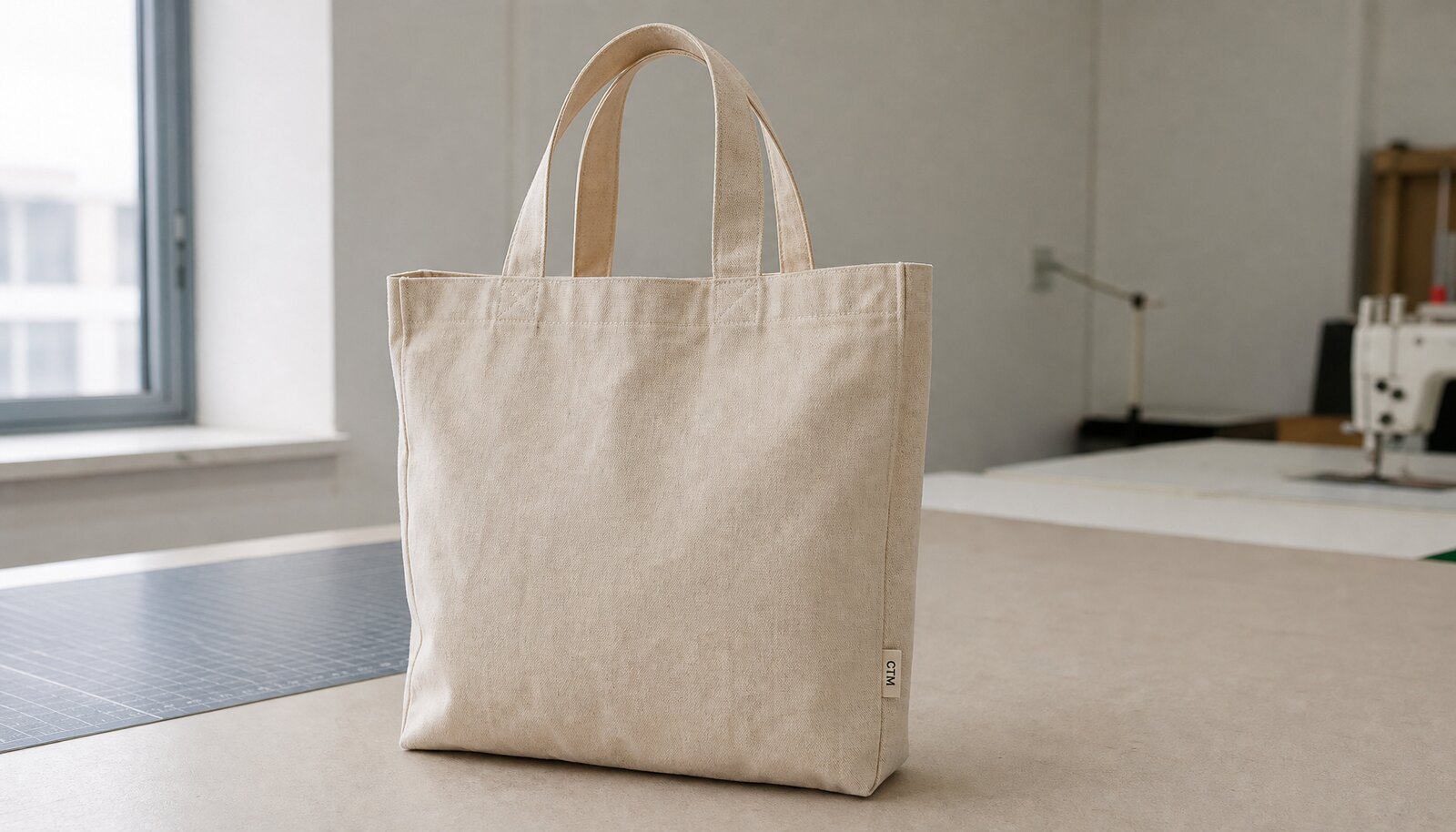
1. Why corporate event totes fail when the spec is too loose
Most event tote problems are not design problems; they are spec problems. Procurement teams often receive a pretty render, a logo file, and an attendance number, then ask for quotes from three suppliers. That usually produces three bags that look similar on paper but behave very differently in the hand, in the carton, and on the show floor. Recycled canvas is especially sensitive because the recycled fiber blend, weave tightness, and finishing process can change the way the bag hangs and prints.
For corporate events, the tote has to do a few jobs at once: look credible, carry enough weight, survive handling by attendees and staff, and arrive on time. If the bag is for a conference or internal brand event, the real buying problem is not choosing a tote style; it is getting a repeatable, event-ready spec that balances cost, print quality, and lead time. Buyers who define those three variables upfront usually avoid the most common quote traps.
- A vague brief invites weak fabric, bad print placement, and inflated setup fees.
- A clear spec makes supplier comparison easier and reduces remake risk.
- Event totes need to be judged as a system: fabric, stitch, print, packing, and timing.
2. Choose fabric weight for the actual event load, not the catalog look
For recycled canvas totes used at corporate events, fabric weight is one of the fastest ways to control both perceived value and failure risk. A 10 oz bag can work for light brochures and flat handouts, but it starts to feel thin once you add a notebook, water bottle, and product samples. In most buyer RFQs, 12 oz to 14 oz recycled canvas is the practical range because it prints well, keeps its shape better, and feels substantial without moving into an expensive premium-gift category.
If the event tote will carry heavier inserts or repeated staff use, it is smarter to increase fabric weight before upgrading decoration. A thicker body usually delivers more value than extra decoration, especially when the tote is seen in large quantities around a venue. The common mistake is specifying a heavier print method or extra trim while leaving the fabric too light, which leads to wrinkling, seam stress, and a bag that looks cheap after the first use.
- 10 oz: best for flat giveaways and low-load distribution.
- 12 oz: a balanced default for corporate events and sponsor packs.
- 14 oz: better for premium welcome kits, retail resale, or multi-item loads.
- Heavier than 14 oz: useful only when the event concept justifies higher freight and unit cost.
3. Compare supplier routes before you compare unit price
A recycled canvas tote quote can come from a direct factory, a trading company, a domestic decorator, or a local event merch supplier. These routes do not compete on the same basis. A direct factory usually offers the best control over fabric, stitch, and packing, but the buyer must be more specific and often manage sampling and artwork approvals more tightly. A trading company can simplify communication and bundle multiple products, yet the price may include extra margin and less visibility into where the bag is actually made.
For corporate events, the right route depends on how much risk you can absorb. If the event date is fixed and the bag is a core brand asset, a factory with tote-bag experience is usually the safer path. If the order is small, highly customized, or tied to local compliance and last-minute replenishment, a domestic decorator may be worth the higher unit cost. Compare suppliers by the evidence they can show, not by the friendliness of the first email.
- Direct factory: best for repeat orders, tighter cost control, and spec discipline.
- Trading company: useful when combining multiple product categories in one shipment.
- Domestic decorator: useful when timing is tight and volume is low, but unit cost is usually higher.
- Local promo distributor: good for simple projects, weaker for true manufacturing detail.
4. What a useful RFQ should include for a recycled canvas event tote
The strongest RFQs read like a production brief, not a marketing concept. Start with finished size, seam allowance, handle length, print area, and fabric weight. Then add the event use case, because that tells the factory whether the tote needs to hold a single brochure or a full attendee kit. Recycled canvas suppliers can quote much more accurately when they know whether the bag is flat, gusseted, or structured, and whether the logo goes on one side or both.
The RFQ should also separate design choices from commercial choices. For example, specify whether recycled content claims are needed in the artwork or packaging text, whether the bag must arrive individually folded or bulk packed, and whether the carton label needs SKU-level detail. If those details are left out, the factory often fills the gap with its standard method, which can be the opposite of what the buyer expected.
- State finished size in centimeters and acceptable tolerance.
- Provide artwork as vector file and show print position on a dimensioned layout.
- List quantity by color, version, or region if the order is split.
- Specify packaging count per polybag and master carton.
- Request unit price, sample cost, setup cost, and carton dimensions separately.
5. Printing choices: where most event tote quotes diverge
Print method is one of the biggest cost drivers, but it also changes how the tote looks after handling. For simple corporate logos, one or two color screen print is often the most stable and economical choice. It works well on recycled canvas because the fabric texture can support the ink layer without looking overly glossy. If the art is small, detailed, or needs multiple colors in low quantity, heat transfer or digital print may be more practical, but buyers should expect more sensitivity to rubbing and a higher chance of mismatch on textured canvas.
The key issue is not whether the print is technically possible; it is whether the print remains clean at the production volume and lead time you need. Large event orders should include a print strike-off or pre-production sample, especially if the design is centered, includes fine type, or uses light ink on dark fabric. On recycled canvas, minor weave variation can shift the visual center more than many brand teams expect.
- Screen print: best for simple logos, strong opacity, and repeat runs.
- Heat transfer: useful for short runs and multicolor art, but verify durability.
- Digital print: suitable for detailed artwork, but confirm handfeel and wash/rub behavior if relevant.
- Always define print size and placement window in millimeters, not just by eye.
6. MOQ logic and quote comparison: unit price is not the real number
MOQ on recycled canvas totes usually comes from three places: fabric usage, print setup, and cutting/sewing efficiency. A supplier may quote a low total MOQ but still require a minimum per color or per artwork version, which matters a lot for events with sponsor tiers or regional personalization. Buyers who split the order across multiple versions should compare the MOQ structure, not just the headline minimum quantity.
The best way to compare quotes is to isolate the full landed cost per sellable or distributable tote. That means adding sampling, print setup, labels, inner packing, carton charges, and any local delivery or freight assumptions. A lower unit price can disappear quickly if the supplier charges separately for each color pass, each artwork side, or each label application. For procurement teams, the objective is not the cheapest tote; it is the lowest acceptable cost for the right event result.
- Look for base price by quantity break, not a single advertised rate.
- Separate one-time setup charges from recurring unit costs.
- Ask whether reorders keep the same cutting pattern and print plates.
- Compare landed cost on the same packing assumption and carton count.
7. Sample approval should cover function, not only appearance
A good sample for a corporate event tote should be judged like a working product, not a photo prop. Check the bag in the hand, load it with the actual event insert weight, and see how the handles sit on the shoulder. Recycled canvas often looks fine in a flat sample photo, but the real test is seam behavior after the bag carries weight and the print area flexes. If the sample loses shape too easily or feels abrasive on the handle edge, that usually shows up more clearly in bulk production.
The sample approval note should record exactly what was accepted and what must stay fixed. Save a dated photo set and a short written approval that includes size, color, print position, and packing format. If you allow open-ended revisions after approval, the factory may reinterpret minor changes as a new version, which can reset lead time or trigger remake charges.
- Load test with the intended event contents, not random office items.
- Check symmetry of handles and consistency of top hem width.
- Review print edges under natural light and compare against the approved artwork proof.
- Keep one signed sample at buyer side for final lot comparison.
8. Packing and carton planning can save or lose the event budget
Packing is not a back-office detail when the bag is a giveaway at a scheduled event. Flat packing with a controlled inner bundle count reduces distortion and makes receiving faster. Over-compressed bundling can leave permanent creases and may damage the printed surface, while loose folding increases carton volume and freight cost. For importers and distributors, the carton plan should be part of the quote comparison because freight and warehouse handling can change the true unit cost materially.
Specify the outer carton label content clearly: SKU, color, quantity, country of origin if needed, and handling marks. If the bags are pre-inserted into event kits, ask whether the supplier can do kit-level packing or only bulk carton packing. Many event delays happen because the bag arrived correctly but was packed in a format that created extra local labor.
- Choose inner pack counts that are easy to count and re-pack.
- Request master carton dimensions before booking freight.
- Avoid unclear mixed-color packing unless the event team can handle sorting.
- Protect printed sides with tissue or a low-friction interleaf if needed.
9. Lead time risk: where corporate event orders usually slip
The published production time for a recycled canvas tote often leaves out the steps that matter most: fabric booking, print queue time, sample approval, and carton finalization. A realistic schedule for a standard corporate event tote usually includes sample development, approval, production, and packing, not just sewing days. If the order includes custom labels or multiple print positions, the lead time can stretch quickly, especially during peak event seasons.
To reduce schedule risk, buyers should push for a milestone-based timeline in the quote. Ask for the sample-ready date, bulk start date, and ex-factory date separately. That makes it easier to see whether the factory is promising a real schedule or just offering a broad window. When an event date is fixed, it is better to choose a simpler spec with a controlled lead time than a more complex decoration that creates approval bottlenecks.
- Separate sample time from bulk production time.
- Confirm whether fabric is in stock or must be woven/dyed first.
- Ask if print plates or screens need approval before production starts.
- Build in buffer time for freight, customs, and local receiving.
10. The landed-cost comparison buyers should use before awarding the order
When comparing recycled canvas tote suppliers for corporate events, the right method is a simple landed-cost model. Start with unit price, then add print setup, sampling, packaging, and freight assumptions. If the bags will be distributed at a single event venue, local handling cost may be small, but if they are moving through a distribution center, packing efficiency becomes part of the real cost. A quote that looks cheaper by 8% on unit price may end up more expensive once carton size and packing labor are included.
The second layer of comparison is risk cost. A slightly higher quote from a supplier that can show similar production history, clearer QC thresholds, and realistic lead time can be the better commercial decision. For event giveaways, the cost of a late or visibly poor tote is usually far higher than the difference between two factory quotes. Procurement teams should award to the supplier that delivers the lowest risk-adjusted landed cost, not just the lowest catalog number.
- Compare quotes on the same tote size, fabric weight, print method, and packing count.
- Include all one-time charges in the first-order cost model.
- Estimate freight by carton volume as well as weight.
- Treat remake risk as a commercial cost, not just a quality issue.
Specification comparison for buyers
| Spec decision | Recommended option | When it fits | Buyer risk to check |
|---|---|---|---|
| Supplier route | Direct factory with event-promo experience | You need consistent specs, lower unit cost, and control over print, packing, and carton count | Verify actual tote samples, recent production photos, and whether the factory handles event deadlines or only basic blank goods |
| Fabric weight | 12 oz to 14 oz recycled canvas for most corporate giveaways | Best balance of handfeel, print stability, and perceived value for conferences, employee events, and sponsor packs | Too-light fabric can skew, show print bleed, and feel low value; too-heavy fabric increases cost and carton volume |
| Construction style | Reinforced side and bottom seams with top hem at least 2.5 cm | When the bag must carry brochures, notebooks, bottles, or welcome kits without seam failure | Weak seam allowance and loose stitch density often pass visual inspection but fail after repeated loading |
| Print method | 1 to 2 color screen print or heat transfer for small runs; reactive or digital print only when artwork demands it | For logos, event names, or simple sponsor graphics where legibility matters more than photo realism | Complex artwork on recycled canvas can look muddy; require a pre-production strike-off or approved digital proof |
| Handle length | 55 to 65 cm total drop for shoulder carry | Conference attendees, trade show visitors, and staff welcome packs that need hands-free carrying | Short handles reduce usability; overly long handles drag on the floor and increase carton friction damage |
| MOQ logic | Base MOQ by color and print setup, not just total order quantity | When buying several event versions, such as by region, sponsor, or attendee tier | A low headline MOQ may hide extra setup charges for each artwork version or each dye lot |
| Packing format | Flat-packed with controlled inner bundle count and master carton labels | Best for importers and distributors who need easy count verification and lower freight damage risk | Loose folding causes shape distortion; over-compressed packs can set permanent creases and ink cracking |
| Lead time structure | Sample approval plus 25 to 40 days production, depending on print complexity and fabric availability | For events with a firm date and a procurement window that cannot slip | Factories often quote only sewing time; confirm fabric booking, print queue time, and carton schedule separately |
| Quality tolerance | Measure panel size, handle symmetry, print registration, and seam strength against a written spec | When you need repeatable supply across multiple events or regions | If tolerances are not written, each lot can drift in size, print placement, and carton count |
Buyer checklist before sampling
- Define the event use case first: welcome kit, registration giveaway, sponsor gift, or staff pack. Each one changes bag size, fabric weight, and print area.
- Lock the recycled canvas fabric spec in GSM or ounce weight, plus weave density if the supplier can provide it.
- State the finished size, handle length, seam allowance, and whether you want gusseted or flat construction.
- Separate artwork into print count, print size, and print position; do not send only a logo file.
- Ask for a pre-production sample, then approve size, color, stitch quality, and print registration in writing.
- Specify packing count per polybag and per carton, carton strength, and outer label requirements.
- Compare quotes on landed terms: unit price, setup, sampling, inner packing, master carton, and freight assumptions.
- Confirm whether the supplier uses recycled canvas from post-consumer or post-industrial feedstock if that matters for your marketing claim.
- Set acceptance criteria for shade variation, slub level, and minor weave marks before production starts.
Factory quote questions to send
- What is the exact recycled canvas fabric weight in oz or GSM, and can you send a cut swatch with the quote?
- Is the quoted MOQ per design, per color, per print setup, or per total order?
- What print method are you recommending for this artwork, and what is the setup charge for each color or side?
- Can you provide a sample lead time, production lead time, and carton ready date separately?
- How many bags are packed per polybag and per master carton, and what carton size do you expect?
- What tolerances do you hold for finished size, handle length, and print placement?
- Do you have recent factory photos or inspection records for similar recycled canvas tote orders?
- What is included in the quote and what is excluded, such as sample charge, tooling, plates, labels, and freight?
- If the artwork is changed after sample approval, what reproof or remake fees apply?
Quality-control points to confirm
- Finished size within an agreed tolerance, typically plus or minus 1 cm on small totes and plus or minus 1.5 cm on larger event bags.
- Handle stitching secure at both ends, with no loose threads, skipped stitches, or puckering at the top edge.
- Print registration centered within the approved placement window and no visible cracking on a light flex test.
- Fabric surface free from oil stains, broken yarns, and severe shade mismatch between body panels and handles.
- Seams aligned at corners and gusset, with no open stitches when the bag is lightly loaded.
- Carton count matching the packing list, with clear outer labels, SKU, color, and quantity visible.
- Sample approval photo and physical sample matching the bulk lot within acceptable natural variation.
- No strong odor from print ink, packaging, or recycled fiber that could trigger event-floor complaints.