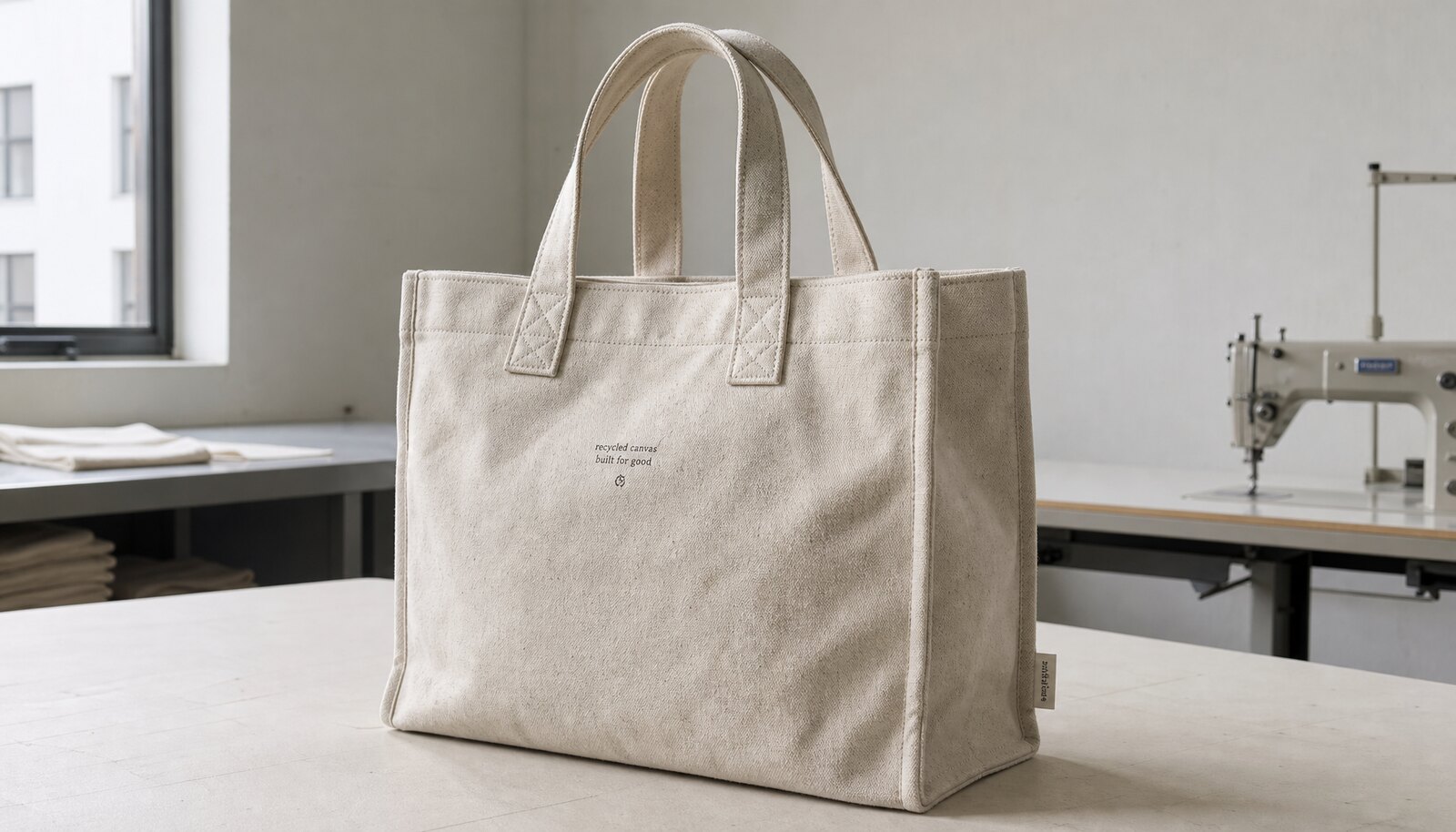
What coffee brands usually need from a recycled canvas tote
For coffee brands, a recycled canvas tote is usually a working product, not a freebie. It may sit at the café counter as a retail item, ship inside a subscription box, support wholesale merchandising, or act as a resale add-on for beans and brewing gear. That means the bag has to do several jobs at once: look like a credible brand item, hold up to regular use, and stay economical enough that it can be reordered without redesigning the whole program.
The sourcing mistake is to treat the tote as a print job with handles. Procurement should treat it as a finished consumer good. A low-cost sample can still fail in retail if the handles are too short for shoulder carry, the fabric collapses when filled, or the print starts to abrade after a few weeks. For coffee brands, the better question is not whether the tote looks good in a photo. It is whether the spec will survive use, reorder, and shipping without creating hidden cost.
In practice, the most reliable coffee-brand tote is usually a straightforward build: recycled canvas body, reinforced handles, one strong logo application, and minimal decorative extras. That keeps the commercial model understandable. Once you start adding lining, zippers, interior pockets, contrast binding, or specialty washes, the order shifts from a simple merch item into a higher-risk custom program that needs tighter sampling and more lead-time cushion.
- Retail merch tote: needs shelf appeal, clean finishing, and a premium-feeling hand.
- Café counter tote: needs practical carrying strength and a visible logo that reads quickly.
- Subscription or wholesale tote: needs predictable carton packing and low defect risk on bulk receipt.
Start with a spec that controls cost and consistency
The first real decision is fabric weight. For recycled canvas totes, many coffee brands land around 12 to 14 oz, or roughly 340 to 400 GSM, because that range balances hand feel, structure, and cost. Below that, the tote can start to feel too soft or promotional. Above that, the bag can feel more premium, but the quote often rises faster than the perceived retail value, especially once freight and sewing labor are included.
The second decision is construction. An unlined tote with clean internal seams is usually the best starting point for a buyer who wants controlled MOQ and a reasonable lead time. A gusseted bottom improves shape and usability, but it adds cutting and sewing steps. Lining, pockets, zippers, and board inserts can improve presentation, yet each item also creates more ways for a factory to miss the spec, especially if the supplier is balancing multiple orders.
Ask suppliers to quote the base bag and each add-on separately. If they only give one lump price, you lose the ability to see what actually drives the cost. A clear spec should include fabric GSM or ounce weight, finished dimensions, handle length, handle width, seam type, print area, and any trim or label requirements. That level of detail is what turns a tote from a vague sample into a repeatable purchase order.
For coffee buyers, that discipline matters because the brand usually wants a natural look with modest decoration. The more restrained the design, the more any inconsistency stands out. A simple natural recycled canvas tote with a one-color logo is unforgiving of crooked stitching, weak handles, and poor print alignment. Less decoration means less room to hide mistakes.
- 12 oz: lower cost, lighter structure, usually better for promotional or entry-level retail.
- 14 oz: stronger body, better shape retention, usually safer for daily-use retail merch.
- Hidden cost drivers: lining, pocketing, zipper closures, custom binding, and nonstandard handle construction.
Recycled-content checks, fabric origin, and compliance questions
A buyer should not stop at the phrase recycled canvas. Ask what the supplier means by recycled content and how that claim is documented for the exact production lot. Some factories use recycled fibers in the body fabric only, while others may mix conventional materials into thread, labels, or webbing. If your sourcing policy requires a minimum recycled-content threshold, that threshold has to be spelled out in the RFQ.
Fabric origin matters because it affects both consistency and risk. If the supplier is buying recycled canvas from a mill, ask whether they can name the mill, the basis for the recycled claim, and whether there is a lot-specific document trail. If the supplier is blending or finishing fabric in-house, ask where that work happens and whether the finish changes the fabric weight or color. Buyers should also ask about dye lots, especially if the tote is not natural off-white. Undyed natural canvas is usually easier to source consistently than a custom shade.
Compliance is usually straightforward for a tote, but procurement still needs to verify the pieces that touch your market. Depending on the destination, you may need documentation related to recycled content, restricted substances, packaging requirements, or label law. If the tote includes a print ink, coating, or laminated finish, ask about the chemistry used and whether any material restrictions apply for your channel. This is especially important if the tote is going through a retailer approval process rather than a pure promotional buy.
The practical buying rule is simple: if the brand story depends on sustainability language, do not rely on a supplier's brochure wording. Require the document that supports the claim, and keep it with the spec file. That is what protects both the order and the marketing team when the product is reviewed later.
- Ask whether recycled content is verified at fabric level, finished product level, or only by supplier statement.
- Request the mill name or fabric source when the supplier can provide it.
- If the tote is dyed or coated, confirm whether the finish changes the recycled-content claim or the applicable compliance documents.
- Keep the claim support file attached to the PO so marketing and procurement work from the same source of truth.
MOQ logic: what actually pushes the minimum up or down
MOQ for recycled canvas totes is usually not a market-wide fixed number. It is the output of a production route. A factory can often lower MOQ if the order uses stock natural fabric, a standard silhouette, one print location, and simple packing. If the order needs custom-dyed canvas, special label work, multiple print placements, or a nonstandard handle, the minimum usually rises because the factory has to batch more material, more labor, or more setup time.
There are three common MOQ pressure points. First is fabric sourcing: if the supplier must reserve or weave a specific fabric lot, the minimum often reflects that material commitment. Second is printing setup: more colors, more positions, or more complex artwork can push the print shop to demand a larger run. Third is packing and fulfillment: if the bags need retail bagging, barcode labels, inner inserts, or specific carton counts, the factory may need a larger batch to make the packing line efficient.
Buyers should watch for low MOQ quotes that are quietly offset by other costs. A supplier may accept a small order but raise unit price, charge more for samples, or specify a higher freight volume through oversized packing. That does not make the quote wrong, but it means MOQ alone is not the real decision metric. The right comparison is setup cost plus unit cost plus schedule risk.
When the brand wants to test a new tote program, the lowest-risk route is often a standard recycled canvas body in a common size with one-color branding. That keeps the order easy to repeat. If the first run performs well, the second run can then justify more customization, better finishing, or a lower unit price through volume.
- Lowest-friction route: stock fabric, standard size, one-color print, basic packing.
- Moderate-friction route: custom label, retail bagging, or a second print location.
- Highest-friction route: custom color, washed finish, lining, hardware, or mixed-size assortment.
Supplier routes compared: factory-direct, trading, regional, and mixed-program sourcing
The supplier route should match the commercial goal. Factory-direct sourcing is usually the cleanest option when the tote needs repeatability, custom sizing, and direct QC control. It is especially useful if the brand expects to reorder and wants to keep the spec stable across seasons. The tradeoff is that sampling and coordination can take a little longer if the factory is busy or if the buyer is not disciplined about documentation.
Trading companies and sourcing agents can be useful when the buyer is coordinating several product lines, especially if the tote is only one piece of a larger café merch or gift program. The benefit is coordination. The risk is opacity. Unless the agent gives you the real factory, the fabric source, and the QC owner, the quote can look clean while the actual production plan changes behind the scenes.
Regional production close to the sales market is often the better choice for urgent launches, short replenishment cycles, or premium retail programs where speed matters more than the absolute lowest unit price. Longer-haul offshore sourcing often wins on unit economics for larger runs, but it requires more forecast discipline. If your coffee brand has unpredictable demand, the lowest unit price can become expensive if the product arrives late or if the order has to be split across multiple shipments.
The strongest procurement approach is to compare routes using the same spec and the same commercial assumptions. Ask who owns the fabric, who owns the print step, where QC happens, what documents support the recycled-content claim, and how the supplier handles reorder continuity. That is much more useful than comparing glossy sample photos.
- Factory-direct: best spec control and repeat-order reliability.
- Trading or agent route: useful for coordination, but demand clarity on factory, fabric, and QC ownership.
- Regional production: often shorter lead time, but usually a higher unit price.
- Offshore scale production: better for larger programs, but requires more forecasting and transit buffer.
A more useful comparison table for sourcing decisions
A procurement comparison should tell you more than which quote is lowest. It should show why the price differs, what can break the schedule, and what you gain or lose by choosing a route. For recycled canvas totes, the differences usually come from fabric availability, print complexity, packing method, and whether the supplier is operating from stock materials or building a custom lot.
The table below is meant to help a buyer decide whether to prioritize speed, unit cost, or control. Use it with a same-spec RFQ, not with loose descriptions. If every supplier is quoting a different fabric weight or bag size, the comparison is not valid.
- Compare same-spec quotes only.
- Treat setup fees and packing labor as part of the real price.
- Ask for the cost of a reorder before you place the first PO.
Print method and finishing choices that affect durability and schedule
For most coffee-brand totes, screen printing remains the most practical method when the design is simple and the order is more than a tiny test run. One- or two-color art is usually crisp, efficient, and durable enough for repeated folding. It also tends to be easier for the factory to repeat on reorder, which matters when the tote becomes part of your core merch line. The main risk is not the method itself but poor art preparation, weak curing, or a print size that is too large for the fabric texture.
Heat transfer and digital methods can be useful for small runs or more detailed graphics, but procurement should treat them as a different commercial category, not as a drop-in replacement for screen print. On textured canvas, detailed gradients, fine text, and full-coverage art can lose sharpness, wear unevenly, or look more promotional than retail. If the tote needs a premium coffee-brand feel, simpler decoration often performs better over time than more elaborate graphics.
Finishing decisions also influence lead time. A woven label, hangtag, or sewn side label may look small, but each one adds a step and a QC checkpoint. If the tote uses contrast binding, washed treatment, or a special print placement across seams, the production line becomes less forgiving. These are not reasons to avoid customization, but they are reasons to ask whether the commercial gain is worth the added complexity.
If the tote will be resold, ask how the print behaves after folding, light abrasion, and occasional surface cleaning. A beautiful fresh sample is not enough. A retail tote is judged in use, not on the sample bench.
- Screen print: usually best for simple logos, repeat orders, and durability.
- Heat transfer or digital: better for small runs or complex art, but with more wear risk.
- Any added trim or finish should be justified by sales value, not only by appearance.
Lead time review: where the calendar actually goes
Lead time is usually longer than buyers expect because the bag is simple only after the spec is frozen. A standard order typically moves through artwork approval, sample production, sample review, fabric allocation, cutting, printing, sewing, packing, inspection, and shipment booking. Even when each step is fast, the handoff between steps creates delay. For a standard recycled canvas tote with a stable spec, many buyers should plan around 25 to 35 days after sample approval before shipment readiness, but that assumes the supplier already has suitable fabric on hand.
The largest delays are often self-inflicted. Artwork revisions, changing the logo size after sample approval, asking for a different handle length, or changing the carton pack midstream can all reset batching decisions. If the tote is tied to a coffee launch, seasonal event, or wholesale rollout, lock the commercial spec before you ask the factory to cut fabric. A lower unit price is not useful if the bags arrive after the campaign window.
Regional differences matter too. A closer supplier can often turn around a replenishment order faster because transit time is shorter and communication is easier. A farther supplier may give better unit economics on larger runs, but the real schedule must include production plus freight plus customs or receiving time. Procurement should plan to protect the launch date with a buffer, not just the factory's quoted ship date. In tight calendars, the buffer is usually worth more than a small price improvement.
The cleanest way to manage lead time is to separate the timeline into fixed steps and ask the supplier which step is on the critical path. If a certain print method or fabric source adds a week, say that explicitly in the RFQ so the factory can quote the real schedule rather than an optimistic one.
- Typical timeline blocks: artwork finalization, sample, approval, bulk material allocation, production, inspection, packing, outbound booking.
- Common delay triggers: artwork revisions, packaging changes, special fabric sourcing, and peak-season queueing.
- Use a schedule buffer when the totes support a launch date, event, or retail reset.
Landed cost and packing strategy for retail and wholesale channels
A tote quote only becomes useful when the buyer sees landed cost. Unit price alone hides the impact of carton volume, gross weight, inner pack count, label application, and freight method. For example, a neat-looking polybagged tote can cost more to ship than a bulk-packed version even when the ex-factory unit price is similar. On small programs, that difference can change the real margin materially.
Packing decisions should follow the channel. For wholesale or distributor receipt, bulk packing usually makes sense because the buyer can unpack and distribute later. For shelf retail or subscription fulfillment, individual polybags, barcode labels, and cleaner carton marking may be worth the extra cost. The point is not to minimize every packing step. It is to spend on the steps that protect the channel and avoid rework at the receiving dock.
A useful procurement habit is to ask for two versions of the same quote: one for standard bulk packing and one for retail-ready packing. Then compare total landed cost rather than arguing from memory about what should be cheaper. If the tote is going into a gift box or promotional kit, confirm the folded size as well. A tote that is physically small in use can still be expensive if it ships in oversized cartons or needs extra hand-fold labor.
For coffee brands, the bag often becomes a branded touchpoint, so presentation matters. But the cleaner the presentation, the more important it is to measure the operational cost of that presentation. The quote should tell you exactly what you are paying for, and the carton dimensions should match the way your warehouse actually receives product.
- Ask for landed cost, not only ex-factory price.
- Compare bulk pack against retail-ready pack as separate options.
- Check carton dimensions, gross weight, and inner pack count before you approve the PO.
Sample approval and QC: the checks that prevent rework
A sample should be treated as a production reference, not as a marketing object. For recycled canvas totes, the sample has to show the real fabric hand feel, the actual stitch pattern, the print quality, and the handle reinforcement that will be used in production. If the supplier sends a beautiful sample that is not tied to a precise spec version, it becomes almost useless once bulk production starts. The buyer can no longer prove whether a defect is a deviation or part of the approved design.
The best review method is mechanical and boring. Measure the finished dimensions. Check handle length and drop. Examine the side seams, bottom seams, and reinforcement points. Verify the print location with a ruler rather than eyeballing it. If the tote is natural or undyed, accept or reject based on the shade range you agreed beforehand, not based on a vague sense of whether the fabric looks the same as the sample photo. If the tote is sold into retail, inspect the inside finish as seriously as the outside appearance.
QC should also match the commercial use. A wholesale tote that will be repacked at a distributor does not need the same aesthetic polish as a premium café merch item. But it still needs consistent sewing, no open seams, and no batch-to-batch size drift. Put the defect rules in writing: what is cosmetic, what is functional, what can be repaired, and what triggers a remake or claim. That is what protects margin when the production line gets busy.
If possible, keep one signed physical approval sample with the PO and spec sheet. Photos are useful, but a physical reference settles disputes faster when there is a question about texture, print density, or seam finish.
- Measure size, handle drop, print position, and seam allowance on the sample.
- Check the inside finish, not only the front face of the tote.
- Record the sample version number and attach it to the order file.
- Define cosmetic versus functional defects before the factory starts bulk production.
Specification comparison for buyers
| Sourcing route or spec decision | Best fit | Cost drivers to watch | Risk tradeoff | What to request in the quote |
|---|---|---|---|---|
| Stock natural recycled canvas, standard size, one-color print | Best for lower MOQ, repeat orders, and fast commercial rollout | Fabric availability, print setup, carton pack, and basic sewing labor | Lowest complexity, but less control over exact shade and finish | Exact GSM, finished dimensions, handle length, print size, and carton count |
| Factory-direct tote maker | Best for brands that need control over construction and reorders | Cutting efficiency, print method, reinforcement details, inspection standard | Usually better spec discipline, but sampling can take longer if the factory is busy | Separate lines for body fabric, handles, print, label, and packing |
| Trading company or sourcing agent | Best when the order includes mixed products or the buyer needs coordination help | Agent margin, document control, communication lag, and hidden factory changes | Can simplify communication, but may obscure the real production spec | Factory name, production site, fabric origin, and who owns QC sign-off |
| Custom-dyed or washed recycled canvas | Best for premium retail merch where brand look matters more than minimum price | Dye lot control, extra processing, shade variation, and re-sampling | Higher visual differentiation, but higher MOQ and more lead-time risk | Lab dip approval, shade tolerance, wash effect reference, and re-run policy |
| Screen print, one or two colors | Best for most coffee logos and retail-safe decoration | Screen setup, curing, color count, and artwork simplicity | Durable and cost-efficient, but detailed art may lose clarity | Print method, ink type, curing standard, and registration tolerance |
| Polybagged and barcoded retail packing | Best for shelf retail, e-commerce, and subscription fulfillment | Bagging labor, barcode application, carton volume, and insertion steps | Cleaner presentation, but higher freight volume and touch labor | Inner pack count, barcode format, carton dimensions, and label placement |
| Regional production close to the market | Best for short lead times and smaller replenishment runs | Labor rate, local freight, and material sourcing constraints | Can reduce transit time, but unit price may be higher | Incoterm, transit time, origin of fabric, and dispatch schedule |
| Longer-haul offshore production | Best for larger runs that can absorb longer transit and planning time | Sea freight, customs timing, and more complex schedule coordination | Lower unit cost can be offset by slower replenishment and more in-process risk | Production lead time, shipment method, buffer stock plan, and sample timeline |
Buyer checklist before sampling
- Confirm the end use before you request quotes: café retail, subscription insert, wholesale merch, or promotional giveaway. Each use case changes the target fabric weight, finish, and packing standard.
- Lock the bag size, handle length, gusset depth, and print area in a spec sheet before comparing suppliers. If those are loose, you are not comparing the same product.
- Ask whether recycled content is required only in the canvas body or also in thread, labels, and webbing. Many buyers forget that the tote can contain mixed material inputs.
- Request the fabric origin and recycled-content basis in writing. If the supplier mentions recycled material, ask how that claim is documented and whether the report applies to the exact lot you will receive.
- Decide early whether you need a natural undyed look, a custom-dyed tone, or a washed finish. Shade variation and re-dyeing are common MOQ and lead-time drivers.
- Approve artwork in a production-ready file format and specify the print location, dimensions, and color count. Poor artwork handling still causes delays on very simple logos.
- Set acceptance criteria for seam strength, handle reinforcement, size tolerance, print registration, and allowable shade variation. Write the rules down before bulk production starts.
- Require sample photos of front, back, inside, side seam, bottom seam, and packed carton, and keep the approved sample version tied to the same PO and spec revision.
- Compare landed cost, not just unit price. Freight volume, carton count, duty, and packing labor can change the real cost per sellable tote materially.
- Confirm whether the bags need retail barcodes, hanging tags, dust protection, or master carton marks. Those details are cheap to specify early and expensive to add later.
Factory quote questions to send
- What exact recycled canvas GSM are you quoting, and what production tolerance do you allow on that fabric weight?
- How is your MOQ determined: fabric roll minimums, printing setup, sewing batching, packing quantity, or a combination of these?
- Can you separate the quote into body fabric, handles, reinforcement, print, label, and packing so we can compare like-for-like options?
- What is the fabric origin, and what document do you provide to support the recycled-content claim for the production lot?
- Which print method are you recommending for this artwork, and what durability standard do you use after folding and light abrasion?
- What is the realistic timeline from artwork approval to bulk completion, and which step usually creates the longest delay?
- Can you quote blank sample, printed sample, and pre-production sample separately, and state which one is most useful for approval?
- What carton dimensions, gross weight, and inner pack are you assuming in the quote?
- What QC checkpoints do you run for seam strength, handle attachment, print registration, and final packing accuracy?
- If we need a reorder, what parts of the spec can stay fixed and what parts usually trigger a new setup or new MOQ?
Quality-control points to confirm
- Fabric weight should match the agreed GSM or ounce spec within a stated tolerance, and the bag should feel consistent across cartons rather than variable from panel to panel.
- The recycled canvas should have a consistent weave density, with no obvious thin spots, slubs that compromise structure, or uneven lamination if a coating is used.
- Finished dimensions should stay within the size tolerance agreed in the PO, especially if the tote must fit retail shelving, coffee bag bundles, or a specific gift box.
- Handle drop, handle width, and handle alignment should be uniform bag to bag so the tote carries straight and does not twist when loaded.
- Handle reinforcement should use a repeatable stitch pattern or bar-tack equivalent, with no skipped stitches, loose ends, or crooked reinforcement points.
- Side seams and bottom seams should be straight, closed, and trimmed cleanly, with no open stitching, seam puckering, or broken thread tails above the defect limit.
- Print position, print size, and color density should match the approved sample, with clear registration and no smudging, cracking, or under-cured ink.
- If the tote is sold as natural or undyed recycled canvas, define the acceptable shade range before production so lot variation does not become a dispute.
- Carton labels, barcodes, and quantity marks should match the receiving requirements of the buyer's warehouse or retail partner exactly.
- Random carton pulls should be checked, not only the top bag from each carton, because packing defects often hide below the first layer.