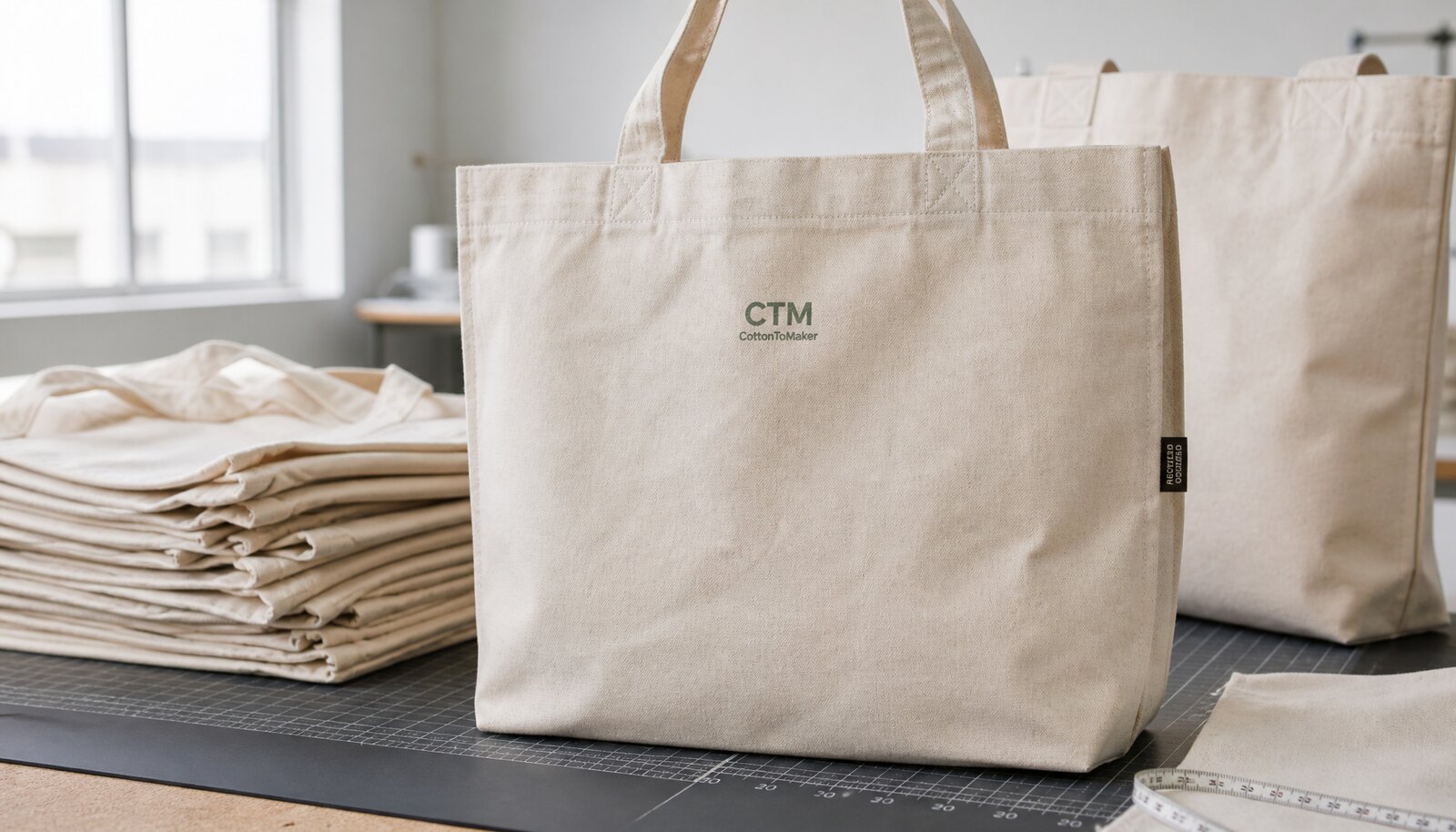
Why material selection matters more than artwork for charity totes
For charity campaigns, the tote is usually a functional donor touchpoint rather than a fashion accessory. That changes the buying priority. A weak bag may still print cleanly, but if the fabric pills quickly, the handle twists, or the print cracks after a few uses, the campaign message loses value fast. Procurement teams should treat the material decision as the main control point, not a design afterthought.
Recycled canvas is attractive because it supports a sustainability story while still giving enough body for a logo, slogan, or simple illustration. The problem is that suppliers often describe several different constructions under the same name. One quote may use 8 oz recycled canvas, another 12 oz, and another a recycled cotton blend with a very different hand-feel. If those are compared only on unit price, the buyer can end up with an apples-to-oranges quote sheet and a bag that does not meet the campaign brief.
- Use the campaign purpose to define the bag standard: awareness giveaway, donor gift, retail item, or volunteer kit.
- Treat canvas weight, recycled content, and sewing reinforcement as the real buying variables.
- Avoid comparing quotes that do not clearly state the same fabric and print assumptions.
Choose the right recycled canvas construction first
For most charity campaigns, the safest starting point is 10–12 oz recycled canvas, roughly 340–410 GSM. This range gives enough body for a premium feel without making the bag overly heavy or difficult to sew. Below 10 oz, the tote can look thin once the bag is filled. Above 12 oz, the material is stronger but can raise cost, increase freight weight, and make folding or packing less efficient.
The exact recycled structure matters as much as the weight. Some factories use recycled cotton from cutting waste, while others use blended recycled fibers with new cotton or polyester mixed in for strength and consistency. If the campaign messaging requires a specific recycled claim, write that into the RFQ. If the buyer only needs the bag to be made from recycled input, say so clearly. Ambiguous wording causes supplier confusion and weakens your ability to verify the material later.
- 8 oz or lighter: suitable only for low-load event handouts or short-use items.
- 10–12 oz: best balance for charity campaigns, donor gifts, and resale-ready totes.
- 12 oz and above: better for premium retail positioning or repeated daily use.
Match fabric weight to print method and bag size
The same artwork behaves differently depending on the canvas structure. On a denser 12 oz fabric, a screen print usually looks cleaner and sits more sharply on the surface. On lighter fabric, large ink coverage can cause slight cockling or show-through if the ink application is too heavy. If the bag is oversized, the print area may need to move up or inward so it does not distort when the tote is loaded.
For charity campaigns, the print is often simple: one logo, a short line of text, and maybe a campaign date. That simplicity is useful because it reduces cost and minimizes quality risk. Screen print is usually the most economical for 1–2 colors. If the art includes more colors, gradients, or fine tonal effects, a digital transfer or heat transfer may be more realistic, but those methods need clean surface prep and good adhesion testing on the exact fabric.
- Screen print: best for flat, bold logos with strong wash resistance if cured properly.
- Heat transfer: workable for multi-color or detailed art, but test crack resistance and peel edges.
- Large artwork: requires more attention to print position tolerance and tote lay-flat consistency.
Use a comparison table to separate real supplier options
Many quotes look different only because the supplier is quoting a different sourcing route. A factory direct quote, a trader quote, and a stock-blank customization quote can all appear close on price while carrying very different risk. The table below is the practical way to compare them. Use it to normalize the offer before you decide whether the lower price is actually better value.
For charity totes, the hidden cost is not usually the bag body itself. It is the cost of rework, delayed delivery, or a bag that misses the campaign feel. A slightly higher unit price from a factory that controls fabric, printing, and packing can be cheaper than a lower quote that later needs correction or split shipments.
Supplier route comparison for recycled canvas charity totes
The sample record for recycled canvas totes for charity campaigns material selection guide should include front, back, side, seam, logo, label, inside, and packed-carton photos. For important programs, keep one signed physical sample and record the sample version in the approval file.
Approval should include the known deviations. A small accepted deviation is manageable when written down; an unwritten deviation becomes a dispute during final inspection.
- Write decisions in measurable language, not only descriptive wording.
- Ask for sample photos plus one physical approval sample for important orders.
- Keep quotation, sample approval, and inspection notes tied to the same spec version.
How MOQ logic changes the quote you receive
MOQ is not just a factory policy; it is a pricing mechanism. When a supplier says the MOQ is 3,000 pcs, they are usually protecting fabric cutting efficiency, print setup, and sewing line output. If you request 500 pcs, the supplier may still accept the order, but the price will usually rise because fabric loss, setup, and labor are spread across fewer units. This is normal and should be expected in the quote comparison.
For branded charity campaigns, the real question is whether you need custom fabric, custom print, custom label, or custom packaging. Each customization layer can have its own MOQ logic. A factory may allow a low bag MOQ but require a higher MOQ for a woven label or custom pantone-dyed fabric. Procurement teams should separate these items in the RFQ so the supplier can price each layer transparently.
- Factory direct: better for 3,000+ pcs and repeat campaigns.
- Trader or stock route: acceptable for lower quantities when lead time is tight.
- Hybrid order: stock base bag plus custom print can reduce MOQ while keeping the campaign identity.
What a fair pre-production sample should prove
A sample is not just for artwork approval. It is the only practical way to verify the real fabric feel, stitch density, seam line, handle stiffness, and print result before bulk production. For recycled canvas totes, the sample should be made from the actual bulk fabric, not a substitute fabric. If the supplier sends a different material, the approval is not meaningful and can create disputes later.
A strong sample approval process should include at least three points: the bag dimensions, the print position, and the sewing quality. If the tote is meant for retail sale or donor presentation, also review the label placement and the folded appearance. The sample should reflect how the bag will arrive in the carton, because some canvas bags look acceptable hanging but arrive uneven or heavily wrinkled when packed flat.
- Verify fabric shade against the agreed reference, especially for natural recycled canvas.
- Measure finished size, handle length, and print position with a tape, not by eye.
- Pull test the handle attachment area and inspect for skipped or loose stitches.
Packing details that affect landed cost and campaign readiness
Packing can change the landed cost more than buyers expect. If the tote is bulky, carton volume becomes a major freight factor. A flat-packed recycled canvas tote with efficient folding can save a meaningful amount in shipping, especially for air freight or when volume-based ocean charges apply. If the supplier uses individual polybags, the bags may stay cleaner, but unit packing cost and waste increase. For many charity campaigns, a simple bulk carton pack is enough unless the bags are retail-ready.
Ask for carton quantity, carton dimensions, and gross weight before approving the order. Those three numbers determine whether the shipment is efficient and whether the distribution team can handle the cartons easily on arrival. If the campaign needs direct donation distribution, also specify whether bags must be grouped by carton count for easy picking. Mixed carton counts create labor inefficiency at the warehouse.
- Bulk export carton: best for low-cost distribution and minimal packaging waste.
- Individual polybag: useful when bags must stay cleaner or be retail-shelf ready.
- Carton count consistency: important for donation sorting and warehouse planning.
Lead time risk: where recycled canvas orders slip
Lead time usually slips in three places: fabric availability, print approval, and packing coordination. Recycled canvas can require a specific fabric batch, and if the factory has not reserved it, production may wait while material is sourced. The second delay comes from artwork revisions. A simple logo can move quickly, but campaigns often change slogans or donor wording after the first sample. The third delay is at the end of production, when carton labels, barcodes, or retail tags are added after sewing and printing are already finished.
A realistic planning window for standard custom recycled canvas totes is often 25–40 days after sample approval, depending on order size and material availability. Smaller or stock-based orders can move faster, but buyers should still build in time for sampling, approval, and a packing review. If the campaign date is fixed, do not leave sample approval to the final week. That is how buyers get forced into air freight or partial shipment.
- Plan backward from the campaign date, not from the PO issue date.
- Freeze artwork before sample sign-off to avoid change orders.
- Reserve a time buffer for carton mark approval and shipping documentation.
How to read supplier quotes without missing hidden cost
The most useful quote is the one that breaks down what is included. For recycled canvas totes, the quote should state fabric weight, recycled content description, bag size, handle type, print method, packing method, and incoterm. If one supplier quotes FOB and another quotes EXW, the unit price will not be comparable. If one includes a woven label and the other does not, the lower price may be incomplete. This is where procurement teams save the most money: not by chasing the cheapest number, but by standardizing the quote basis.
As an example of quote structure, a buyer might receive one offer at a lower unit price for 8 oz canvas with one-color screen print and bulk carton pack, and another at a slightly higher unit price for 12 oz canvas with reinforced handles and cleaner print registration. The second option may still be the better commercial choice if the campaign expects heavier use, donor retention, or retail resale. The right comparison is landed value per usable tote, not unit price alone.
- Normalize all quotes to the same fabric weight and print spec.
- Separate product cost from freight, packing, and label costs.
- Review the supplier’s assumed defect allowance and remake policy.
Specification comparison for buyers
| Spec decision | Recommended option | When it fits | Buyer risk to check |
|---|---|---|---|
| Fabric weight | 10–12 oz recycled canvas (about 340–410 GSM) | Main charity giveaways, retail resale, or events where the bag must feel substantial and carry 4–6 kg | Too light and the tote looks low value; too heavy and cost, sewing load, and freight weight rise |
| Recycled content structure | Recycled cotton or recycled cotton blend with documented fiber ratio | When the campaign story needs a credible recycled material claim | Undefined blend can create claim risk; ask how the recycled content is measured and described on the spec sheet |
| Handle construction | Self-fabric handles or reinforced webbing handles with bar-tack reinforcement | When bags will carry books, donation items, or repeated daily use | Weak handle sewing is the most common failure point; test stitch density and pull strength |
| Print method | Screen print for 1–2 colors; heat transfer or digital transfer for more complex art | When logo clarity matters and the design has limited colors or fine lines | Overly detailed artwork on thick canvas can crack, blur, or sit unevenly if the print method is wrong |
| MOQ route | Factory direct for 3,000+ pcs; trader or stock-blank route for smaller campaigns | When you need price control and custom specs versus a smaller one-off run | Low MOQ often hides higher unit cost, fewer size options, or weaker control over recycled fiber claims |
| Packing method | Flat packed in export cartons with quantity per carton and polybag only if needed for retail | When shipping efficiency and carton count matter | Overpacking increases freight cost; loose packing can cause soil marks and shape loss |
| Sample approval level | Pre-production sample with approved fabric, print, and sewing standards | When the bag has charity branding, donor messaging, or fixed campaign deadlines | Artwork approval alone is not enough; the sample must reflect actual fabric shade, hand-feel, and stitching |
| Supplier route | Factory with in-house cutting, sewing, and printing rather than a pure reseller | When you need tighter control on lead time, QC, and repeat orders | If the supplier outsources every step, variation in shade, print position, and stitching usually increases |
| Lead time strategy | Plan 25–40 days after sample approval for standard custom runs | When the campaign date is fixed and you need reliable dispatch planning | Short lead times may force fabric substitutions, partial production, or freight upgrades that raise landed cost |
Buyer checklist before sampling
- Define the campaign use case: donation giveaway, retail fundraising, volunteer kit, event merch, or member gift, because the required bag weight and print durability are not the same.
- Lock the target fabric weight in GSM or oz before seeking quotes; do not accept vague terms like 'heavy canvas' without a measured spec.
- State the recycled content claim you need on the buyer side, including whether you need recycled cotton, recycled blend, or simply recycled fabric input.
- Specify finished size, handle length, handle width, gusset depth, and whether the tote must stand upright or collapse flat.
- Confirm print method, number of colors, print area, and whether artwork contains fine lines, gradients, or small type.
- Request a pre-production sample made from the actual bulk fabric and actual print method.
- Ask for carton packing details, carton dimensions, units per carton, gross weight, and whether inner polybag is required.
- Get the supplier to state lead time from sample approval, not from PO date alone.
- Compare quotes on the same basis: fabric weight, recycled content, print method, packing, and incoterm.
Factory quote questions to send
- What is the exact fabric spec in oz and GSM, and is the recycled fiber content measured on the finished fabric or only on the yarn input?
- Is the quoted price for self-fabric handles or webbing handles, and what handle reinforcement is included?
- Which print method is included in the price, how many colors are covered, and what is the repeat setup cost if we reorder?
- Can you share a sample photo of the actual fabric shade and stitch construction from a previous production run with similar weight?
- What is the MOQ by fabric color, print color count, and order size if we need custom woven labels or side labels?
- What packing method is included, how many pieces per carton, and what is the carton size and carton weight target?
- What is the production lead time after sample approval, and what steps could extend it if the artwork or fabric is changed?
- Which QC checkpoints do you perform before packing, and can you share the acceptable tolerance for print position, size, and stitch defects?
Quality-control points to confirm
- Fabric weight tolerance should be stated in the spec sheet; for buyer control, require a reasonable production range rather than a single nominal number.
- Color shade should be approved against a physical swatch or lab-dip where possible; recycled canvas often has natural variation that should be accepted within a defined range.
- Handle pull test should show reinforced stitching at the attachment point; inspect for skipped stitches, crooked bar-tacks, and thread tension issues.
- Print registration should hold within an agreed tolerance; for simple charity logos, the key is clean edges and consistent coverage rather than decorative perfection.
- Seam allowance and side seam alignment should be visually straight; irregular seam lines are a common sign of rushed sewing on canvas.
- Carton packing should prevent crushing and soil marks; count random cartons at packing stage and at arrival to verify the carton quantity matches the packing list.
- Final sample should match the bulk sample in fabric hand-feel, print sharpness, and handle stiffness before mass production is released.