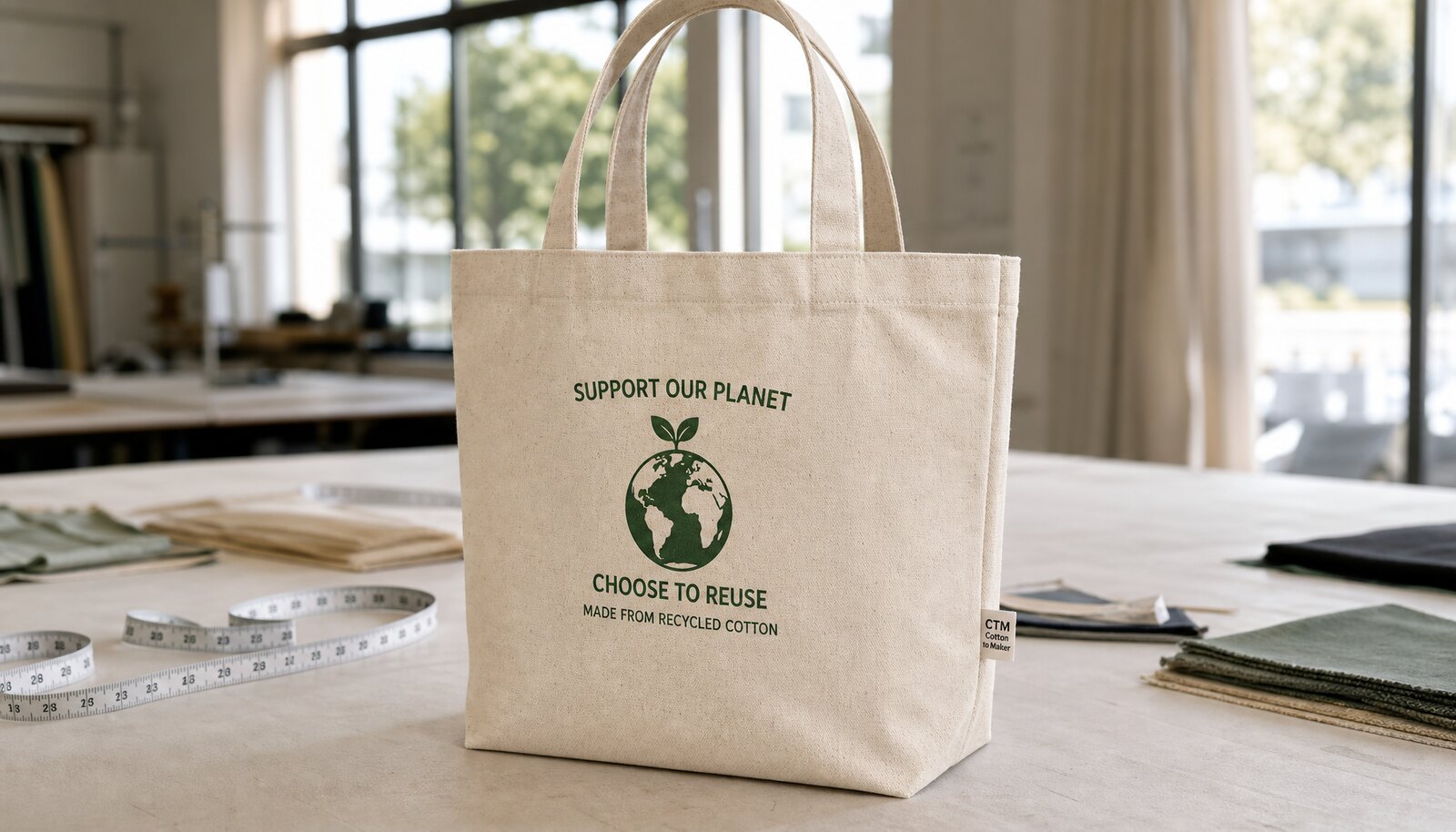
Why recycled canvas tote buying goes wrong in charity campaigns
Charity campaign buyers usually run into the same problem: the tote has to support a good cause story, but the spec is often written too loosely to control cost or quality. One supplier quotes a light fabric with attractive pricing, another quotes a heavier fabric with better stitching, and the buyer ends up comparing two different products as if they were equivalent. That is where missed deadlines and budget overruns start.
For campaigns, the bag is not just a commodity carrier. It is part of the donation experience, the public face of the campaign, and sometimes a retail item that helps raise funds. The right sourcing plan therefore starts with a clear performance target: enough structure to look credible, enough print quality to carry the message, and enough margin in the quote to survive freight, packing, and replacement units.
- Treat the tote as a campaign asset, not a generic giveaway.
- Do not compare quotes unless fabric weight, size, print method, and packing are identical.
- Build in a buffer for sample revisions and seasonal factory congestion.
Choose the right recycled canvas spec before you request quotes
For most charity programs, recycled canvas between 12 oz and 14 oz, or about 350 to 475 GSM, is the practical range. It gives the bag enough body to stand up on a table, survive repeated handling, and hold a donation insert or small retail purchase without collapsing. If the bag is meant for premium fundraising or resale, the upper end of that range usually gives better perceived value. If it is a large-volume event handout, the lower end may be enough if construction is clean.
The recycled content itself needs clear wording. Some suppliers use post-industrial recycled cotton, others use blended reclaimed fibers, and some use fabric that is recycled only in part. Buyers should not rely on the phrase “eco canvas” in a quote. Ask for the exact composition, the weight tolerance, and whether the surface finish is brushed, raw, or washed. A rougher recycled canvas often prints well with simple graphics, but it can also create more visible ink spread if the artwork has fine edges.
- Common buyer spec range: 12 oz to 14 oz recycled canvas.
- Use heavier canvas if the bag will be resold or reused many times.
- State acceptable shade variation, especially for natural recycled fabric.
- If the campaign story depends on sustainability, require written recycled-content wording in the quote.
Print method decisions that affect cost and campaign appearance
For charity campaign totes, screen print is still the most reliable option when the artwork is simple. One or two colors, strong logo shapes, and bold text will usually print cleaner and cost less than more complex methods. Screen print also tends to hold up well on textured canvas, provided the supplier uses proper mesh choice and curing. If the design has a large solid area, ask how they manage ink build-up and whether they recommend a test strike to reduce cracking on folds.
Transfer printing can help when the campaign needs short-run flexibility, more colors, or fine detail, but it is not the first choice for every order. On recycled canvas, transfer prints can look flat if the fabric is too rough or if the heat application is not controlled. Embroidery is usually better for small premium marks than for full charity messaging because it adds cost and can warp lighter canvas. The cleanest purchasing route is to simplify the artwork early so the quote is based on the print process the factory can run consistently.
- Screen print: best for simple logos, bold slogans, and repeat campaigns.
- Transfer print: better for short runs or more detailed art, but verify durability.
- Avoid tiny reverse type on textured recycled canvas.
- If the campaign needs both a logo and a message block, separate them into a main side and a secondary placement.
How supplier route changes price, control, and risk
A factory-direct quote is usually the cleanest route when the bag design is stable and the quantity is meaningful. You get fewer communication layers, better visibility on fabric and sewing decisions, and a clearer path for sample correction. That matters when the buyer wants to control handle length, seam reinforcement, and packing detail. The risk is that a factory may keep the quote low on the first pass and then add charges for artwork preparation, revised labels, or carton changes later.
A trading company or sourcing agent can be useful when the campaign uses mixed bag types, multiple delivery points, or a compressed deadline. They may consolidate materials and manage communication faster than a factory that is busy with larger production runs. The downside is cost opacity. You must know whether the quote represents the actual factory MOQ or a blended commercial number. If a middle layer is involved, insist on the final production spec and carton standard in writing so later revisions do not get blamed on the manufacturer.
- Factory direct: best for repeatable specs and tighter technical control.
- Trading route: useful for mixed orders or urgent coordination, but less transparent.
- Ask who owns print setup, carton artwork, and replacement claims before approval.
- Make sure the actual maker of the bag is identified somewhere in the workflow.
Comparison of sourcing routes for recycled canvas charity totes
The sourcing route changes more than the unit price. It affects how quickly you can validate a sample, how much technical detail you can lock before production, and how expensive mistakes become if the bag needs correction. Procurement teams should compare sourcing routes on the same commercial basis rather than simply choosing the lowest quote. The table below is the practical way to separate risk from cost when the campaign deadline matters.
Use the comparison to decide whether the order belongs with a direct factory, a trading layer, or a domestic decorator that applies print after receiving blank bags. Each route can work, but each route shifts responsibility in different places. The wrong choice is usually the one that hides the highest risk item rather than solving it.
Sample approval should test the bag, not just the artwork
A sample is not approved simply because the logo looks acceptable. For recycled canvas totes, the buyer should inspect fabric handfeel, shape recovery, stitch alignment, handle strength, and how the print sits on the weave. A well-printed but badly sewn bag still creates campaign risk. The sample should be handled in the same way the final order will be used: opened, filled, folded, carried, and stacked.
The best approval path is usually two-stage. First, review the material swatch or plain prototype to confirm fabric weight, color, and construction. Second, review the decorated pre-production sample for print registration, logo placement, and overall appearance. If the bag includes recycled-content wording, label placement should be checked at this stage as well because labels are often moved late in production and can interfere with seam allowance or brand presentation.
- Check size against the approved spec sheet, not just visual appearance.
- Test handle attachment points by pulling evenly with weight in the bag.
- Inspect print edges after the bag is folded, because this is how it often ships.
- Approve label location only after confirming it does not interfere with stitching or print.
QC thresholds that matter for bulk orders
Bulk quality control should focus on the few defects that actually affect campaign use. Recycled canvas naturally shows more texture variation than a polished retail fabric, so the key is to define what variation is acceptable. If the bag is for a charity event, a small amount of shade variation may be acceptable as long as the print remains consistent and the bag feels structurally sound. If the bag is sold as a branded merchandise item, the tolerance needs to be tighter, especially around size consistency and print alignment.
Handle reinforcement is one of the first failure points in cheap tote production. Buyers should specify bar-tacks or equivalent reinforcement at the handle joins and confirm stitch count in the factory sample. Top-edge seam finishing also matters because recycled canvas can fray more visibly if the edge is poorly folded or the thread tension is inconsistent. Even when the order is large, QC should focus on a practical AQL-style mindset: what defects can be tolerated without hurting the campaign, and what defects would trigger a rework or replacement?
- Reject samples with skewed seams that make the tote hang unevenly.
- Require no open stitches or loose thread tails at handle joins.
- Set a clear tolerance for print shift and size variance before bulk starts.
- Check that the bag stands upright if that is important for retail display.
Packing and carton planning for charity distribution
Packing decisions can quietly change both the quote and the landed cost. If the campaign distributes bags through multiple locations, carton count and carton size matter more than buyers expect. A carton that is too large can reduce shipping efficiency; a carton that is too tight can crush printed surfaces or create fold marks that do not recover. The right approach depends on whether the bags are shipped direct to a fulfillment center, a charity warehouse, or a retail partner.
For most wholesale charity orders, bulk packing in cartons is the best default. Individual polybags are only justified when the bag will be sold as a finished product, displayed in retail, or handled through a fulfillment process that needs single-unit cleanliness. If polybags are used, they should not obscure the recycled story or create unnecessary plastic waste unless that is part of the receiving requirement. Always ask how many pieces per carton, what the gross weight is, and whether carton marks will include size, color, and carton count.
- Bulk carton packing usually gives the lowest handling cost.
- Single polybags add labor, weight, and carton volume.
- Avoid overfilled cartons that crease printed surfaces.
- Confirm whether cartons need barcodes, lot numbers, or destination marks.
Lead time planning and where schedule risk really sits
A realistic lead time for standard recycled canvas tote production is often 25 to 40 days after sample approval, but that number only works if the artwork is stable and the supplier already has suitable fabric available. The timeline usually breaks into fabric sourcing, cutting, printing, sewing, inspection, and packing. If any one of those stages needs approval, the schedule can move quickly from manageable to tight. Buyers should protect the campaign date by asking where the longest dependency is, not by accepting the shortest quoted delivery promise.
The biggest schedule risk is usually rework. If the print proof is wrong, the sample is rejected late, or the carton mark is revised after approval, the factory may lose a full production slot. Seasonal demand also matters because canvas and print lines get congested before major event periods. A buyer who wants reliable delivery should leave enough time for one correction loop and one logistics buffer, especially if the shipment is moving by sea.
- Use a schedule with explicit milestones: sample approval, material booking, production start, inspection, and packing.
- Build in extra days if the order needs new labels, hangtags, or custom carton artwork.
- Do not treat the factory’s quoted ship date as a guaranteed delivery date.
- If the campaign is fixed-date, consider splitting production and delivery windows.
What to compare in the quote before you move to PO
A useful quote is a spec document as much as a price sheet. It should show the fabric weight, exact size, print method, handle construction, packing method, and shipping basis. If any of those fields are missing, the buyer is not yet comparing true total cost. The cheapest number may simply be the lightest fabric, the loosest seam standard, or the least protective packing. Procurement teams should force every supplier to quote the same bag, the same decoration, and the same shipping assumption.
It also helps to separate one-time costs from unit costs. Setup charges for printing, pattern adjustment, or sample revision should not be hidden inside the piece price if the buyer is trying to compare multiple sources. When the campaign is likely to repeat, note those setup costs separately because a slightly higher unit price with lower setup cost may be cheaper over two or three reorder cycles.
- Compare total landed cost, not unit price alone.
- Separate sample cost, setup cost, and production cost.
- Require the same Incoterm across all quotes.
- Clarify whether print setup is charged per side, per color, or per order.
Specification comparison for buyers
| Spec decision | Recommended option | When it fits | Buyer risk to check |
|---|---|---|---|
| Fabric weight | 12 oz to 14 oz recycled canvas, or 350 to 475 GSM | Most charity campaigns need a bag that feels premium enough for donations, retail resale, or event distribution without becoming too costly | Too light below 10 oz can feel flimsy; too heavy can push cost and freight up without improving campaign value |
| Fabric content | Recycled cotton canvas with documented post-industrial or post-consumer input | Best when the campaign story needs an authentic sustainability claim and a natural textile look | Unclear recycled content wording can create labeling risk; ask how the supplier defines recycled input and how it is documented on the spec sheet |
| Print method | 1 to 2 color screen print for simple campaign graphics; transfer print only for short runs or variable artwork | Works when the design is bold, logo-led, and must stay readable from a distance | Fine gradients, tiny text, or large full-color art can distort on textured canvas or crack after folding |
| Handle construction | Self-fabric or webbing handles with bar-tack reinforcement | Use when bags will carry brochures, donor gifts, or retail items and need repeated handling | Short handles can hurt usability; weak stitch density near the top edge leads to seam failure under load |
| Supplier route | Factory direct for repeat campaigns; trading company only if you need consolidated sourcing or mixed SKU handling | Best when quantity is meaningful and design is stable enough for direct control | Trading layers can hide true factory MOQ, add markup, and slow sample correction unless responsibilities are clearly written |
| MOQ logic | Base on print color count, bag size, and fabric shade availability rather than only total units | Useful when the campaign is fixed date but volume is modest | Low MOQ may still require higher unit cost or stock fabric compromise; check whether the factory is quoting true production MOQ or sample-friendly exceptions |
| Packaging | Bulk packed by carton with size label, or single polybag only if retail presentation requires it | Suitable for charity drives, mail programs, and distribution through multiple locations | Individual polybags raise labor and carton volume; loose packing can scuff printed surfaces if cartons are overfilled |
| Lead time | Allow 25 to 40 days after sample approval for standard recycled canvas tote production | Fits most planned campaigns with fixed artwork and normal factory workload | Seasonal congestion, fabric dyeing, and print complexity can stretch timelines; build buffer for revised proofs and carton changes |
Buyer checklist before sampling
- Confirm intended use: donor gift, fundraising retail item, event handout, mailer insert, or resale SKU.
- Lock the finished size with tolerance, especially width, gusset, and handle drop.
- Specify recycled canvas weight in GSM or oz, plus acceptable shade variation.
- Define print artwork limits: number of colors, minimum line thickness, and whether edge-to-edge coverage is required.
- State the required bag test expectation, such as seam strength, handle pull resistance, and load target.
- Decide whether recycled content documentation must appear on the bag, hangtag, carton mark, or only on the spec sheet.
- Choose packing method, carton quantity, and whether individual polybags are needed.
- Set sample approval steps for material handfeel, print registration, stitch quality, and bulk color consistency.
- Request the supplier’s production calendar with fabric sourcing, printing, sewing, inspection, and packing milestones.
- Compare all quotes on the same basis: identical size, fabric weight, print method, packing, and Incoterms.
Factory quote questions to send
- What recycled canvas GSM or oz are you quoting, and what tolerance do you allow on finished weight?
- Is the recycled content from post-industrial or post-consumer input, and how is that documented on your spec sheet?
- What is your MOQ by size, color, and print method, and does MOQ change if we reduce print colors?
- What is the included print setup cost, and is it separate by color or by artwork side?
- What sample will you provide before bulk production: plain material swatch, pre-production sample, or full decorated sample?
- What carton packing standard do you use, and how many bags per carton at the quoted spec?
- What are your seam and bar-tack reinforcement standards for handles and top edge?
- What lead time do you need after sample approval, and where are the likely delay points?
- Which Incoterm is quoted, and what cost items are excluded from the number we receive?
- How do you handle shade variation, print misalignment, or short packing counts in bulk?
Quality-control points to confirm
- Fabric weight matches the approved range and feels consistent across the order, not just on the first sample.
- Recycled canvas surface is even, with no weak thin spots, broken yarn zones, or heavy contamination marks.
- Print registration aligns within the approved tolerance, and small text remains legible after folding.
- Seam density is consistent, with reinforced handle joins and no skipped stitches at stress points.
- Bag dimensions stay within the accepted tolerance after sewing and pressing.
- Top edge is straight and clean, with no puckering where handles attach.
- Stitching thread color and type match the approved sample, especially on natural or light-colored canvas.
- Carton count, label details, and packing method match the approved packing list and shipping mark.