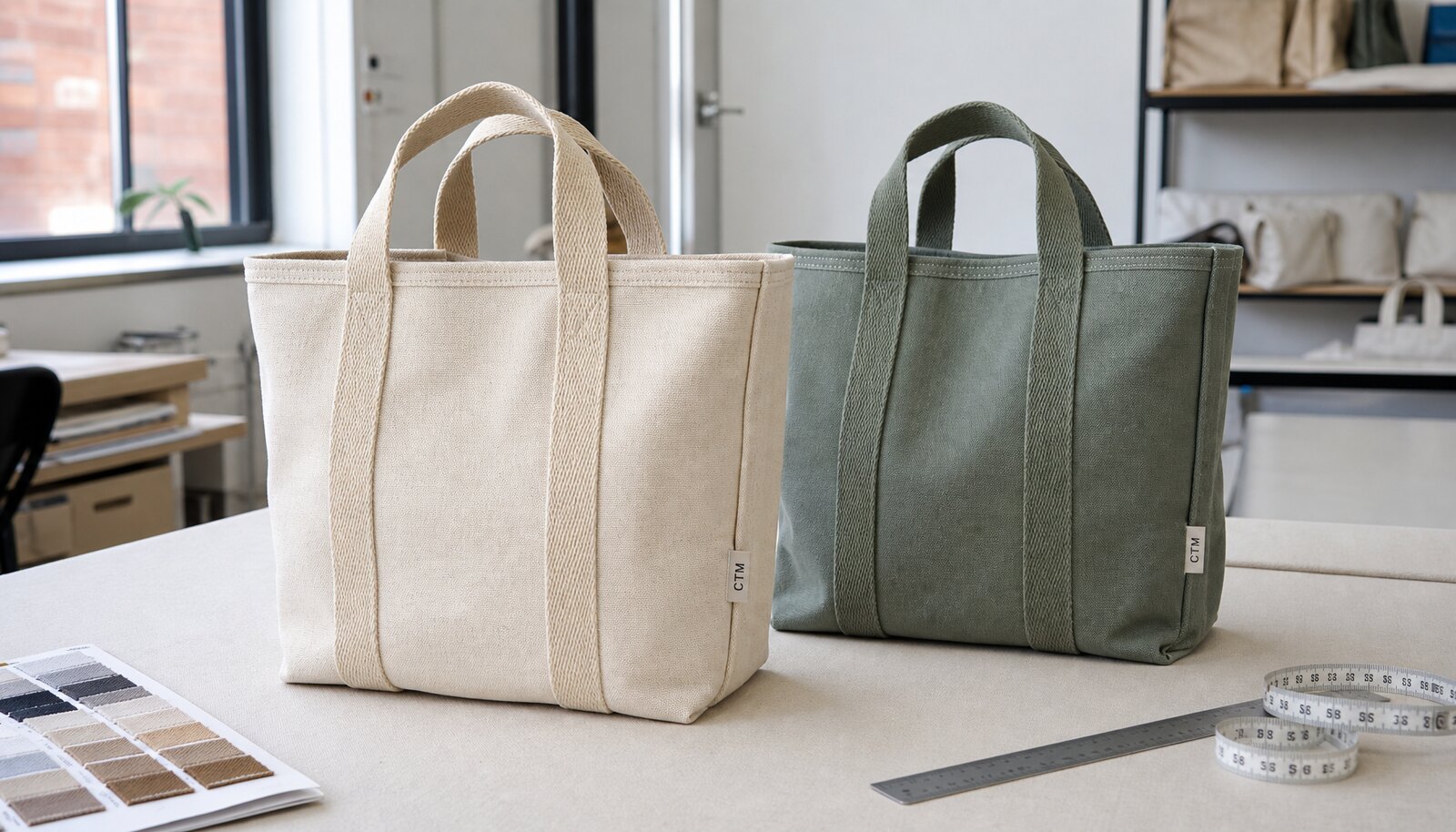
Why recycled canvas totes fail at retail launch if the spec is vague
A boutique retail launch is a different buying problem from a giveaway order. The bag has to look deliberate on shelf, survive handling by customers, and support a price point that makes sense for the retailer. If the brief only says “recycled canvas tote,” suppliers will fill in the gaps with their default cloth weight, default handle length, and default print setup. That usually creates a product that is technically usable but commercially weak.
The most common launch failure is mismatch between visual expectation and factory reality. Buyers want a tote that feels premium enough to sit next to apparel or fragrance, but they also want a landed cost that leaves room for retail margin. That balance depends on getting the fabric weight, construction, print method, and packing plan right before quote comparison starts.
- Retail launch bags need a stronger handfeel than event giveaways.
- A vague spec usually creates quote apples-to-oranges problems.
- Launch buyers should optimize for shelf presence, not just unit price.
Choose the right recycled canvas weight before you talk price
For boutique launches, recycled canvas commonly works best in the 14–16 oz range, which is roughly 400–450 GSM depending on weave and finish. That range gives enough body for the bag to hold its shape, carry apparel or boxed merchandise, and accept a clean print surface without looking flimsy. If the bag is intended as a premium retail accessory, many buyers end up closer to 16 oz because it photographs better and feels more substantial in hand.
Going lighter can save money, but it also increases the chance of wrinkling, corner collapse, and print show-through. Going heavier adds cost in fabric, sewing time, and carton weight. For launch work, the right answer is not “heaviest possible,” but “heavy enough to preserve perceived value and consistent construction.”
- 14 oz suits lower-cost retail add-ons and lighter carry loads.
- 16 oz fits premium boutique positioning and better shelf display.
- If the canvas is recycled, ask whether GSM is measured after finishing and washing, not only at greige stage.
Compare sourcing routes before you compare unit price
The same tote can come from a factory direct quote, a trading company quote, or a local distributor quote. Those routes are not interchangeable. A direct factory quote often gives the best control over fabric weight, stitch details, and packing format, especially if you need custom labels or a retail-ready fold. A trading company can be useful if they consolidate several factories, but the buyer needs clearer evidence of where cutting, sewing, and printing actually happen.
For launch programs, the sourcing route affects more than cost. It affects change control. If artwork changes after sample approval, a direct factory is usually easier to manage because responsibility sits closer to the line. If the supplier is only a reseller, you may get slower answers and less flexibility on trim or carton changes.
- Direct factory: best for custom size, print, and packaging control.
- Trading company: useful when you need sourcing convenience, but check traceability.
- Local distributor: fastest for small urgent fills, usually highest landed cost.
Use a buyer comparison table that exposes cost and risk
When suppliers send quotes, the buyer’s job is to strip out hidden differences. One quote may include a woven side label, another may not. One may use 12 oz recycled canvas and another 16 oz. One may quote loose bulk packing while another includes folded retail packing and barcodes. If you do not normalize those differences, the cheapest quote can become the most expensive after corrections and delays.
A practical comparison should include fabric weight, construction, print method, MOQ, packing, and lead time. It should also show which sourcing route is being used, because a direct factory and a reseller can quote the same tote with very different accountability. That is why the decision rows below are designed around commercial tradeoffs rather than generic spec labels.
- Normalize every quote to the same fabric weight and bag size.
- Separate product price from retail packing and cartonization.
- Treat lead time as part of the cost because launch timing affects sell-through.
Approve the sample in stages, not as one vague sign-off
For recycled canvas totes, the sample process should have at least two checkpoints: a pre-production sample and a top-of-production sample or sealed reference. The first sample confirms the final fabric feel, logo position, handle length, and stitch construction. The second protects you from line drift after production starts. A photo is not enough for this category because recycled canvas can vary in texture, color depth, and print absorption.
The buyer should also test the sample the way the customer will use it. Fold it. Hang it. Put in a garment pack or boxed item. Look at how the bag stands on a table and whether the print sits flat without cracking or feathering. If the bag is meant for boutique retail, the unfilled silhouette matters almost as much as the carry load.
- Compare sample against a physical reference, not only a spec sheet.
- Approve logo placement in millimeters, not “roughly centered.”
- Confirm handle drop with actual shoulder carry if the bag is intended to be worn.
Print method choice should follow artwork complexity and order size
Screen print is still the most practical choice for many recycled canvas tote launches because it is durable, cost-effective, and visually strong on coarse fabric. It works best for one-color logos, simple line art, and moderate print areas. If the art is fine, multi-color, or gradient-heavy, buyers should understand that the extra complexity will raise setup risk and can reduce yield on textured canvas.
Heat transfer can be useful for short runs or highly detailed artwork, but it should not be the default answer for a premium retail tote unless the buyer accepts the feel and durability tradeoff. Embroidery can elevate a logo, but it works best as a small accent rather than a full-panel design. The wrong method can turn a clean retail item into a visibly cheap one, even when the bag itself is well made.
- Screen print: best for simple, durable, repeatable retail logos.
- Heat transfer: useful for small runs or detailed art, but evaluate wash and rub resistance.
- Embroidery: premium look on limited logo areas; avoid oversized stitched coverage on heavy canvas unless budget allows.
MOQ logic should match launch risk, not just factory convenience
For boutique launch programs, MOQ should be tied to how many variables are locked. If the bag uses standard recycled canvas, one logo color, and simple packing, a factory may accept a lower MOQ. Once you add a custom shade, woven label, retail insert, and barcode sticker, the factory needs to amortize more setup and handling time. That is why a 500–1,000 piece MOQ per color/style is common for a genuine custom launch order.
Do not negotiate MOQ in isolation. A lower MOQ can come with higher unit price, less color consistency, or weaker commitment on carton packing. If the brand expects a reorder, it is often smarter to place a controlled first run with a clear repeat plan than to force a tiny test lot that uses different materials or alternate subcontracting.
- Low MOQ makes sense only if specs are stable and repeat orders are likely.
- Multiple colors or multiple logo versions usually need separate MOQs.
- Ask whether MOQ applies per style, per fabric shade, or per print design.
Build landed cost by line item, not by headline price
A quote that only shows one unit price hides the drivers that matter most. On recycled canvas totes, the cost usually moves with fabric weight, print method, handle type, lining or no lining, label type, and packing requirement. If the quote includes export cartons, barcode stickers, or retail fold inserts, that needs to be clear. Buyers comparing only ex-works piece price often miss the cost of finish work that the warehouse or retailer later has to do.
A simple landed-cost view should include factory price, inland movement to port or warehouse if applicable, carton and packing charges, inspection cost, freight, duty, and expected rejection or rework allowance. For launch projects, the hidden cost is often not freight; it is schedule risk. If a delayed tote launch misses a retail reset date, the commercial loss can dwarf small unit savings.
- Separate quote lines for fabric, sewing, print, trim, packing, and cartons.
- Estimate rework risk if the launch window is fixed.
- Compare total landed cost, not just factory price.
Lock packing and carton rules for retail receiving
Retail buyers should not leave packing as an afterthought. A tote that is packed loosely may arrive with crushed corners, uneven folds, or mixed counts that slow receiving. If the retailer requires barcode labels, SKU-specific carton marks, or a particular fold direction, the factory has to know that before production starts. The more retail-visible the bag is, the more packing discipline matters.
For boutique launches, flat-packed folding with a clean insert is often the safest route. It supports neat shelf presentation, easier counting, and lower carton volume. Polybags are optional, but they should only be used if the retailer requires them or if the product needs extra surface protection. Otherwise, they add cost and can work against a natural, recycled-material positioning.
- Define whether the bag is retail-ready or warehouse-only packed.
- Specify carton count by SKU and insist on consistent master marks.
- Use inserts only if they help keep shape or support retail display.
Use clear QC thresholds so inspection is not subjective
Inspection for recycled canvas totes should focus on measurable points: fabric weight, dimensions, seam quality, handle reinforcement, print placement, and carton count accuracy. A good inspection plan does not rely on “looks fine.” It states what is acceptable and what is rejectable. For retail launch, that matters because a small print shift or handle asymmetry can make the entire batch look inconsistent on shelf.
A practical acceptance standard is to allow only minor measurement tolerance, no open seams, no broken or skipped stitching at stress points, and no visible print defects in the main logo area. If the bag uses a natural recycled canvas with visible texture, slight irregularity in the weave may be normal; the key is that the irregularity does not distort the logo or affect bag strength.
- Measure body size, gusset, and handle length on a sample set, not a single bag.
- Check logo position against a physical approved reference.
- Test carton count and barcode readability before release.
Specification comparison for buyers
| Spec decision | Recommended option | When it fits | Buyer risk to check |
|---|---|---|---|
| Fabric weight | 14–16 oz recycled canvas, typically about 400–450 GSM | Boutique retail launches where the bag must feel substantial and hold shape on shelf | Too-light fabric can wrinkle, collapse, and print unevenly; too-heavy fabric raises unit cost and sewing time |
| Tote construction | Reinforced side seams with bottom gusset and top hem | Retail bags that need better structure, more usable volume, and cleaner display presentation | Weak corner stitching or narrow seam allowance can cause early failure under folded apparel or boxed goods |
| Print method | Screen print for simple logos; heat transfer only for short runs or multi-color detail; embroidery for premium positioning on limited areas | Brands needing clear logo visibility and predictable unit economics | Fine lines may fill in on coarse canvas; layered print positions can create misalignment or cracking |
| Supplier route | Direct factory with recycled canvas experience and in-house cutting/sewing/printing | Launches with repeat orders, custom sizing, and controlled QC requirements | Trading layers can hide factory capability, inflate lead time, and complicate accountability when defects appear |
| MOQ approach | Start at 500–1,000 pcs per color/style if custom fabric, print, and packing are involved | Retail launches with forecast uncertainty but a need for consistent production setup | MOQ that is too low can force higher pricing or unstable shade/print consistency; too high can leave stranded inventory |
| Packing method | Flat-packed with size insert, barcode sticker, and carton count by SKU | Store replenishment and warehouse receiving where fast counting matters | Loose bulk packing creates damage risk, mixed counts, and longer receiving time at the DC |
| Sample route | Pre-production sample after artwork and trim confirmation, then top-of-production seal sample | Any launch where color match, logo placement, and handle length matter | Approving only a photo sample can miss real fabric handfeel, stitch density, and print opacity issues |
| Lead time | 35–55 days after sample approval for standard custom launch orders | When fabric is available and artwork is final before PO release | Lead time can slip if recycled fabric sourcing, custom dyeing, or retail barcode labeling is not locked early |
| Sourcing model | Factory-direct for custom retail packs; local distributor only for urgent low-volume fill-ins | Brands balancing margin control and timeline risk | Buying from a local reseller can reduce speed but usually increases landed cost and reduces control over spec changes |
Buyer checklist before sampling
- Lock the bag use case first: shelf display, point-of-sale add-on, gift-with-purchase, or standalone retail item.
- Specify fabric weight in GSM or oz, plus recycled content claims wording to be printed on hangtags or carton marks if needed.
- Confirm tote dimensions, gusset depth, handle length, handle drop, and whether the bag must stand upright when empty.
- Approve one print standard only: logo size, Pantone target, placement tolerance, and acceptable ink coverage on recycled canvas.
- Request a pre-production sample made from final fabric, final trim, and final print method before production release.
- Define packing by retail requirement: polybag or no polybag, barcode label position, carton pack count, and master carton mark format.
- Get a factory quote that separates fabric, sewing, print, labels, packing, and inland export cartons so cost drivers are visible.
- Set an inspection threshold for stitch quality, print alignment, measurement tolerance, and carton count accuracy before shipment.
Factory quote questions to send
- What recycled canvas GSM range are you quoting, and is that based on finished fabric weight or greige fabric before dye and print?
- Is the quote for direct factory production or through a trading company, and which steps are done in-house?
- What is the MOQ by color, by print design, and by packaging version?
- Which print methods are available for this bag size, and what is the cost difference between one-color screen print and multi-color options?
- Can you quote with and without retail packing such as barcode sticker, hangtag, folded insert, or polybag?
- What sample stages are included before mass production, and what is the timing for each stage?
- What are your measurement tolerances for body width, height, gusset, handle length, and handle drop?
- What carton size, carton pack count, and gross weight are you using for this quote?
- What lead time changes if we approve artwork late, change the recycled canvas shade, or add a woven label?
Quality-control points to confirm
- Fabric weight must be within the agreed GSM range, with no thin spots, visible slubs that affect print, or uneven dye lot contrast outside tolerance.
- Logo placement should stay within the agreed measurement window; for retail launch work, a 5–8 mm shift is usually the most a buyer should allow, depending on print size.
- Stitching should be straight with no skipped stitches, broken threads, or open seams at the gusset corners and handle joins.
- Handle attachment should be reinforced with consistent box-X or bar-tack construction where specified, and pull test failure should not occur under normal retail load expectations.
- Final packed count must match carton marks and PO quantity, with no mixed SKUs in the same carton unless the packing plan says otherwise.
- Barcode labels, hangtags, and country-of-origin marks must be legible, aligned, and placed consistently for retail receiving.