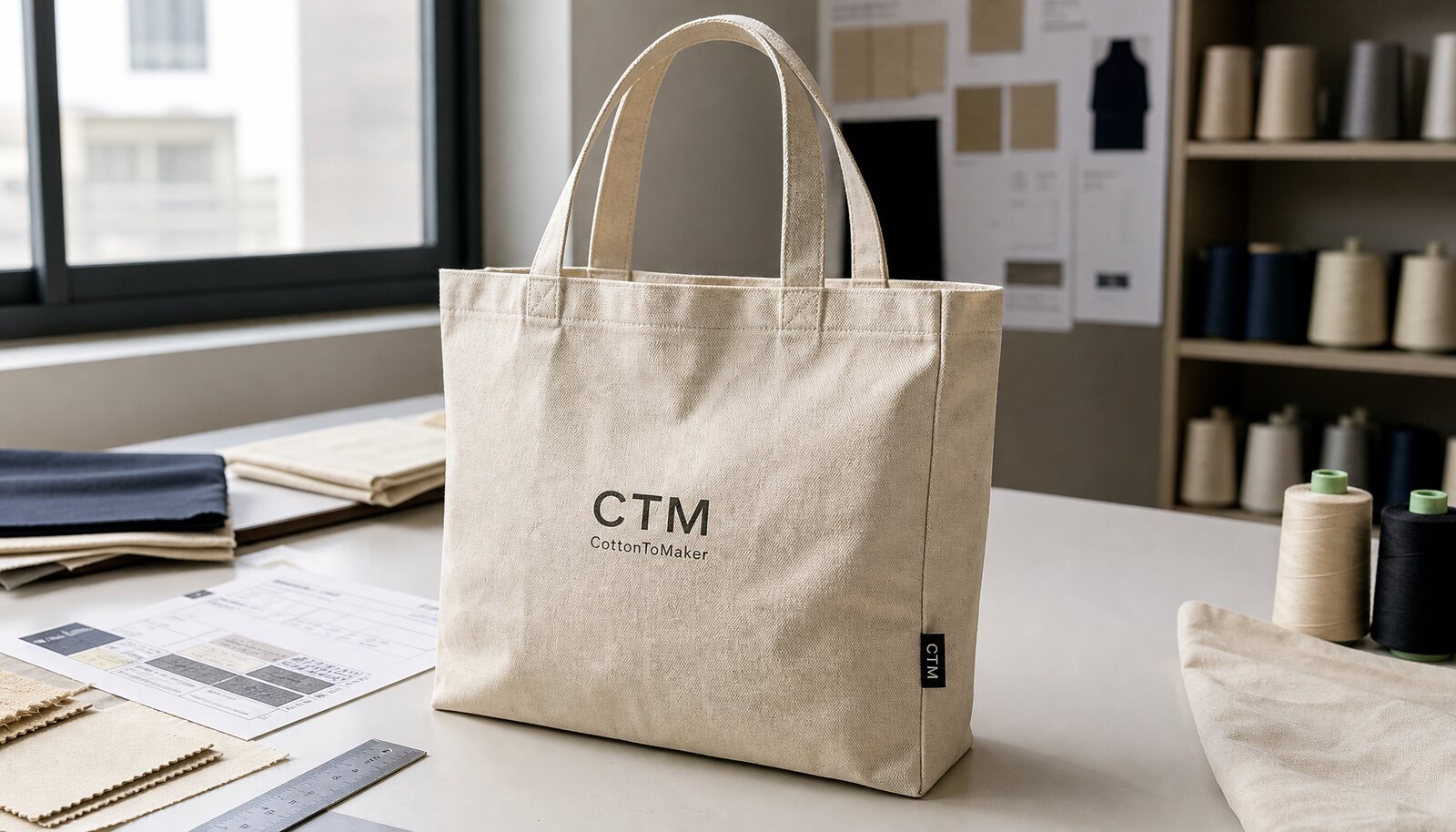
Why boutique buyers need a stricter checklist
Recycled canvas totes for boutiques are not difficult to make, but they are easy to get wrong in ways that show up immediately on the shelf. A slightly crooked logo, uneven handle placement, or weak seam will not be ignored by a retail customer the way it might be in a bulk promo program. Boutique buyers are paying for presentation as much as function, so the inspection standard has to match that reality.
A proper quality inspection checklist turns a vague tote brief into measurable production targets. It also gives procurement a cleaner way to compare supplier quotes. If one supplier includes stronger stitching, better folding, and proper carton marking while another only quotes the bag body, the lower price is not a real saving. The checklist is what stops a simple tote order from becoming a margin leak.
- Use the same approved spec for every quote.
- Separate the bag cost from setup, sample, packing, and freight.
- Treat shelf appearance and handling strength as equal priorities.
Lock the recycled canvas construction first
Start with the fabric, not the logo. For boutique shopping totes, recycled canvas in the 300 to 340 GSM range is usually a good starting point when the bag needs a softer hand and lower freight cost. Move up to 380 to 450 GSM when the bag needs structure, a premium feel, or a higher load target. Once you move too far down in weight, the fabric begins to show seam lines and handle distortion; too far up, and the bag becomes stiff to fold and more expensive to ship.
Ask the factory exactly what they mean by recycled canvas. Some suppliers mean recycled cotton from production waste, some mean a blend with recycled polyester, and some use a recycled fiber content claim loosely. If the material choice affects brand positioning, lock the fiber source, weave, and color band before bulk starts. For boutique programs, that is more important than a glossy sample photo because recycled canvas can vary in shade and texture from one lot to the next.
- Record GSM, weave, and fiber blend in the RFQ.
- Approve a fabric swatch before the bag sample if shade matters.
- Set a finished size tolerance so the bag does not come out too loose or too tight after sewing.
Pick a logo method that survives retail handling
For most boutique programs, a clean screen print is still the most practical logo method. It gives consistent placement, reasonable unit cost, and easy inspection on the line. One or two spot colors usually hold up better than a complicated gradient on recycled canvas, especially when the bag is folded repeatedly and handled by shoppers all day. If the logo is simple, this is the safest route for repeat orders.
If the brand wants a more premium finish, a sewn patch, woven label, or embroidery on a patch may be a better fit than a detailed print. Those options usually last longer under abrasion, but they bring their own risks: edge fray, patch lift, thread density issues, or puckering on lighter canvas. Heat transfer can work for short runs, but it is the first method to show wear when the tote is folded, rubbed, or stored in warm conditions. The decoration choice should follow the bag's real use, not just the design file.
- Specify logo size, placement, and color references in millimeters and Pantone values.
- Set a tolerance for misregistration so the factory knows what is acceptable.
- Do not let the sample use a different print method than the bulk order.
Write an RFQ the factory can quote cleanly
A good RFQ makes a supplier quote comparable. Include the finished dimensions, fabric weight, color, handle length, handle width, decoration method, reinforcement, and packing method. If the tote has a gusset, inner pocket, zipper, or side label, those details need to be in the request too. Many quote gaps come from one missing line item, and those gaps only appear after the buyer tries to place the order.
Ask for pricing at the same specification across several order tiers. A supplier should quote the same bag at 500, 1,000, and 3,000 pieces so you can see where setup cost drops and where production efficiency starts to matter. Keep sample cost, print setup, and any tooling separate from unit price. That is the cleanest way to compare factories, trading companies, and stock suppliers without mixing one-time charges into the bag price.
- Dimensions and gusset depth
- Fabric GSM and fiber blend
- Print method and color count
- Handle length, width, and reinforcement
- Packing style and carton count
- Target lead time after approval
Treat the sample as the production reference
The pre-production sample should be inspected like a production unit, not like a showroom piece. Compare it to the written spec, the approved artwork, and the fabric swatch. The sample should prove that the factory can sew the bag at the right size, place the logo correctly, and fold it the way you want it packed in bulk. If the sample looks good but uses a different fabric or print setup, it is not a valid reference for production.
Inspect the sample in the same way the customer will experience the bag. Open it fully, check symmetry, refold it, and look at the front face under normal light. Make sure the side label, barcode sticker, or hangtag does not interfere with the handle attachment or the brand mark. If the sample already shows fraying, crooked seams, or a weak fold line, the bulk order will not improve on its own.
- Check the logo placement from the top seam and from the side view.
- Look for loose threads at all load-bearing seams.
- Confirm that the fold style does not crush or crease the printed area.
Set measurable QC thresholds before bulk sewing
Factories work better with numbers than with subjective language. A useful baseline is zero critical defects, AQL 2.5 for major defects, and AQL 4.0 for minor defects, then add tote-specific rules. For recycled canvas bags, major defects usually include holes, open seams, missing bartacks, stains, broken stitches at the handle base, and logo misplacement outside the allowed tolerance. If the bag is being sold in a premium boutique, the tolerance should be tighter than a general promo tote.
Add a simple load test that reflects real use. For many boutique totes, a 6 to 8 kg load held for 10 minutes is a practical minimum. If the bag is marketed for heavier shopping or bottle carry, raise the target accordingly and make the factory state that target in the order sheet. Do not let shade variation, handle twist, or seam pull be judged case by case on the line. Those rules belong in the spec before production starts.
- Critical defects: holes, broken handle seams, contamination, wrong size, wrong logo.
- Major defects: open stitch lines, print drift, visible stain, missing reinforcement, wrong carton count.
- Minor defects: small trim issues, slight fold variation, small cosmetic marks within the approved limit.
Pack for shelf appeal and carton efficiency
Packing is part of quality, not a separate afterthought. A tote folded too tightly can leave permanent creases across the front panel or logo, and a loosely packed tote can arrive wrinkled and messy. For boutique retail, a flat fold with a clean insert, belly band, or paper wrap often looks better than a rushed polybag approach, but the right method depends on how the bags move through your channel. Wholesale and direct-to-store programs usually need different pack formats.
Define the inner pack and carton spec before the factory starts packing. The buyer should know how many pieces go into one polybag or bundle, how many bundles go into a carton, what the carton mark should say, and how the barcode is placed. Keep manual lift weight reasonable so warehouse staff do not crush cartons during handling. If the tote is sold as a retail item, make sure the brand label is visible and the packing method does not damage the appearance at first open.
- State whether the bag should ship flat, folded once, or folded with tissue.
- Set the carton weight limit and carton dimension target.
- Require readable carton marks and scannable barcodes where needed.
Match MOQ and lead time to the actual production route
MOQ is driven by fabric source, print setup, and packing complexity. A simple recycled canvas tote with stock fabric and one-color screen print can often be produced in a lower MOQ tier, while custom-dyed fabric, multi-color artwork, or a special closure raises the minimum quickly. That is not a sales trick; it is how the cutting, sewing, and printing lines are scheduled. The wrong MOQ assumption usually leads to either a higher unit cost or a delay while the factory waits for a larger lot to be viable.
Lead time should be counted from pre-production approval, not from the first inquiry. A realistic plan is about 5 to 10 days for samples and 25 to 40 days for bulk after approval, with extra time if the supplier still needs to source recycled yarn, reserve print capacity, or prepare custom packing. If the order has a retail launch date, leave a buffer for inspection and rework. That buffer matters more than a small price difference when the goods must land in a narrow receiving window.
- Standard fabric and one-color print support lower MOQs.
- Multiple colors, special labels, and custom packing raise setup cost.
- Split colors only if the supplier can keep shade control across lots.
Compare supplier routes by landed cost, not brochure price
The cheapest quoted tote is often the most expensive one after the full supply chain is counted. A direct factory usually gives the strongest control over stitch quality and fabric weight, while a trading company can simplify communication if you are buying several categories together. A stock supplier can reduce MOQ and speed up replenishment, but you give up control over exact shade, handle reinforcement, and sometimes even the final folding method. The right route depends on what failure would cost your business.
Compare quotes on the same landed-cost basis. Include FOB or EXW terms, sample fees, print setup, packing, carton labeling, testing, and any internal freight you will pay before export. If one supplier includes a stronger handle build or better retail packing and another does not, the unit price cannot be read as a like-for-like comparison. A clean buyer file should show the same spec, the same packing method, and the same QC target before anyone decides who is truly cheaper.
- Direct factory: best control, usually best for repeat programs.
- Trading company: easier coordination, but confirm who makes the bag.
- Stock supplier: faster and lower MOQ, but less control over details.
- Local decorator: useful for urgent small runs, usually higher unit cost.
Use a final release gate before shipment
Do not release the shipment just because production finished. Run a pre-shipment inspection against the approved sample, the written QC sheet, and the packing list. Pull random cartons, verify counts, measure a few bags, and inspect sewing, print, labels, and folding. If the order is packed by carton only, the packing list and carton marks need to align exactly with the physical shipment. Any mismatch creates receiving delays at the warehouse and makes claims harder to defend.
Hold the shipment if the defect pattern points to a process issue. One loose thread is a random defect; repeated logo drift, missing bartacks, or the wrong carton count points to a setup or packing failure. Fixing that before dispatch is cheaper than issuing replacements after the bags reach stores. For boutique programs, the final gate is often the difference between a clean launch and a series of small avoidable problems that burn time across procurement, logistics, and sales.
- Inspect random cartons, not just the top box.
- Compare every sampled bag against the approved reference sample.
- Do not release balance payment until carton counts and defect levels are acceptable.
Specification comparison for buyers
| Spec decision | Recommended option | When it fits | Buyer risk to check |
|---|---|---|---|
| Supplier route | Direct canvas tote factory with sewing and printing in-house | Best when you need control over fabric weight, stitch quality, and logo placement | Confirm the same factory handles cutting, sewing, and print, not a hidden subcontractor |
| Supplier route | Trading company or sourcing agent | Useful for mixed-category buys or when your team needs one contact for several items | Clarify who owns defect responsibility and whether the quoted factory is fixed or changeable |
| Supplier route | Stock tote supplier with limited customization | Fits low-risk first orders, fast replenishment, or simple one-color programs | Check whether the stock fabric lot, shade, and handle reinforcement are truly consistent |
| Fabric weight | 300-340 GSM recycled canvas | Works for light boutique shopping bags, event retail, and lower freight targets | Watch for thin hand feel, see-through weave, and lower seam tolerance on handle stress |
| Fabric weight | 380-450 GSM recycled canvas | Fits premium retail bags, heavier carry loads, and shelf presentation that needs structure | Confirm fold quality, carton weight, and whether the bag becomes too stiff for packing |
| Print method | 1-2 color screen print | Best for clean logos, repeat orders, and durable retail use | Check registration, ink cure, and whether the ink cracks on repeated folding |
| Print method | Sewn patch, woven label, or embroidery on a patch | Fits premium branding where the logo should survive rubbing and handling | Inspect edge fray, patch alignment, and whether dense embroidery distorts lighter canvas |
| Reinforcement | Box-x stitching plus bartack at handle ends | Needed for boutiques selling reusable daily-use totes or heavier contents | Check stress points for skipped stitches, seam pull, and consistent stitch density |
| Packing route | Flat-folded with size sticker and master carton marks | Good for wholesale distribution, retail replenishment, and lower storage cost | Verify folding does not crease the logo and carton labels scan without opening the case |
Buyer checklist before sampling
- Lock the recycled content definition first: post-consumer, pre-consumer, or recycled cotton blend, plus the target GSM and weave.
- Approve finished dimensions, gusset depth, handle length, and handle width in millimeters, not only in marketing terms.
- State the logo method, artwork size, Pantone references, and acceptable placement tolerance before requesting quotes.
- Set reinforcement requirements for all load-bearing points, including box-x stitching and bartacks where handles meet the body.
- Request a pre-production sample made from the same bulk fabric, print setup, and packing method that will be used in production.
- Define the QC standard in writing, including critical, major, and minor defects, plus any load test or seam pull target.
- Compare quotes on the same basis: FOB or EXW, sample cost, setup cost, packing, and carton labeling included or excluded.
- Specify inner pack count, fold style, barcode placement, and master carton weight limit before the factory starts packing.
- Ask for production photos, inspection records, and lot identification so you can trace a defect back to the source.
- Hold final balance payment until the pre-shipment inspection matches the approved sample and the shipping documents match the carton count.
Factory quote questions to send
- What is the exact recycled canvas construction, including GSM, fiber blend, weave, and finished fabric width?
- Is the print, sewing, and packing handled in-house, and if not, which process is subcontracted?
- What is the MOQ per color and per logo version, and does the MOQ change if we add a side label, zipper, or inner pocket?
- Can you quote the same tote at 500, 1,000, and 3,000 pcs so we can see how setup cost affects the unit price?
- What is the sample charge, what does the sample include, and how long after artwork approval will the sample be ready?
- Which packing options are standard, and what is the extra cost for retail folding, tissue, belly band, or barcode sticker?
- What QC standard do you use in production and before shipment, and can you share a sample inspection report format?
- What documents can you provide for recycled content, material origin, carton count, and export labeling?
- What is the normal lead time after pre-production sample approval, and what factors add delay?
- If one color or print area changes, how much does the price move, and which changes force a new setup fee?
Quality-control points to confirm
- Fabric weight should stay within the agreed tolerance, usually around plus or minus 5 to 8 percent of the approved spec.
- Shade should match the approved lab dip or sealed sample, with no obvious lot-to-lot banding across the shipment.
- Finished dimensions should stay within plus or minus 1 cm on the body and plus or minus 0.5 to 1 cm on handle length.
- Handle attachment must use box-x stitching plus bartacks or an equivalent reinforcement approved in writing.
- No skipped stitches, broken stitches, open seams, loose needle holes, or seam slippage at stress points.
- Logo placement should stay within plus or minus 5 mm of the approved position unless your brand standard is tighter.
- Print should show no bleeding, smudging, cracking, ghosting, or visible misregistration on the front face and side label area.
- A load test should pass the agreed carrying weight, commonly 6 to 8 kg for 10 minutes on standard boutique totes, without seam failure.
- Packing count, barcode, and carton mark content must match the packing list exactly.
- Cartons should arrive clean, dry, and structurally sound, with no crushed corners or oil marks on the inner bags.