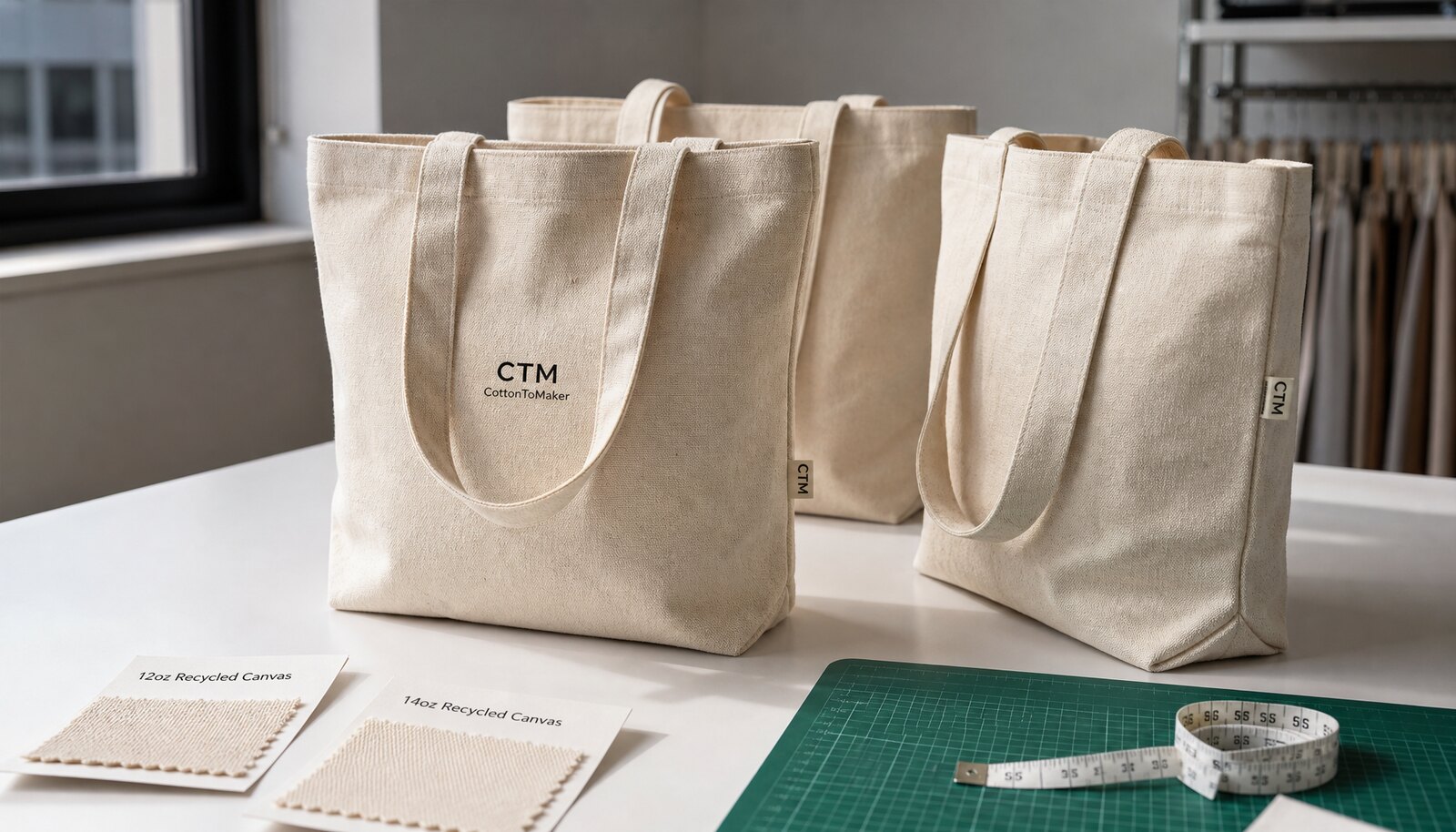
Why bookstore totes need a different comparison model
A recycled canvas tote for a bookstore is not the same sourcing problem as a conference giveaway or a grocery bag. Bookstore buyers care about repeated use, weight-bearing performance, and whether the tote still looks good after being stuffed with hardcovers, notebooks, and daily carry items. The bag has to work as merchandise and as packaging, which means the comparison should start with how the tote behaves in the real use case, not with a generic product photo or a lowest quoted unit price.
That changes how procurement should evaluate the program. A tote that looks cheap but folds efficiently may produce a better total cost outcome than a visually premium tote that ships in oversized cartons, needs retail repacking, or creates more damaged units. For bookstore programs, the meaningful comparison is between the full sourcing route, the construction spec, and the packing method. If those three pieces are not aligned, the landed cost and the customer experience drift apart quickly.
- Evaluate the tote as a carry product, a retail item, and a packaging object at the same time.
- Use the buyer use case first: impulse counter sale, gift-with-purchase, membership tote, or premium brand merchandise.
- Treat freight cube, inspection risk, and store handling as part of the product, not as afterthoughts.
What recycled canvas should mean in a quote
The phrase recycled canvas is often used too loosely in sourcing conversations. A buyer needs a measurable fabric description: weight, width, fiber composition, and the exact recycled-content claim. Some suppliers use recycled cotton blends, some use mixed recycled cotton and polyester, and others rely on recycled yarn or reclaimed fiber with varying visible texture. If your bookstore brand wants to promote sustainability, the paper trail matters as much as the hand feel.
A practical RFQ should ask for the fabric base in oz or GSM, the finish, the color state, and the supplier declaration that supports the recycled claim. If the product will be sold in the US or EU, compliance documents may also matter. Ask whether the supplier can support REACH, CPSIA, Prop 65, GRS, RCS, or OEKO-TEX requests where relevant to your market and policy. None of those names replace a real spec sheet, but they help you understand whether the supplier has a system for documentation or is just relabeling standard canvas as eco-friendly.
The visual character of recycled canvas is part of the product story. Natural shade variation, small flecks, or irregular weave can be acceptable, and sometimes desirable, but only if the approved sample shows the range you are willing to accept. If a buyer approves a perfectly clean sample and the production lot arrives with visible variation, the problem is usually not the mill; it is the approval process.
- Request a material declaration, not a marketing line.
- Define recycled-content evidence you will accept before the order is placed.
- Approve a fabric lot or swatch range when natural variation is part of the intended look.
Fabric weight and construction: where the tote really wins or fails
For bookstore programs, 10 to 14 oz recycled canvas is the most common decision band. The lower end is usually enough for a lower-priced retail bag or a gift-with-purchase item. The upper end gives the tote more structure, a better shelf presence, and a stronger feel when the customer loads dense books into it. That said, heavier is not always better. If the tote becomes too stiff or expensive for the intended price point, the buyer can end up with slow sell-through and excess inventory.
Construction detail matters as much as fabric weight. A handle that is visually neat but lightly stitched will fail before the body fabric does. Buyers should specify handle width, handle drop, stitch density, reinforcement at the top edge, and any bartack or box-stitch pattern. A soft, flexible tote can work well, but it should not twist, tear at the seam, or deform when carried on one shoulder. For a bookstore, the first real test is the lift: a bag should hold a realistic stack of books without the handles biting into the user’s hand or the top opening collapsing inward.
A useful way to think about construction is by failure mode. If the body is too thin, the tote sags and looks low value. If the handles are too narrow, the bag feels cheap and tires the hand. If the stitching is too sparse, the bag may pass visual inspection but fail in use. Procurement should ask the factory to explain where the product is overbuilt, where it is just adequate, and where it could fail under load. That conversation usually surfaces more than another page of generic spec language.
- Use fabric weight to set the value tier, not to signal quality by itself.
- Specify handle reinforcement and stitch pattern as part of the commercial spec.
- Test the bag with books, not empty hand carrying, before approval.
Print method choice: durability, setup cost, and appearance on textured canvas
The print method should be chosen from the artwork and the use case, not from habit. For bookstore logos, a one-color screen print is usually the strongest default because it gives good opacity on textured canvas and keeps setup cost predictable. It is especially suitable when the design is a mark, short wordmark, or simple reading-related graphic. On recycled canvas, the fabric surface can absorb ink irregularly, so buyers should approve a strike-off on the actual material rather than assuming the design will print the same way it looks in a PDF.
Heat transfer, digital print, and embroidery each solve different problems. Heat transfer can work for short runs or more detailed art, but buyers should verify adhesion and edge stability after folding and abrasion. Digital print can support more complex artwork or a tonal illustration, but the cost and durability need to be checked carefully on a textured substrate. Embroidery can feel premium, but it adds time, cost, and needle-hole risk, and it can distort lighter canvas if the stitch density is too high. For bookstore merch, the print method should support the brand story without making the tote fragile or too expensive for shelf price.
When evaluating suppliers, ask them to show where the image sits on the fabric and how they cure or fix it. The real question is not whether the design looks good on a sample board; it is whether the image stays readable after the bag has been folded, packed, shipped, shelved, carried, and used several times.
- Screen print is the safest starting point for simple bookstore branding.
- Ask for a strike-off on the actual recycled canvas, not on substitute cloth.
- Require durability checks if the bag uses transfer, digital, or embroidered decoration.
Sustainable packaging comparison: bulk, retail-ready, and the hidden freight cost
A tote can be made from recycled canvas and still be inefficient if the packaging is excessive. Buyers should compare bulk packing, individual polybagging, and shelf-ready retail packing as distinct commercial options. Bulk packing is usually the most efficient for warehouse replenishment or distributor shipments because it minimizes labor and cube. Individual retail packing is only justified if the bag needs to go directly to shelf, be barcode-scanned at store level, or preserve a premium presentation in a retail display.
The packaging decision changes more than labor. It affects carton count, compression, moisture protection, receiving time, and freight cost. A bag that folds flat and packs tightly may lower the actual landed cost even if the ex-factory price is slightly higher. Conversely, a cheaper bag that requires a bulky hangtag, oversized polybag, or extra fold board can cost more once ocean freight and warehouse handling are included. For sustainable packaging comparison, the right question is not whether the bag is eco-friendly in isolation, but whether the entire packout is right-sized for the channel.
Buyers should also be careful with sustainability claims on the package itself. If you use recycled paper sleeves, compostable poly alternatives, or unbleached labels, check whether the claim is practical in your selling market. A packaging claim is only useful if it is understandable, compliant, and realistically recyclable or recoverable in the destination market. Otherwise it becomes branding overhead rather than procurement value.
- Bulk pack is usually best for distribution centers and lower freight cube.
- Retail-ready pack only makes sense if the store process needs it.
- Compare packaging options by carton size, units per carton, and handling time, not only by material claim.
How to shortlist suppliers by region and production model
The strongest supplier is not the one with the fastest reply. For bookstore tote programs, you are usually comparing factories across different production models and tradeoffs. China-based factories often have the broadest range of canvas weights, print methods, and packout options, which is useful if you need a custom spec and a stable repeat program. India-based suppliers can be attractive for cotton-heavy or natural-fiber positioning, especially when the visual story leans into a more organic hand feel. Vietnam-based factories are often strong on export workflow and sewing discipline, which can be helpful when you care about consistency more than absolute lowest price.
Turkey and EU-adjacent suppliers can make sense when lead time, proximity, or lower transit friction matters more than unit cost, especially for UK and European bookstore networks that replenish quickly. Nearshore or domestic suppliers are usually the best fit for short-run launches, urgent replenishment, or programs where it is easier to pay for speed and lower inventory risk. Trading companies and sourcing agents can still be useful, but only if they can identify the actual factory, the fabric mill, and the inspection path. If the sourcing layer cannot explain who controls what, the buyer has very little leverage when something slips.
A useful shortlisting rule is to group suppliers by what they are best at, not by who is cheapest on the first quote. If you need repeatability, choose factories with documented material control and export experience. If you need speed for a launch, choose suppliers who can prove sample turnaround and consistent packing. If your business is still testing demand, choose a smaller run structure and keep the spec simple enough to compare on one page.
- Group suppliers by production model: direct factory, trading layer, nearshore, or stock program.
- Verify who buys the fabric, who prints, and who does final inspection.
- Use regional tradeoffs to decide speed, documentation burden, and reorder stability.
Landed-cost math: why the cheapest tote can still cost more
Procurement teams often compare tote quotes as though the ex-factory price is the whole story. It is not. Landed cost depends on bag price, packing method, carton cube, freight mode, duties or import charges where applicable, and the labor needed to receive and prepare the goods. A lower unit price can be offset by poor packing efficiency or a higher defect rate. In practice, a bag that is 10 to 15 cents more expensive at source can still land cheaper if it packs more tightly and reduces freight volume.
A simple example shows the issue. Suppose Tote A quotes at $1.28 ex-factory and packs 18 units per carton, while Tote B quotes at $1.42 but packs 24 units per carton because it folds flatter and uses a tighter carton spec. If freight, handling, and receiving costs are spread across the packed unit count, Tote B can become the cheaper landed option even before you count the reduced chance of rework. The right comparison is not ex-factory alone; it is cost per sellable unit delivered into your channel.
This is also why buyers should ask for quote lines that separate bag sewing, print setup, packing labor, inner packaging, and carton charges. Once those items are visible, it becomes much easier to see whether the supplier is genuinely competitive or simply quoting a low base price and recovering margin in packing or freight-sensitive details.
- Compare ex-factory price, carton cube, and units per carton together.
- Ask for separate lines for sewing, print, packing, and carton cost.
- Use a landed-cost sheet before negotiating final supplier selection.
QC that is specific enough to prevent disputes
Quality control for recycled canvas totes needs more than a list of general checks. Buyers should set measurable acceptance criteria before production begins. A practical starting point is an AQL-based inspection plan, often with 0 critical defects, a defined major-defect threshold, and a separate minor-defect threshold. The exact sample size depends on lot size and the standard you use, but the supplier should know in advance what triggers a pass, rework, or hold. If the order is retail-facing, tighten the plan and make sure the inspector is checking the actual sellable format, not a loose sewing sample.
Dimensional tolerances should be specific. For a standard tote, buyers commonly define acceptable ranges for body height, body width, gusset, handle length, and handle drop. The point is not to chase perfect uniformity; it is to avoid bags that differ enough to affect shelf presentation, carrying comfort, or carton fit. Handle attachment is the most sensitive area. A bag can look correct on a table and still fail when the handle stitch line is too close to the edge or the reinforcement is too small. That is why a load test matters. Pack the tote with the weight profile your customers will actually carry, then check seam behavior, handle stretch, and user comfort.
Print QC should also be based on the real fabric lot. On textured recycled canvas, the same artwork may appear lighter, rougher, or more broken than it did on the approved artwork proof. Inspect for registration, opacity, edge sharpness, and cure. Then test abrasion or rub resistance in a simple way that reflects handling, folding, and shelf display. If the tote will be sold in a premium setting, the buyer should reject obvious ink smears, ghosting, or weak coverage; if it is a lower-priced merch item, define the threshold so the supplier knows what variation is acceptable and what is not.
- Use an AQL plan before production, not after defects are found.
- Define dimension tolerances for body, handle, and gusset in the tech pack.
- Load test with real books and inspect the handle and seam response under weight.
- Check print adhesion and rub resistance on the actual production lot.
Sample approval and reorder control: where many tote programs go wrong
Most tote disputes are not caused by bad intent. They are caused by weak approval discipline. A sales sample is useful, but it is not enough when the production lot uses a different fabric batch, a different print screen, or a different packing method. The buyer should approve a pre-production sample tied to the actual bulk plan, and the approval should reference the same revision of the spec sheet, artwork file, and packing instructions. If those documents drift apart, the factory can be right and the buyer can still be unhappy because both parties were effectively working from different definitions.
Reorder control matters just as much as first approval. Recycled canvas can vary in shade, texture, and packing behavior from lot to lot. For bookstore programs that reorder through multiple seasons, the supplier should be asked how they manage fabric lot continuity, print repeatability, and carton consistency. If the brand wants a long-running line, the quote should explain how the factory will protect the original approved look when the next batch is produced months later. A good supplier can explain that process in plain language. A weak one will only repeat that the sample is approved and hope the customer does not notice the difference later.
For teams with multiple stores or distributors, the best practice is to keep one approved reference sample, one production photo set, and one signed-off inspection record tied to the same order number. That sounds administrative, but it saves time when the question becomes whether a defect is a one-off issue or a repeatable process problem.
- Approve pre-production samples against the live production spec, not a generic show sample.
- Store one signed reference sample and one signed inspection record for each order.
- Ask how the supplier will manage fabric lot changes on reorder programs.
A buyer-friendly RFQ structure for bookstore tote programs
A strong RFQ for recycled canvas totes should make comparison easy. Start with the use case, because the use case drives fabric weight, print method, and packing. Then define the body size, handle spec, artwork file, color target, and packaging format. Add the recycled-content statement you need, the documentation you expect, and the inspection standard you want applied. If you are asking several suppliers to quote, make sure they all answer the same questions and return the same line items. Otherwise the lowest quote usually wins only because it was the least complete.
It also helps to state what you are trying to optimize. If the tote is a lower-price counter item, cost and efficient packout may matter most. If it is a premium membership tote, feel, print quality, and shelf presentation may outweigh a slightly higher landed cost. If it is a chain-wide promotional program, repeatability and reorder stability may be more important than the very lowest first order price. When procurement clarifies the objective, the supplier can quote a product that actually fits the channel instead of merely hitting a number.
The best comparison is therefore not one tote against another. It is one sourcing route against another, each tied to a clear commercial use case. That is the level where a bookstore can avoid overbuying, reduce waste, and get a bag that customers will keep using.
- Lead with use case, then move to spec, packaging, documentation, and inspection.
- Keep every supplier quoting the same version of the same RFQ.
- State the commercial priority: lowest landed cost, premium retail feel, or fastest repeat order.
Specification comparison for buyers
| Sourcing route | Best fit for bookstores | Typical strengths | Tradeoffs and risks | What to ask before quoting |
|---|---|---|---|---|
| Direct factory in China | Repeatable custom programs, multiple store locations, or mixed packaging requirements | Broad fabric access, mature sewing capacity, fast sampling, strong print capability, detailed packing control | Quality varies widely by factory tier; recycled-content claims and packing discipline need verification; tariffs and transit time can affect landed cost | Ask for recycled fabric declaration, current production photos, carton loading plan, inspection process, and the same quote broken out by bag, print, and packing |
| Cut-and-sew supplier in India | Natural-fiber positioning, cotton-heavy programs, or buyers prioritizing textile depth | Strong cotton ecosystem, flexible small-to-mid production runs, good fit for natural or undyed looks | Shade consistency and finishing can vary; documentation and shipping lead times may be longer than expected | Ask for fabric origin, shrinkage behavior, print strike-off timing, and whether the factory or an outside unit handles printing |
| Sewn-goods supplier in Vietnam | Programs that need consistent stitching and stable export workflows | Good sewing discipline, reliable export processes, often competitive for medium volume | Fabric sourcing may depend on imported cloth; recycled canvas availability should be confirmed early | Ask who sources the fabric, whether cloth is stocked or milled to order, and what lead time changes when color or weight changes |
| Turkey or EU-adjacent supplier | Shorter transit into Europe, faster replenishment, or premium retail positioning | Lower ocean transit burden for EU/UK distribution, better responsiveness, useful for smaller reorder cycles | Unit cost can be higher; MOQ may be less flexible than Asia-based supply | Ask for incoterms, expected transit by mode, carton dimensions, and whether recycled-content documentation is available in English |
| Domestic or nearshore supplier | Urgent launches, test programs, or smaller premium batches | Fast communication, easier QA visits, simpler rework, lower inventory risk | Usually highest ex-factory cost and limited fabric variety; recycled canvas may not be locally available in all weights | Ask for exact material origin, available print methods, packing options, and whether they can match a target spec after approval |
| Trading company or sourcing agent | Simple pilot orders or multi-category buys where procurement needs one point of contact | Faster quote aggregation, easier coordination across factories, sometimes lower admin burden | Less visibility into true mill and factory controls; traceability and defect accountability can get diluted | Ask who actually makes the bag, who buys the fabric, who inspects production, and whether the quoted factory is the final producer |
Buyer checklist before sampling
- Define the bag as recycled canvas with a measurable fabric weight in oz or GSM, not just a marketing descriptor.
- Specify recycled-content evidence required: supplier declaration, mill statement, or a recognized recycled-content certificate if your policy requires it.
- Choose one primary use case for the first order: impulse retail, gift-with-purchase, membership tote, or premium carry bag.
- Write handle length, handle width, handle reinforcement, and seam construction into the tech pack before quoting.
- Require the print method, ink count, print area, and curing method to be listed in the quote.
- Separate the bag quote from packing, labeling, and cartonization so landed cost can be compared cleanly.
- Ask for a carton loading plan with inner count, outer carton size, gross weight, and fold method.
- Request sample approval against a measurable spec sheet, not only against a sales sample.
- Confirm compliance documents required for your market, such as REACH, CPSIA, Prop 65, GRS, RCS, OEKO-TEX, ISO 9001, or social audit summaries where relevant.
- Set an AQL standard and a test plan before bulk approval, especially for handle strength, print adhesion, and dimension tolerance.
Factory quote questions to send
- What is the exact fabric composition, recycled-content claim, weight, and fabric width for the canvas you plan to use?
- Can you separate the quote into bag sewing, print setup, packing labor, carton cost, and any labeling or hangtag charges?
- What is your MOQ by color, print color count, and packing format, and how does that MOQ change for repeat orders?
- Which print method do you recommend for our artwork, and can you show a strike-off on the actual fabric before bulk approval?
- What are your dimension tolerances for body width, body height, gusset, handle length, and handle drop?
- What seam construction do you use at the handle and bottom, and how many bartacks or reinforcement stitches are standard?
- What is your inspection standard, sample size method, and acceptable AQL for major and minor defects?
- Can you provide carton dimensions, units per carton, master carton marks, and the target pallet or container loading plan?
- How do you control shade variation across recycled canvas lots, and how do you handle fabric lot changes during reorders?
- Which documents can you provide for traceability, recycled content, and packing verification before shipment?
Quality-control points to confirm
- Use ANSI/ASQ Z1.4 or an equivalent AQL sampling plan, with 0 critical defects, a defined major-defect limit, and a separate minor-defect threshold for each order.
- Check finished dimensions against the approved spec, not only the counter sample; practical tolerance is often around plus or minus 0.5 in, but define your own limits by bag size and retail tolerance.
- Measure handle length, handle drop, and reinforcement placement on a random sample from the bulk lot; mismatched handles are a common cause of returns and customer complaints.
- Inspect stitching at side seams, bottom seams, and handle attachments for skipped stitches, loose ends, seam slippage, and uneven bartacks; use a pull or load test on the sample lot.
- Set a load test that reflects bookstore use, such as 5 to 10 kg of books held for 30 minutes and repeated lift cycles, then inspect for seam opening or excessive stretch.
- For print, confirm opacity, placement, edge sharpness, and cure on the actual fabric lot; textured recycled canvas can cause ink scatter or weak coverage.
- Perform a simple rub or tape check after curing to confirm ink adhesion, and reject prints that smear, transfer heavily, or show visible cracking beyond your threshold.
- Review shade variation under consistent lighting against the approved sample; recycled canvas can vary naturally, but obvious lot-to-lot mismatch should be treated as a defect.
- Verify fold method, carton count, barcode placement, and carton marks so bags arrive in the format your warehouse or stores can receive without rework.
- If sustainability claims will appear on-pack or in marketing, confirm the wording is backed by the supplier documents before shipment, not after the goods clear customs.