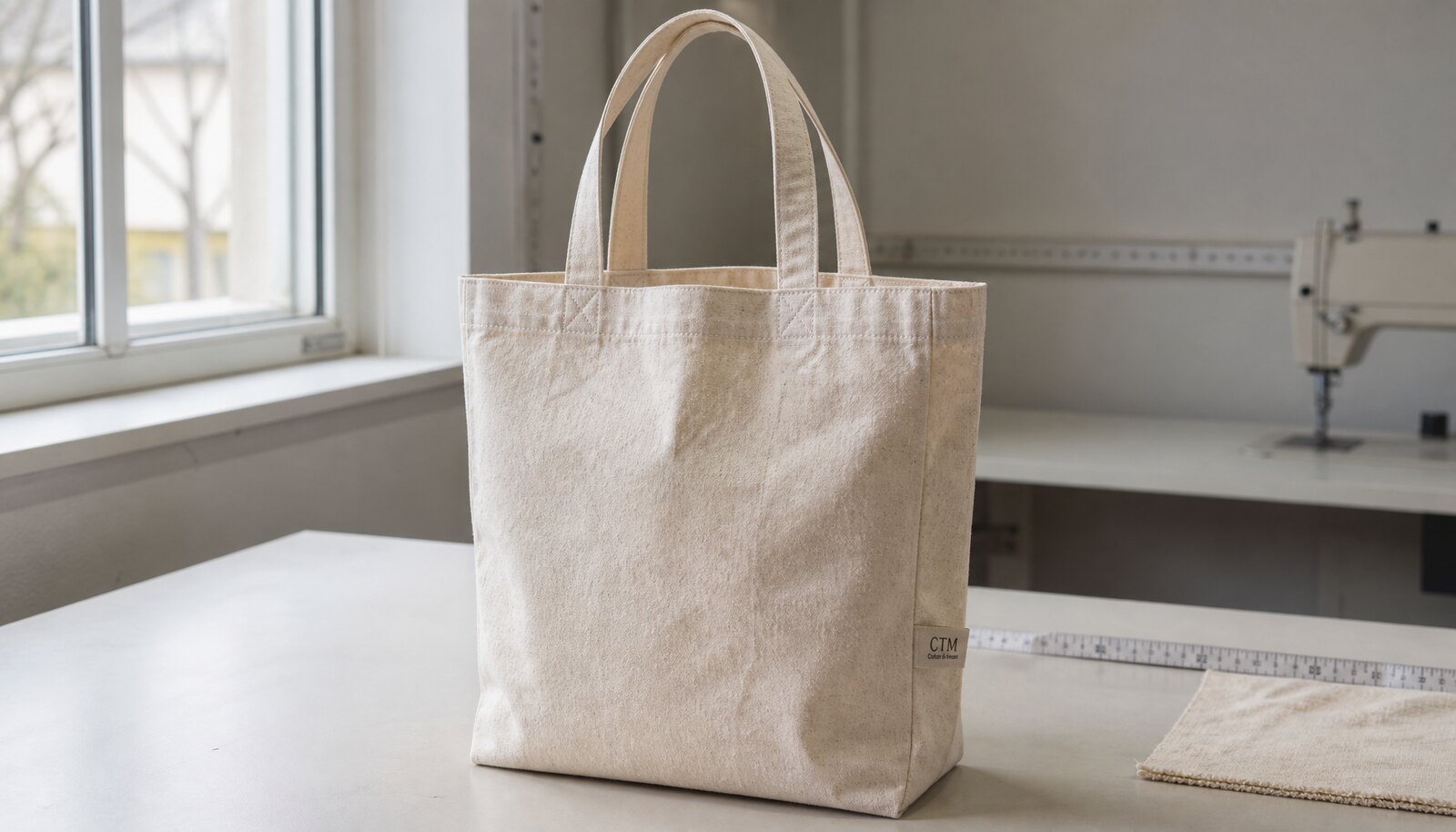
Why bookstore tote programs fail in procurement, not in retail
Recycled canvas totes for bookstores usually fail because the buying brief is too vague. A tote that looks acceptable on a sample table can still arrive with poor handle strength, inconsistent recycled yarn appearance, or a print that loses clarity once the bag is folded, packed, and handled at store level. For bookstores, the customer expectation is practical: the bag should carry a hardback or two, look presentable at checkout, and survive repeated use without seam failure.
The procurement problem is that many quotes only compare price and size. That misses the real cost drivers: fabric GSM, stitching labor, print setup, carton density, and how much quality risk is hidden behind a low MOQ offer. If you define the tote only as a printed recycled canvas bag, suppliers will fill in the missing details differently and the result becomes hard to compare.
- Treat the tote as a functional retail item, not only a branded giveaway.
- Write the buying brief around use case: books, journals, stationery, and checkout carry weight.
- Compare quotes on the same fabric weight, construction, print method, and packing format.
Set the spec around use, not just appearance
For most bookstore orders, a recycled canvas tote in the 10 oz to 12 oz range, roughly 340 to 410 GSM, is the practical starting point. Below that range, the bag can look fine but feel soft and unstable once loaded. Above that range, the tote gets heavier and the landed cost climbs faster than the perceived retail value. If the tote is meant for premium bookstores or museum-style retail, you can move up in weight, but do it because the product needs the stiffness, not because the mill quote looks impressive.
Handle construction matters just as much as fabric weight. A self-fabric handle with reinforced box-X stitching is usually the safest commercial choice. If you specify a long handle drop for shoulder carry, the attachment point must be reinforced cleanly or the tote will distort under book weight. For bookstore programs, a wider body with a moderate gusset often works better than a tall narrow bag because it packs books more naturally and displays better at point of sale.
- Typical working spec: 38 x 42 cm body with 8 to 12 cm gusset, depending on book size and shelf display needs.
- Handle drop should be long enough for shoulder carry if the tote is sold as a reusable shopper.
- If the tote must stand upright on shelf, ask for a firmer canvas hand and a more stable bottom seam.
Choose the print method based on artwork and shelf life
Screen print remains the default for bookstore totes when the logo is simple and the run is decent in volume. It gives the best unit economy for one or two spot colors and can hold up well if the ink is cured properly. The tradeoff is that fine text and tight linework may lose detail on recycled canvas, especially when the fabric surface is uneven or has visible fiber variation.
Heat transfer and digital methods make more sense when the artwork is complex, the order is small, or the buyer wants a short seasonal run. Those methods can reproduce finer detail, but they are not automatically better. On a tote that will be folded, carried, and rubbed against books, the buyer should care about edge durability, not only first-look sharpness. If the artwork has large solid fills, ask the supplier how they control cracking at fold lines.
- 1-2 spot colors: screen print is usually the cost-effective route.
- Small quantities or full-color graphics: digital or transfer may save setup cost.
- Always approve print on the actual recycled canvas, not on a smooth substitute fabric.
How recycled canvas changes the inspection standard
Recycled canvas is not the same as virgin canvas, and buyers should not write the same quality standard for both. Recycled yarn often shows more visual variance: slight slubs, color flecks, and surface irregularity can be normal. The inspection job is to separate acceptable texture variation from uncontrolled contamination, shade mismatch, and poor weaving consistency. If your team rejects every natural variation, you will create disputes with the supplier. If you accept everything, you will miss quality drift.
The best approach is to define visual acceptance by example. Approve one golden sample for hand feel, color tone, seam finish, and print placement, then state which variations are allowable in bulk. For bookstore programs, the most important recycled-fabric QC points are color consistency across cartons, absence of oil or dust marks, stable weaving density, and no weak zones near the handles or bottom folds.
- Allow normal recycled-fiber texture variation but reject dirty, oily, or badly shaded fabric.
- Use a reference sample for visual standards, not a vague verbal description.
- Check both front and reverse sides, because recycled fabric issues can show differently on each face.
Comparison of sourcing routes for bookstore tote programs
The cheapest quote is not always the best sourcing route. For recycled canvas totes, the supplier structure matters because sewing, printing, and packing can be split between different workshops. Direct factory sourcing gives stronger control over dimensions and schedule, but only if the factory actually owns or tightly manages the print and sewing process. Trading-company routes can be useful when you need sourcing flexibility, but they can make quality accountability harder to trace if the quote does not separate body fabric, print, and packing responsibilities.
When buyers compare routes, they should look at who owns the risk at each stage. The right route depends on whether the bookstore program is a repeat order, a seasonal launch, or a one-time retail test. A low MOQ route may be useful for a pilot launch, but it should be priced with clear setup charges and sample rules so the next order can scale cleanly.
- Use direct factory sourcing when you need size control, repeatability, and better margin visibility.
- Use a trading route only if the quote clearly shows which processes are outsourced.
- For pilot programs, pay attention to re-order consistency, not just first-order flexibility.
Supplier comparison table for recycled canvas tote sourcing
Below is a practical comparison of the sourcing routes buyers usually face. The goal is not to choose the cheapest line on the sheet. It is to identify where hidden rework, delayed approvals, or quality disputes are most likely to appear. A book retailer or distributor should be able to read the quote and know who will answer when the handle stitch fails or the carton count is off.
Use the comparison with your RFQ and sample plan. If two suppliers quote the same unit price but one includes fabric evidence, pre-production sample control, and carton spec clarity, that supplier often has the lower real procurement risk.
- Write decisions in measurable language, not only descriptive wording.
- Ask for sample photos plus one physical approval sample for important orders.
- Keep quotation, sample approval, and inspection notes tied to the same spec version.
Sample approval is where most tote disputes should be removed
The pre-production sample should not be treated as a courtesy sample. It is the production contract in physical form. For recycled canvas totes for bookstores, the sample needs to show fabric hand feel, size, handle length, print position, seam finish, and packing method. If your team approves a loose sample without measuring it or testing it under load, the bulk order can still fail in ways that were visible from day one.
A useful sample workflow is straightforward: first confirm the spec sheet, then review a pre-production sample made from the intended fabric and print method, then ask for a top-of-line or production-start photo set before the bulk run goes too far. If the supplier cannot share sample photos or measurement notes, that is a warning sign. The cost of rework on a tote order usually exceeds the cost of the extra sample stage.
- Check dimensions at finished seam lines, not just overall lay-flat measurements.
- Load-test one sample with books or equivalent weight before approval.
- Verify print registration and edge clarity on the same fabric batch that will be used in bulk.
QC thresholds that matter for bookstore retail
For tote bags, visual inspection alone is not enough. A bookstore tote is handled many times before and after sale, so the useful QC standard needs both appearance and function. At minimum, inspect fabric flaws, size tolerances, seam strength, print quality, and packing cleanliness. If you use an AQL process, define separate defect categories for critical, major, and minor issues. A broken handle stitch or misprinted logo is not the same as a slightly uneven fold line.
The inspection team should also test whether the bag works as a retail product. A tote that passes sewing inspection but collapses under a standard book load is not acceptable for a bookstore program. Buyers should ask the factory to show how they test a sample before shipping, even if the test is simple. A short load check and a visual check of the stress points will catch many avoidable claims.
- Critical defects: broken seam, missing handle reinforcement, wrong size beyond agreed tolerance.
- Major defects: misprint, visible staining, open stitch run, carton count mismatch.
- Minor defects: loose thread ends, slight fold variation, small non-structural creases.
Packing, carton density, and shelf-ready delivery
Packing is often under-specified in tote RFQs, but it affects both cost and store operations. Recycled canvas totes can be folded, flattened, or lightly stuffed depending on presentation needs, but the buyer should decide before quote comparison. Flat packing reduces carton volume and shipping cost, while more structured packing can improve retail presentation. The factory should state how many pieces go into a master carton, how bundles are counted, and whether each tote is individually folded the same way.
For bookstore distribution, a clean and consistent pack-out is worth paying for if it reduces receiving labor. Ask for carton marks, barcode placement, and whether the tote has to arrive ready for shelf replenishment or warehouse counting. The wrong packing format can create hidden labor costs at the DC, even if the ex-factory price looks attractive.
- Keep folding instructions in the PO if the retail display depends on a certain shape.
- Require master carton dimensions and gross weight before booking freight.
- Use consistent bundle counts so receiving teams can reconcile cartons quickly.
Lead time planning and the real schedule risk
A tote lead time is not one number. It is usually sample approval time, fabric booking time, printing or dyeing time, sewing time, inspection time, and dispatch time. Buyers who only ask for a single delivery estimate often discover that the factory included none of the earlier steps in the promised date. For bookstore launches, the real schedule risk is not the sewing line; it is the delay created when the buyer changes artwork or dimensions after sample approval.
The safest schedule is to freeze the spec early and separate sample approval from bulk production. If the order is seasonal, leave time for corrective reprint or resewing if the first bulk samples drift from the approved standard. A common planning mistake is to select a low MOQ vendor, then expect the same factory lead time as a high-volume stock program. Those are not the same production model.
- Sample stage often takes longer than buyers expect if artwork needs revisions.
- Custom sizes and custom labels usually extend the production window.
- Ask whether lead time starts from artwork approval, sample approval, or deposit receipt.
Specification comparison for buyers
| Spec decision | Recommended option | When it fits | Buyer risk to check |
|---|---|---|---|
| Fabric weight | 10 oz to 12 oz recycled canvas, usually around 340 to 410 GSM | Daily bookstore retail use, gift-with-purchase programs, moderate book weight | Too-light fabric stretches at the bottom corners; too-heavy fabric raises freight and unit cost without adding much retail value |
| Handle construction | Self-fabric handles with reinforced box-X stitching or cross bar tack | Standard bookstore tote where customers carry books, notebooks, and small gifts | Short handle drop or weak stitching causes customer complaints and returns |
| Print method | Screen print for 1-2 spot colors, heat transfer or digital for small runs and full color | Logo-forward retail programs and seasonal artwork | Soft-hand expectations can conflict with abrasion resistance; fine text may fill in on recycled canvas texture |
| Source route | Direct factory with pre-production sample approval and inline QC photos | Repeat programs, custom dimensions, and strict margin control | If the factory outsources printing or sewing, accountability becomes fragmented unless responsibilities are written into the PO |
| MOQ logic | Lower MOQ on stock-size tote body, higher MOQ for custom size or custom-dyed components | Brand tests, first-time bookstore programs, multi-location pilot orders | A low MOQ quote may hide high setup charges or mixed production lots |
| Packing method | Flat packed with consistent bundle counts, barcode sticker on polybag or master carton | Retail distribution, DC receiving, or e-commerce fulfillment | Loose folding and inconsistent bundle counts slow receiving and increase damage risk |
| Recycled content evidence | Written fiber statement and lot traceability from yarn or fabric supplier | Eco-positioned retail programs and buyers with sustainability reporting needs | Claims without lot evidence are hard to defend in audits or buyer questionnaires |
| Seam and load test | Bottom seam and handle attachment tested on a filled sample before bulk approval | Any bookstore tote meant for books, catalogs, or bundled merchandise | Passing only a visual inspection can miss seam failure after repeated loading |
| Delivery approach | Staged production with PP sample, inline check, and final AQL inspection | Seasonal launches and replenishment programs with fixed store opening dates | Skipping the PP stage can turn late print corrections into shipping delays |
Buyer checklist before sampling
- Confirm finished size, gusset depth, handle length/drop, and whether the tote must stand upright on a shelf or fold flat for checkout display.
- Lock fabric weight in GSM, not just ounce notation, and state whether recycled canvas variance within an approved range is acceptable.
- Specify print placement, color count, artwork file format, and whether recycled fabric texture allows a softer, less solid print target.
- Define the loading expectation: number of books, target weight, and whether the tote must survive repeated use or only one retail purchase cycle.
- Require pre-production sample approval that includes fabric hand feel, sewing quality, logo placement, and packing count verification.
- Ask for carton pack-out details, including bundle count, master carton dimensions, gross weight, and barcode label position.
- Set AQL or equivalent acceptance rules for fabric flaws, print defects, broken stitches, and measurement tolerance.
- Clarify lead time by stage: sample, bulk fabric readiness, production, inspection, and ocean or air dispatch.
- Request recycled content evidence and a lot traceability note if your brand or retailer needs sustainability claims support.
Factory quote questions to send
- What exact recycled canvas GSM do you quote, and what tolerance do you allow across bulk rolls?
- Is the tote body cut from greige recycled canvas, pre-dyed fabric, or post-consumer blended fabric, and how does that affect color variation?
- Which print method is included in the quote, how many colors are included, and what is the setup charge for extra colors or extra placements?
- What handle construction, stitch count, and reinforcement method are included in the base price?
- What is the MOQ for the base size, and how does MOQ change for custom dimensions, lining, or internal pockets?
- What sample stages are included before bulk production, and which sample types are chargeable?
- How many pieces per carton, what is the carton size, and whether retail-ready barcode labels or inner polybags are included?
- What lead time applies after sample approval, and what part of that time is consumed by fabric booking, printing, sewing, packing, and QC?
- Can you share one recent inspection report format or inline QC photo set for a similar tote program without revealing confidential customer data?
Quality-control points to confirm
- Measure finished width, height, and gusset at three points per tote and compare against the approved spec sheet.
- Inspect handle stitching for symmetry, reinforcement placement, loose threads, skipped stitches, and visible tension issues.
- Check fabric surface for recycled-content contamination, slubs, oil marks, yarn thick-thin variation, and shade inconsistency within an order.
- Rub-test print edges by hand and inspect for cracking, fading, misregistration, or ink bleed at folds and seams.
- Fill a sample tote with books or weighted cartons to test bottom seam integrity and handle extension under load.
- Verify carton counts, bundle counts, inner packing cleanliness, barcode readability, and whether bags are folded consistently.
- Record the number and type of defects by lot, not only the total defect rate, so the factory can correct the right process step.
- Treat any odor, dust, or visible contamination in recycled fabric as a packing rejection issue, not a cosmetic detail.