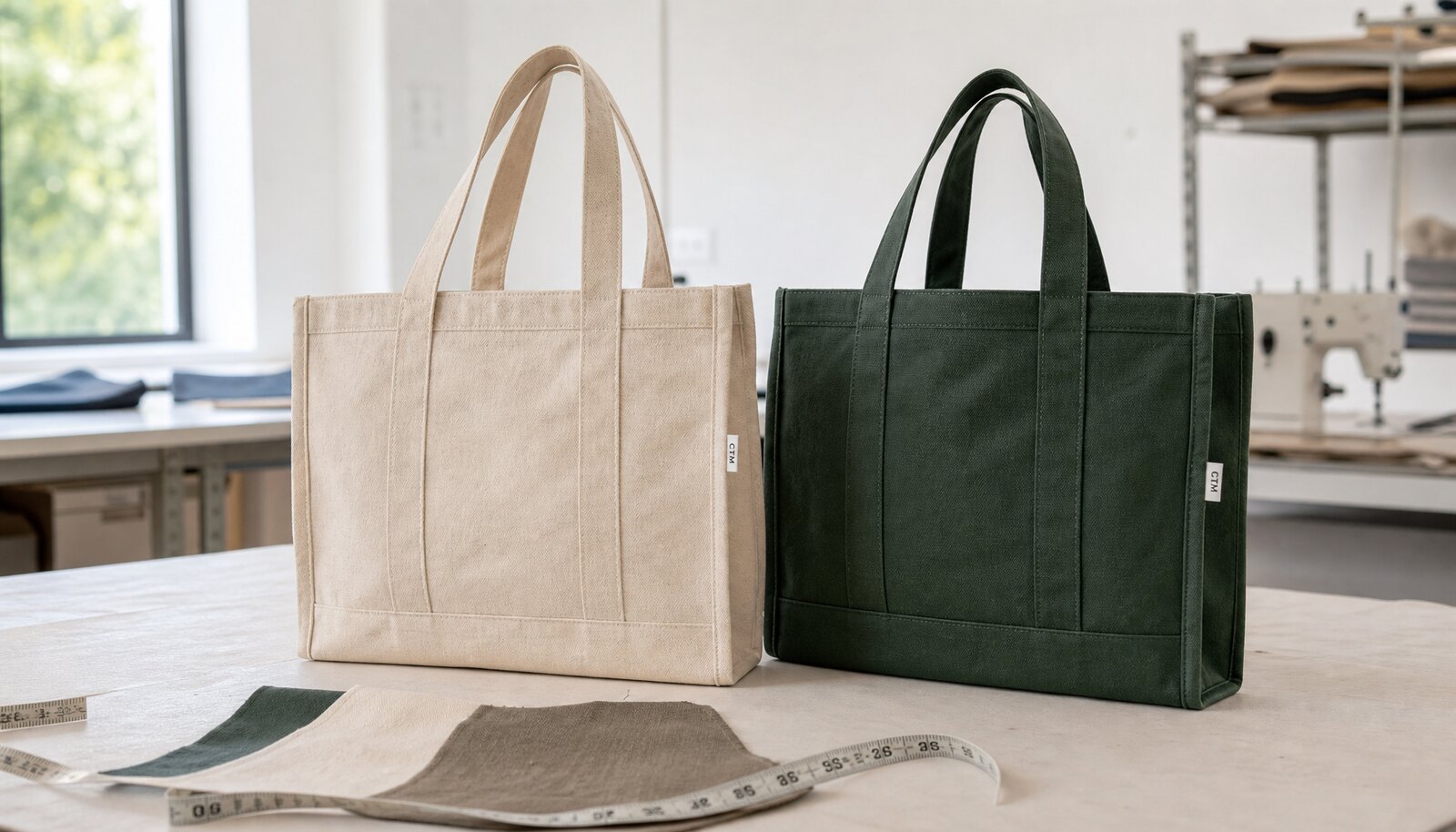
Why bookstore totes fail when the spec starts with appearance
A bookstore tote is both a utility item and a retail product. It has to carry hardcovers, sit neatly at checkout, print cleanly with a store logo, and still feel like something a customer wants to reuse. The common mistake is to start with the visual sample and stop there. A soft or attractive sample can still be underweight, loosely woven, or unstable in sewing, and those weaknesses only show up after the first production run.
Procurement gets better results when the use case is defined first. A bag for a seasonal event has different priorities from a tote sold year-round at retail, and both are different again from a bag used as a daily carry item. Once the use case is clear, the conversation moves from vague preference to measurable requirements: load target, fabric weight, handle construction, print method, and acceptable variation. That is the basis for a quote that can actually be compared across suppliers.
- Checkout tote: prioritize fast throughput, clean branding, and enough strength for common book purchases.
- Retail SKU: prioritize visual finish, repeatability, and low defect tolerance.
- Daily-carry tote: prioritize handle comfort, seam strength, and dimensional stability over the longest useful life.
Define the load profile before you choose fabric
For recycled canvas totes for bookstores, the right fabric weight depends on the heaviest realistic load, not on a trend label like premium or eco-friendly. A standard bookstore retail program often lands in the 10-12 oz range, because that range balances cost, body, and print stability. If the bag will regularly hold heavy books, stacked orders, or long commutes, the spec should move up to 14 oz or a denser weave. The important point is that the tote must be designed around load and wear, not around a sample that only feels substantial in the hand.
Set the load target in plain numbers and make the factory test to that target. Many buyers use a static hang threshold in the 8-12 kg range for standard retail bags and push higher for heavier-use programs, but the right number is your number, based on the product's actual use. Also define handle drop, gusset depth, and whether the tote needs to stand upright at checkout. Those dimensions change the construction and the finished look as much as the fabric weight does.
- State the maximum expected book load in kilograms or pounds.
- Specify whether the tote must stand upright, fold flat, or both.
- Confirm handle drop, because comfort changes quickly once a bag is full.
- Tie fabric weight to the product role instead of using one spec for all bookstore use cases.
Verify recycled content, not just recycled-style appearance
A recycled canvas tote should be backed by documentation, not just by a supplier description. If recycled content matters to your brand or retailer, ask the factory to identify the fiber composition, source flow, and the paperwork they will provide with the order. If you need a certified recycled-content claim, ask whether the supplier can support GRS or RCS documentation or another recognized chain-of-custody route. If they cannot, treat the bag as recycled-content-adjacent rather than certified recycled content in your marketing and buyer records.
This is where procurement teams need to be careful with wording. A fabric can look rustic and natural without being verifiably recycled. That matters if the tote will be sold through a chain account, listed online, or described in sustainability copy. Ask for the exact claim the factory is comfortable supporting, the supporting documents, and whether the lot can be traced back to the same material source on reorder. If the supplier cannot prove the composition, you should not build a commercial claim on it.
- Ask for a fiber composition declaration and batch traceability.
- Request certification support if your claim will mention recycled content explicitly.
- Confirm whether the same recycled feedstock can be repeated on reorders.
- If needed, request third-party verification for fiber content and market-specific compliance.
Choose fabric weight, weave, and surface finish with print in mind
Fabric choice affects more than durability. It determines how the logo looks, how the tote hangs, and how much variation you can tolerate from one lot to the next. A tight plain weave usually gives the cleanest print edge and the most controlled hand feel. A looser weave can look more casual, but it often creates more visible slub, more ink spread, and more inconsistency around seams and corners. For bookstores, where the tote may sit next to a curated product display, that visual control matters.
If the body color is natural, ask the factory what shade range they accept for the base cloth. Natural recycled canvas can vary by batch, and that variation is normal. What matters is whether the variation is acceptable for your program. If you want dyed canvas, require a color standard and ask for rub fastness and wash fastness expectations before approval. If the tote must hold its shape, ask whether the fabric is pre-washed or treated to reduce shrinkage, and make sure the final measurements account for the finishing route.
- 10 oz: suitable for lower-cost giveaway programs and light retail use.
- 12 oz: the practical middle ground for most bookstore retail bags.
- 14 oz: better for heavier book loads and a more premium feel.
- Pre-washed or controlled-finish fabric reduces the risk of size change after production.
Construction details decide whether the tote survives real use
Handle construction is one of the clearest differences between a cheap-looking tote and a bag that works. For bookstore use, self-fabric handles can be fine if the fabric is dense enough and the stitch pattern is reinforced. Webbing-reinforced handles usually perform better under heavy loads and are less likely to stretch. In either case, the stress point should be reinforced with a box-X, bartack, or another visible reinforcement method that the factory can describe in writing. If the tote will hold hardbacks or multiple books, this is not a cosmetic detail; it is a failure-point control.
Seam allowance and bottom structure matter just as much. A tote that uses a gusset may stand better and carry more naturally, but it also adds sewing complexity and more places for variance. Top hems and edge finishing should be specified clearly so the tote does not fray in retail handling. If the bag has a lining, inner seams, or a closure, require the supplier to show how those elements interact with the outer shell. Complexity is not a problem by itself, but each added step should earn its place in the spec.
- Use reinforced handle anchoring, not just standard stitching, when the tote is expected to carry books.
- Specify seam type and reinforcement at the corners and base.
- Require a simple load test that matches the tote's actual use case.
- If the tote is lined or has a closure, confirm how those extras affect cost and sewing risk.
Decoration choices should match artwork complexity and reorder volume
Screen print is usually the best choice for bookstore totes with simple logos, clean typography, and repeatable order volumes. It handles textured canvas better than many transfer methods and typically offers the best balance of opacity, durability, and cost at scale. For a design with two colors or fewer, screen print is often the most procurement-friendly option because the cost model is easier to compare across vendors. The caveat is that the artwork has to be built for the process: tiny text, very thin lines, and tight registration requirements increase the risk of defects.
Heat transfer can work for short runs or variable artwork, but on recycled canvas it can look too glossy or sit too much on top of the fabric. Embroidery is a good fit for a small mark, not for large editorial artwork or text-heavy graphics. If the logo includes fine type or details that need to stay legible on a busy weave, ask the supplier for a strike-off or decorated sample before you approve production. The sample should show the exact method that will be used in bulk, not a simplified mock-up.
- Screen print: best for repeated bookstore SKUs and clean logo work.
- Heat transfer: useful for short runs, but validate hand feel and wash performance.
- Embroidery: suitable for small marks and premium positioning, not for large art.
- Ask for a strike-off whenever the artwork includes small text, line art, or halftones.
Compare supplier quotes by what they prove, not by unit price alone
The cheapest quote is often the least comparable quote. A serious factory quote should identify fabric weight, recycled-content documentation path, print method, handle structure, bag dimensions, seam reinforcement, packing format, and lead time after approval. If the quote leaves these items vague, it is not a lower price; it is an unfinished specification. Buyers who only compare unit price often discover that the low quote excludes the exact details they need for retail acceptance.
It also helps to separate direct-factory pricing from trading-company pricing. A direct factory usually gives better visibility into sewing, printing, and packing assumptions. A trading partner may be useful if you are bundling several product lines, but you should still insist on a production-level spec sheet and sample path. Ask what is made in-house, what is outsourced, and what remains under the supplier's control. If the answer is unclear, the quote is carrying more risk than it appears to.
- Check whether printing, sewing, and packing are all under one control point.
- Ask for a line-item view of fabric, decoration, packing, and sample costs if the supplier can provide it.
- Make sure the quote states whether the sample cost is credited back on bulk order.
- Confirm reorder pricing and whether the supplier will hold the same spec on repeat runs.
Sample approval should prove construction, not just appearance
A sewn pre-production sample is the approval artifact that matters most. Flat cloth swatches can show color and texture, but they do not prove handle comfort, seam stability, or how the tote behaves under load. For bookstore programs, the sewn sample should use the final fabric, final decoration method, and final packing method. If the supplier changes any of those three elements later, the approval is no longer fully valid. That is a simple rule, but it prevents a lot of avoidable confusion.
Use the sample to test the real use case. Put books in the bag, check the handle drop, look at how the base sits, and verify whether the print stays readable when the tote is under tension. If the tote will be sold retail, inspect it under normal store lighting, not only under factory light. If the bag includes a recycled-content claim, keep the sample records together with the supporting documents so the product file is complete when buying, merchandising, and compliance teams review it later.
- Approve a sewn sample made from the final fabric and final decoration method.
- Check the bag with actual book weight, not just by visual inspection.
- Hold the signed sample, measurement sheet, and artwork approval together.
- If the tote is color-critical, approve the shade before mass production starts.
Build a QC plan with test thresholds, not just visual checks
For bulk production, a visual inspection alone is not enough. Set an AQL target before the order begins, and use it consistently. Many buyers start with AQL 2.5 for major defects and 4.0 for minor defects, with critical defects set to zero, then tighten the plan for premium retail programs or sensitive chain accounts. The exact AQL target is a commercial decision, but the key is to write it down and make the factory work to it. Without that, inspection results are hard to compare and reorders are harder to defend.
The tote should also have a test plan that covers the practical failure points. Ask for shrinkage testing if the bag will be washed or laundered; a common buyer target is no more than 3 percent dimensional change on critical measurements, but you should set the limit based on the product's intended use. Ask for colorfastness results on the print and fabric, including dry rub and wet rub where relevant. For load testing, define a static hang threshold and the duration for the test. If the bag is meant for daily book carry, the threshold should be tougher than if it is only a gift tote. Pack inspection should also verify label placement, carton count, SKU separation, and correct barcode or outer marking.
- Use an AQL standard that matches the product's retail risk.
- Set a shrinkage limit for width, height, gusset depth, and handle length.
- Require rub and wash fastness checks where the tote will face repeated handling.
- Define a load test in advance, including weight and hold time.
- Inspect carton labeling, pack count, and SKU separation before shipment release.
Lock MOQ, lead time, and reorder terms before the first order lands
MOQ is usually driven by fabric sourcing, print setup, and efficiency on the sewing line. A simple natural canvas tote with one-color print can often support a lower MOQ than a dyed, lined, or retail-packed bag. That does not make the higher MOQ arbitrary; it reflects the factory's cost to change material, set screens, manage dye lots, or control more packing steps. The right response is not to chase the lowest MOQ at any cost. It is to decide which features are actually required for the launch and which can be simplified.
For reorder planning, write down what must stay stable from run to run. That usually includes fabric weight, weave type, handle construction, decoration method, and pack format. If color variation is acceptable, say so; if it is not, say that too. If the tote will be sold through multiple channels, ask whether the supplier can hold screens, patterns, or packaging assets for future runs and what will trigger a price revision. That way, procurement is not rebuilding the spec from scratch each time the tote is replenished.
- Higher fabric weight usually means more sewing time and more line wear.
- More print colors increase setup, registration risk, and waste.
- Closures, lining, woven labels, and retail packing all add labor.
- Reorder stability matters as much as first-order price for bookstore programs.
Specification comparison for buyers
| Spec decision | Recommended option | When it fits | Buyer risk to check |
|---|---|---|---|
| Fabric weight | 10-12 oz recycled canvas for standard bookstore retail; 14 oz if the tote must carry heavy books every day | Gift shop checkout bags, branded retail SKUs, and mid-weight carry programs | Too light can sag and distort; too heavy raises cost, sewing difficulty, and freight weight |
| Weave and finish | Tight plain weave with controlled slub and a stable finish; pre-washed only if dimensional stability matters | Logo-led totes that need clean print edges and consistent panel size | Loose weave can blur print, shed lint, and make size tolerances harder to hold |
| Recycled-content proof | Documented recycled content declaration with traceable batch records; GRS or RCS documentation if you are making a certified claim | Retail programs, ecommerce launches, or any SKU that mentions recycled content in marketing | A recycled-looking fabric is not proof; ask for paperwork and, if needed, third-party test support |
| Handle build | Self-fabric handles or webbing-reinforced handles with box-X stitching and bartacks at stress points | Totes expected to hold hardcovers, bundled orders, or daily-use purchases | Thin handles can cut into the hand or fail early if the stitch pattern is under-specified |
| Decoration method | Screen print for simple logos and repeat runs; embroidery or woven label only for small marks or premium branding | One- or two-color bookstore branding, author events, and retail merch | Fine text, halftones, or oversized graphics can fail if the print method is chosen only for price |
| Base color | Natural recycled canvas for lower cost; dyed canvas only when brand presentation justifies the added control | Programs where shade consistency and shelf appeal matter | Natural shades vary by batch; dyed shades add dye-lot and colorfastness checks |
| Compliance documents | Fiber declaration, chemical compliance statement, and market-specific test reports where required | Wholesale programs, chain accounts, and export orders | Without documents, the tote may be hard to clear through buyer compliance or marketplace review |
| Packaging | Bulk pack for wholesale; retail-ready packing only when shelf presentation or ecommerce prep requires it | Distributor orders, chain bookstores, and warehouse replenishment | Retail packing can increase labor, carton count, and freight cost faster than expected |
| Supplier route | Direct factory for repeat SKUs and tighter production control; trading company only if the workflow is fully documented | Annual demand, reorders, and spec-driven procurement | A lower quote can hide outsourced printing, mixed fabric sources, or incomplete QC control |
Buyer checklist before sampling
- Define the tote's intended load in kilograms or pounds, not just bag size, so the supplier can size fabric weight and handle reinforcement correctly.
- Specify whether the fabric must be verified recycled content, and ask what documentation will be provided at order stage and shipment stage.
- State the weave type, target weight in GSM or ounces, acceptable tolerance band, and whether the fabric should be pre-washed or left raw.
- Confirm the artwork details: number of colors, print size, print placement, minimum text size, and whether the design includes fine lines or halftones.
- Set a clear use case: checkout tote, retail SKU, event giveaway, or daily-carry bag, because each use case changes the seam, handle, and finish spec.
- Request a sewn pre-production sample made from the final fabric with the final print method, final handle construction, and final packing format.
- Ask for carton pack count, carton dimensions, net and gross weight, and whether cartons need barcodes, country-of-origin labels, or SKU labels.
- Define an acceptance plan for size tolerance, seam quality, print cure, odor, recycled-content paperwork, and packaging accuracy before bulk release.
Factory quote questions to send
- What exact recycled canvas weight are you quoting, in GSM or ounces, and what finished-weight tolerance is included?
- Can you provide a recycled-content declaration or certification path for this fabric, and is the source traceable by batch or lot?
- Is the quote based on direct-factory production with in-house sewing and printing, or are any steps outsourced?
- What is the MOQ breakpoint for this fabric weight, print count, handle style, and packaging format?
- Does the sample cost include a sewn pre-production sample, and will it be made from the same fabric and print process as bulk production?
- What are the handle, side seam, bottom seam, and top hem specifications, including reinforcement at stress points?
- What testing can you support for shrinkage, colorfastness, seam strength, and load bearing, and which method will be used?
- How are the bags packed per carton, what are the carton dimensions, and what gross weight should we use for freight planning?
- What lead time applies after sample approval, and what events could extend it, such as dyeing, screen prep, or packaging procurement?
- What reorder protections can you offer so the same tote can be repeated with the same fabric basis and print placement later?
Quality-control points to confirm
- Fabric weight matches the approved spec within the agreed tolerance, with no thin spots, holes, or excessive slubs in the body panels.
- If recycled content is claimed, the fabric lot has the matching declaration or certification paperwork, and the claim wording matches the documents.
- Handle anchoring uses box-X, bartack, or an equivalent reinforced construction that can support the intended book load without tearing.
- The tote passes the agreed load test, such as a static hang test at the buyer's target weight, without seam failure or handle distortion.
- Print registration, opacity, and cure quality are acceptable on the front panel and any secondary logo placement.
- Finished dimensions stay within the approved tolerance after sewing, trimming, and any wash or finishing process that the tote will receive.
- Seams are straight and even, with no skipped stitches, loose thread ends, weak corners, or exposed raw edges that would look poor at retail.
- Shrinkage stays within the approved limit after the agreed test, especially on width, height, gusset depth, and handle length.
- Colorfastness meets the agreed standard for the market and use case, including dry rub, wet rub, and wash resistance where relevant.
- Cartons are packed to the approved count, labeled correctly, and free from mixed colors or mixed SKUs unless the buyer has approved that format.