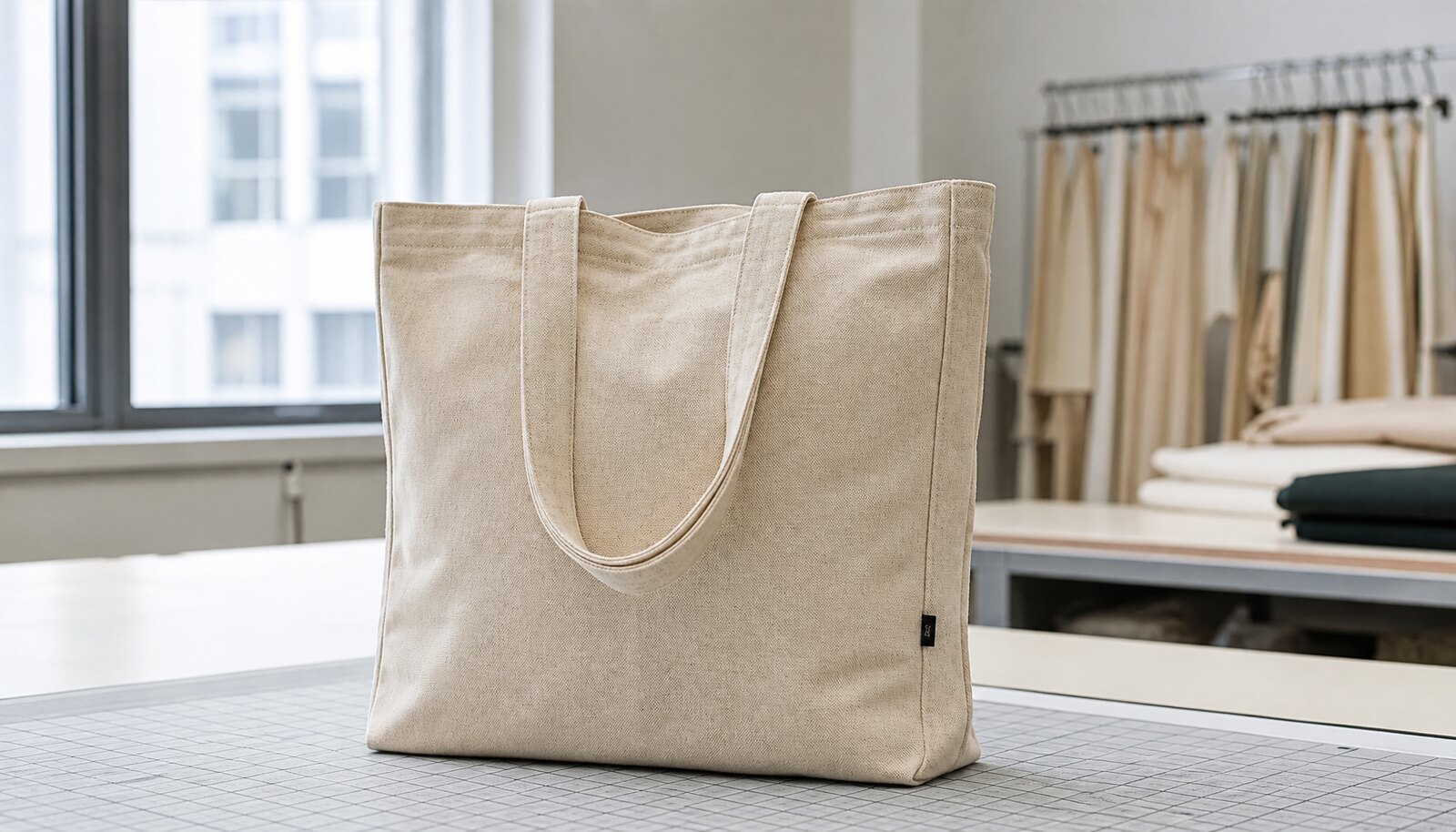
1. Why bookstore tote sourcing fails when the price plan is vague
Bookstore buyers often begin with a simple request: recycled canvas totes for bookstores bulk pricing plan, logo on one side, ship them quickly. That is enough to get a quote, but not enough to buy well. The problem is that a tote quote can hide multiple decisions: fabric weight, handle construction, print method, packing style, carton count, and delivery term. If those variables are not frozen before quoting, the supplier is not pricing the same product you think you are buying.
For bookstores, the tote is usually more than a giveaway. It can be a resale item, a gift-with-purchase, a membership reward, or an everyday checkout bag. That matters because the tote has to carry books without collapsing, look clean enough to sit near the register, and survive repeated folding and handling. A bag that feels too thin or prints too loosely will look like a promo item even when it is being sold as merch. A bag that is too heavy may improve perceived quality but can reduce margin and raise freight.
Procurement buyers should treat the tote as a retail item with a commercial spec, not a generic event bag. The right process is: define the end use, lock the spec, ask for tiered pricing, and compare like for like. That sounds basic, but it is where most sourcing mistakes begin. If one supplier quotes a 10 oz bag with loose bulk packing and another quotes a 12 oz bag with retail folding and label sewing, the cheapest line item is not the best value. The comparison has to account for what is included, what is excluded, and what the customer will actually receive at store level.
- Start with the tote’s use case: resale, gift-with-purchase, checkout, or event merch.
- Do not compare quotes unless the same spec sheet, carton pack, and Incoterm are used for every supplier.
- Treat print setup, label tooling, and packing as commercial line items, not invisible extras.
2. Build a bookstore-friendly recycled canvas spec before you ask for price
For most bookstore programs, 10 oz to 12 oz recycled canvas is the sensible procurement range. Ten-ounce fabric is usually the better starting point when the buyer needs to protect margin or hit a retail price target. Twelve-ounce fabric is often the better choice when the tote is a visible merchandising item, a premium gift, or part of a long-life retail assortment. The point is not that one number is universally better; the point is that the bag must match the buying channel and carry load.
The RFQ should define recycled canvas more precisely than the phrase alone. Ask whether the material is recycled cotton, a recycled cotton blend, or post-industrial recycled canvas with a conventional cotton face. Those differences affect slub appearance, color consistency, print edge definition, and the way the bag folds after use. If the supplier cannot explain the source of the fiber, it becomes difficult to judge whether a price difference is real or just a spec substitution.
Size also matters. Bookstore buyers usually need enough internal volume for a paperback bundle, a hardback, a journal, or a small gift item. Specify finished body width, height, gusset depth, handle drop, and any reinforced bottom detail. The more precise the bag dimensions, the easier it is to estimate carton efficiency and store presentation. A tote that stands well on the shelf may be worth more than a cheaper bag that slouches flat after folding.
Color should be handled as a sourcing decision, not a vague aesthetic request. Natural recycled canvas often gives the best cost and the least risk. Dyed colors can look attractive, but they can introduce shade variation, shrinkage differences, and longer lead time. If you want dyed fabric, ask for a small lab-dip or strike-off path before bulk approval. That way, the factory is pricing the right route from the start.
- Use 10 oz for cost-sensitive programs; use 12 oz when retail feel and shape matter more.
- Define recycled canvas composition in the RFQ instead of relying on a generic term.
- Lock size, gusset, handle drop, and color approach before you request tiered pricing.
3. Decoration choice has to be priced before the first supplier comparison
Decoration is one of the biggest hidden drivers in recycled canvas tote pricing. Screen print is usually the best commercial option for one or two solid colors because it gives a clean result, a predictable setup, and efficient bulk economics. It also scales well when the artwork is simple and the print area is not oversized. The limitation is that recycled canvas has texture, so very fine text, delicate lines, and heavy gradients can lose clarity if the mesh, ink, or cure settings are not matched to the fabric.
A woven label, side label, or small sew-on patch can be better for bookstores that want a more understated premium look. This route often uses less ink, creates less visual clutter, and keeps the brand visible without dominating the bag. It can also help when the buyer wants the tote to look like a retail accessory rather than a promotional item. The tradeoff is that label sewing adds a placement risk, and the quote should state where the label sits relative to seams, folds, and handle stress points.
Heat transfer is worth pricing only when the artwork demands it. It can help with small runs or complex graphics, but it should not be assumed to perform like screen print. The buyer needs the supplier to state how the decoration will be cured, what rub test they use, and whether the print is intended to survive repeated folding and backroom handling. The right way to compare options is to price the same artwork through two or three routes, then compare unit cost, setup cost, and the risk of early wear.
For bookstore programs, the safest procurement habit is to keep the artwork simple. One strong logo, one placement, one approved size. If the design includes fine type, QR codes, or a special campaign graphic, ask the supplier for a proof on real fabric before approving mass production. The higher the complexity, the more likely the quote will shift after sampling if the first setup does not print cleanly.
- Screen print is the default for simple bookstore logos and repeatable bulk pricing.
- Woven labels or patches work best when the brand wants a premium, understated look.
- Ask for a real-fabric proof whenever the artwork has fine text, QR codes, or thin lines.
4. MOQ-to-price curve: what changes at 500, 1,000, and 3,000 pieces
MOQ is not just a factory policy; it is the point where setup cost either hurts or disappears. At 500 pieces, the supplier spreads cutting waste, screen setup, and packing labor over fewer bags. That is why the unit price often feels steep even when the tote spec is reasonable. At 1,000 pieces, many factories start to recover more of the setup cost through efficient cutting and steadier production flow. At 3,000 pieces, the price curve often improves again if the design is stable and the supplier does not need to split the run across multiple fabric lots or print versions.
For bookstore buyers, this matters because the right initial volume depends on how the tote is being used. A local independent bookstore or a pilot program may only need 500 units to test demand. A chain promotion or seasonal campaign may justify 1,000 to 3,000 units because the buyer can amortize decoration setup, cartons, and freight over a broader sell-through. The key is not to choose the lowest MOQ automatically. The key is to know how much extra you pay for smaller volume and whether the extra margin is acceptable for the first run.
A useful procurement request is to ask the supplier to quote a clear tier ladder: 500, 1,000, and 3,000 pieces at the same spec. This reveals the MOQ-to-price curve. If the jump from 500 to 1,000 is large, the supplier is signaling setup-heavy production or inefficient cutting. If the jump from 1,000 to 3,000 is small, the program may be ready for scale. That is far more useful than a single price point, because it shows how much room the buyer has to improve cost on the next reorder.
Be careful with multi-color and multi-style orders. MOQ should be stated per style, per color, and per decoration version if needed. Otherwise the factory may quote one attractive number and later add charges for every added variation. For bookstores that want seasonal designs, it is usually better to keep one body spec and vary only the print or label. That preserves the pricing curve while still allowing SKU rotation.
- Ask for prices at 500, 1,000, and 3,000 pcs to expose the real curve.
- State whether MOQ applies per color, per style, or per artwork version.
- Keep the body spec stable and change only the graphic when you want seasonal variety.
5. Comparison table: sourcing routes, pricing bands, and decision rules
A good tote procurement plan compares sourcing routes as well as unit prices. The lowest ex-works number is not always the best landed result once packing, quality drift, and freight efficiency are included. Direct factory sourcing usually gives the buyer more control over fabric selection, sewing details, and packing decisions. Trading companies can be useful when the buyer wants a smaller launch or a mixed product program, but the sourcing chain must be clear or the quote can hide markups and substitution risk.
Use the table below as a decision guide, not a rigid rule. The right route depends on your quantity, how often you will reorder, and how much spec control you need. Bookstores with repeat seasonal programs usually benefit from direct factory control. Buyers testing a first promotion may prefer a trading route if they need broader support. Either way, the quote must disclose who actually sews, prints, inspects, and packs the tote.
Commercially, the real question is not only what the tote costs at the factory gate, but what it costs to deliver a sellable unit to the warehouse or store network. That is why the comparison includes pricing bands and sourcing-route implications. The buyer should be able to see where setup costs, freight density, and QC risk enter the picture.
6. Quote structure: what must be in the same basket before you compare numbers
Two tote quotes can look close and still be impossible to compare. The most common reason is that one supplier has bundled setup charges, while another has separated them; one includes retail folding, while another quotes loose bulk only; one assumes FOB port delivery, while another is giving an inland or DDP-style figure. If those assumptions are not aligned, the buyer is comparing different commercial bundles rather than real alternatives.
A proper quote sheet should separate base bag cost, decoration setup, label cost, packing materials, cartons, and freight term. It should also state whether the price covers fabric purchase, cutting loss, sewing, print setup, and final packing. Buyers should ask for the same Incoterm on every quote and the same carton count. If one supplier uses a larger carton count or looser folding, the apparent unit price can be artificially low because the freight and handling impact are being hidden elsewhere.
It is also important to ask what the supplier is excluding. Exclusions are where many procurement surprises sit: insert cards, barcode labels, extra polybags, moisture protection, palletization, or a second print hit. If the supplier does not write exclusions plainly, the buyer may face later surcharges or discover that the first production lot does not match the approved sample. A quote that is too brief is not buyer-friendly; it is risk-heavy.
For internal approval, it helps to build a simple landed-cost workbook. Start with unit price, add packaging, add estimated freight, then add any label tooling or sample amortization. If you expect reorders, divide the one-time setup across the expected order horizon. This shows the true cost of first buy versus repeat buy and helps the buyer decide whether to invest in better decoration or packing upfront.
- Require every quote to show what is included and what is excluded.
- Use the same Incoterm, carton count, and packing method across all bids.
- Add setup, packing, and freight into one landed-cost view before approval.
7. Example landed-cost math for bookstore tote planning
A practical landed-cost model is easier to use than a theoretical one. Suppose a bookstore wants 1,000 recycled canvas totes with one-color screen print, bulk folded in master cartons, and shipment to a domestic warehouse. The example below is not a promise of market price; it is a way to think about cost drivers before you quote. If the fabric weight changes, the carton count changes, or a label is added, the landed figure will move.
Example planning model: start with a quoted unit price for the bag body and printing. Add any screen setup fee. Add unit packing cost if the tote needs individual polybags, barcode stickers, or insert cards. Add domestic or international freight based on carton count and cube. Add a small allowance for sample cost if your organization amortizes it into the first order. Then compare the total to the expected retail margin or giveaway budget. The buyer can quickly see whether the tote supports the business case or needs a spec adjustment.
Here is the useful part: the cheapest bag often becomes more expensive after freight if it is packed inefficiently or requires an oversized carton. A slightly heavier tote may use the same carton volume as a lighter one, meaning the freight difference is smaller than expected. Likewise, a simple label can be cheaper than a large print because it may reduce setup and yield a cleaner retail look. The landed model should therefore test the full basket, not only the bag body price.
When you ask suppliers for a quote, ask them to give carton dimensions and gross weight. That lets your team estimate shipping cube and receiving efficiency. If the cartons are too large for the bag count, the freight math will look worse. If cartons are overpacked, you may save on freight but create crushed corners, crease lines, and customer complaints. A good landed-cost plan balances unit price, pack density, and in-store appearance.
- Build landed cost from unit price, setup, packing, freight, and sample amortization.
- Ask for carton dimensions and gross weight so your team can estimate cube and receiving efficiency.
- Do not assume the lightest bag is the cheapest once freight and shelf quality are included.
8. QC standards: the thresholds that matter before production starts
Quality control should be measurable, not just descriptive. For recycled canvas totes, the buyer should define what counts as acceptable before production begins. Start with fabric weight: ask for the finished oz or GSM and the tolerance allowed per lot. If the supplier cannot state a tolerance, the buyer has no way to know whether the delivered fabric matches the approved sample. The same is true for size. The RFQ should specify the finished width, height, and gusset with an allowable variance.
Stitch quality needs explicit numbers. Ask the factory to state stitch-per-inch targets for hems, seams, and handles. A tote used in a bookstore should not be approved on “looks okay” alone. The buyer should look for even stitch spacing, no skipped stitches, and no loose thread tails at load points. Handle joins should include bartacks or equivalent reinforcement if the tote is expected to hold books or heavier bundled items. If the factory cannot explain how it reinforces the stress points, that is a warning sign.
Load performance should also be tested in a practical way. Fill the sample with books or a weight equivalent to the intended use and check seam behavior, handle stretch, and bottom shape retention. A good tote should keep its shape during normal carry and should not twist permanently when lifted. For print, define the acceptable position tolerance and the visual limit for registration blur. A logo can be centered enough to pass in production and still look off to a retail buyer if the placement drifts too far from the fold line.
Color tolerance should be handled using a sealed reference sample or a physical swatch under neutral light. Recycled canvas can vary naturally from lot to lot, so the buyer needs a visual method for deciding what is acceptable. Reject batches that shift beyond the approved range or that look obviously different across panels. Finally, make packing part of the QC standard. A carton with wrong counts, crushed corners, or mismatched labels can create warehouse delays even when the tote itself is fine.
- Define stitch-per-inch targets, not just “good stitching.”
- Use a pull or load test on the sample and keep the result on file.
- Reject production that misses size, color, print placement, or count tolerances.
9. Sampling and approval workflow that protects the first bulk order
The sample is not only a visual check; it is the point where the buyer verifies that the factory can repeat the spec at scale. Start with a pre-production sample that reflects the final artwork, final fabric, final handle construction, and final packing method. If the sample uses a different fabric lot or a different fold, it is not a useful approval reference. The buyer should inspect the sample under neutral or natural light and compare it to the chosen reference photo or physical swatch.
A bookstore tote sample should be tested the way customers will use it. Put books or equivalent weight inside, check how the handles feel, and confirm that the bag still sits upright or at least maintains a clean retail profile. If the program includes an insert card or barcode sticker, approve those too. Many production problems come from details that were never checked on the sample: a label that interferes with folding, a barcode that sits over a seam, or a handle that pulls the top hem out of shape.
Keep one sealed sample after approval. That sample should be the reference for incoming inspection and dispute resolution. Ask the supplier to photograph the sample from multiple angles and to confirm the approved version number in writing. If there are changes after approval—new label text, different carton count, or a shift in decoration placement—treat them as a formal revision and re-approve before bulk starts. This discipline prevents “small” changes from becoming quality drift in production.
It is also sensible to ask for a first-article check on the initial bulk run if the order is large or time-sensitive. That means the factory completes a few units from actual production materials and you approve them before the full run proceeds. This is useful when the tote is linked to a launch date or when the artwork is tight. It costs a little time, but it is cheaper than discovering an error after several thousand units have already been sewn.
- Approve the final sample under the same lighting you will use for inspection.
- Test the sample with realistic book weight before sign-off.
- Freeze any later changes as a formal revision with a new approval record.
10. Packing, carton math, and shipping decisions that affect store-ready delivery
Packing is a commercial decision, not just a logistics detail. Bulk folded totes in master cartons are the lowest-cost route when the bags are moving to a warehouse or distribution center. That option reduces unit handling and usually improves freight efficiency. A retail fold with an insert card, barcode, or hangtag is better when the tote will be sold directly in-store. The buyer pays a little more, but the product arrives shelf-ready and can reduce backroom labor.
The carton spec should be based on the folded tote thickness, not a generic carton size. A recycled canvas tote with webbing handles, a gusset, and reinforcement stitching can take more cube than expected. If the carton is too tight, the corners can crush and the print can crease. If the carton is too loose, the bags shift and the receiving team gets a messy, uneven stack. Ask the supplier to propose carton count, carton dimensions, and gross weight together so you can judge cube and handling.
For bookstore buyers, moisture protection is worth discussing, especially when the route involves humid transit or long storage. A simple polybag may be enough, but if the tote has a retail label or printed surface that scuffs easily, the buyer may want extra protection. The point is not to overpack every tote. The point is to match protection to the route and the shelf outcome. If the order is moving straight to stores, a cleaner retail fold may be worth the added cost. If it is going to the warehouse first, bulk packing is usually the better commercial choice.
When freight is being compared, carton efficiency matters as much as bag price. Ask for gross weight and carton cube because a tote that looks inexpensive at the unit level can become costly if the cartons are bulky. That is why the best procurement teams treat packing as part of the spec, not as an afterthought after the order is placed.
- Bulk master-carton packing is best for warehouse fulfillment.
- Retail fold, insert cards, and barcode labels are best for shelf-ready delivery.
- Ask for carton dimensions, gross weight, and pack count before approving the quote.
Specification comparison for buyers
| Spec decision | Recommended option | Why bookstore buyers choose it | Quote and QC points to verify |
|---|---|---|---|
| Fabric weight | 10 oz to 12 oz recycled canvas | Best balance of body, perceived value, and freight weight for bookstore resale, gift-with-purchase, and checkout tote programs | Ask for exact oz or GSM, fabric tolerance by roll, and a cut-piece sample from the same lot |
| Pricing tier at 500 pcs | Higher unit price; setup cost spread over fewer bags | Useful for pilot launches, seasonal tests, and independent bookstores with limited storage | Confirm whether screen setup, label tooling, and packing are already included or charged separately |
| Pricing tier at 1,000 pcs | Common break point for better unit economics | Often the first volume where cutting, printing, and packing become materially more efficient | Request a price jump schedule from 500/1,000/3,000 pcs to see the MOQ-to-price curve |
| Pricing tier at 3,000 pcs | Lower unit price if spec is stable | Fits chain-wide promotions, annual programs, and repeat private-label replenishment | Check whether the lower price depends on one colorway, one carton pack, or one shipment window |
| Source route | Direct factory with recycled canvas sewing and decoration capability | Best for buyers who need spec control, repeatability, and better leverage on trim, fabric, and packing | Verify factory role, audit photos, and whether they subcontract sewing or printing |
| Source route | Trading company or sourcing agent | Useful when you need broader category coverage or smaller first orders | Ask who actually controls fabric, sewing, and print approvals; hidden markups often sit in the chain |
| Decoration method | 1-2 color screen print | Most efficient for bookstore logos, event marks, and simple retail branding | Confirm mesh count, print position tolerance, cure method, and rub resistance criteria |
| Decoration method | Woven label or small sew-on patch | Good for premium tote lines where understated branding matters more than a large print | Check label stitch location, fold interference, and edge fray control |
| Handle construction | Reinforced self-fabric or webbing handles | Webbing supports heavier book loads; self-fabric can keep cost lower | Ask for handle width, stitch rows, bartack locations, and pull-test target |
Buyer checklist before sampling
- Lock the end use first: resale, gift-with-purchase, checkout bag, or event merch. The use case drives weight, handle strength, and packing.
- Specify fabric composition, exact oz or GSM, and an allowable roll-to-roll tolerance. If you do not set tolerance, you cannot judge quote differences fairly.
- Define bag dimensions, gusset depth, handle drop, handle width, and stitch pattern on one spec sheet.
- Send vector artwork, Pantone references, logo placement, and the maximum print area in millimeters.
- Choose the decoration route before quoting: screen print, woven label, patch, or mixed decoration.
- Request tiered pricing at 500, 1,000, and 3,000 pcs so you can see the MOQ-to-price curve.
- Ask for sample lead time, bulk lead time, and what causes schedule slippage, including artwork changes and trim substitution.
- Confirm packing method, carton count, carton dimensions, gross weight, and whether barcode labels are on unit pack or master carton.
- Request one physical pre-production sample and keep one sealed approval sample as the production reference.
- State inspection criteria in writing: stitch defects, color tolerance, print registration, load test, and carton count acceptance.
Factory quote questions to send
- What is the exact recycled canvas composition, finished weight in oz or GSM, and the acceptable tolerance by production lot?
- Are you the direct factory for sewing and printing, or are any steps outsourced? If outsourced, who signs off on fabric and print quality?
- Please quote the same tote at 500, 1,000, and 3,000 pcs so we can see the unit-price curve and the break point for better economics.
- What is included in the base unit price: body sewing, handle construction, print setup, label sewing, packing, and cartons?
- What are the setup charges for each decoration method, and do they change if we move from one color to two colors?
- What handle construction is standard, how many stitch rows or bartacks are used, and what pull-test target do you use internally?
- What are your sample lead time, pre-production sample cost, bulk lead time, and the most common causes of delay?
- What carton size, pack count, and gross weight do you propose, and what is the landed cost effect if we change the fold or insert card?
- How do you control color consistency for recycled canvas across rolls, and what is your method for handling shade variation?
- Can you provide in-process and final inspection photos, plus the acceptance criteria you use for stitch quality, print registration, and packing count?
Quality-control points to confirm
- Fabric verification: confirm the approved weight in oz or GSM on the lot record and compare against the approved sample. A practical acceptance rule is the agreed finished weight range plus or minus the supplier’s stated tolerance; reject if the fabric is visibly underweight, overly thin at the fold line, or inconsistent between panels.
- Stitch density: require a consistent stitch count on the seams and handles, with no skipped stitches, loose loops, or broken thread. For a bookstore tote, ask the factory to state stitch-per-inch targets for top hems, side seams, and handles; if they cannot state a number, the process is too informal for bulk buying.
- Handle security: verify bartacks or reinforcement at the handle join points. Pull-test a finished sample to the internal target the supplier uses for production. If no target exists, define one in the RFQ and require a recorded result on the sample approval sheet.
- Load and shape retention: fill the sample with books or an equivalent test load and check that the bottom stays flat, seams do not twist, and the tote remains functional after repeated lifting. Reject if the handles distort, the gusset collapses, or the body permanently tilts under normal carry weight.
- Print control: define print position tolerance before sampling. A usable retail threshold is a centered logo within the agreed tolerance band on both left-right and top-bottom placement; reject if the artwork touches a seam, drifts off-center, or shows obvious registration blur.
- Color tolerance: approve against a physical standard under neutral light, not only on a screen photo. Use a simple A/B comparison method against the sealed reference sample or Pantone-approved swatch, and reject if the production lot shifts beyond the agreed visual tolerance.
- Trim and label quality: check woven labels, side labels, and insert cards for fray, crooked stitching, or placement that interferes with fold lines or handle stress points.
- Packing accuracy: verify unit count per polybag or carton, carton marks, barcode placement, and moisture protection. Reject shipments with overfilled cartons, missing labels, crushed corners, or mismatched pack counts.
- Final inspection threshold: define major and minor defects in the RFQ. Major defects should include wrong fabric, wrong size, broken seams, unreadable print, or wrong count; any carton with major defects should be held for rework or replacement before release.