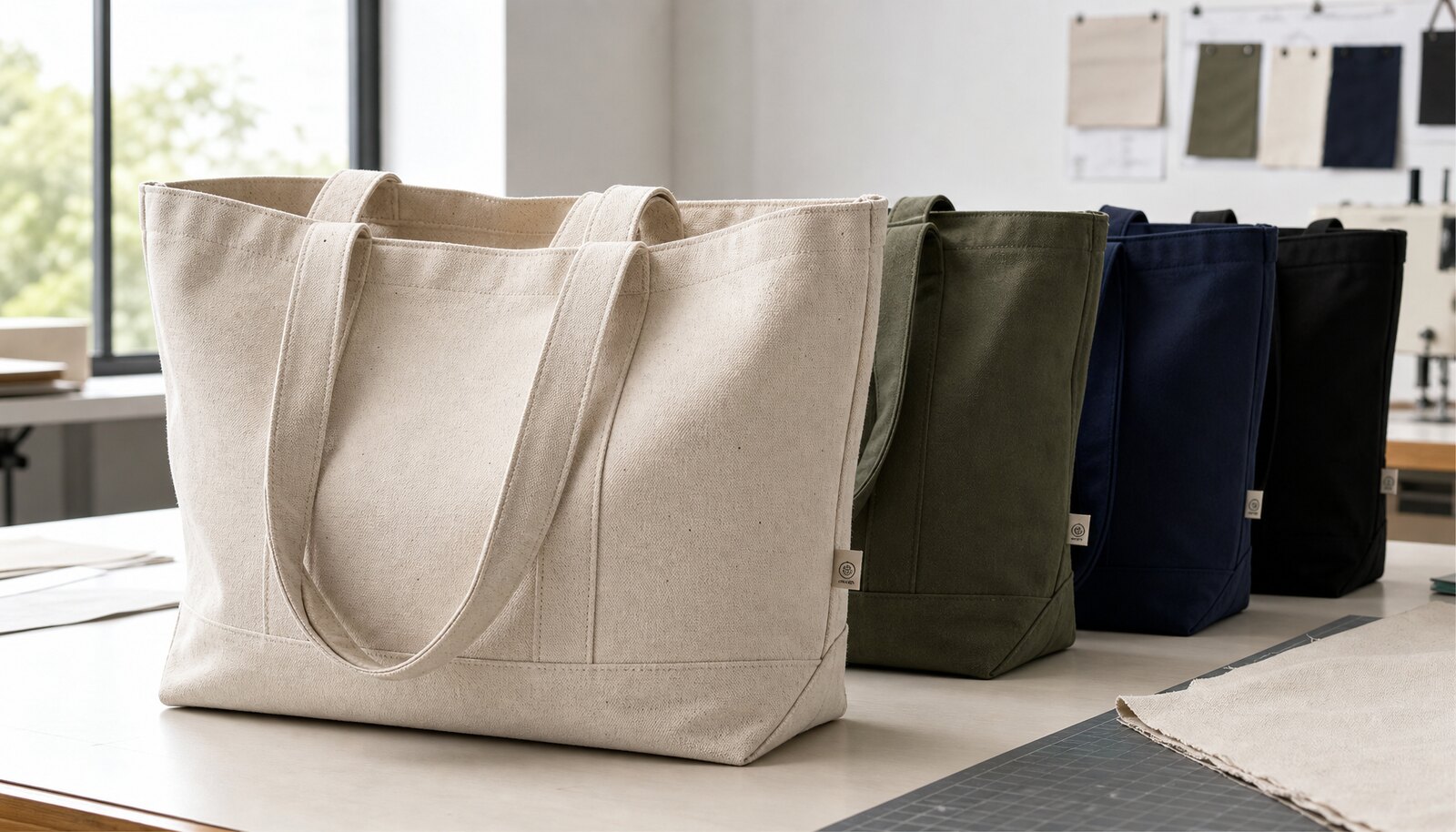
Start With the Event Use Case, Not the Tote
Bookstore giveaways are not all the same job. A tote handed out at checkout for a paperback promo does not need the same structure as a bag that carries a hardback, a catalog, and signed inserts after an author talk. If the brief is vague, the supplier will quote a generic tote and optimize for the easiest build, not the real use. The buyer should define what the bag must carry, how it will be handed out, and whether the goal is a low-cost giveaway or a reusable branded item that stays in circulation after the event.
A useful way to frame the project is to separate it into light giveaway, mixed media bag, and book-carry tote. Light giveaway runs can work at 240-280 gsm if the load is minimal. Mixed media usually needs 280-340 gsm, a proper gusset, and a stronger bottom seam. If the tote may hold multiple books, move the brief toward a heavier body, reinforced handles, and a load test. When those use cases are mixed in one order, the supplier will usually price to the weakest spec unless you make the minimum acceptable build explicit.
- Write the intended load in concrete terms, such as two paperbacks and one hardback.
- State whether the tote must fit A4 catalogs or standard 8.5 x 11 inserts.
- Decide early whether premium hand feel or lowest landed cost has priority.
Fabric Weight, Body Shape, and Handle Build
Recycled canvas is not one material. Mills blend recycled cotton, recycled cotton/poly, and other recycled fiber mixes in different weights and finishes, and those differences matter in a bookstore setting. For event giveaways, 280 gsm is a practical floor if the bag has to hold books without sagging. 320-340 gsm gives a firmer body, better print opacity, and a more premium hand feel, but it also adds fabric cost and sewing time. If the brand wants a softer, less rigid bag, a 280 gsm body with a controlled gusset is often the better commercial choice.
Body shape matters as much as fabric weight. A flat tote saves money and packs efficiently, but a 10-15 cm gusset improves usable capacity for books and handouts. Handles should be long enough for shoulder carry if the event involves crowded aisles or guests leaving with multiple items. A common buyer mistake is approving a sample that looks fine on a table and then feels short and awkward once loaded. The tote may technically work, but the user experience drops fast, and that hurts the brand impression.
- Good baseline: 280-340 gsm recycled canvas, 35-40 cm wide, 38-42 cm high, 10-15 cm gusset.
- Handle length: 55-60 cm for shoulder carry or 50-55 cm for hand carry.
- Ask for finished size after stitching, not cut size before sewing.
Print Method and Artwork Limits
For bookstore event giveaways, the decoration is usually simple: a logo, a reading-season message, a store name, or a short event title. Screen print is still the safest route for one or two colors because it is durable, easy to control, and economical at medium volume. Water-based ink is a good fit when the buyer wants a softer hand on natural recycled canvas. If the art has fine type, gradients, or more than two colors, the quote must say whether the supplier is using screen print with separations, heat transfer, or digital printing, because each process changes cost, lead time, and acceptable artwork detail.
The hidden cost is rarely the ink. It is the artwork cleanup. Thin strokes can disappear into the recycled fiber texture, and small reversed text can fill in after print. A good factory should tell you the minimum stroke width, the safe print area, and any border needed around the art before sampling. If the logo has to sit close to a seam, edge, or gusset fold, ask for a placement drawing on the stitched bag. That avoids the common argument where the flat sample looked centered, but the assembled tote shifts the artwork once sewn.
- Use one or two spot colors when the goal is a clean, retail-grade giveaway.
- Avoid hairline details and tiny reversed text unless the process is proven on canvas.
- Approve print size on a stitched sample, not only on a flat artwork proof.
How MOQ and Price Should Be Read
A tote quote is only useful when the MOQ logic is visible. Direct factories usually price better once the order reaches a full material run because fabric cutting, printing screens, and sewing setup costs are spread across more units. If a supplier gives almost the same unit price at 500 and 5,000 pieces, read that carefully. They may be using stock fabric, a trading margin, or a different print route that is not obvious in the quote. For bookstore events, it is usually smarter to ask for pricing at 1,000, 3,000, and 5,000 pieces so the setup cost curve is visible.
The cheapest quote is not always the right one if the tote will be seen by the public at an event. A lower unit price can hide a lighter fabric, fewer stitches, a smaller print area, or bulk packing that moves labor to your team. Compare each offer on the same basis: identical fabric weight, exact size, handle spec, print colors, reinforcement, packing method, and incoterm. If those variables are not locked, the comparison is noise. The buyer ends up selecting the cheapest misunderstanding.
- Request tiered pricing at 1,000, 3,000, and 5,000 pieces.
- Ask whether the unit price includes print, woven label, hangtag, or inner packing.
- Separate factory price from freight and destination handling before comparing suppliers.
Compare Sourcing Routes Before You Quote
For recycled canvas totes, the sourcing route changes both control and risk. A direct factory gives the buyer stronger control over fabric weight, stitch details, and print method, which matters when the tote has to match a bookstore event brand. A trading company can simplify communication and bundle multiple products, but the buyer needs to know who actually controls fabric sourcing and quality inspection. A regional decorator using blank stock is faster for urgent events, but the fabric, shade, handle build, and finishing options are limited by what is already in inventory.
The right route depends on timeline and spec depth, not on slogans about one-stop service. If the project is tied to a seasonal author tour and the tote has to feel consistent across all events, a direct factory or tightly managed trading model is usually safer. If the order is a simple one-color logo on a standard tote and the deadline is tight, blank stock can be acceptable. The buyer should ask every supplier to state whether the tote is made to order, printed from stock, or assembled from pre-bought components. That one line often reveals more than the sales pitch.
- Direct factory: better for custom size, handle, reinforcement, and repeat ordering.
- Trading company: useful when you need consolidation or multiple product lines in one PO.
- Local decorator: good for rush jobs, but weaker on material control and shade consistency.
Sample Approval That Actually Catches Mistakes
The sample should be treated like a pre-production part, not like a marketing prop. Start with finished dimensions, fabric weight, handle width, seam quality, and print placement. A sample can look polished and still fail if the tote shrinks too much, the handles twist, or the print lands too close to the seam. For bookstore use, put a paperback, a hardback, and a brochure inside the sample, then carry it by the handles for a realistic feel. That tells you more than a flat photo or a clean tabletop shot ever will.
Set pass and fail criteria before the sample ships. Ask for a measurement sheet with cut size and finished size, close photos of the inside seams, and confirmation of the print method. If the supplier provides a pre-production sample, use it to validate the production recipe, not to debate the brand story. A second sample round is expensive because it usually means the specification was too loose the first time. The safest approach is to lock the spec early and use the sample to catch execution errors, not to redesign the tote from scratch.
- Measure finished width, height, gusset, and handle drop on the physical sample.
- Inspect handle stitching, corner reinforcement, and seam alignment.
- Reject samples with obvious shade mismatch, print blur, or an uneven top edge.
Packing and Event Distribution
Bookstore giveaways often look simple until packing starts. If bags are shipped bulk packed, the unit cost is lower and carton efficiency is better, but your event team must sort and distribute them. If each bag needs an insert, postcard, or QR card, confirm whether the factory can do kit packing or whether that work must happen after receipt. Many buyers miss the labor cost of adding inserts later and then wonder why a cheap tote becomes expensive once the event kit is assembled. The packing method should match the handoff plan, not just the shipping quote.
Carton planning matters because recycled canvas is bulky for its weight. Ask for carton dimensions, gross weight, and carton count before freight is booked. If the event is retail-led, a reusable polybag can protect print quality in transit. If the bags are handed out the same week they arrive, bulk packing may be enough. The correct choice is not automatically more packaging; it is the packing that protects the print, stays within freight limits, and does not slow event prep. Packaging is part of the production cost, not an afterthought.
- State whether each tote needs an insert, hangtag, barcode, or UPC sticker.
- Ask for carton count per size and per color if there are variants.
- Confirm whether carton marks should show style code, quantity, and destination detail.
Lead Time Risk and Schedule Control
Lead time slips usually happen before sewing starts. The common delays are artwork approval, fabric sourcing, color matching, and screen setup. A buyer who needs bags for a bookstore anniversary event should work backward from the event date and leave time for sample approval, production, packing, transit, and a cushion for receiving. If the supplier says the tote can be finished quickly but has not confirmed fabric availability, that is a warning sign, not a schedule. The best schedule is the one that is realistic on paper before any PO is issued.
The cleanest way to control timing is to freeze the spec early. Once the buyer changes fabric weight, print color count, or handle length after the sample, the production clock usually resets. For seasonal campaigns, ask the factory to state the latest artwork approval date and the latest material lock date. If the event date is fixed, choose the route that gives the most predictable delivery, even if the unit price is slightly higher. A late giveaway has no value. In procurement terms, on-time delivery beats a small cost saving that arrives after the event is over.
- Keep a dated approval trail for artwork, sample, and carton mark signoff.
- Ask for production milestones: fabric ready, print done, sewing complete, packed.
- Add extra time if the order uses recycled materials with visible shade variation.
Landed-Cost Comparison and Final RFQ Package
The strongest RFQ is the one that makes quote comparison easy. Include the tote use case, target load, finished size, fabric GSM, print colors, handle length, packaging method, carton target, incoterm, and required shipment date. Then ask suppliers to quote the same quantities on the same terms. When one supplier includes inner polybags and another leaves them out, the price gap is not real. For bookstore events, landed cost should include freight, destination handling, and any sorting or insert labor you will pay after the bags arrive.
It also helps to compare the amount of work required to get the tote event-ready. A slightly higher factory price can still win if it reduces repacking, lowers print defects, and arrives with enough buffer to absorb receiving delays. Treat the tote as a small production program, not as a loose accessory purchase. The supplier that gives the clearest answers often ends up being the least expensive over the full order cycle because fewer corrections are needed later. Good sourcing is not only about what is printed on the quote; it is about what happens after the truck arrives.
- Use one RFQ file for all suppliers so the comparison stays clean.
- Require them to separate unit cost, sample cost, freight, and tooling.
- Ask for overrun or underrun tolerance and whether partial shipment is allowed.
Specification comparison for buyers
| Spec decision | Recommended option | When it fits | Buyer risk to check |
|---|---|---|---|
| Supplier route | Direct factory with recycled canvas capability | You need custom size, exact GSM, and repeat orders | Confirm who controls fabric, printing, and QC, not only the sales contact |
| Supplier route | Trading company managing multiple factories | You want one contact for mixed products or bundled orders | Ask for the actual factory name and inspection ownership |
| Supplier route | Local decorator using imported blank stock | You need a fast regional drop for a small event | Check whether fabric, handle length, and shade are fixed by stock |
| Fabric weight | 280-340 gsm finished recycled canvas | Books, catalogs, and heavier handouts will go inside | Light fabric may sag or show print bleed |
| Print method | 1-2 color screen print with water-based ink | Brand mark is simple and the order volume is medium or high | Fine text, gradients, and tight registration need a better process |
| Reinforcement | X-box or bar-tack at handle joins and bottom stress points | The tote will carry hardbacks or be reused after the event | Overbuilding adds cost; underbuilding causes handle failure |
| Packing method | Bulk packed with carton labels and counted bundles | The event team can distribute bags without kitting inserts at origin | If inserts are required, confirm who pays labor and packing materials |
| Commercial terms | FOB with separate freight comparison | You need a clean view of factory price versus shipping cost | Do not compare quotes that hide different packing or handling charges |
Buyer checklist before sampling
- State the event date, venue type, and how the bags will be handed out.
- Define what the tote must carry: paperback, hardback, catalog, insert cards, or all three.
- Lock finished size, gusset depth, handle drop, and whether shoulder carry is required.
- Choose a fabric weight target and say whether the tote should feel soft, structured, or premium.
- Specify print method, number of colors, and whether the art must sit near a seam or edge.
- Decide on packing: bulk, polybag, insert pack, or carton labeling by event lot.
- Request a pre-production sample with finished measurements and load test notes.
- Compare quotes on the same incoterm, same packing method, and same quality standard.
Factory quote questions to send
- What finished GSM are you quoting after finishing, not just the raw fabric basis weight?
- Is the tote made from recycled cotton canvas, recycled cotton/poly blend, or another recycled fiber mix?
- What is your standard MOQ per color and per artwork version?
- Which print method are you quoting, and what is the minimum line width you can hold cleanly?
- What reinforcement do you include at the handle joins and bottom corners?
- Can you share the finished size, carton size, gross weight, and pack count per carton?
- What are your sample lead time and production lead time after sample approval?
- What overrun or underrun tolerance do you work to, and can you split shipment if needed?
Quality-control points to confirm
- Finished width, height, and gusset stay within the agreed tolerance after stitching.
- Handle length and handle drop match the approved sample and do not twist after load.
- Stitching on handles, side seams, and bottom seams is even with no skipped stitches or loose ends.
- X-box, bar-tack, or other reinforcement points are complete and positioned as approved.
- Print placement is centered correctly and does not drift into the seam allowance.
- Print color, opacity, and edge sharpness match the signed-off sample under normal light.
- Fabric shows no holes, oil stains, obvious shade mismatch, or broken needle marks.
- A simple load test with 5-7 kg for 30 minutes does not cause seam opening or handle failure.