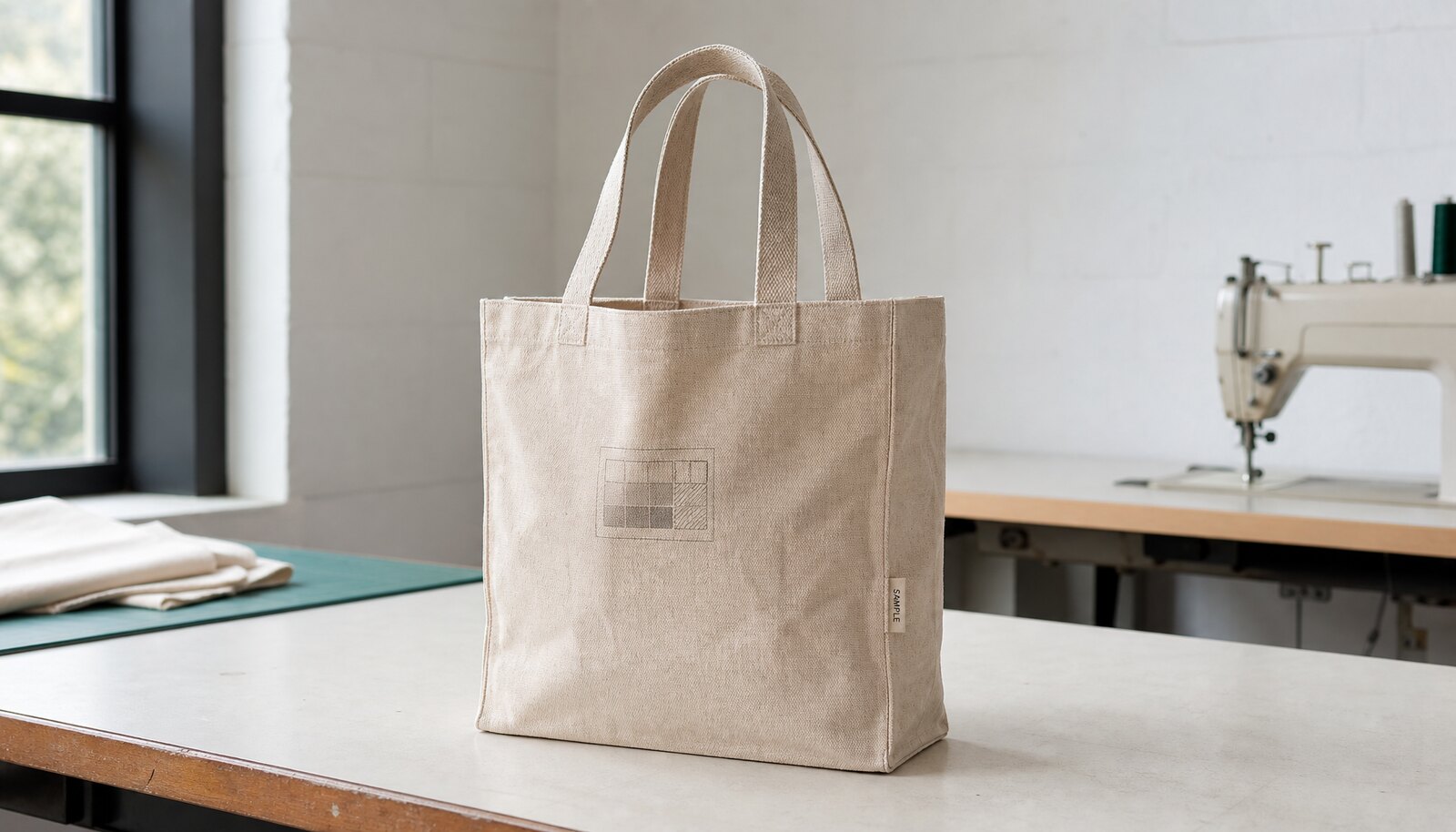
Why apparel brands need a tighter tote spec than most buyers expect
For apparel brands, a recycled canvas tote is rarely a simple bag. It often becomes part of the retail offer, a launch insert, a gift-with-purchase item, or a branded accessory that sits next to the clothing collection in the customer’s hand. That makes the tote a brand-touchpoint product, not just a shipping carton substitute. Buyers who treat it like generic promotional merchandise usually get generic results: soft handfeel, uneven print, weak handles, and packaging that looks fine in the quote but feels cheap in store.
The sourcing problem is that 'recycled canvas' is not a fixed product. Two factories can both use that phrase and still be quoting very different goods. One may mean a lightweight canvas with modest recycled input and simple stitching. Another may mean a structured bag with stronger handles, better print stability, and tighter finishing. If procurement only asks for a price without pinning down the bag’s use case, the comparison is not useful and the launch team ends up managing preventable revisions.
A good wholesale buying checklist for recycled canvas totes for apparel brands starts with business intent. Are you selling the tote at retail as a standalone item, using it as a branded packaging upgrade, or adding it as a margin-sensitive giveaway? Each one requires a different balance of material, decoration, and cost control. The bag that works for an internal event kit may not be good enough for a shop floor display.
The goal is to define the tote like any other product in the assortment: performance standard, appearance standard, packing standard, and commercial standard. Once those are written down, supplier quotes become comparable and you can evaluate the real trade-offs instead of the marketing language around them.
- For retail resale, prioritize shape, print clarity, and handle comfort.
- For garment packaging inserts, prioritize foldability, carton density, and consistent sizing.
- For giveaways, prioritize speed, repeatability, and a decoration method that survives handling.
Start with the right fabric spec, then work backward to price
Fabric weight is the first commercial decision because it drives almost everything else: cost, print performance, handfeel, seam stress, and how the tote photographs online. For many apparel-brand programs, a useful starting point is 14–16 oz recycled canvas, or roughly 400–500 GSM. That range is not a rule, but it is a practical benchmark when the tote needs to feel retail-worthy and keep its shape after being packed with folded apparel, catalogs, or samples.
The issue is not simply weight. It is how the fabric behaves in the finished bag. A canvas can be technically heavy and still feel floppy if the weave is loose or the finishing is inconsistent. A slightly lighter cloth can perform better if the weave is tighter and the sewing is cleaner. That is why buyers should request a swatch and not rely on the seller’s description alone. Ask to feel the fabric, inspect the weave, and compare the same spec from more than one factory before you lock the order.
If you are using the tote as a premium accessory, heavier fabric can help the item justify a higher retail price. If the tote is an insert or a cost-controlled promo item, you may need to accept a lower weight, but then the construction has to carry more of the performance load. In that case, reinforce the handles and top hem, and ask for a clear explanation of what the factory changed to keep the bag durable at a lower cloth weight.
For procurement, the question is not 'what is your cheapest recycled canvas?' It is 'what fabric weight and weave will deliver the look, carry performance, and margin structure we need?' That framing produces better quotes and fewer surprises after sampling.
If you want a fast shortcut, use this decision rule: choose the heaviest fabric that still keeps your landed cost within margin, then reduce weight only after you confirm that the bag still looks full, prints cleanly, and survives the intended use case.
- 10–12 oz: lower-cost option for giveaways, compact inserts, or campaigns with modest load requirements.
- 14–16 oz: common retail-grade range for stronger structure and better perceived value.
- Above 16 oz: more premium in hand, but check sewing stress, freight efficiency, and unit margin before committing.
Choose a decoration method that matches artwork complexity and reorder volume
Decoration is where many sourcing programs drift off spec. On paper, a logo can look simple. On fabric, the same logo may need a different method to stay legible and attractive. Screen print is usually the best value for bold artwork, solid logos, and repeatable volume. It is efficient, easy to reproduce, and well understood by most factories. But screen print on textured canvas still needs careful control of ink density, mesh choice, curing, and registration. Thin type can fill in, and oversized coverage can crack if the ink layer is too stiff.
If your brand wants a more fashion-forward or tactile presentation, a woven patch or embroidered patch can deliver better shelf appeal. That said, patch decoration adds thickness, sewing complexity, and a new failure point at the attachment edge. It also changes the look of the bag in a way that may not suit every collection. Heat transfer can work for short runs or multicolor art, but it is not the default choice for a premium tote unless you have test data showing it wears well on canvas.
The best practice is to approve decoration on the actual substrate, not only on a digital proof. Ask for a strike-off on the approved fabric, because canvas texture affects how ink lands and how sharp the logo reads. Review the strike-off in normal light and at close range. If the artwork has small text, ask the supplier to tell you the smallest readable size they can consistently hold. That number matters more than a pretty mockup.
For a wholesale order, the decoration method should be selected by art type, brand position, and reorder frequency. If you expect restocks, favor the method that can be repeated with the least variation. If the tote is a one-season fashion statement, you may accept a more complex decoration route if the visual result is stronger.
- Screen print: best for strong logos, simple artwork, and better unit economics at scale.
- Woven or embroidered patch: useful when the tote must feel more premium or more fashion-driven.
- Heat transfer: only after confirming durability, edge lift, and how the print sits on textured canvas.
Use MOQ logic to compare suppliers fairly
MOQ is often presented as a hard number, but it is really a reflection of the factory’s setup costs and process constraints. A supplier that quotes a low MOQ may be offering stock fabric, simplified printing, or a standard construction that happens to be close to your brief. A supplier quoting a higher MOQ may be giving you a cleaner custom route with better repeatability. Procurement should not assume the lower MOQ is the better buy until the production assumptions are visible.
For apparel brands, MOQ should be separated into components. The bag body may have one minimum, the custom label another, and the printed artwork a third. If you need to test multiple colorways, ask which changes trigger a new MOQ and which changes only add a small setup fee. This distinction matters when the first drop becomes a reorder with a new color, a different handle length, or a revised hangtag.
A practical quote comparison should include at least four fields: body MOQ, decoration MOQ, packaging MOQ, and reorder MOQ. Then ask whether the quoted MOQ is per style, per color, per artwork, or per fabric lot. Without that clarification, two quotes can look similar while being commercially very different.
If you expect the tote to return season after season, prioritize a spec that can be repeated without forcing a full re-development. That means choosing a fabric that is stable in supply, a decoration method with a known repeat, and packaging that does not depend on unusual custom components. Repeatability is a value driver, not just a production convenience.
The rule of thumb is simple: do not compare MOQ numbers in isolation. Compare the amount of freedom each supplier gives you to vary size, color, packaging, and label treatment without resetting the entire program.
- Ask whether the MOQ is driven by fabric dye lot, print setup, or sewing-line efficiency.
- Separate the MOQ for the bag from the MOQ for labels, inserts, and outer packaging.
- For reorders, confirm whether the original fabric and artwork can be repeated without a new approval cycle.
Comparison table: sourcing routes for apparel-brand tote programs
Before you compare unit price, compare the sourcing route. Different routes offer different tradeoffs in control, speed, and commercial visibility. A factory-direct quote can be the cleanest path when you need a custom spec, but it requires stronger buyer-side documentation and follow-up. A trading company can simplify coordination and paperwork, but the actual manufacturing source may be less visible. Domestic decorators can be fast and easy to manage, but they often become expensive when the spec gets more custom or the volume gets larger.
The right route depends on the order’s role in your business. A retail tote attached to a seasonal apparel drop should not be sourced the same way as a simple event giveaway. If the tote is part of your brand image, visibility into material origin, decoration control, and approval samples matters more than shaving a small amount off the quote. If the tote is a short-term test, speed may matter more than full supply-chain detail.
Use the comparison below as a procurement screen before you request samples or negotiate price. It will help you see where the hidden costs and hidden risks usually sit.
- Do not compare routes only by per-unit price; compare control, traceability, and repeatability.
- Ask which party holds the real production records: fabric source, decoration, and packing details.
- Tie every quote back to one spec version so quote differences are easy to explain later.
What a usable recycled-content claim actually looks like
Sustainability claims are easy to say and harder to support. For procurement, a recycled canvas tote is not just about the word 'recycled' in the product description. You need to know what the claim refers to, how it is documented, and whether the supplier can stand behind it if the brand asks for evidence later. If the tote will be sold with a sustainability message on hangtags, website copy, or wholesale line sheets, the documentation standard should be defined before production starts.
At a minimum, ask the supplier to state the fiber composition clearly. Is it recycled cotton, a recycled cotton blend, or fabric with recycled content only in one part of the construction? If the bag body uses recycled material but the handles, labels, or reinforcement use virgin material, the claim should reflect that nuance. If the supplier cannot explain the content in a way that a retail buyer or compliance team would understand, the claim is too vague for brand use.
You should also ask what proof is available. Depending on the supply chain, this may include transaction evidence, chain-of-custody documentation, mill declarations, or certification-related paperwork. Not every factory can provide the same level of support, and not every brand needs the same level of proof. But the supplier must be able to tell you exactly what is available and for which lot. Avoid accepting a generic 'eco-friendly' or 'recycled material' statement without supporting detail.
Country-of-origin matters too. If the tote will cross borders, the origin statement should be consistent across invoice, packing list, carton marking, and customs paperwork. Inconsistent origin language can slow clearance and create compliance questions. If the recycled claim is important to your brand story, ask the supplier how they will label the goods and which documents they can provide before shipment.
The practical approach is this: define the claim you plan to make, then ask the factory to show what evidence supports that claim. If the evidence is weak, reduce the claim or choose a different supplier. That is much cheaper than fixing sustainability language after the order ships.
- Ask whether the recycled-content claim applies to the body fabric, all textile components, or only part of the product.
- Request lot-level proof where possible, not only a generic factory statement.
- Verify that origin documents, invoice language, and carton markings tell the same story.
- Do not use broad 'eco' language in procurement notes if the final marketing claim needs support.
Sample approval should test more than logo placement
A good sample review for recycled canvas totes needs three separate checks: material, decoration, and construction. The fabric swatch tells you whether the canvas is too soft, too coarse, too thin, or too inconsistent. The strike-off tells you whether the logo is legible and stable on the actual substrate. The pre-production sample tells you whether the factory can reproduce the spec with real cutting, sewing, pressing, and packing. If you skip one of these steps, you are approving a partial product.
The sample should be judged like a retail item, not a craft project. Measure the finished dimensions, check the handfeel, inspect the inside seams, and review how the tote hangs when loaded. Look at the top hem, handle attachment, corners, and any gusset or base seam carefully, because these are the areas where poor workmanship is easiest to hide in photos. Ask the supplier to tell you the exact dimensions after sewing, not just the cut size, because shrinkage and sewing variance can change the final bag more than you think.
Color approval also matters. If the tote uses dyed fabric or a print that depends on exact contrast, compare the sample under standard light and keep a physical reference. Computer screens distort neutral tones and can make a rough fabric appear more even than it is. If the product is part of a fashion collection, ask for the tolerance on shade variation and whether the factory is expecting a single dye lot or multiple lots.
For important programs, the pre-production sample should be made with the same components as bulk: same fabric lot if possible, same label, same print method, same handle material, same carton style. If the sample uses upgraded components that bulk will not receive, the sample is not fully representative and the buyer should not approve it as final.
A useful habit is to annotate the sample with written notes: approval date, sample version, approved dimensions, agreed artwork, and any exceptions. That small step prevents disputes later when production and buying teams reference the sample months after approval.
- Check the fabric swatch, the strike-off, and the pre-production sample as separate milestones.
- Measure the actual bag after sewing and compare it against the approved spec sheet.
- Review handles, corners, top hem, and inside seams under normal light and close inspection.
- Record the sample version and any exceptions in writing before production begins.
QC thresholds that reduce returns and shipment disputes
Quality control for totes is mostly about measurable basics. Because the product is simple, even small defects are obvious to buyers. That means the acceptance standard should be defined before bulk runs so the factory knows what counts as a pass and what counts as a reject. A strong QC plan is not long; it is specific. It tells the supplier how much variation is acceptable, how defects are counted, and which issues trigger rework.
Start with appearance. Define how close the print must be to the intended position, how much misregistration is tolerable, and whether slight color variation is acceptable across the shipment. Then define sewing quality: whether skipped stitches, loose thread bundles, puckering, or uneven top hems are minor or major defects. Next, define performance: how the handles are checked, whether a pull test is required, and what visible failure would fail inspection. If the tote is meant for retail, presentation defects matter more than they would for internal packaging.
Use an AQL-style mindset even if you do not write a full formal inspection standard. That means defining sample size, acceptable defect categories, and the action threshold for each lot. Many brands use third-party inspection, but the useful part is not the inspection vendor. It is the buyer’s clarity on what the inspector should look for. If you ask for 'good quality,' you will get inconsistent results. If you ask for specific, measurable checks, the report becomes usable.
Useful measurable checks include finished size tolerance, stitch count consistency, handle attachment integrity, color consistency, and carton count accuracy. You can also require a simple functional test: load the tote with a realistic weight and confirm that the handles and top seam do not show immediate failure. If the bag is sold as reusable, confirm that any wash, steam, or cleaning-related shrinkage remains within the level you can accept.
Do not forget packaging QC. Carton labels, SKU references, and gross/net weight are part of the product’s accuracy because they affect receiving and storage. A clean tote that arrives in the wrong carton count still causes warehouse delay. For procurement, that is a quality failure too.
- Define major and minor defects before production starts.
- Set measurable checks for size, print placement, seam quality, handle reinforcement, and carton count.
- Use a simple load check on handles if the tote is intended for repeated carrying.
- Require label and carton verification as part of quality control, not just production administration.
Packing and carton planning affect landed cost more than many buyers model
A tote bag is bulky, so packing choices change the economics quickly. Two quotes with the same product price can land very differently once you account for folding method, inner pack size, carton density, and freight mode. If the supplier packs the goods loosely, cartons become larger and freight cost rises. If the supplier packs too tightly, the tote may arrive wrinkled or with flattened handles that hurt shelf presentation. The quote should tell you not just how many units fit in a carton, but how they are folded and what the outer packaging looks like at warehouse receipt.
For apparel brands, packing should be matched to the route to market. If the tote goes directly to stores, you may want cleaner folding and more controlled presentation. If it goes to a fulfillment center, carton efficiency and clear labels may matter more. If it is inserted with garments, you need to know whether the tote is packed flat enough to fit the garment carton or mailer without forcing a packaging redesign.
Landed-cost modeling should include the item cost, decoration setup, labels, master cartons, any inner bags or suffocation warnings, inland trucking, origin handling, ocean or air freight, duty, customs brokerage, and receiving labor. Buyers often focus on the product unit price and overlook the fact that a bigger carton can cost more per sellable unit than a slightly better-made bag with denser packing.
When you request a quote, ask the supplier to state the Incoterm clearly. EXW, FOB, CIF, DDP, and similar terms change who pays for what and when risk transfers. Without that clarity, a cheap quote can become expensive after origin charges, freight, or import costs are added. Compare quotations only after you normalize them to the same landed-cost basis.
A good procurement sheet shows the real cost per tote at the destination warehouse, not just the factory gate price. That is the number your margin team can actually use.
- Ask for the full packing structure: units per polybag, units per carton, carton dimensions, and gross weight.
- Confirm whether the quote is EXW, FOB, CIF, DDP, or another Incoterm.
- Model freight and warehouse labor using the carton size, not only the unit price.
- Check whether better packing density could offset a slightly higher factory price.
How to compare quotes without getting fooled by hidden assumptions
Most bad comparisons happen because the quotes are not actually for the same product. One supplier may be quoting a 12 oz fabric, another a 16 oz fabric. One may include a single-color print, another a patch, and a third may have omitted reinforcement or certain packaging steps. If you do not control the assumptions, the lowest price can be an incomplete quote rather than a better price.
Create a comparison sheet with one row for each quote and columns for fabric weight, finished size, handle spec, decoration method, recycled-content support, sample fees, setup fees, packing method, Incoterm, lead time, and payment terms. Then normalize the numbers. For example, a quote with a lower unit cost but a higher carton cost, or a lower ex-factory price but a more expensive freight profile, may lose once you calculate destination cost. This is especially true for bulky canvas bags because the freight penalty can matter more than the difference between two sewing prices.
Do not ignore payment terms. A quote with a favorable price but an unfavorable deposit schedule may tie up working capital in a way that matters to your buying calendar. Likewise, a supplier that can ship faster but needs a rushed sample approval may create downstream cost if the first round fails and needs correction. Procurement is not just choosing a product; it is choosing a working relationship with a lead-time and cash-flow profile.
If you expect repeat orders, include repeat pricing in your analysis. Ask what changes after the first bulk run: does the price drop if screens already exist, if labels are reused, or if the same fabric is booked again? The best supplier is not always the cheapest first order; it is often the one whose second order is also simple to place and predictable to execute.
The cleanest comparison is like-for-like. Anything less is a guess dressed up as a quote.
- Normalize all quotes to one spec version before comparing price.
- Include setup fees, packing, freight assumptions, and payment terms in the same sheet.
- Ask what gets cheaper on a reorder and what must be paid again.
- Reject quotes that do not show the actual fabric weight and decoration assumptions.
Specification comparison for buyers
| Spec decision | Recommended benchmark | When it fits | Buyer risk to check |
|---|---|---|---|
| Fabric weight | 14–16 oz recycled canvas, or roughly 400–500 GSM for a structured retail tote | Apparel brands need shape retention, a premium handfeel, and enough body for folded garments, lookbooks, or event inserts | Too-light canvas can collapse, show print distortion, and feel promotional instead of retail-ready; confirm the supplier is quoting finished fabric weight, not yarn count or raw fiber weight |
| Surface finish | Plain weave canvas with controlled lint; lightly brushed or lightly calendared only if print quality improves | Best for screen print, woven labels, and clean product photography | Over-processed fabric can look plastic or reduce the natural canvas character; excessive lint creates print inconsistency and packaging mess |
| Print method | 1-color or 2-color screen print for volume; embroidered patch, woven patch, or heat transfer only when art and budget justify it | Screen print is usually the most repeatable route for strong logo visibility; patch decoration suits premium retail positioning | Fine text below about 6 pt equivalent can fill in on rough canvas; check registration tolerance, edge sharpness, and ink penetration |
| Handle construction | 25–40 mm handle width, box-X or cross-stitch reinforcement, and approximately 24–26 in total handle length for shoulder carry | Good for apparel shopping, gifting, folded denim, or promotional programs where the tote may be carried for longer periods | Narrow handles dig into the shoulder and weak reinforcement can tear at the top seam or handle base after repeated loading |
| Construction detail | Seam allowance around 10–12 mm on main seams, double-needle or equivalent secure seam construction, bar-tack or reinforcement at stress points | Useful when the bag must be stable, repeatable, and suitable for resale or long-term reuse | If seam allowance is too small, stitching can wander close to the edge and reduce durability; ask whether seam allowance is before or after turning/hemming |
| Recycled-content verification | Documented recycled fiber claim with chain-of-custody or transaction evidence where available; lot-level support for recycled input if the factory can provide it | Needed when sustainability claims appear on product pages, hangtags, or buyer presentations | A vague 'eco' claim is not enough; request source documents, scope of recycled content, and which part of the bag the claim applies to |
| Sample approval path | Fabric swatch + decoration strike-off + pre-production sample made on the actual production line | Best when color, logo placement, handfeel, and retail finish all matter | Photo approval alone misses density, seam finish, and how the bag actually hangs when filled |
| Packing method | Flat-folded in polybag, then master carton with SKU/count label, carton number, and gross/net weight | Useful for warehouse intake, retail distribution, and e-commerce fulfillment | Overstuffed cartons crush handles and create wrinkling; loose packing invites count errors and dirt marks |
| Lead time structure | Sample development 7–14 days, bulk 30–45 days after approval, then transit and receiving time | Useful as a planning baseline for standard custom orders with stable materials | These are planning ranges, not promises; fabric booking, decoration complexity, seasonality, and freight can extend the timeline |
Buyer checklist before sampling
- Define the end use before requesting quotes: retail resale, free-with-purchase gift, wholesale add-on, event giveaway, or garment packaging insert.
- Specify fabric weight in GSM or oz, finished size, handle length, handle width, and whether the tote must stand upright when empty.
- Ask the supplier to state recycled-content composition clearly: recycled cotton, recycled blended fiber, or post-consumer recycled input, plus what part of the bag it applies to.
- Lock the decoration method to the artwork: screen print for bold logos, woven or embroidered patch for premium branding, heat transfer only with documented durability testing.
- Request a fabric swatch, print strike-off, and a full pre-production sample before approving bulk.
- Ask for exact seam construction, seam allowance, reinforcement points, and handle attachment method.
- Confirm packaging details: units per polybag, polybag thickness, carton dimensions, carton weight, and whether the goods are flat-packed or lightly stuffed.
- Compare landed cost, not only factory unit price: product price, setup fees, labels, inner packs, cartons, freight, duty, brokerage, and warehouse receiving.
- Ask for documentation that supports recycled claims and country-of-origin statements, not just marketing language.
- Make reordering easier by saving the approved spec sheet, artwork files, pantone references, sample photos, and carton standard in one version-controlled folder.
Factory quote questions to send
- What exact recycled canvas weight are you quoting, in GSM or oz, and what tolerance do you allow on production lots?
- What is the fiber composition of the fabric, and can you identify whether the recycled content is pre-consumer, post-consumer, or blended?
- Can you share the fabric source, mill reference, or traceability document for the recycled canvas lot you plan to use?
- Which decoration method is included in the price, and what are the setup charges for each additional color, location, or artwork revision?
- Can you provide a fabric swatch, a print strike-off, and a pre-production sample made on the actual production line?
- What are your MOQ, price breaks, and the MOQ trigger when we change size, handle length, handle width, or print color count?
- What seam allowance do you use on the body panels, and where do you reinforce stress points at the handle bases and top edge?
- What packing standard is included: units per inner pack, units per carton, carton dimensions, gross weight, and palletization details?
- What quality checkpoints do you apply for print registration, seam appearance, handle symmetry, and carton count verification?
- What origin, recycled-content, and customs documents can you provide for export clearance and sustainability review?
Quality-control points to confirm
- Fabric weight is within the agreed tolerance band, and the handfeel is consistent across the shipment.
- Finished dimensions match the approved spec within tolerance, especially width, height, and gusset depth if the tote must hold folded apparel.
- Handle width, length, and attachment points match the approved construction, with no asymmetric placement or twisted webbing.
- Seams are straight, fully stitched, and free from skipped stitches, open seams, loose thread nests, or puckering at stress points.
- Reinforcement at handle bases and top hem is secure, with a documented stitch pattern such as box-X or bar-tack equivalent.
- Print placement is centered within tolerance, color density is even, and no significant misregistration is visible at normal viewing distance.
- If the artwork is meant to be crisp, small text and fine lines remain legible on the actual fabric rather than only in the digital proof.
- Color consistency is checked against approved reference under standard light, with acceptable lot-to-lot variation defined before production.
- Shrinkage or distortion after basic laundering or steam conditioning stays within the buyer’s acceptable range, if the tote will be washed or treated as a reusable retail item.
- Carton count, bundle count, SKU labels, and packing list quantities match before shipment release.