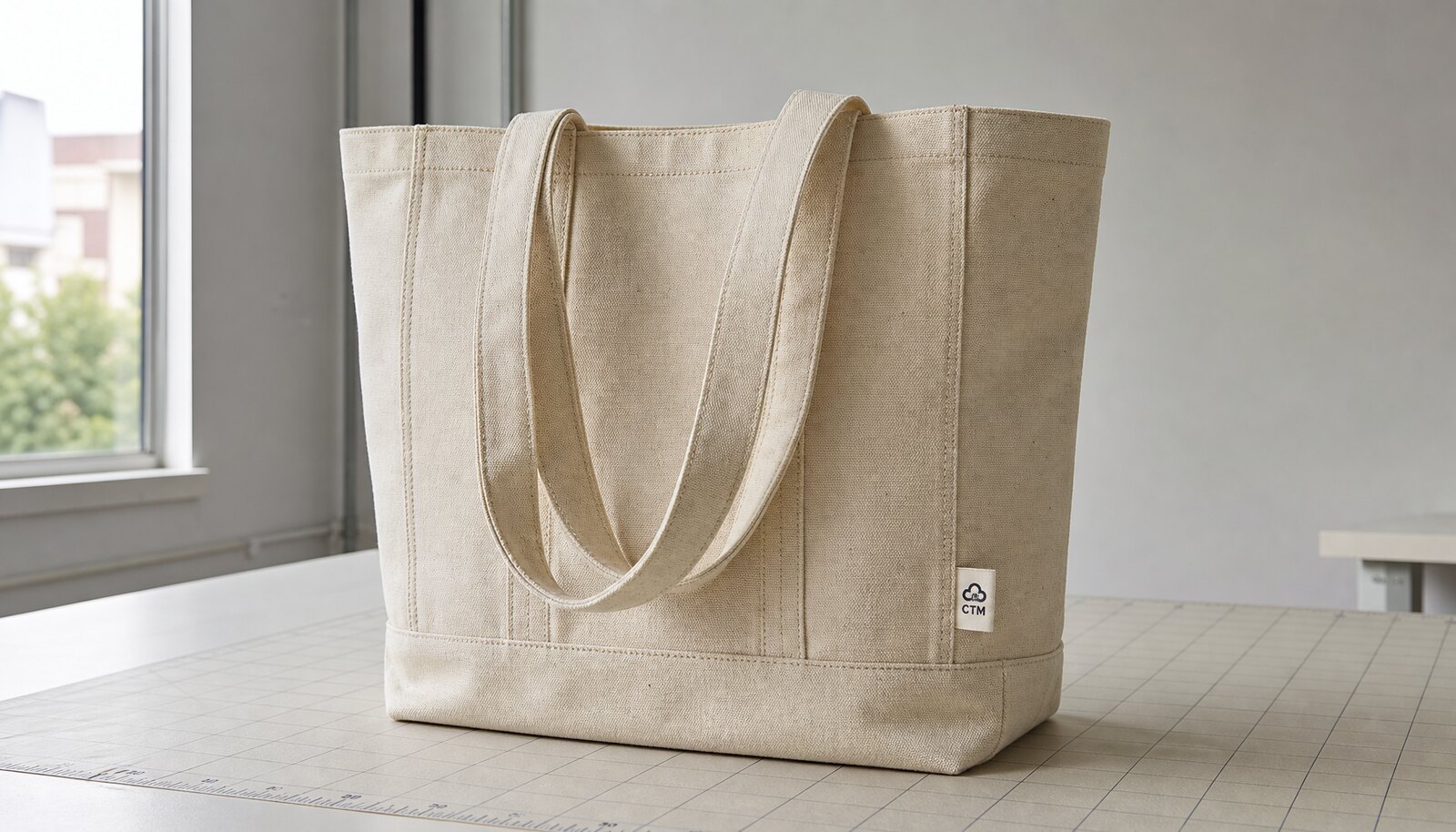
Start with the channel use case before you choose fabric
For ecommerce brands, the tote spec should start with fulfillment reality, not aesthetics. A recycled canvas tote that looks great on a mood board can still fail in warehouse intake, overfill a shipping carton, or arrive with a print that cracks after the first fold. The right fabric is the one that supports the way the bag will be sold, packed, handled, and reordered—not the one that simply sounds premium in a quote sheet.
A tote used as an insert bag has different priorities from a tote sold as a retail accessory. If the bag will sit inside a subscription box, your buying focus should be flat-fold behavior, low bulk, and a light enough weight to keep parcel economics under control. If the bag will be displayed in a store or used as a branded gift, you may need more structure, cleaner top-stitching, and stronger shape retention. That is why this guide treats recycled canvas totes for ecommerce brands as a sourcing decision, not just a decoration choice.
The fastest way to reduce quote noise is to define the end use in one sentence before the supplier sends pricing. A good brief tells the factory whether the tote is for DTC order inserts, bundle packaging, retail merchandising, trade-show gifting, or a hybrid channel. It also tells them whether the bag needs to ship flat, carry a specific fill weight, accept barcode labels, or arrive retail-ready. Once those points are clear, you can compare suppliers on the same basis.
- For DTC insert use, prioritize low-bulk folding, consistent pack count, and durable print rather than a heavy hand feel.
- For retail or gifting, prioritize structure, seam finish, and a cleaner outer surface that presents well on shelf or in photography.
- For promo or event runs, prioritize MOQ flexibility, simple artwork, and clear sample approval gates so launch timing does not slip.
Choose recycled canvas by fiber source, weave, and GSM—not by a generic label
The phrase recycled canvas can cover very different materials. One supplier may be using recycled cotton from post-industrial cutting waste, another may be blending recycled cotton with virgin cotton, and a third may be using a yarn mix that changes from lot to lot depending on available feedstock. Buyers often compare these options as if they were identical, but they are not. Recycled source, weave density, and finishing method affect hand feel, print sharpness, shrink behavior, and how well the tote folds for packing.
For most ecommerce programs, the useful starting point is a midweight canvas in the 340 to 400 gsm range. That is heavy enough to feel like a real product, but not so heavy that freight, carton weight, and fulfillment handling become painful. Lower weights in the 280 to 320 gsm range can work for inserts, light gifts, or tightly packed mailers. Higher weights above 400 gsm are usually reserved for premium retail bags, larger carry loads, or brands that want the tote to stand upright more cleanly. A strong buying spec should list both GSM and the acceptable tolerance the factory must hold.
Recycled content itself should be treated as a verified claim, not a marketing adjective. Ask whether the fabric is post-industrial recycled cotton, post-consumer recycled cotton, or a blend, and ask the factory how it documents that claim. Depending on the supply chain, verification may come from supplier declarations, mill records, transaction certificates, lot traceability documents, or third-party textile standards. If a supplier cannot tell you the source class or cannot explain how the fabric lot maps back to the declared material, the quote is too vague for procurement use.
- Ask the supplier to state whether the GSM is measured on greige fabric, finished fabric, or after washing and pressing.
- Request a yarn or fabric lot identifier on the sample so you can tie the approved sample to the production lot.
- Ask about shrinkage expectation, because recycled cotton can move more than buyers expect after heat or wash treatment.
- If the bag will be packed flat, test whether the chosen fabric holds its crease without leaving deep fold marks after repacking.
Use a spec sheet that controls the details factories actually miss
A tote quote is only useful if the supplier is quoting the same object you intend to buy. The spec sheet should define the finished bag size, handle length, gusset depth if applicable, seam allowance, print placement, fabric composition, and pack method. Without those details, suppliers often fill in the blanks differently: one uses a wider seam allowance, another shortens the handle by a few centimeters, and a third assumes a looser print position because it suits their standard production process.
For ecommerce buyers, the most expensive misses tend to be small and repetitive rather than dramatic. A handle that is 1 to 2 cm too long can change how the bag sits in a carton and how it hangs on a hook. A logo centered on the cut panel instead of the finished panel can look off once the bag is sewn. A tote that is 10 mm wider than spec can push the packed carton over a target size band and affect freight math. The solution is not to overcomplicate the brief; it is to be precise on the few dimensions that matter most.
The best spec sheets also clarify what is acceptable variation and what is not. Buyers should not expect every natural fiber bag to look identical, but they should define the tolerances that matter to function. That includes the acceptable range for finished size, the maximum allowed panel skew, the approved shade band, and whether small slubs or neps are acceptable in the cloth. When those limits are written, the factory can self-check before packing instead of waiting for a complaint after shipment.
- Write finished dimensions as the measured post-sew bag, not only the cut panel size.
- State the handle drop or handle length in the same unit system the factory uses for production tickets.
- Define artwork position from seams or from finished edges, and keep the reference points consistent across the whole order.
- If the bag will include inserts or folded collateral, specify the internal clearance needed so the packaging team is not guessing.
Select the decoration method after you define print durability and hand feel
Print method is not just an art decision. It changes the surface feel, fold behavior, and acceptance rate in production. On recycled canvas, a large ink deposit can stiffen the bag, especially if the cloth is lighter or loosely woven. That may be fine for a display tote, but it can be a problem if the bag needs to fold cleanly for packing and re-fold without cracking. The right choice depends on artwork complexity, run size, and the amount of handling the bag will see before it reaches the customer.
For simple logos and larger repeat orders, water-based screen print often remains the most procurement-friendly route because it balances cost, clean edges, and softness. For smaller runs or art with gradients, DTF or heat transfer can be more practical, but buyers should ask about edge lift, hand feel, and whether the decoration leaves a glossy patch that looks out of place on natural canvas. Embroidery can elevate the product, but it also increases labor, adds thickness, and can distort lighter fabrics. A factory should be able to show how it prevents puckering, fabric pull, and thread shadow on the reverse side.
The key is to ask performance questions before you approve the artwork. What happens after the bag is folded 20 times? Does the print crack on the outer edge of the fold? Does the pigment rub off on adjacent bags in a carton? Does the logo remain centered after final pressing? Those are the questions that turn a decoration decision into a usable procurement spec.
- Ask the supplier to confirm whether the print is tested for rub resistance and fold cracking on the actual fabric weight being quoted.
- Check whether ink or transfer layers change the bag’s stiffness enough to affect packing density.
- For multi-color art, ask which colors are printed separately and whether registration tolerance changes by print method.
- If the tote will be sold as a premium item, request a print sample on the final fabric rather than on a substitute blank.
Compare sourcing routes with a procurement lens, not just a price lens
The lowest ex-factory price is not always the lowest total cost. Direct factory sourcing gives the most control over fabric, sewing, and packing, but it also asks the buyer to manage more of the detail work: artwork approvals, defect language, timeline control, and payment milestones. Trading companies can simplify communication if your program has many SKUs or changing pack configurations, but you should still demand visibility into the factory behind the quote. If the quote cannot tell you who is actually cutting and sewing the bags, you do not yet have a meaningful sourcing comparison.
There is also a middle path that many ecommerce teams use for pilots: buying a standard blank and decorating it locally. This can reduce lead time for a launch test, but it weakens your control over recycled-content evidence, seam construction, and lot consistency. It works best when the goal is market validation, not long-term repeat ordering. Once the tote becomes a stable SKU, buyers usually need a factory-based program with a locked spec and reorder record.
A useful way to compare routes is to ask who owns the risks. If there is a print defect, who pays for sorting or rework? If the cartons are packed differently than specified, who carries the cost of repacking at destination? If the bag arrives with a material claim that cannot be supported, who is responsible for the correction? The right supplier is not simply the cheapest one; it is the one whose responsibilities are written clearly enough to keep the program stable.
- Direct factory: strongest option for repeat programs, custom spec control, and long-term consistency.
- Trading company: useful when you need coordination across multiple items, but require clear factory visibility.
- Blank-bag decorator: good for speed tests, weaker for recycled-content traceability and construction control.
- Ask every route who approves the golden sample and who signs off on bulk before sewing begins.
Read a quote like a buyer, line by line and line item by line item
A tote quote should separate the variables that change your landed cost. If the supplier gives only one unit price, you cannot tell whether the number is based on stock fabric, custom woven fabric, a single print color, or a bulk pack assumption that hides extra labor. Strong buyers ask for the quote to show fabric, sewing, decoration, trim, packing, and shipping basis separately. That separation makes it easier to compare quotes from different factories and to see where the real cost drivers sit.
MOQ is usually driven by more than the bag itself. Fabric booking, print screens, thread colors, label setup, and carton configuration can all affect minimums. A supplier may accept a small pilot if the fabric is in stock, the print is one color, and the bags are packed simply. Add woven labels, multiple artwork versions, or retail folding instructions, and the minimum often rises. Buyers should expect the factory to explain whether MOQ is per colorway, per artwork, per fabric lot, or per shipment. Those are not the same thing, and they should not be treated as interchangeable.
The landed-cost conversation also needs to separate one-time costs from recurring ones. A print screen or embroidery setup is a setup cost, not a unit cost. Barcode stickers, carton changes, and special packing can become recurring labor costs if they are handled one-by-one at the factory. Good procurement practice is to compare the total cost of an order under the same assumptions, including how the goods will enter your warehouse and how much time they will need before they are ready to sell.
- Separate setup charges from recurring unit price so you can see the cost of reorders.
- Ask whether the quote assumes stock trims or newly manufactured trims.
- Require carton dimensions and gross weight on every quote for freight comparisons.
- If two suppliers look close in ex-factory price, compare repack labor and shipping weight before deciding.
Build recycled-content verification into the approval flow
Procurement teams should not wait until after production to ask for proof that the fabric is actually recycled. Verification belongs in the quotation and sampling stages. Depending on the supply chain, the supplier may use mill declarations, recycling certificates, lot traceability records, purchase records for recycled feedstock, or third-party standards. The method matters because different programs support different levels of confidence. A declaration may be enough for an internal file, while a regulated customer or marketplace program may require stronger documentation.
The practical buyer move is to ask for the exact proof mechanism before the PO is placed. Ask what document names the recycled material, what lot or batch it covers, and whether the claim can be tied to the specific fabric roll used for your order. If the fabric is blended, ask for the percentage by weight and whether that percentage is consistent across all lots in the production run. If a supplier gives a generic sustainability statement without naming the supporting document, the claim is not ready for procurement approval.
It also helps to align your product description early. Do not let the production team call the bag '100% recycled' unless the fabric, trim, and labels truly support that language. Many tote programs only qualify the canvas as recycled rather than the entire bag. Buyers should keep the marketing claim and the material proof in the same folder so the final packaging, web copy, and wholesale spec stay aligned.
- Ask whether proof comes from a mill declaration, traceability file, certificate, or third-party standard.
- Confirm the lot number on the sample matches the lot that will be used in bulk production when possible.
- If you need a specific recycled-content claim, make the wording part of the approved spec before production starts.
- Keep the legal/product claim separate from the fabric description if trims or labels are not recycled content.
Set sample approval gates that stop bad bulk orders early
The strongest procurement programs use approval gates, not just a single sample signoff. The first sample should prove the design and usability: dimensions, handle drop, print placement, and overall appearance. The pre-production sample should prove the real production setup: final fabric, final print method, final trim, and final pack method. If the supplier changes any of those elements between sample and bulk, the buyer should treat the new version as a fresh approval point.
This matters because recycled canvas can behave differently once the factory switches from a photo sample to a production lot. Handles may sit differently after pressing, a natural fiber weave may show more slub than expected, or a print may look crisp on a test piece but slightly heavier on a real production fabric. The sample approval system should make those differences visible before bulk sewing starts. A good rule is simple: if the bag in bulk is not materially the same as the approved sample, the approval is not valid.
A useful approval file includes photographs, measurement records, and a short written acceptance note. That file should note what was checked, what was allowed to vary, and what must not change. Buyers often save time later by attaching the approved sample image and the dimensional sheet directly to the purchase order. If there is a dispute, the factory and the buyer are then looking at the same reference.
- Approve one visual sample and one pre-production sample if the fabric, print, or trim changes between stages.
- Measure finished width, height, gusset, and handle length on the finished bag, not on cut panels.
- Check that the print is centered relative to the finished seams, not only relative to the cut fabric.
- Reject any sample with odor, staining, oil marks, loose fibers, or obvious stitching irregularity before moving to bulk.
Write QC tolerances that the factory can actually inspect against
Quality control becomes more valuable when the expectations are measurable. Instead of saying the tote should be well made, specify the checks and the tolerances. For example, define an acceptable finished-size range, the minimum stitch standard the factory must keep, and the rule for handle reinforcement at load points. Tell the factory how to check print position and which defects trigger sorting versus rejection. This gives the supplier a practical inspection list and gives your receiving team a way to audit the shipment.
For ecommerce totes, the most common defect categories are construction, print, packing, and cleanliness. Construction issues include crooked seams, weak handle anchors, loose threads, and uneven top-stitching. Print issues include poor registration, smudging, excessive stiffness, and crack-prone ink coverage. Packing issues include wrong fold direction, count mismatch, bad carton labeling, and moisture exposure. Cleanliness issues include oil spots, odor, lint, and contamination from sewing or packing. A useful QC plan should cover all four categories rather than focusing only on appearance.
Procurement teams should also ask the supplier how they sort defects. Not every issue needs the same response. A loose thread may be trimmed, a count error may require carton correction, and a print shift may require rework or replacement. The important point is that the threshold for action is decided before shipment, not after a warehouse receives the goods. If the factory already knows what defect level triggers repair, replacement, or hold, it can inspect to that standard in-house.
- Define the measurement points for size and handle length so every inspector uses the same reference.
- Ask the factory to state whether it inspects by 100% check, in-line check, or lot sampling.
- Specify what happens to cosmetic defects versus functional defects so the supplier does not guess.
- If your fulfillment center has carton limits, include them in the QC plan so packing matches warehouse rules.
Specify packing for ecommerce fulfillment, not just for export
Packing is where many tote programs become inefficient. A tote that is technically correct can still create warehouse friction if it arrives folded the wrong way, packed in the wrong count, or labeled inconsistently. For most ecommerce programs, flat-fold bulk packing in master cartons is the most efficient choice because it reduces plastic use and allows quick intake. If the bag needs retail presentation, then individual polybags or insertion cards may be justified, but they should be written into the spec and priced separately.
The carton spec should be detailed enough that your receiving team can validate the order without opening every box. That means piece count per carton, carton dimensions, gross weight, outer labeling, and barcode placement if applicable. If the product will ship by sea, ask about moisture protection and whether the cartons are strong enough for stacking. Recycled canvas can absorb humidity or smell if stored poorly, and it can pick up pressure marks if the pack is too tight or the carton board is weak.
Packing also changes labor costs at origin and destination. Every extra unit handling step costs someone time. A barcode sticker placed on the wrong face, a polybag inserted after folding instead of before, or a carton count that varies by box creates downstream labor. In practice, the best packing spec is the one that lets the factory pack efficiently and lets the warehouse receive without manual rework.
- State fold direction and whether the logo must face up or be protected during transit.
- Write whether individual polybags are allowed, required, or prohibited.
- Use consistent master carton counts unless a specific warehouse requirement says otherwise.
- For sea freight, ask for carton strength, stacking guidance, and moisture handling instructions.
Specification comparison for buyers
| Buying scenario | Recommended tote spec | Why buyers choose it | Procurement watchout | Best verification step |
|---|---|---|---|---|
| Low-risk DTC launch | 340–380 gsm recycled cotton canvas, one-color print, flat-fold bulk pack | Balances hand feel, freight weight, and easy warehouse handling | Can look too light if the brand expects a structured retail tote | Request a physical pre-production sample with final fabric and final print |
| Retail add-on or gift-with-purchase | 380–420 gsm recycled canvas, reinforced handles, cleaner top-stitching, optional woven label | Better shelf presence and a more premium drape | Heavier fabric can raise landed cost and carton weight quickly | Confirm finished dimensions after pressing and the handle drop after sewing |
| Mailer insert or bundle tote | 280–340 gsm recycled canvas, minimal decoration, compact fold spec | Keeps volume and shipping cost lower for enclosed carton use | May feel too soft for standalone retail presentation | Test fold memory and carton fit with a packed sample |
| Illustrated brand drop | 340–400 gsm recycled canvas, DTF or transfer print, tighter artwork approval | Handles more complex art without committing to large print runs | Transfers can affect hand feel and crack if fold testing is ignored | Run rub, fold, and edge-adhesion checks on the approved sample |
| Repeat program with stable reorder demand | Factory-direct sourcing, locked fabric spec, documented QC AQL, carton labeling spec | Best path for consistency across lots and reorders | Requires stronger buyer discipline on approvals and change control | Approve a golden sample and a written spec sheet before PO release |
| Fast pilot or market test | Stock fabric or stock blank with simple decoration, small MOQ, limited trim | Lets the brand test sell-through before scaling | Custom recycled-content claims may be weaker if the blank source is unclear | Ask for material declarations and origin proof for the blank bag |
Buyer checklist before sampling
- Lock finished bag size, handle length, and intended fill weight before asking for quotes.
- State fabric composition in writing, including whether the recycled content is post-industrial, post-consumer, or a blend.
- Request GSM in both g/m² and oz, and ask the supplier to confirm the measuring method used.
- Freeze the print method, print area, color count, and whether printing is one-sided or both sides before sampling.
- Define trim needs clearly: woven label, care label, hangtag, barcode sticker, swing tag, or none.
- Write the fold, pack, and carton count spec for ecommerce fulfillment so the supplier does not improvise.
- Ask for recycled-content evidence and the test or declaration used to support the claim.
- Confirm MOQ by design, by color, and by fabric lot, not just the headline tote MOQ.
- Clarify incoterms, sample fee policy, rework liability, and who pays if bulk does not match the approved sample.
- Ask for a dated production calendar covering fabric booking, sample approval, bulk sewing, packing, and ship handoff.
Factory quote questions to send
- What is the exact fiber composition by weight, and is the recycled component post-industrial or post-consumer?
- What finished GSM are you quoting, and is that measured before or after washing/pressing?
- Is the price for a blank tote, a printed tote, or a packed carton-ready unit with all inserts and labels?
- What is the MOQ per color, per artwork version, and per order if we need multiple SKUs?
- Which print method is included in the quote, and what extra charges apply for additional colors, larger coverage, or print on both sides?
- What seam construction, stitch density, and reinforcement do you use at the handle anchors and side seams?
- What are your standard sample lead time and bulk lead time after artwork approval and deposit?
- Which QC checks do you perform before shipment, and what defect threshold triggers repair, replacement, or sorting?
- What carton size, piece count, gross weight, and master carton markings do you recommend for ecommerce receiving?
- What extra costs apply for woven labels, care labels, polybags, barcode stickers, export documents, and freight terms?
Quality-control points to confirm
- Fabric GSM should be within an agreed tolerance band, and the supplier should state how many points and which method they use to measure it.
- Finished dimensions should match the approved spec after cutting, sewing, and pressing, not just the cut panel size.
- Handle length should be checked from stitch-to-stitch or top edge to handle apex using one consistent measuring rule across all samples.
- Handle reinforcement should include bar tacks or boxed reinforcement at load points, with no skipped stitches, loose ends, or seam puckering.
- Seam density should be visibly even; buyers should specify a minimum stitch standard where the factory normally measures stitch count per inch or per 3 cm.
- Print placement should stay within the approved artwork position, with no visible shifting between front and back panels beyond the written tolerance.
- Print should pass a basic fold-and-rub check on the approved sample without obvious cracking, flaking, or color transfer.
- Color should stay within the approved shade band across the bulk lot; small natural variation is acceptable, but panel mismatch or patchy dyeing is not.
- Labels should be correctly oriented, securely sewn, and readable after folding, carton packing, and light warehouse handling.
- Cartons should match the purchase order count and barcode format, with clean outer markings and no evidence of moisture, oil, odor, or contamination.