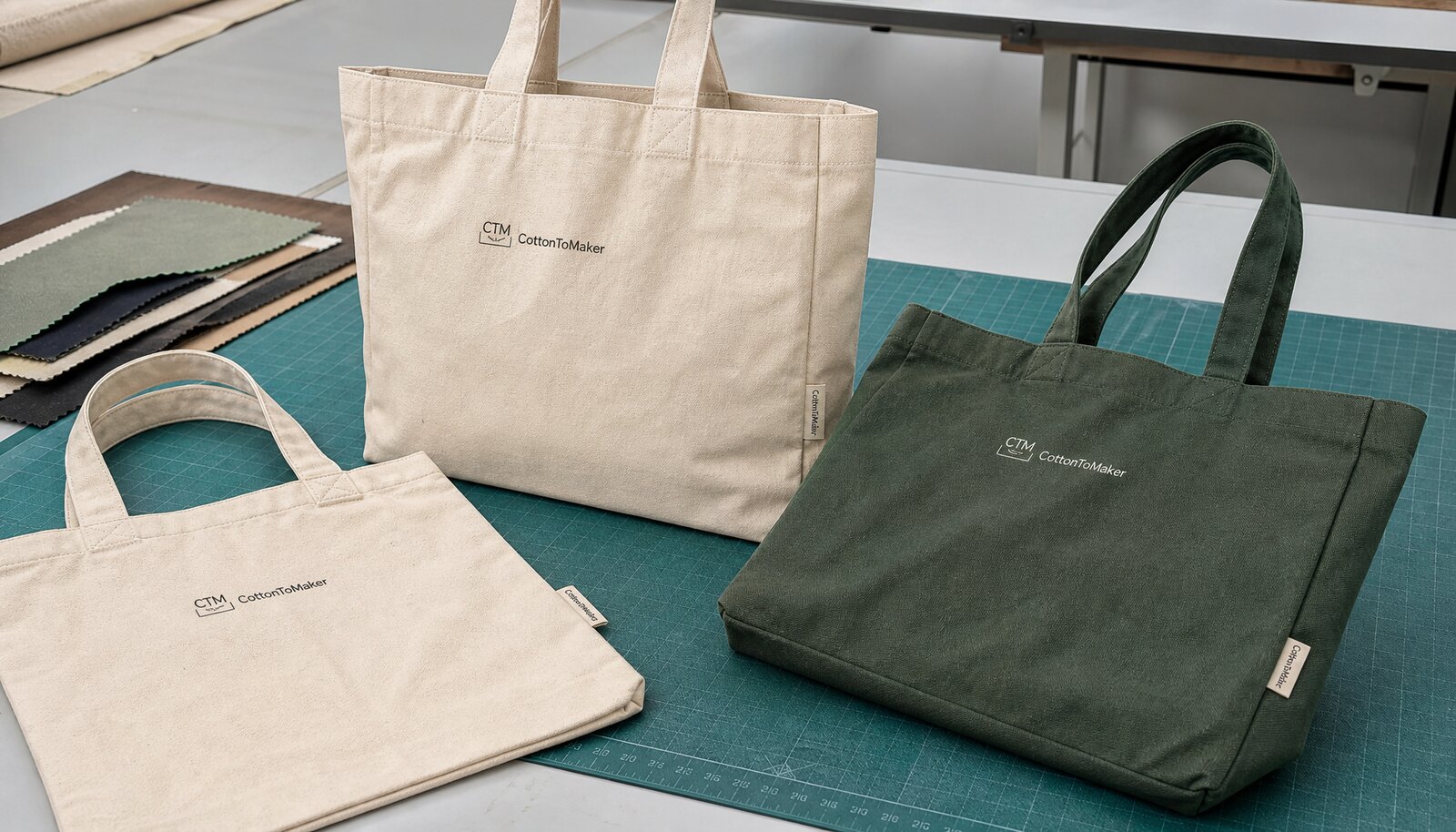
Why corporate-event buyers need a different tote spec
A recycled canvas tote for a corporate event is not the same buying job as a retail shopping bag. Event bags are often handed out with inserts, brochures, notebooks, or sample packs, then judged in minutes by attendees who notice print clarity, handle comfort, and whether the bag looks substantial enough to keep using after the event. That means the sourcing decision should start with use-case, not with artwork.
Procurement teams usually get into trouble when the tote spec is copied from a previous campaign without checking what is actually going inside the bag. A lightweight 8 oz version may save a few cents, but it can collapse when filled with hard goods. A premium 14 oz build may feel nice, but it can blow up landed cost and freight volume. The right answer is usually a middle weight with controlled construction and a clean print area.
- Good fit for event kits: 10 oz to 12 oz recycled canvas, reinforced handles, flat or modest gusset.
- Better fit for heavier contents: 12 oz to 14 oz with stronger bottom seam and wider handle tape.
- Avoid specifying purely by bag look; define carrying load, print visibility, and expected reuse.
Fabric weight, weave, and finishing choices that change the quote
For recycled canvas totes, fabric weight is one of the biggest cost drivers and one of the easiest to misunderstand. In buyer discussions, suppliers may quote the same sounding product while using very different cloth density, yarn thickness, and finishing quality. Ask for GSM and, when possible, the fabric hand-feel reference or a swatch photo with a ruler. For most corporate events, 340 to 420 GSM is the practical zone. Below that, the bag can feel thin and wrinkle easily. Above that, you pay for strength you may not need.
The weave and finishing matter as much as the GSM. A tight weave with consistent surface gives better print edges and a cleaner retail look. A brushed or washed finish may improve hand-feel, but it can change shrinkage and print behavior. If the supplier is using recycled fibers, confirm whether the fabric is blended with conventional cotton or recycled cotton content, because that can affect consistency from lot to lot.
- Request finished bag weight, not only raw fabric weight.
- If your event kit includes rigid inserts, check bag opening width and gusset recovery after folding.
- For dark colors, ask whether the fabric is pre-dyed or garment-dyed, because this changes lead time and shade control.
Print method selection for logos that need to survive handling
A custom logo order is won or lost on decoration quality. For simple corporate logos, screen print is often the best balance of price and durability. One-color or two-color logos on canvas usually print sharply, with stable unit cost once the setup is done. If the artwork has thin lines, gradients, or small text, heat transfer or digital transfer may be discussed, but those methods should be used only after checking the look under folding, rubbing, and repeated carry use.
If the bag is intended as a higher-end event giveaway or a distributor sample item, consider a woven side label or a small sewn patch in addition to the main print. That gives the bag a more finished brand impression without turning the order into a complicated decoration project. The more placements you add, the more you need to control alignment, sew quality, and the risk of inconsistent placement across cartons.
- Use screen print for bold logos, event names, and sponsor marks with controlled color count.
- Use heat transfer only when artwork detail cannot be maintained by screen print.
- Keep print area large enough to breathe; cramped logos look smaller than they should on canvas.
How to compare quotes without being misled by unit price
A tote quote is only useful when every supplier is pricing the same specification. One factory may include a heavier fabric and stitched reinforcement while another quotes a lighter cloth and simpler seam. That is why buyer teams should compare the total cost structure: fabric, printing, sewing, packing, cartons, and freight assumptions. A quote that looks cheaper per piece can become more expensive once packing upgrades or freight volume are added.
Use landed-cost thinking before you select the supplier route. For a 2,000-piece event order, a factory-direct quote with exact packing and carton marks may outperform a trading route that adds margin and lengthens sample coordination. For very small orders, a local distributor may still win on speed, but only if the buyer accepts a narrower spec and less control over lot consistency. The key is to compare route by service level, not by unit price alone.
- Compare like-for-like fabric GSM and bag dimensions.
- Check whether setup cost is hidden in the unit price or shown separately.
- Ask for freight-ready carton dimensions if you need air shipment or pallet planning.
Supplier route comparison for corporate-event tote sourcing
Corporate-event buyers usually have three sourcing routes: factory-direct, trading company, or domestic distributor. Each route serves a different risk profile. Factory-direct gives the best control over fabric, stitch details, and packing, but the buyer must manage sample approvals and communication more carefully. Trading companies can simplify communication and multi-item sourcing, but they may not control sewing lines directly. Distributors are useful when the deadline is short and the buyer can accept standard stock or light customization.
For a custom logo order, the best route is usually the one that can prove production control. That means showing sample photos, line inspection checkpoints, and carton packing evidence, not just a polished catalog page. If the event date is fixed, route selection should prioritize certainty of repeatable output over a theoretical saving of a few cents per unit.
- Factory-direct: best for logo control, packing control, and recurring programs.
- Trading company: useful when combining multiple SKUs or when buying team needs one contact point.
- Distributor: best for fast-turn or low-complexity orders, but usually less flexible on spec.
Sample approval should cover the whole bag, not just the print
The most common mistake is approving a logo strike-off and assuming the whole order is safe. On recycled canvas totes, the print may look fine while the bag body is too thin, the handle tape is weak, or the sewn seam twists after filling. A proper sample approval needs the full product: fabric, size, print, stitch line, handle reinforcement, side label if used, and packing style.
For corporate events, the production sample should represent the final order as closely as possible. If the factory sends a hand-made sample using a different fabric lot, it should be marked clearly as a development sample, not a final approval. Ask for a pre-production sample or a sealed reference sample if your order is large enough to justify one more control point.
- Measure finished bag size and compare against the approved drawing.
- Rub the print after curing and folding to see if ink transfers or cracks.
- Load the sample with the actual event insert weight before signing off.
QC thresholds that matter for tote bags used at events
The useful QC question is not whether a tote bag is perfect; it is whether it is consistent enough to hand to attendees without embarrassment or functional failure. Set practical acceptance criteria before production starts. For example, define whether a one-size tolerance is acceptable on the opening width, whether minor thread tails are allowable, and how many print defects per carton can be tolerated. Clear thresholds prevent arguments after shipment arrives.
For event bags, the highest-risk defects are structural rather than cosmetic. A minor shade variation may be acceptable if the tote is natural recycled canvas, but a crooked handle stitch, weak bottom seam, or distorted print placement is not. If the bag will be displayed on a registration desk, front-panel alignment deserves more attention than the inside seam finish. Match the QC plan to the use.
- Reject bags with broken seams, open stitches, severe print blur, or heavy stains.
- Agree on acceptable tolerance for panel size, handle length, and gusset depth.
- Specify whether loose threads may be trimmed in packing or must be removed at sewing stage.
Packing, carton marks, and distribution readiness
Packing spec is often ignored until the shipping department sees the cartons. For recycled canvas totes, flat packing is usually the most efficient route for freight and warehouse handling. Individual polybags can protect print surfaces, but they also add labor and plastic cost. If the bags are going to a retail or distributor channel, barcode labels and SKU separation may matter more than the extra few grams of packaging.
A corporate event order often moves through a third-party logistics team, venue coordinator, or regional branch network. That means carton marks should be readable and practical, not decorative. The carton list should show quantity per carton, color, artwork version, and gross weight. If the order is mixed by branch or event day, packing mistakes become expensive because they are hard to correct after shipment.
- Use flat packed cartons with clear size and SKU marks.
- If needed, add a single insert card or care note only after confirming labor cost.
- Request carton dimension data if freight charges are calculated by volumetric weight.
Lead time planning and the schedule risks buyers should price in
Lead time for custom recycled canvas totes is usually driven by sample approval, fabric readiness, print setup, and final packing. If the artwork is simple and the factory has ready fabric, production can move efficiently. Delays usually come from late artwork changes, unclear packing instructions, or a sample that gets approved too loosely and then has to be corrected during bulk production. For a fixed corporate event date, the schedule buffer should sit before production starts, not after it.
A practical planning approach is to separate order milestones: artwork freeze, sample approval, material confirmation, bulk production, and final inspection. Buyers should also treat shipping mode as a schedule variable. Air freight can save the event date when production is tight, but it changes the landed-cost picture quickly. Sea freight is cheaper for larger runs, but only if the factory can finish early enough to clear transit time.
- Build time for artwork confirmation and a sample round into the critical path.
- Keep one buffer week if the event cannot slip.
- Ask the supplier which step would restart production if changes are made after sample approval.
Specification comparison for buyers
| Spec decision | Recommended option | When it fits | Buyer risk to check |
|---|---|---|---|
| Fabric weight | 10 oz to 12 oz recycled canvas, roughly 340 to 420 GSM | Most corporate events, conference giveaways, internal brand activations, and mid-price retail programs | Too light looks cheap and distorts after filling; too heavy increases freight and sewing cost |
| Supplier route | Factory-direct with event packaging support | Buyers who need custom logo control, stable QC, and a single source for production plus packing | If the factory is only a sewing shop, carton labeling, insert packing, and barcode handling may be weak |
| Print method | 1 to 2 color screen print or heat transfer for small detailed logos | Simple logos, large front graphics, and event branding with controlled artwork cost | Screen print can crack on stiff low-grade canvas if curing is poor; heat transfer may look less premium under close inspection |
| Decoration complexity | One-position print with optional woven side label | Volume orders where speed and repeatability matter more than premium decoration | Multiple placements raise setup cost, slow approval, and increase reject risk |
| MOQ strategy | 500 to 1,000 pcs per color/art version for efficient pricing | Corporate events with a confirmed attendee list, branch rollout, or distributor program | MOQ below factory comfort level often means higher unit price or inconsistent color lots |
| Handle build | Self-fabric or webbing handles with reinforced X-box stitching | Bags carrying catalogs, bottles, laptops, or event kits | Weak handle reinforcement causes seam failure in actual use, not at photo stage |
| Packing format | Flat packed in polybag, then bulk carton with size label and carton mark | When shipping by sea or consolidating to a distribution center | Over-packed tote bags wrinkle heavily and inflate carton volume; under-packed cartons shift in transit |
| Sample approval route | Pre-production sample with print, label, stitching, and packing approved together | Any order with fixed date, logo sensitivity, or multiple stakeholders | Approving fabric only, then changing print or packing later, often causes schedule slips |
Buyer checklist before sampling
- Finalize tote dimensions, fabric weight, handle length, and gusset before requesting quotes.
- Send logo in vector format and state print color count, placement, and maximum print area.
- Specify whether the tote must carry catalogs, bottles, notebooks, or mixed event kits.
- Define packing requirement: bulk carton, individual polybag, insert card, barcode, or assorted packing.
- State target delivery window, ship-to country, and whether you need air, sea, or mixed freight pricing.
- Request a pre-production sample and a production photo approval if the event date is fixed.
- Compare quotes on the same basis: fabric GSM, print method, packing, and carton quantity, not only unit price.
Factory quote questions to send
- What exact recycled canvas construction are you quoting, including GSM, weave, and finished bag weight?
- Does your price include the logo print plate/setup, one sample round, and carton labeling?
- What is your MOQ by color and by artwork version, and what happens if I reduce the order below that level?
- Can you confirm handle reinforcement, stitch count, and seam allowance on the quote sheet?
- Which print method are you recommending for my artwork, and what is the durability risk after folding and repeated use?
- What is your standard packing spec, and can you price individual polybag or insert card separately?
- How many days for sample, how many days for bulk production, and what issues would restart the lead time?
- Can you provide photos of similar recycled canvas tote production, carton loading, and QC checkpoints?
Quality-control points to confirm
- Fabric GSM matches the approved sample within a practical tolerance agreed with the factory.
- Bag dimensions are within a workable tolerance for width, height, and gusset so inserts fit consistently.
- Print registration is centered correctly, with no pinholes, smearing, under-curing, or ghosting.
- Handle stitching is reinforced at stress points and not drifting off the seam line.
- No broken threads, skipped stitches, contamination marks, oil spots, or uneven dye tone on visible panels.
- Carton count, carton marks, and packing configuration match the approved packing list.
- Pre-production sample and bulk production use the same fabric lot or an approved equivalent lot.