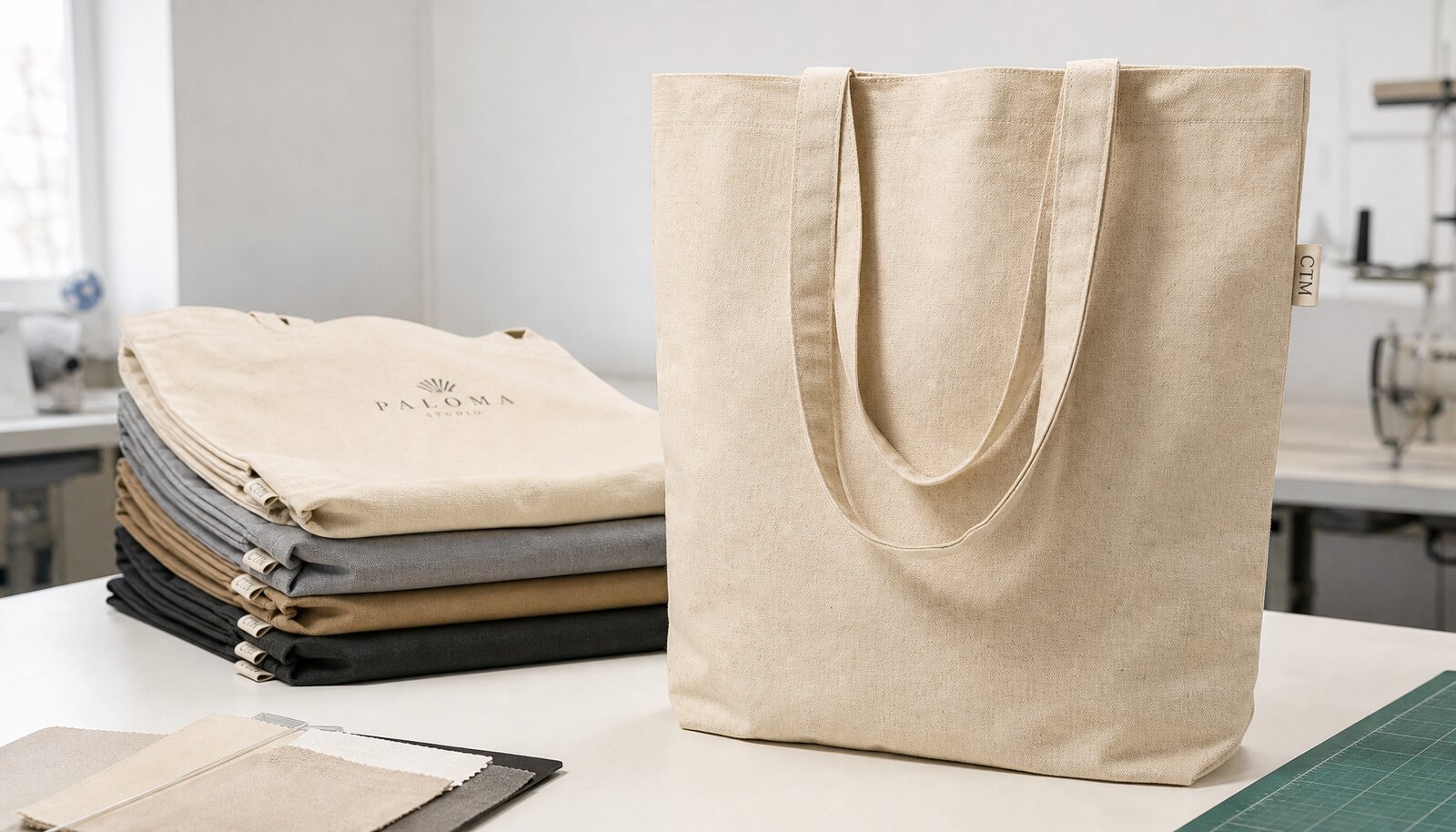
Why boutiques buy recycled canvas differently from standard promo totes
Boutique buyers usually need recycled canvas totes to do two jobs at once: hold up in daily retail use and look good on the floor. That changes the sourcing plan. A promo tote can survive with loose finishing and inconsistent shade; a boutique private label tote cannot. The bag needs a cleaner silhouette, tighter stitch control, and a fabric weight that feels deliberate rather than cheap or overbuilt.
For this product category, recycled canvas usually works best when the buyer specifies the end use first. If the tote is a retail add-on, 10–12 oz recycled canvas is the most balanced starting point. If it is a higher-ticket fashion accessory or a premium gift bag, you may move to a heavier construction, but only if the handle build and sewing line can support it without making the bag stiff.
- Retail display tote: cleaner finish, controlled shade, simple branding
- Gift-with-purchase tote: lower cost, but still needs stable seams and readable logo placement
- Merchandise tote: stronger hand feel, more attention to label and hangtag presentation
Fabric choice: the GSM range that usually works for boutique programs
For recycled canvas totes for boutiques private label sourcing plan work, the fabric specification should be written in both ounces and GSM if your supplier uses mixed market terminology. A practical target is 10–12 oz, roughly 340–410 GSM, for most boutique tote programs. That range gives enough body for shelf presentation and carry use without making the tote feel like a tool bag.
Heavier fabric is not always better. Once you push too far up in GSM, the tote becomes bulkier to sew, the corners lose drape, and the unit price rises because the factory consumes more material and slows down at the needle. Buyers often overlook this and then wonder why the quote jumps after adding handles, lining, or a printed pocket. The right question is not “what is the heaviest fabric you can make?” but “what weight gives the right balance of look, feel, and cost for this store segment?”
- 10–12 oz / 340–410 GSM: balanced for boutiques and lifestyle retail
- Below 10 oz: lower cost, but watch for limp structure and print show-through
- Above 12 oz: premium hand-feel, but higher sewing effort and freight weight
Construction details that change the quote more than buyers expect
The biggest cost differences are often hidden in the construction, not the headline tote size. Handle material, reinforcement method, and bottom seam design can move the quote more than many buyers expect. Same-fabric handles are usually cheaper and visually clean, while cotton webbing handles often feel stronger and retail better, but they add a separate material line and another sewing step.
If you want a boutique-ready tote, specify the reinforcement method in the RFQ. Box-X stitching at the handle anchor is the safer standard for retail programs. For heavier loads or wider totes, a bar-tack or reinforced gusset seam may be necessary. Do not leave this vague and rely on the factory’s default pattern, because each factory has its own cost-saving habits.
- Same-fabric handles: good for visual consistency and cost control
- Webbing handles: better comfort and perceived strength
- Box-X stitching: preferred at load points for retail use
- Bottom gusset or boxed base: improves shelf shape and carrying stability
Comparison of supplier routes for private label tote sourcing
Buyers sourcing recycled canvas totes for boutiques usually compare three routes: direct factory, trading company, and stock-base converter. The wrong route can make a clean-looking quote turn expensive after sample, label, and packing changes. A direct factory is often the best fit when you need custom trim, repeat reorder consistency, and clear control over sewing and packing. A trading company can help if you need multi-item consolidation or if your internal team cannot manage factory communication in detail.
Stock-base converters can be useful for very low MOQ programs, but they are usually the least stable route for boutique private label work. They may offer fast sampling and flexible print, but shade control, exact sizing, and repeatability can be weaker because the base goods were not built around your spec from the start.
- Direct factory: best for repeatable private label programs and better cost control at scale
- Trading company: useful for bundled sourcing, but verify who actually owns QC and production decisions
- Stock-base converter: fast start, but higher risk on color consistency and trim matching
Sample approval: what should be fixed before bulk cutting starts
Sample approval is where most tote mistakes are either prevented or locked in. For a boutique private label tote, the first sample should resolve fabric hand-feel, logo position, handle drop, and label placement. After that, a pre-production sample should confirm the final size, stitch pattern, packing method, and artwork output on the actual production fabric. Do not approve a sample simply because it looks close in a photo; the recycled canvas texture, print density, and seam alignment need physical review.
A usable sample checklist should measure the opening width, height, gusset depth, handle length, and printed area. If there is a woven label or side label, inspect edge finish, fold direction, and stitching accuracy. If the tote is being sold retail, the sample should also be checked under store lighting, because some recycled fabrics look flatter or more mottled once they are under bright shelf lights.
- Measure the approved sample against the spec sheet, not against memory
- Place the tote on a flat surface and confirm symmetry of side seams and handles
- Inspect print edges for feathering, cracking, or color shift on textured canvas
- Keep one signed golden sample at the factory and one with the buyer
Print and branding choices that work on recycled canvas
Recycled canvas is textured, so not every branding method performs equally well. For most boutique programs, one- or two-color screen print is the most economical and reliable choice. It reads clearly, holds up on textured fabric, and is easy to repeat across replenishment orders. If the brand identity depends on a premium look, combine a small print with a woven side label or sewn-on cotton patch rather than forcing detailed artwork across the whole panel.
Complex gradients, tiny serif text, and thin line art are risky on recycled canvas unless the printer has already proven the ink spread and registration on that exact fabric. The quote should specify the number of print colors, print area, and placement tolerance. Without that detail, one supplier may quote a simple flat logo while another prices a multi-step finish, and the comparison becomes useless.
- Best default: 1-color or 2-color screen print
- Premium private label look: woven side label plus simple front print
- Avoid: tiny text, fine gradients, and overpacked artwork on coarse canvas
MOQ logic: how to set a first order that does not trap cash
MOQ should be tied to style, print setup, and color plan, not just the supplier’s standard minimum. For a boutique launch, 500 to 1,000 pieces per style or per color is often a reasonable first discussion point if the factory is running full production, not simply selling stock blanks. If you split across multiple colors, the MOQ can rise because fabric cutting, dye lot control, and print setup all create extra waste.
A smarter way to structure the first order is to keep the silhouette fixed and vary only one element: either print color, body color, or label type. That keeps development risk manageable and helps you read the market. If the first launch is still uncertain, quote two volume tiers at once: the starting MOQ and the reorder MOQ. That reveals whether the supplier’s cost is truly scalable or only attractive at one size.
- Single style, multiple colors: good merchandising flexibility but higher setup complexity
- Single color, multiple prints: cleaner production, easier shade control
- One style first: lower risk than launching several tote shapes at once
Quote comparison: what a useful factory quote should actually show
A useful factory quote for recycled canvas totes should break out fabric, sewing, print, label, packing, and sample charges. If the supplier only sends one lump sum, the number is hard to audit and almost impossible to compare against another offer. In practice, the line items matter because one factory may include an inner bag and barcode sticker while another excludes them. Those small differences turn into receiving problems later.
Ask for the quote at the exact pack configuration you need. If the tote is sold in retail, you need the price per unit plus the carton count, carton size, gross weight, and packing method. If you are importing, also ask for the freight-friendly carton dimensions. A tote that looks inexpensive on paper can become costly when the carton is oversized or the packing method wastes cube.
- Unit price should include the same material and print assumptions across all quotes
- Carton details should be in the quote, not added after order placement
- Sample cost and tooling cost should be separated from production unit pricing
Packing, labeling, and carton planning for retail receiving
Packing is not a warehouse afterthought. For boutique totes, flat packing is usually the most efficient route because it protects the tote shape and keeps carton counts predictable. If the bag surface can scuff, a simple inner polybag may be justified, but avoid overpacking unless the retailer specifically wants it. Excess packaging adds labor and volume, and it rarely improves the selling experience for this category.
Labeling needs to be handled at the factory level if the bags are going into distribution. SKU stickers, barcode placement, and carton markings should match the buyer’s receiving process. A common mistake is approving a good-looking sample and then receiving mixed-size cartons or labels applied to the wrong panel. That problem is expensive because it turns factory labor into warehouse rework.
- Use flat pack unless the bag shape must be preserved for premium presentation
- Fix barcode position and SKU logic before bulk packing begins
- Limit carton weight so warehouse handling stays practical
Lead time risks and the parts of the schedule that slip first
For private label recycled canvas tote programs, lead time usually slips at material booking, print approval, and packing confirmation. Fabric color matching can add time if the recycled content varies from batch to batch. Printing can also slow down if the artwork requires too many colors or if the buyer changes the logo after sample approval. The safest schedule is one that leaves room for artwork lock, sample review, and a short buffer before carton marking begins.
Do not plan based only on sewing time. A tote program needs coordination across fabric prep, cutting, printing, stitching, inspection, and final packing. If the factory gives a very short overall lead time but cannot describe each stage, the timeline is probably optimistic. In a buyer RFQ, request stage-by-stage timing so you can see where the real schedule risk sits.
- Material lead time can be longer than sewing time for recycled fabrics
- Artwork changes after approval usually push the schedule more than buyers expect
- Packing and carton labeling should be included in the production timeline
Specification comparison for buyers
| Supplier option | What to verify | Commercial advantage | Buyer risk to control |
|---|---|---|---|
| Direct sewing factory | fabric swatch, approved sample, seam close-ups, logo test photos, packing pilot, and final inspection evidence | Better sample-to-bulk control and faster production feedback | May be weaker on export paperwork or branded packing unless checked early |
| Trading company | Factory name, production photos, trim-source proof, and who owns QC decisions | Can coordinate small mixed orders and extra services | Markup can hide real factory capability and slow defect decisions |
| Specialized bag workshop | bag size, gusset, handle drop, seam allowance, stitch density, reinforcement patch, and loading expectation | More practical for detailed construction, trims, and repeat programs | Capacity may be limited during peak seasons |
| Low-price general supplier | 8-12 oz cotton canvas, 120-220 gsm cotton, recycled cotton, or blended fabric selected by use case and target price | Useful for simple promotional runs with loose specs | Material downgrades, weak packing, and vague inspection scope can erase savings |
| Retail-ready supplier | fold method, inner bundle, carton count, carton mark, moisture protection, SKU separation, and warehouse receiving needs | Can handle labels, SKU separation, carton marks, and receiving rules | Higher unit cost must be compared against reduced warehouse work |
| Compliance-focused supplier | Fabric records, labeling review, test plan, and production traceability | Safer for retail programs and repeat brand orders | Documentation claims need evidence, not only sales language |
| Local sample room plus bulk factory | Signed sample, bulk factory handoff, first-piece photos, and deviation owner | Good for complex branding before large production | Sample room quality may not match bulk line unless handoff is controlled |
Buyer checklist before sampling
- Define the tote use case: retail purchase bag, gift-with-purchase, or wholesale merchandise bag, because the target GSM, handle length, and finishing level change with the use case.
- Lock the fabric target in writing: recycled canvas content, finished weight in GSM or oz, weave density, and acceptable shade variation.
- Choose the print approach early: screen print, heat transfer, woven label, embroidery, or mixed branding, then confirm minimum line width and color limits.
- Set the tote dimensions, handle drop, seam reinforcement, and bottom construction before sampling.
- Specify packing: flat pack or stuffed, inner bag yes/no, barcode position, carton count, and master carton limits.
- Request a pre-production sample and a production golden sample, then compare them against the approved spec sheet.
- Ask for carton and unit price at the same MOQ you plan to buy, not a theoretical higher volume tier.
Factory quote questions to send
- What recycled canvas construction are you quoting: fabric composition, finished GSM, weave type, and whether the canvas is piece-dyed, yarn-dyed, or natural with print only?
- Is the MOQ based on fabric stock, cutting efficiency, or print setup? Please split MOQ by color, print color, and label type if they differ.
- What is included in the unit price: fabric, handles, print, label, sewing, inspection, packing, and inner polybag or not?
- What are the exact sample stages and sample charges: development sample, PP sample, and courier cost?
- What seam reinforcement do you use at handle joints and bottom corners, and what stitch count or seam allowance do you quote?
- What carton dimensions, pack quantity, and gross weight do you expect for this size and construction?
- What is the lead time by stage: sample, material booking, bulk production, inspection, and dispatch?
- What artwork file format, Pantone references, and print tolerance do you need to avoid delays or color disputes?
Quality-control points to confirm
- Fabric GSM should stay within the agreed tolerance, and the hand-feel should match the approved sample, not just the spec number.
- All handles should be equal in length within a tight practical tolerance, with no visible twist after sewing.
- Print position should stay centered within the agreed margin, with no major shift between front panels.
- Seam strength should be verified at the handle anchor and bottom corners; loose stitches or skipped stitches are not acceptable on retail totes.
- Bag opening, width, height, and gusset should match the approved pattern so cartons pack correctly and shelf presentation stays consistent.
- Color variation should be acceptable only within the agreed shade range; recycled content can vary, but random dark/light panels should be rejected if the tote is sold as a uniform lot.
- Labels and barcodes should be placed consistently and readable at scan distance if the bags are entering retail distribution.
- Cartons should arrive dry, square, and packed to the agreed count without crushing the tote shape.