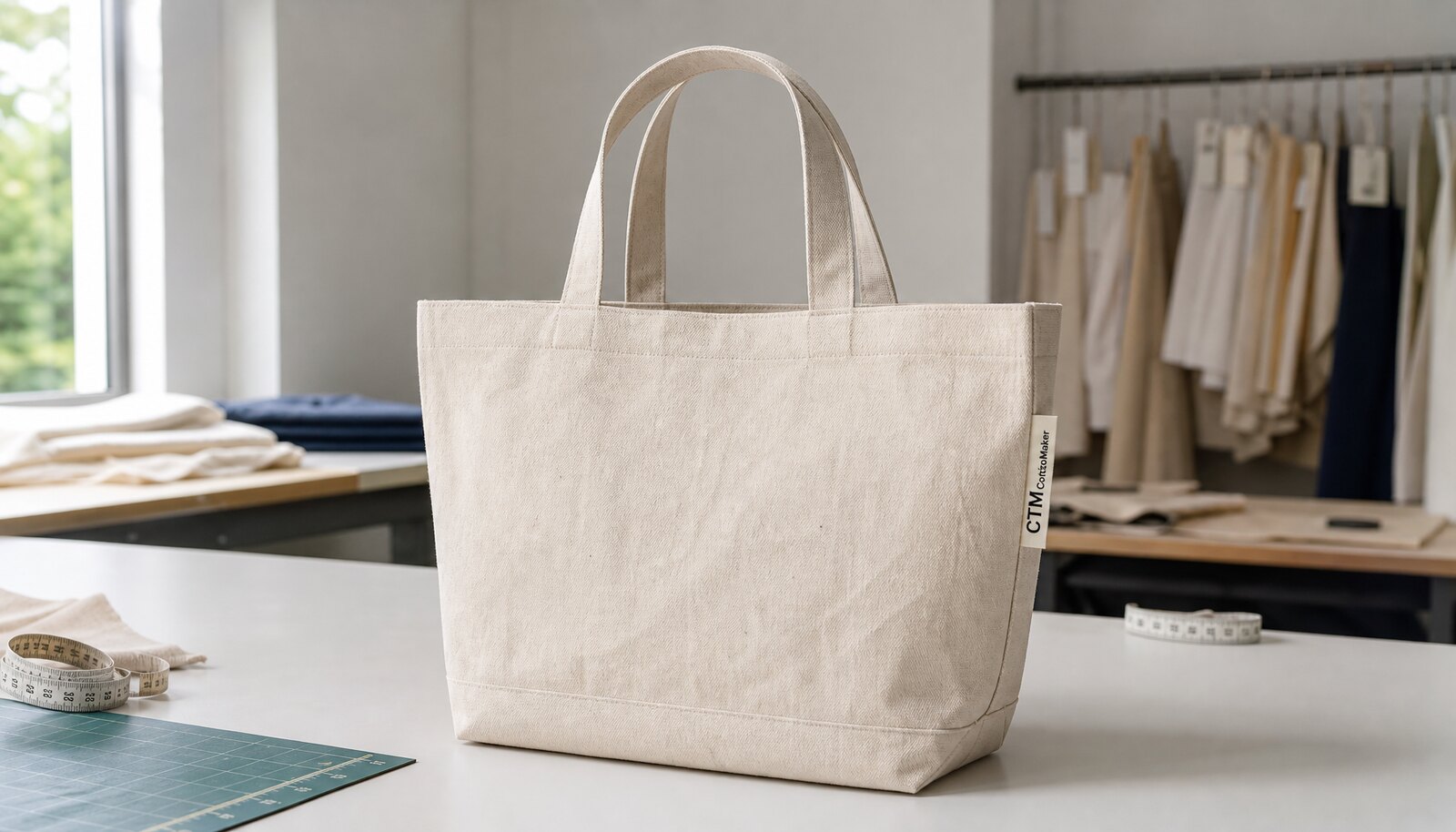
Why sample approval matters before bulk order release
For recycled canvas totes sold through retail chains, sample approval is not a formality. It is the point where the buyer locks the actual production standard: fabric weight, bag shape, handle length, print method, packing format, and the level of variation the factory is allowed to ship. If any of those items are left vague, the factory will usually fill in the gap with its own default spec, and that default is rarely the one your stores need.
The sample should answer one simple question: can this bag be reproduced at scale without changing the customer-facing look and the retailer receiving requirements? If the sample is only judged on appearance, buyers often miss the operational issues that appear later in bulk production, such as a lighter fabric lot, handles that twist under load, carton counts that do not match warehouse expectations, or print placement that shifts once the line runs faster.
- Treat the approved sample as a reference standard, not just a marketing sample.
- Lock the bag dimensions, fabric GSM, decoration, and packing before issuing bulk approval.
- Store the signed sample with the PO file so future reorders can be compared against it.
Choose the fabric and construction baseline first
Most recycled canvas tote programs for retail chains work best in the 10 to 12 oz range, roughly 340 to 410 gsm, because that band gives enough body for shelf presentation without pushing freight and sewing cost too high. If the tote needs to feel premium, hold shape on display, or carry denser merchandise, move up to 14 oz or around 475 gsm. Lighter cloth can work for promo-driven programs, but buyers should be clear that the bag will feel softer, crease more easily, and show seam distortion sooner under load.
Construction matters as much as fabric weight. A good sample should show clean seam lines, reinforced handle attachment, and enough top hem structure that the opening does not collapse after a few uses. For retail chains, the handle width and attachment method are not cosmetic details; they decide whether the bag survives store use and customer reuse. If the program expects bottle packs, heavy grocery items, or repeated carry cycles, ask for bar tacks or reinforced stitching at the handle junction and a bottom seam that does not pull apart when the bag is filled.
- Use 10 to 12 oz canvas for most chain retail programs; move heavier only when the use case justifies it.
- Keep handle width and handle drop consistent across all samples so the retail team can compare them fairly.
- Reject any sample that shows visible twisting, uneven top hem, or weak reinforcement at the handle base.
Compare sourcing routes before you compare prices
The quote you get depends heavily on the sourcing route behind it. A direct cut-and-sew factory usually gives the best control over fabric, stitching, and repeat orders, but only if it truly owns the process from fabric purchase through final packing. A trading company can be useful when the buyer needs help coordinating sampling, artwork, and documentation, yet the buyer still needs the actual factory name and the real production responsibility. Stock importers can be fast, but they only make sense if the blank bag already matches the final spec and the decoration is simple enough not to distort the base product.
For retail chains, the safest route is the one that matches the approval risk. If the order is small and the launch date is tight, a stock or hybrid route may be acceptable. If the buyer expects a long program with repeat buys, a direct factory or a specialist eco-bag producer usually gives better control over fabric lot matching, label placement, and reorders. The key is to compare sourcing routes on the amount of variance they introduce, not on the headline unit price alone.
- Ask who owns fabric sourcing, sewing, printing, and packing before you compare unit prices.
- Use a trading company only if it can prove the real factory path and manage revisions without confusion.
- Do not use stock bags unless the blank item already matches the approved sample spec on size, fabric weight, and color.
Build the sample set so approval has real meaning
One sample is usually not enough for a retail chain approval. A useful approval set includes a blank sewn sample, a decorated sample, and a packed sample, because each stage can hide a different problem. The blank sample shows shape, sewing, and fabric behavior. The decorated sample shows artwork placement, print quality, and how the ink sits on the canvas texture. The packed sample shows whether the factory can actually deliver the bag in the way the distribution center expects to receive it.
Buyers should also request the actual fabric swatch used for the sample, not just a photo of it. On recycled canvas, color tone and fiber mix can shift from one lot to another, and those shifts are easy to miss if the sample is judged only under warehouse light or on a screen. The approval set should be tied to a signed tech pack or spec sheet that includes size, GSM, artwork dimensions, and packaging instructions. If the factory later changes one of those items, the burden should be on them to resample.
- Request blank, decorated, and packed samples as separate approval checkpoints.
- Keep the fabric swatch and the physical sample together in the approval file.
- Tie every sample to a signed spec sheet so the approval is enforceable in bulk production.
Pick the print method that matches the artwork and the canvas texture
For most recycled canvas totes, simple spot-color screen printing remains the most reliable option because it gives strong color, good coverage, and predictable repetition across a large order. It is usually the right choice when the logo is bold and the artwork area is large enough to avoid tiny lines. Digital print can work when the artwork has gradients or the quantity is small, but buyers should inspect how the ink behaves on rough canvas fibers. A transfer may solve detail problems, yet it can also create a heavier feel that changes the hand of the bag and sometimes looks less natural on recycled cloth.
The approval sample should make the print decision visible. Look at placement, edge sharpness, ink build, and how the logo behaves at fold points. If the artwork is too close to a seam or a gusset, the line can distort once the bag is sewn and packed. The buyer should also set the print standard in practical terms: exact artwork size, acceptable registration drift, and the minimum line thickness that will still read well after handling. That prevents the factory from scaling the logo down or simplifying details to reduce risk on its own.
- Use screen print for bold retail logos and keep the artwork simple enough for rough canvas.
- Use digital or transfer only when the artwork complexity justifies the tradeoff in hand feel or durability.
- Approve print placement with a physical sample, not a flat artwork file alone.
Use QC thresholds that are specific enough to fail bad samples
A retail buyer should never approve a sample on a vague impression that it looks fine. The right approach is to set measurable failure points before the sample arrives. The most common problem areas are size drift, handle mismatch, stitch inconsistency, print movement, and poor packing execution. If the sample is not held to a measurement tolerance, the bulk order will usually drift farther from the intended design because the line will build around the factory's own habits rather than your spec.
For a tote in this category, the bag should be measured in finished state, not stretched by hand. Compare width, height, and gusset on both sample and spec sheet. Check whether the handle lengths match each other, whether the bag sits square when empty, and whether the seams remain flat at the corners. The logo should not bleed into the weave or break apart at the edges. If the bag is meant to be reused in stores, give it a practical load test and fail any sample that shows handle twist, seam noise, or obvious shape collapse.
- Set dimension tolerances before sampling so the factory knows what counts as an accept or reject.
- Fail any sample with uneven handles, crooked print placement, or visible seam puckering.
- Use a simple load test that matches real retail use instead of a decorative hand inspection only.
Build the packing spec as part of the sample, not after it
Many tote approvals go wrong because the bag itself is acceptable but the packing is not. Retail chains and distributors often have strict expectations for folding method, unit polybagging, barcode position, carton count, and outer mark readability. If those details are not tested in the sample stage, the bulk order can arrive with a correct product in the wrong pack configuration, which creates receiving delays and repacking cost.
The packed sample should show the exact fold, the bag orientation inside the carton, and any inserts or labels that must stay with the unit. If a polybag is used, make sure the size is right and the opening does not force the canvas into a distorted shape. If the buyer wants shelf-ready presentation, the sample carton should reflect the final retail handling path, not a temporary factory packing shortcut. The more precise the pack spec is at approval, the fewer surprises appear at the warehouse dock.
- Approve the fold style, carton count, and unit orientation as part of the sample set.
- Make the barcode, country-of-origin label, and hangtag positions part of the packing approval.
- Reject any sample carton that is hard to read, hard to count, or inconsistent with the distribution center requirement.
Read MOQ and lead time as production logic, not sales language
MOQ for recycled canvas totes is usually driven by fabric minimums, print setup, and packing labor rather than by the bag alone. A simple one-color logo on one body panel can support a lower MOQ than a program with multiple print colors, label variations, or special fold packs. If the buyer starts adding options, the factory has to manage more cutting, more print setup, and more QC touchpoints, and the minimum order rises for good operational reasons. Buyers should want to understand that logic instead of hearing a generic minimum that appears disconnected from the quote.
Lead time should also be broken into stages: fabric sourcing, sample approval, bulk sewing, printing, packing, and dispatch. That lets the buyer see where delays are likely to occur. A late artwork file or a changed label spec can move the schedule as much as an equipment issue. Chain programs also need a realistic buffer for periods when mills, dye houses, or freight lanes slow down. If the factory cannot name the stage that controls the schedule, the quoted lead time is not strong enough for a retail launch plan.
- Expect MOQ to rise when you add print colors, label types, or special packing instructions.
- Ask for a stage-by-stage schedule, not a single delivery date with no production detail.
- Hold a buffer for artwork finalization, sample revision, and carton label approval.
Compare quote data on the same basis before you shortlist suppliers
A useful quote for recycled canvas totes should tell you exactly what is included and what is assumed. The buyer needs to compare finished fabric weight, dimensions, handle length, print method, packing format, and any added labels or inserts. If one supplier quotes a lower unit cost but excludes carton marks, sample revisions, or a second print screen, the quote is not actually cheaper. It is just less complete. That is the kind of gap that turns into surprise cost after the PO is placed.
The cleanest way to compare quotes is to build a buyer-owned line item list and require every supplier to answer against the same spec. That makes the differences visible: one supplier may have a better fabric source, another may have a lower setup burden, and a third may be strong on packing but weak on artwork control. Once the quote is normalized, the buyer can judge which supplier has the lowest landed risk, not just the lowest ex-factory number.
- Compare every quote against the same finished size, GSM, print area, and packing format.
- Separate base bag cost from setup, sample, packing, and documentation cost.
- Reject quotes that do not state what happens if the fabric lot, print setup, or label spec changes.
Use final approval as a controlled release, not an informal yes
Final approval should be a short controlled process with a clear record. At this point, the buyer is not choosing a design direction anymore; the buyer is authorizing production of an agreed item. The final sample should match the signed spec, the approved fabric swatch, and the packing configuration. Any deviation, even one that seems small, should be written down and either accepted with a tolerance note or sent back for revision. If the deviation is ignored, the factory will treat it as acceptable in the bulk run.
The release file should contain the approved sample photo, the measurement sheet, the artwork proof, and the packing details. That file becomes the reference for reorder review and for any dispute about whether the bulk bag matches the approved version. For retail chains, this discipline protects the buyer more than the supplier because it reduces internal ambiguity. The strongest approval process is the one that can survive a reorder six months later without anyone having to guess what was originally approved.
- Release bulk only after the sample, spec sheet, and packing plan all match.
- Document every accepted deviation so it does not become an unspoken production change.
- Keep the approved sample file with the PO and reorder history for future programs.
Specification comparison for buyers
| Spec decision | Recommended option | When it fits | Buyer risk to check |
|---|---|---|---|
| Sourcing route | Direct cut-and-sew factory with recycled canvas sourcing | Annual retail programs that need stable repeat orders and tighter spec control | Confirm who owns fabric sourcing, who approves shade matching, and who pays for resampling if the fabric lot changes |
| Sourcing route | Trading company with named factory backing | Smaller launches or buyers new to this product category who need support on paperwork and coordination | Verify the real factory name, the actual sample maker, and whether the quote includes only brokerage or true production control |
| Sourcing route | Stock bag importer with local decoration added | Fast seasonal resets where the base bag already matches your size and fabric target | Check that the blank stock bag matches the final GSM, handle length, color tone, and carton count before decoration starts |
| Fabric weight | 10 to 12 oz, about 340 to 410 gsm | Most retail tote programs that need a balanced mix of structure, cost, and shelf presentation | Make sure the factory is quoting the same weight by finished fabric, not a lighter greige cloth that looks heavier after washing |
| Fabric weight | 14 oz, about 475 gsm or above | Premium retail use, heavy merchandising loads, or bags that must hold shape on display | Expect a higher sewing load, slower stitching, and a heavier carton weight that can affect freight and pack-out |
| Decoration method | 1 to 3 spot-color screen print | Most chain retail logos, especially when the artwork is bold and the print area is medium to large | Lock Pantone references, print size, and minimum stroke thickness or the logo may fill in on rough canvas texture |
| Decoration method | Digital print or transfer | Small trial quantities, complex gradients, or artwork that changes often | Confirm rub resistance and whether the finish will crack or sit too heavily on recycled fibers |
| MOQ logic | One body, one fabric, one print spec across the first order | When the buyer wants the lowest risk path to approval and reorders are likely | Every extra option, such as handle color or label type, can multiply setup cost and delay sign-off |
Buyer checklist before sampling
- Approved size spec with finished width, height, gusset, handle length, and seam allowance
- Confirmed recycled canvas GSM and a retained fabric swatch signed by both sides
- Decoration proof with artwork size, placement, Pantone reference, and print method
- Blank sample, decorated sample, and packed sample all approved as a set
- Load test result for expected retail use, including handle stress and bottom seam behavior
- Final packing format with fold method, polybag use, carton count, and case mark layout
- Barcode, country of origin, and retail label position approved before bulk production
- Lead time written by stage, including sample, bulk sewing, printing, and packing
- Reorder rule documented for fabric lot matching and shade tolerance
- Signed photo record of the approved sample stored with the purchase order
Factory quote questions to send
- What is the exact finished fabric weight, weave type, and recycled content basis used in your quote?
- Who supplies the fabric, and can you hold the same fabric lot for a reorder if the first order is approved?
- Which decoration method is included in the price, how many colors are covered, and what setup charges apply?
- What is the minimum order quantity by fabric color, print color count, and label type?
- Which sample stages are included, and which ones are chargeable if we need a revised prototype?
- What finished dimensions, handle length, gusset depth, and seam allowance are assumed in the quote?
- What packing method is included, including fold style, polybag requirement, insert card, and carton quantity?
- What is the lead time after sample approval, and which steps are most likely to delay it?
- What overrun or underrun range do you allow, and how do you handle rejected pieces at final inspection?
- What documents can you provide with the bulk order, such as carton marks, packing list format, and production photos?
Quality-control points to confirm
- Fabric weight matches the approved swatch and does not feel noticeably lighter or looser in weave
- Bag dimensions stay within the agreed tolerance and both sides of the bag remain symmetrical
- Handles are equal in length, anchored cleanly, and reinforced at the stress points without skipped stitches
- Bottom seam and side seams are straight, flat, and free from puckering, gaps, or loose threads
- Print placement is centered or positioned to the approved artwork drawing and does not drift between samples
- Print coverage is even, with no bleeding, cracking, pinholing, or heavy ink build that makes the bag stiff
- Label, hangtag, and barcode positions match the retail packing plan and do not interfere with folding
- Fabric surface is free from obvious stains, oil marks, holes, hard slubs, and mixed-color contamination
- The bag passes a realistic load test for the intended retail use without handle distortion or seam failure
- Carton packing, case count, and outer marks match the approved shipper spec and are easy to verify at receiving