1. Start with the buying use case before asking for a unit price
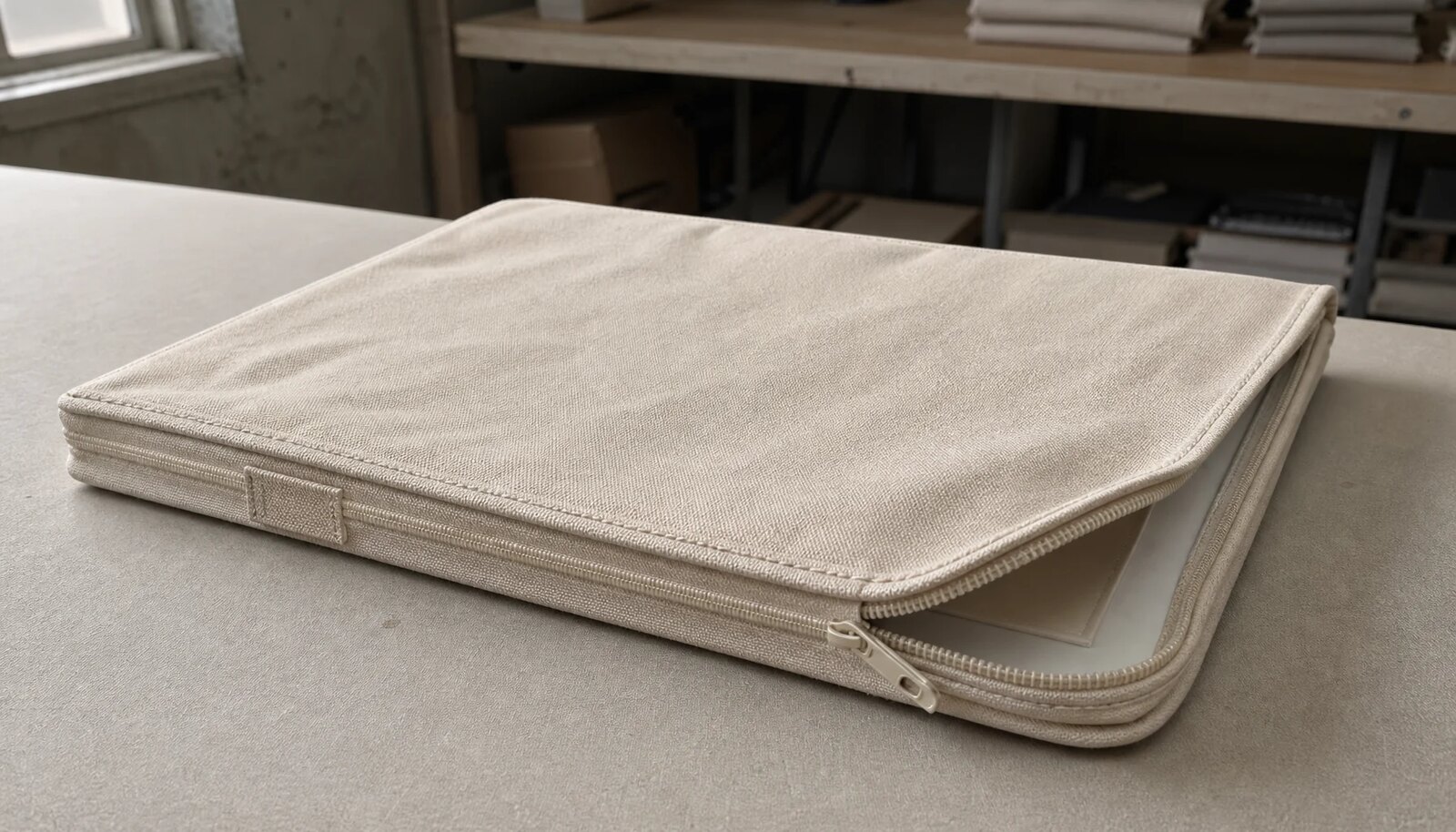
A canvas zipper portfolio looks simple, but for an eco apparel brand it often carries more than paperwork. It may hold line sheets, fabric swatches, order forms, showroom notes, lookbooks, or retail merchandising materials. That means the product is judged at arm’s length, in meetings, at trade shows, and during shipment receiving. Small faults are visible. A crooked logo, a rough zipper, an oil mark, or a weak corner can undermine the way buyers perceive the brand before they ever touch the apparel collection.
Before asking for pricing, write the use case into the RFQ. State who will use the portfolio, what will go inside, how often it will be opened, whether it needs to travel by courier, and whether it must arrive retail-ready. A trade show handout can prioritize speed and cost. A showroom tool used across a season needs better zipper performance, cleaner structure, and more disciplined packing. A retail product needs stronger unit presentation, barcode accuracy, and more consistent finishing.
Avoid vague sourcing language unless it is converted into measurable requirements. Words like premium, durable, sustainable, or clean are not procurement specs by themselves. Durable may mean a zipper that survives repeated opening, corners that stay square in export cartons, canvas that resists dirty handling, or a logo that does not crack. Each version leads to a different build and a different inspection checklist. Buyers get better quotes when the function is written first and the styling is written second.
- Define the user: wholesale buyer, sales representative, showroom staff, retail customer, or internal team.
- Define the contents: A4 sheets, US letter documents, folded line sheets, lookbooks, swatch cards, tablet, or mixed sales kit.
- Define the handling level: one-event handout, seasonal sales tool, retail product, staff kit, or repeat-use document carrier.
- Define the presentation standard: natural casual, clean branded, premium understated, utility-focused, or retail-ready.
- Ask the supplier what construction changes they recommend if the portfolio will be filled and carried rather than photographed empty.
2. Build the RFQ around a measurable baseline specification
The biggest reason canvas portfolio quotes are hard to compare is that suppliers are often pricing different products. One factory may quote 10 oz canvas, an unlined body, a standard zipper, and bulk packing. Another may quote 14 oz canvas, lining, a #5 coil zipper, individual bags, and tighter inspection. Both can call the item a canvas zipper portfolio, but the cost structure and risk profile are not the same.
Write a baseline specification and require every supplier to quote against it. At minimum, include finished external size, usable internal size, canvas weight and finish, lining or interlining, zipper type and size, logo method, number of logo colors, internal layout, packing format, carton requirements, and target delivery date. If a supplier wants to propose a lower-cost alternative, ask them to show it as an option rather than silently replacing the requested build.
Separate recurring unit cost from setup charges. Screen setup, embroidery digitizing, woven label minimums, custom zipper puller tooling, cutting dies, barcode labels, and printed cartons can change first-order cost by a meaningful amount. Repeat-order pricing may drop if the setup does not repeat, but that only helps if procurement tracks it. Compare first-order cost, repeat-order cost, and landed cost, not just the first number in the quote.
- Use one baseline specification for all suppliers so pricing is comparable.
- Separate unit price, sample charge, logo setup, tooling, packing, inland freight, and export documentation if applicable.
- Request price breaks at 500, 1,000, 2,000, and 3,000 pieces using the same specification.
- Ask for estimated carton quantity, carton dimensions, gross weight, and CBM before choosing a supplier.
- Flag any quote that omits fabric GSM, zipper size, logo method, packing format, or tolerance details.
3. Specify canvas by weight, finish, and acceptable variation
For wholesale canvas zipper portfolios, 12 oz to 14 oz cotton canvas is a practical working range for document and sales-kit use. In GSM terms, that is roughly 407 to 475 GSM. The exact conversion can vary by construction and supplier, so buyers should ask for both measurements rather than relying on one. A lighter fabric can reduce freight and cost, but it may wrinkle more easily, show seam shadows, and feel less substantial. A heavier canvas can improve body, though it may also create bulky corners, more visible needle marks, and a higher shipping weight.
The finish matters as much as the weight. Raw or natural canvas supports an earthy brand look, but it may show cotton flecks, slubs, neps, and shade movement more clearly. Washed canvas feels softer, though it may behave with more dimensional variation. Bleached canvas gives a cleaner background for print but can show dirt and scuffs quickly. Dyed canvas needs a shade standard, because even small differences become obvious once the portfolio is stacked in bulk or shown beside seasonal apparel materials.
Set a reasonable tolerance for fabric weight and appearance. Many buyers use plus or minus 5% as a starting point for fabric weight tolerance, but the acceptable range should be written into the purchase order and aligned with the intended use. If the portfolio depends on structure, the low end of the range matters. If it depends on a softer drape, the high end may be acceptable. Attach the approved swatch or physical master to the PO so the factory is not guessing which fabric level has been accepted.
- Request fabric weight in ounces and GSM, with the bulk tolerance stated in writing.
- Ask whether GSM is verified by mill certificate, internal weighing, third-party test, or incoming QC check.
- Define acceptable natural character: small slubs, cotton flecks, neps, and mild shade movement if approved.
- Reject oil marks, mildew odor, water stains, holes, dirty handling, severe weaving lines, and panel-to-panel shade mismatch.
- Confirm whether the fabric is raw, washed, bleached, dyed, coated, laminated, pre-shrunk, or untreated.
4. Control finished size, usable capacity, and internal layout
Many portfolio failures begin with dimensions. A sample can look correct in a photo and still fail once it is loaded with real materials. A4 paper, US letter sheets, seasonal catalogs, fabric swatch cards, and order forms all need slightly different clearance. If the opening is too tight, users bend corners and force the zipper. If the body is too large, the product looks slack, empty, and less intentional. Neither problem helps a brand that wants careful presentation.
Approve external size and usable internal size separately. External size matters for carton planning, shelf fit, courier size, and freight cube. Usable internal size determines whether the product actually works. The zipper opening length is also important because a portfolio can have enough body width but still be awkward to load if the opening is limited by zipper stops, seam allowance, or the way the corners are finished. A quote that only lists overall size is not complete enough for procurement.
For textile portfolios, a body tolerance of plus or minus 5 mm is a useful starting point, while logo placement or pocket placement may need plus or minus 3 mm if the design is visually centered. Those numbers are not universal rules, but they are concrete enough to manage expectation. If artwork sits close to an edge or if a pocket line is part of the presentation, tighten the tolerance before approval. Otherwise the factory may treat the variation as acceptable while the buyer sees it as poor control.
- Approve external finished size, usable internal size, zipper opening length, and pocket dimensions separately.
- Test the sample with the exact documents, catalogs, swatches, or sales kit contents planned for use.
- Specify whether the portfolio should lie flat, hold mild structure, remain foldable, or stand up to repeated carrying.
- Check that pockets, dividers, pen loops, and card slots do not reduce the main compartment below the required capacity.
- Use written tolerances such as plus or minus 5 mm for body size and plus or minus 3 mm for logo placement where appropriate.
5. Choose zipper specifications that match repeated handling
The zipper is the most frequently handled component on the product, so it should never be left as a generic line item. Nylon coil zippers are widely used for textile business bags because they are flexible, smooth enough for repeated use, and easier to sew into fabric than many molded alternatives. For document portfolios, a #5 nylon coil zipper is often a practical baseline. Smaller coils can feel lighter, while larger coils may look more rugged. The right choice should reflect the fabric weight, product size, and brand image, not habit.
Specify the tape color, slider finish, puller type, end stop construction, zipper direction, and the preferred closed position of the slider. A low-profile product may need a tonal zipper with a simple puller. A utility style may accept contrast tape or a cord puller. If the design uses a custom metal or molded puller, tooling, plating quality, lead time, and spare-part strategy all become part of the quote and inspection process. These details are easy to overlook and expensive to correct after production begins.
Test zipper behavior during sample approval and final inspection. Open and close the zipper through the full travel, not just a short section. Check the item empty and filled. Watch for snagging on lining, rough slider movement, tape waviness near corners, insecure end stops, bent sliders, sharp burrs, and teeth that separate under mild tension. If a sample is hard to operate, bulk goods are unlikely to improve. The product should feel controlled from the first cycle, not only after a few attempts.
- Specify nylon coil size, tape color, slider finish, puller type, end stops, sewing position, and closing direction.
- Test the approved sample through at least 10 full open-close cycles while empty and filled.
- Reject snagging, splitting, rough movement, missing teeth, loose end stops, sharp puller edges, and bent sliders.
- Check zipper straightness after sewing; waviness often points to uneven seam allowance or fabric stretch.
- Ask whether custom pullers require tooling, higher MOQ, longer lead time, and replacement parts for QC failures.
6. Match the logo method to canvas texture and artwork complexity
Canvas is a textured surface, so logo approval has to happen on the actual material. Screen print is usually the right choice for bold logos, simple typography, and larger solid artwork. It is less suitable for hairline text, tight reversed text, intricate gradients, or designs that assume a perfectly smooth base. On canvas, ink may bridge texture in some places and break over raised yarns in others. That variation can be perfectly acceptable if it is intentional and approved on the real fabric.
Woven labels, embroidery, and patches are strong alternatives when the brand wants a more subtle or tactile mark. A woven label can deliver a crisp, repeatable identifier with less ink-related risk, but it must be aligned and sewn securely. Embroidery adds texture and a handcrafted look, though it can pucker canvas if stitch density is too high or backing is not balanced. A cotton, recycled-material, or leather-alternative patch can look premium, but the buyer should confirm attachment method, edge quality, colorfastness, and whether the patch material fits the brand’s material policy.
Do not approve a logo from a digital mockup alone. Request a strike-off on production canvas, or on the closest approved bulk fabric, before bulk production starts. Review the sample under daylight and indoor light because natural canvas changes perceived color. Set logo size, placement from edges, color standard, and tolerance. A placement note such as 40 mm from the left seam and 30 mm from the top seam, plus or minus 3 mm, is easier to inspect than a vague centered instruction.
- Use screen print for bold marks, simple typography, and larger solid artwork.
- Use woven labels, embroidery, or patches for restrained premium branding or small brand identifiers.
- Avoid tiny text, hairline strokes, complex gradients, and artwork that depends on a perfectly smooth background.
- Approve a physical strike-off on production canvas before bulk printing or embroidery.
- Set logo size, color reference, position from edges, and placement tolerance in millimeters.
7. Treat sampling as production control, not marketing review
The sample stage should be handled like a controlled production test. A photo can confirm appearance, but it cannot confirm hand-feel, smell, zipper movement, true shade, seam thickness, or usable capacity. For a branded wholesale portfolio, the minimum approval flow should include fabric swatch, logo strike-off, pre-production sample, and packing sample when packaging affects presentation or barcode accuracy.
Inspect the pre-production sample as an actual user would. Fill it with intended documents, carry it, open and close it repeatedly, lay it flat, and check whether the corners remain clean. Measure the external size, internal capacity, pocket dimensions, zipper opening, logo position, and label alignment. Look inside for rough seam backs, loose threads, lining sag, and pocket usability. If the portfolio includes a card slot or pen loop, test it with the real items, not assumptions.
Document the approved sample with enough detail to recreate it. Record fabric reference, zipper details, thread color, logo method, logo placement, lining, pocket layout, size measurements, accepted deviations, packing method, and approval date. If practical, keep one master sample with the factory and one with the buyer. Final inspection should compare bulk units against that approved master, not against memory or a digital mockup.
- Request fabric swatch, logo strike-off, pre-production sample, and packing sample when branding or retail packing is important.
- Measure the sample with a ruler and record size, zipper opening, pocket dimensions, and logo placement.
- Review under daylight and indoor lighting to catch shade, print, and surface issues.
- Test the sample filled with actual line sheets, catalogs, swatches, or sales materials.
- Keep a labeled master sample and written approval record before releasing bulk production.
8. Define defect categories before production starts
Quality control is much stronger when defect criteria are agreed before bulk production begins. For canvas zipper portfolios, critical defects are issues that make the product unsafe, contaminated, or unusable. Examples include sharp metal burrs on the puller, mold, strong chemical odor, broken zipper function, foreign contamination, or substances prohibited by the buyer’s compliance policy. Those defects should normally not be accepted.
Major defects are issues likely to trigger complaints or make the product unsuitable for brand presentation. Examples include wrong size beyond tolerance, incorrect fabric, wrong zipper color, crooked or off-color logo, large stains, open seams, missing pockets, severe shade mismatch, zipper splitting, or cartons packed with wrong barcodes. Minor defects are smaller workmanship issues that do not block normal use but should still be limited, such as short thread tails, very small acceptable slubs, slight stitch waviness, or light surface marks within the approved standard.
For larger orders, many buyers use an AQL-based final random inspection. The exact AQL level depends on buyer policy and order risk, but the checklist must be product-specific. A generic soft goods checklist is not enough. Inspectors should measure dimensions, operate zippers, compare logos, check stitching, inspect fabric cleanliness, test pockets, verify packing, count carton quantities, and compare units against the master sample. Inline checks are especially useful after printing and during zipper sewing because those defects are expensive to rework once the goods are packed.
- Classify critical, major, and minor defects in the PO, QC manual, or inspection booking.
- Treat mold, strong odor, sharp burrs, contamination, unsafe parts, and nonfunctional zippers as critical issues.
- Treat wrong size, wrong material, crooked logo, severe stains, open seams, and zipper failure as major issues.
- Define minor limits for thread ends, small surface marks, mild slubs, and slight stitch variation.
- Use final random inspection plus inline checks for fabric cutting, logo application, zipper setting, sewing, trimming, and packing.
9. Inspect construction details that determine long-term presentation
Construction quality decides whether the portfolio feels deliberately made or roughly assembled. Plain canvas makes sewing errors easy to see because there are few design elements to hide them. Inspect cutting accuracy, grain direction, seam allowance, topstitch position, corner shaping, zipper setting, and reinforcement. If panels are not cut square, the body can twist. If seam allowance varies, the zipper may wave. If corner shaping is inconsistent, the goods will stack unevenly and look careless.
Stitching should be checked for appearance and strength. A common range for canvas bags is around 7 to 9 stitches per inch, but the correct setting depends on fabric, thread, machine, and design. Too few stitches can look coarse and reduce seam security. Too many stitches can perforate heavier canvas or create visible puckering. The supplier should confirm the stitch standard used on the approved sample and hold that standard in bulk. Reinforcement should be present at zipper ends, top corners, pocket openings, and any other pull point.
Interior workmanship matters because users open the portfolio in front of buyers and colleagues. Loose threads, raw edges, sagging lining, tight card slots, or a pen loop that does not fit a normal pen make the item feel unfinished. If lining is used, check that it is secured without twisting and does not catch in the zipper. If internal sleeves are added, test loading and removal. A decorative feature that is too tight to use turns into a complaint risk instead of a value-add.
- Check panel symmetry, square corners, grain direction, and body twist before approving appearance.
- Inspect seam allowance, topstitch straightness, stitch density, skipped stitches, broken stitches, and backtracking.
- Confirm reinforcement at zipper ends, upper corners, pocket openings, gusset stress points, and pull areas.
- Trim loose threads inside and outside so they do not catch in the zipper or appear near the logo.
- Test each internal feature with the intended item: documents, business cards, pens, swatches, or catalogs.
10. Pack for clean arrival, warehouse receipt, and brand presentation
Packing can preserve quality or damage it after sewing inspection is complete. Canvas portfolios can arrive with scuffed logos, crushed corners, bent zipper tracks, dirty surfaces, or pressure marks if the unit pack is poorly thought through. Decide early whether the product needs a polybag, paper sleeve, tissue wrap, belly band, hangtag, barcode label, or retail-ready package. Eco apparel brands may want reduced plastic, but the item still needs protection from abrasion, moisture, dirt, and warehouse handling.
If screen print is used, confirm that the ink is fully cured before packing. Printed surfaces should not be packed under pressure against zipper pulls, metal sliders, or rough carton interiors. If the product uses natural canvas, the handling table matters because dirt and oil marks are difficult to remove later. If paper sleeves are used instead of polybags, ask how the supplier plans to prevent moisture exposure and scuffing during sea freight or long warehouse storage.
Master cartons should be stable without crushing the goods. Overfilled cartons can deform corners, create zipper waves, and press pullers into the fabric. Underfilled cartons allow movement and abrasion. Before shipment, verify carton quantity, carton dimensions, gross weight, carton marks, barcode information, and packing sequence. If the route or season involves humidity, ask about desiccants or other moisture-control procedures and make sure they fit destination requirements and retailer rules.
- Choose unit packing based on route, channel, abrasion risk, moisture risk, and brand packaging policy.
- Prevent zipper pullers, sliders, and labels from pressing directly into printed or embroidered logo areas.
- Verify barcode placement, hangtag position, carton marks, master carton count, and retailer routing requirements.
- Set carton quantity and carton strength so portfolios do not shift, crush, or bow in transit.
- Use moisture control where sea freight, humid season, long storage, or natural canvas mildew risk makes it necessary.
Specification comparison for buyers
| Procurement decision | Recommended specification | Why it matters for eco apparel brands | Inspection or quote risk to control |
|---|---|---|---|
| Canvas base | 12 oz to 14 oz cotton canvas, approximately 407 to 475 GSM, with bulk tolerance stated, commonly plus or minus 5% unless buyer requires tighter control | Provides enough structure for line sheets, order forms, swatch cards, and sales kits without turning the portfolio into a heavy carry item | Suppliers may underquote by using lighter fabric; require fabric weight, GSM method, finish, and approved swatch reference in the PO |
| Fabric finish | Raw, natural, washed, bleached, dyed, or coated finish named in the quote; shade standard approved by swatch, lab dip, or physical master where relevant | Finish changes hand-feel, shrinkage, print behavior, odor risk, and the sustainability story the brand communicates internally | Separate natural slubs and cotton flecks from defects such as oil marks, mildew, dirty handling, holes, or severe shade mismatch |
| Finished size | External size and usable internal size confirmed separately; typical tolerance plus or minus 5 mm for body dimensions and plus or minus 3 mm for key pocket or logo positions | A portfolio that is slightly too tight wrinkles catalogs, crushes fabric cards, or strains zipper ends during buyer meetings | Inspect filled units with actual A4, letter, catalog, swatch card, or sales kit contents, not empty units only |
| Body construction | Lined single compartment with optional flat sleeve, card slot, pen loop, or light interlining; seam allowance and reinforcement points specified | A clean interior improves presentation and hides seam backs, while interlining supports the logo area and corners | Unlined bodies can look unfinished; overbuilt padding increases bulk, corner distortion, and carton cube |
| Zipper specification | Nylon coil zipper, commonly size #5 for document portfolios, with approved tape color, slider finish, puller type, end stops, and sewing position | The zipper is the most handled component and strongly affects perceived quality during repeated opening and closing | Low-grade zippers may snag lining, split at the end stop, wave after sewing, or show inconsistent tape shade across production lots |
| Logo method | Screen print for bold artwork; woven label, embroidery, cotton patch, or debossed leather-alternative patch for subtle branding; strike-off required on production fabric | Canvas texture can break fine artwork, so logo method must match brand identity, fabric surface, and minimum detail size | Approve artwork size, Pantone or physical color standard, placement tolerance, and accepted print texture before bulk |
| MOQ and color split | Practical custom range often starts around 500 to 1,000 pcs per color/artwork, with price breaks requested at 500, 1,000, 2,000, and 3,000 pcs | Lets eco apparel brands test a sales or retail program without fragmenting the order into too many SKUs | Very low MOQ can hide higher setup charges, leftover materials, limited color control, or non-repeatable sourcing |
| Packing format | Individual polybag, paper sleeve, tissue wrap, or retail pack specified; carton quantity, gross weight, dimensions, and moisture protection confirmed before PO | Protects print surface, zipper teeth, corners, and warehouse receiving accuracy while supporting brand packaging policies | Loose packing scuffs logos; tight cartons crush corners; reduced-plastic packing still needs abrasion and moisture protection |
| Inspection model | Inline checks during cutting, printing, zipper setting, and sewing; final random inspection using buyer defect categories and AQL or agreed sampling plan | Catches repeat defects before the full lot is packed and gives procurement a documented shipment release basis | Without written critical, major, and minor defect definitions, factories may pass units that only look acceptable from a distance |
Buyer checklist before sampling
- Define the exact end use: wholesale line-sheet carrier, showroom portfolio, trade show handout, retail merch item, onboarding kit, or staff document bag.
- Confirm external finished size, usable internal size, zipper opening length, target contents, and dimension tolerance before sampling.
- Specify canvas by ounces and GSM, including finish: raw, washed, bleached, dyed, laminated, lined, unlined, or lightly interlined.
- Ask whether the quoted canvas is stock fabric or custom sourced, and whether one fabric lot can cover the full bulk quantity.
- Approve zipper type, size, tape color, slider finish, puller shape, end stop construction, zipper direction, and replacement plan for defects.
- Lock logo method, artwork file, Pantone or physical color reference, print area, label size, stitch color, and placement tolerance in millimeters.
- Define sewing expectations: seam allowance, stitches per inch, topstitch position, reinforcement at zipper ends and corners, bartack locations, and thread trimming.
- Confirm internal organization: flat sleeve, document divider, business card slot, pen loop, gusset, lining, elastic holder, or no added components.
- Require a pre-production sample made with bulk-intended fabric, zipper, lining, thread, logo method, internal layout, and packing.
- Test the approved sample with actual documents, catalogs, swatches, or sales materials instead of approving only a flat product photo.
Factory quote questions to send
- What canvas weight in ounces and GSM is included in this quote, and what bulk tolerance can you hold on fabric weight?
- How will you verify GSM on incoming fabric rolls: supplier certificate, internal cut-and-weigh test, third-party lab, or buyer inspection?
- Is the canvas raw, washed, bleached, dyed, or treated, and what slub, nep, shade, or texture variation should we expect?
- Can the full order be made from one fabric dye or greige lot, and what is your procedure if a second lot is needed?
- What finished external size, usable internal size, zipper opening length, and size tolerance are included in the sample and bulk quote?
- Which zipper type, coil size, tape material, tape color, slider finish, puller design, and end stop detail are included in the base price?
- Are zippers from a nominated brand, a local supplier, or your standard factory stock, and can you send zipper cards before PP approval?
- Which logo methods can you produce in-house and which are outsourced: screen print, embroidery, woven label, patch, heat transfer, or debossing?
- What setup charges apply for screens, embroidery digitizing, woven labels, custom pullers, cutting dies, printed packaging, or barcode labels?
- What MOQ applies per color, artwork version, zipper color, and logo method, and how do prices change at 500, 1,000, 2,000, and 3,000 pieces?
Quality-control points to confirm
- Fabric GSM matches the approved range and does not vary enough to change body structure, opacity, print result, hand-feel, or carton weight materially.
- Canvas surface is clean, with agreed limits for slubs, dark yarns, neps, weaving lines, oil marks, water stains, odor, and shade variation.
- Panels are cut square and symmetric, with grain direction controlled so the portfolio does not twist, torque, or bow after sewing.
- Finished external size, usable internal size, pocket size, and zipper opening length match the approved tolerance, especially when filled with intended documents.
- Stitch density is consistent, seam allowance is even, corners are reinforced, and no skipped stitches, broken stitches, or loose backtracking appear at stress points.
- Thread trimming is clean on exterior and interior, with no long tails caught in the zipper, visible around the logo, or left inside pockets.
- Zipper opens and closes smoothly through full travel, sits straight, and does not snag lining, seam tape, pocket edges, zipper allowance, or loose threads.
- Slider, puller, end stops, and zipper tape color match the approved sample, with no burrs, sharp edges, plating chips, bent parts, or tape waviness.
- Logo registration, color, size, and placement match the approved artwork, with no bleeding, pinholes, ghosting, cracking, crooked labels, embroidery puckering, or adhesive lift.
- Inner pockets, sleeves, pen loops, and card slots are aligned, usable, and securely attached without narrowing the main compartment unexpectedly.