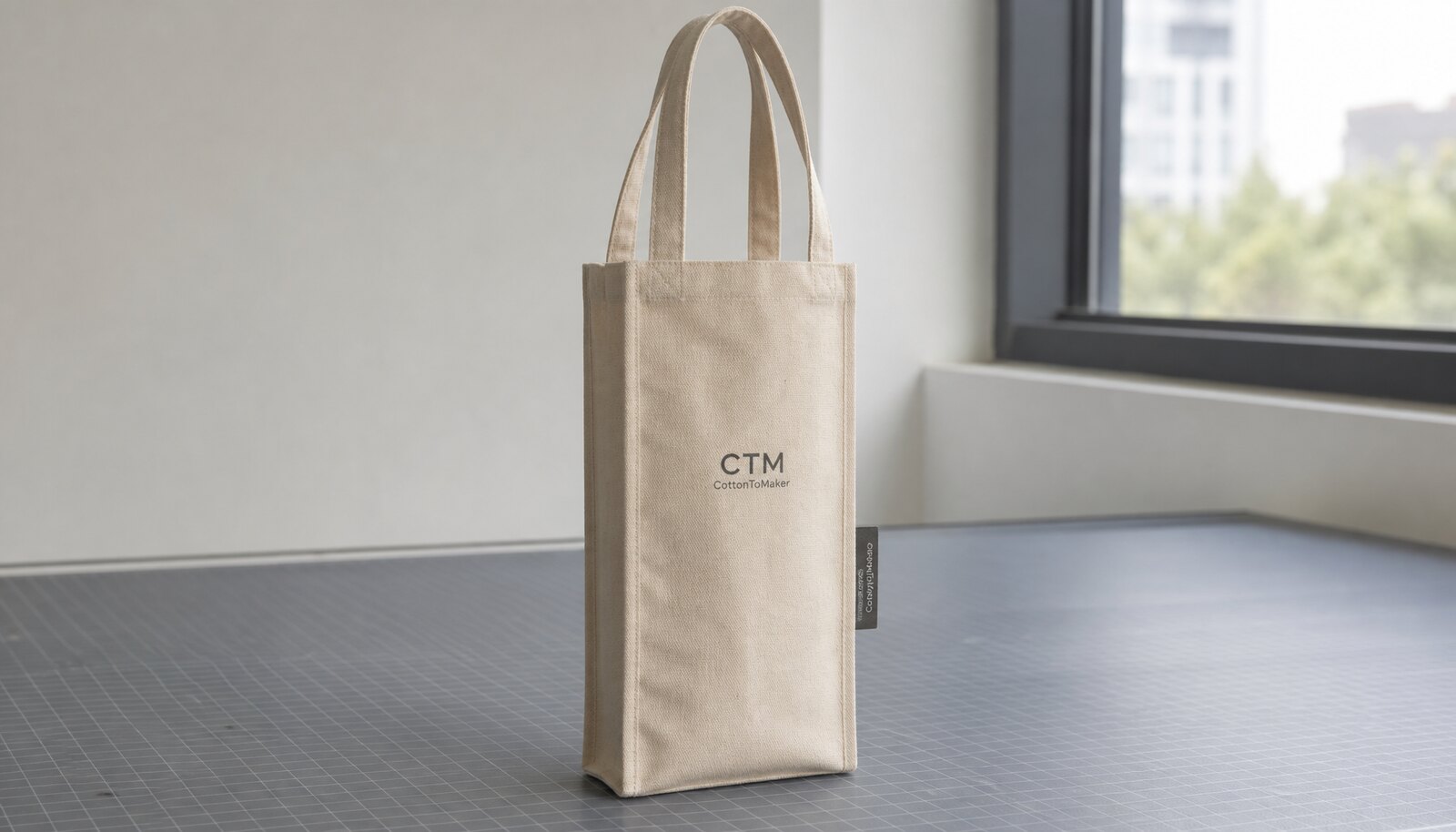
What promotional wine bags are buying for a B2B program
Promotional wine bags are not just soft packaging for a bottle. In a B2B program, they are a presentation item, a distribution item, and a brand-control item at the same time. The bag has to fit the bottle properly, print cleanly, survive transport, and still look respectable when handed to a customer, guest, distributor, or trade visitor. When the bag is right, it upgrades the bottle without much ceremony. When it is wrong, buyers notice immediately: wrinkled fabric, crooked print, a loose bottle, or a bag that tears on the first handoff.
The commercial job is usually one of four things. In an event program, the bag is a quick giveaway and speed matters more than premium construction. In a gifting program, the bag should feel reusable and the closure must look tidy. In distributor or sales programs, the bag may be part of a larger launch kit, so consistency across reorders matters. In retail, the bag becomes shelf-facing packaging and visual finish matters as much as unit cost. If you do not define which job the bag is meant to do, the RFQ will invite mismatched quotes and weak samples.
For procurement, that means the first question is not, 'What logo do we want?' It is, 'What commercial role is this bag playing?' The answer drives fabric weight, structure, closure style, decoration method, and lead time. A bag for a one-day event can tolerate a simpler sleeve. A retail-ready gift bag needs a more stable body, cleaner folding, and a better controlled pack-out. The more clearly you state the use case, the less likely a supplier is to quote the wrong construction and call it equivalent.
The easiest way to avoid this problem is to write the use case into the spec. If the order is for a customer tasting event, say so. If it is for a distributor onboarding kit, say so. If it is for retail resale, say so. Suppliers can work with almost any of those briefs, but they cannot work well with all of them at once.
- Use the bag’s role to define fabric weight, finish, and closure before asking for artwork quotes.
- Treat a promotional wine bag as a presentation item with fit, print, and pack requirements—not just as a small textile accessory.
- If the bag is tied to a campaign date, set the lead-time buffer at the RFQ stage, not after the sample arrives.
Lock the bottle spec first, or every other decision becomes soft
The most common sourcing mistake is to start with artwork and only later discover that the bag does not fit the bottle. Wine bottles vary more than many buyers assume. A standard Bordeaux bottle, a wider Burgundy bottle, a tall sparkling bottle, and a specialty shaped bottle can all demand different width, height, and closure allowances. If you are buying for one brand only, request the exact bottle drawing or measured sample. If you are buying for a distributor or multi-brand program, write the spec around the widest and tallest bottle expected in the order.
A useful RFQ should include three things: the bottle height, the maximum body diameter, and the shoulder / neck profile. Those three dimensions matter more than the generic bottle name. A promotional wine bag that is technically the right length can still fail if the shoulder is too broad, the base is too wide, or the top closure sits too low. The buyer should also state whether the bag must hold the bottle upright on its own, or only present it once the bottle is already boxed or gift-wrapped. That single sentence changes how much stiffness and base support the factory should build in.
A few bottle details are worth calling out because they cause avoidable rework. Foil capsules can add bulk at the neck. Oversized corks and mushrooms on sparkling bottles change the top profile. Some export bottles are slightly heavier and wider than domestic equivalents. Even a small change in base diameter can affect whether the bag hangs straight or pulls to one side once loaded. If the bag is intended to hold a bottle plus a tasting card or small insert, specify that too, because the insert takes up clearance at the top and can interfere with the closure.
For multi-brand sourcing, do not quote against a single average bottle and hope it covers the range. In practice, buyers should define a pass bottle and a fail bottle. The pass bottle is the one the bag must fit comfortably. The fail bottle is the upper limit the supplier should avoid promising. That gives the factory a clear measurement window instead of a vague 'should fit most standard wine bottles' statement that is hard to enforce later.
- Request bottle dimensions in millimeters, not only in bottle type names.
- Confirm if the bottle is capped, corked, foiled, or unusually shaped at the shoulder or base.
- State whether the bag needs to hold one bottle only or a bottle plus a card, insert, or hangtag.
Material choices that make sense in real procurement terms
For promotional wine bags, fabric choice should be driven by print quality, hand-feel, bottle support, and sewing efficiency. Cotton twill and canvas are usually the most practical because they are stable to cut, easy to print, and straightforward to sew in repeat volumes. A 140-180 gsm cotton twill is often the sweet spot for promo use: it looks clean, takes one-color screen print well, and does not overload the sewing line. If the bag is expected to be reused or to feel more premium, 8-10 oz canvas gives more body and reduces the chance that the bottle shape shows through too sharply.
Jute has a different appeal. It can look rustic and gift-like, which is useful for natural or farm-to-table branding. But jute is less forgiving when buyers want fine print, clean edges, or a soft hand-feel. It can shed fibers, pick up odor more easily, and create a rougher presentation if the finishing is not controlled. Blends can reduce some of those issues, but ask how much of the composition is actually jute versus another fiber. Do not accept vague descriptions like 'eco fabric' or 'premium natural material' in a quote. Ask for the composition, weave, gsm or oz, width, base color, shrinkage expectation, and whether the cloth is pre-shrunk.
Thickness changes both the look and the process. A heavier cloth may feel stronger, but it also adds labor, needle wear, and seam bulk. That can make topstitching less neat or corners more likely to pucker if the factory is working on light-duty equipment. Buyers should also ask whether the supplier has already run similar bag constructions on the same fabric, because a material that looks good on paper may still be uncomfortable to sew at scale. If the factory cannot explain how the cloth behaves on their line, you may see uneven seam tension or inconsistent edge finishing in bulk.
As a planning rule, buyers should match material to the campaign outcome. If the bag is a short-run handout, a more economical cloth may be enough. If the bag is intended to be reused by the end customer, the extra cost of a heavier canvas often makes sense because it lowers complaints about limp shape, seam twisting, or premature wear.
- 140-180 gsm cotton twill: practical for cost control and clean logo printing.
- 8-10 oz canvas: better when the bag must feel reusable, giftable, or structurally firm.
- Jute or jute blends: useful for rustic branding, but inspect fiber shedding, odor, and print clarity very closely.
Construction details that separate a sample from a usable order
The shape of the bag affects how the bottle sits, how the bag folds, and how expensive the sewing becomes. A flat sleeve is the simplest option and usually the lowest cost. It is suitable when the bottle itself is the hero and the bag only needs to present the bottle cleanly. A gusseted style adds width and helps reduce the squeezed look that can happen with wider bottles. A boxed base or structured bottom makes the bag stand better and improves gift presentation, but it uses more fabric and requires more careful stitching. That extra stability is often worth it when the bag will be photographed, stacked, or handed out at a higher-value event.
Closure design matters more than many buyers expect. A cotton drawstring is a standard choice because it is simple, light, and easy to source. But you still need to specify cord thickness, channel width, stop-knot method, and whether the cord ends must be heat-sealed, knotted, tipped, or left raw. A top fold with tie may feel cleaner for gifting, but it introduces extra folding labor and can change the visible logo area. If the bag has a side label or woven tag, tell the factory whether it must sit on the front face or in the side seam so they do not place it where the logo should be.
The buyer should also think about reinforcement. The bottom seam is where load moves when the bottle is lifted or set down. If the program will be used repeatedly, ask for an extra seam line, bar-tack, or reinforced stitch path at stress points. The sides should be checked for symmetry so the bag does not twist when loaded. None of that is glamorous, but those details are what keep the bag from becoming a complaint item after distribution. A small change in seam allowance can also affect how neatly the top opening closes, so it helps to confirm the finished opening width rather than just the cut panel width.
One practical decision threshold: if the bag must stand upright in a retail box or on a shelf, do not rely on a flat sleeve alone. If the bottle is wide, heavy, or unusually shaped, a gusset or base structure is usually the safer route. If the bag is purely for event carry-out, the construction can stay simpler and the quote will usually be cleaner.
- Flat sleeve: lowest cost and fastest to sew, best when presentation is simple.
- Gusset or boxed base: better bottle stability and more premium appearance, but higher fabric and labor cost.
- Reinforced bottom seam: important when the bag will be reused or the bottle is heavier than standard.
Decoration should follow the artwork, not the other way around
Decoration choice should come after the buyer has decided what kind of visual detail must survive production. For promotional wine bags, one-color screen print is usually the most practical option when the logo is simple and the order volume is reasonable. It is cost-effective, durable enough for most campaigns, and easy for a supplier to repeat with consistent alignment. If the brand mark is small, has fine lines, or includes text that would fill in on textured cloth, a woven label or sewn patch can be a better procurement decision than trying to force a difficult print.
Embroidery can work when the bag is heavy enough to carry the stitch density and when the buyer wants a more premium look. But embroidery is not automatically the best upgrade. It raises unit cost, may distort lighter fabrics, and can slow production if the factory needs to manage multiple thread changes or dense stitching. Heat transfer has a place for short runs or more complex graphics, but buyers should ask about abrasion and the feel of the finished surface. Some applications are fine for handout use but less convincing for retail or repeat gifting.
The practical point is simple: match the decoration method to the brand function. If the bag will be handed out in volume at an event, keep the logo bold and legible. If the bag will be included in a gift set, visual neatness may matter more than decoration complexity. If the bag is part of a long-running reorder program, choose the method that the supplier can repeat consistently without hidden changes in curing, thread density, or label placement. Buyers should also ask for the exact print size and whether the logo can be placed within 15-20 mm of seams and the top channel without distortion; if the supplier hesitates, the artwork may be too close to the construction edges.
For lighter fabrics, ask how the factory prevents show-through, ink bleed, or panel pull. For heavier cloth, ask how they handle edge crispness and whether the ink is cured before folding. These are small process questions, but they often explain why one factory’s sample looks sharper than another’s even when both are quoting the same decoration method.
- Screen print: best for simple logos, clear visibility, and repeat volume.
- Woven label or patch: better when the fabric texture makes fine print unreliable.
- Embroidery: only worth it when the cloth weight can support the stitch density and the design actually needs that premium look.
How to compare supplier quotes without comparing the wrong thing
A quote for promotional wine bags should separate the real cost drivers: fabric, cutting, sewing, decoration, packing, and export carton work. If a supplier gives one flat unit price without size, fabric weight, print side, or pack format, that quote is not yet comparable. It may be useful as a rough signal, but it does not tell procurement what will happen once artwork is approved and bulk production begins. Good quoting should show how the supplier arrived at the number, not just what the number is.
The most common quote trap is a price that looks low because the supplier has quietly changed the spec. A lighter fabric can save money but hurt presentation. A smaller print area can reduce setup work but make the logo look too small. A quote without individual polybags may look attractive until the warehouse asks for retail-ready packing. Even a drawstring spec can move the number if the cord is custom dyed, waxed, tipped, or tied off in a more labor-heavy way. Ask the supplier to break the quote into at least material, decoration, sewing, and packing so you can see where the cost sits. If the supplier also lists scrap allowance or cutting loss, that is a sign they understand real production behavior.
Land cost matters more than the ex-factory line when you buy in volume. Freight, carton dimensions, packing density, inland movement, and any destination compliance requirements can outweigh a small unit savings. For this product category, a slightly more expensive but more stable spec is often cheaper than a bargain spec that needs rework, rush freight, or an extra approval round. The best procurement comparison is the one that keeps bottle fit, fabric, print area, and packing identical across all quotes, then compares the total delivered cost and the approval risk separately.
A useful rule of thumb is to compare three numbers side by side: unit price, landed cost, and expected approval effort. A quote that saves a few cents but adds another sample round or a more difficult QC window is rarely the real winner. The cleanest supplier is not always the cheapest quote on paper, but it often becomes the lowest total cost by the time the bags reach the warehouse.
- Normalize every quote to the same bag size, fabric weight, decoration method, and packing format.
- Ask the supplier to show which elements are optional, which are fixed, and which affect reorder pricing.
- Compare landed cost, not only unit cost, when carton size or packing format differs.
Comparison table: sourcing route versus risk, speed, and control
The route decision should be made separately from the spec decision. Buyers often ask three suppliers for quotes, but each supplier is quoting a different route: a true factory build, a trading-company managed build, or a stock-shell decoration program. Those are not interchangeable. The right route depends on whether you value control, speed, or administrative simplicity most. A cheaper-looking quote can become expensive if the route creates more communication layers, slower approvals, or less reliable reorder behavior.
Use the comparison below to align commercial expectations before you request samples. It helps procurement teams decide where direct factory sourcing is financially superior, where a trading company can make operational sense, and when a stock-shell program is the better fit simply because the date is too close for a custom run.
A note on the risk rankings in the table: these are buyer-planning assumptions, not universal norms. A strong trading company with good technical control can outperform a weak factory, and a stock-shell program can be low risk if the spec is simple. The value of the table is to force the team to ask the right questions about control points, not to pretend one route is always best.
- Choose the route first, then compare the spec and quote against the same route only.
- If you need annual repeatability, prioritize route stability over first-order convenience.
- If the date is fixed and the spec can flex, a stock-shell program may be the lowest-risk delivery choice even if it is not the cheapest unit price.
When direct factory beats a trading company, and when it does not
Direct factory sourcing is usually superior when the buyer needs custom dimensions, repeat orders, and a tighter grip on the sewing and QC details. It is often the better commercial route for annual programs, brand launches that may reorder, and orders where the bottle fit is non-negotiable. Because the factory is closer to the pattern, cutting, printing, and sewing decisions, it is easier to get a stable specification and cleaner accountability if something drifts during production. If your team needs to lock the same bag for a six-month or twelve-month replenishment cycle, direct factory control usually pays back quickly.
A trading company can be the better route when the buyer needs mixed SKUs, one point of contact across categories, or a team that can bundle a small textile order with other promotional items. That can reduce internal admin work and help if the buyer does not have enough volume to go direct across multiple factories. The tradeoff is not just margin; it is also the number of times the spec is translated, the number of people responsible for QC, and the ease of tracing who actually approved what. When something changes, the buyer should want to know whether the change happened at artwork, material, sewing, packing, or shipping level.
A stock-shell route is operationally superior when time is short and the buyer can accept a limited set of sizes, colors, and decoration areas. It is often the best financial option for a one-off event if the alternative is paying for a rushed custom build plus rush freight. But if the campaign is strategic and the bag may be reordered, stock-shells are riskier because the next batch may not match the first one perfectly in fabric hand, shade, or exact dimensions. Procurement should choose the route based on the whole program, not the first invoice. If a supplier is pushing a stock-shell option, ask exactly which dimensions are fixed, what decoration field is available, and whether the same shell can be re-sourced later.
- Direct factory: best when repeatability, cost control, and custom fit matter most.
- Trading company: useful for mixed-product sourcing or when internal coordination time is limited.
- Stock-shell: strongest on speed, weakest on customization and long-term consistency.
Sampling should be treated as a production rehearsal, not a photo opportunity
Sampling needs to prove that the bag can be made, not only that it can be photographed. A good sample path for promotional wine bags is: blank material reference, decoration strike-off or logo sample, then a full pre-production sample with final stitching, closure, and packing detail. That sequence catches more problems before bulk cutting begins. If the supplier only offers a pretty image or a half-finished hand sample, you do not yet know whether the production line can repeat the result. For procurement, the sample is the first control gate, not a courtesy item.
Use the real bottle when reviewing the sample. A dummy insert often hides problems in shoulder fit, neck exposure, or base movement. Check whether the bag opens wide enough for easy loading, sits straight when filled, and closes without pulling the print into the fold line. If the bag will be retail-facing, also check whether the fold pattern is consistent and whether the side seam or label lands where the carton pack expects it. A lot of 'bag problems' are really packing or presentation problems that only show up at final assembly. The sample should also be assessed under normal handling, not only while flat on a table.
Sample approval should be version-controlled. Save the exact sample date, supplier contact, artwork file, measured dimensions, and any correction notes. If the factory later says the bulk order is based on a different version, procurement needs a paper trail that shows which approval was final. The easiest way to avoid disputes is to have the sample signed off against a checklist that includes size, print placement, seam finish, closure function, and pack format. If any of those items are still open, the sample is not approved yet; it is still a working reference.
A useful buyer scenario: if you are buying a branded wine bag for a holiday gift program, the PP sample should be judged with the actual bottle, the actual card insert, and the actual final fold. That is the fastest way to find out whether the bag still looks balanced once everything is loaded and closed.
- Approve the sample with the real bottle and the final artwork file.
- Ask for a PPS that reflects final sewing and packing, not only print appearance.
- Record the sample version and hold it against the purchase order and QC notes.
Packing, export cartons, and shelf presentation can change the economics
Packing is not a final administrative detail; it is part of the product. For warehouse distribution, a flat bulk fold in export cartons is usually the cheapest and easiest route. For gift or retail use, the bag may need to be folded consistently, inserted with tissue, labeled, or individually polybagged. Each of those choices changes labor, carton density, and the amount of inspection needed before shipment. If the quote does not mention packing method, the unit price is incomplete because the factory has not yet committed to the same labor path you expect at delivery.
Ask for carton size, units per carton, gross weight, and whether the cartons are compressed or loosely packed. Small bags can become surprisingly freight-heavy if they are packed in low-density cartons. If the bag includes a drawstring or top tie, the factory should show how the cord is tucked so it does not knot or snag neighboring pieces. For retail programs, barcode location, hangtag position, and fold direction need to be set early. Otherwise, the first production run may look fine in a warehouse carton but fail the shelf presentation test.
This is also where destination compliance can matter. If your program crosses borders or enters a retail chain, packaging marks, carton labels, and barcodes may need to match the buyer’s receiving standard. Getting that wrong can create delays even when the bags themselves are well made. Buyers should therefore ask for a carton mock-up or at least a packing sketch before bulk starts, especially if the order includes mixed sizes or multiple colors. Mixed assortments are where packing errors show up first.
One practical threshold: if the bags will be re-shelved, gift-wrapped, or sold through retail, ask the supplier to define the fold method in writing. If the bags are for internal distribution only, the fold can be simpler, but the carton count and compression still need to be checked so the goods arrive without creasing or edge damage.
- Bulk packing lowers cost but demands a clear fold SOP and carton compression check.
- Retail packing increases labor but gives more consistent presentation and easier shelf handling.
- Carton dimensions influence freight cost and warehouse handling more than many teams expect.
Specification comparison for buyers
| Decision area | Recommended sourcing option | Typical sample / MOQ / lead-time range | Decoration and spec limits | Buyer risk ranking by route |
|---|---|---|---|---|
| Material route | 140-180 gsm cotton twill for budget campaigns; 8-10 oz canvas when the bag must look giftable or reuse is expected | Sample: 5-10 days for blank swatch or sewn reference; MOQ: 500-1,000 pcs for custom print; lead time: 25-35 days after approval | Best for 1-color screen print, woven label, or simple embroidery; thicker cloth improves body but slows sewing and can raise seam bulk | Direct factory: low route risk for custom control; Trading company: medium route risk from spec translation; Stock-shell program: low speed risk but higher fit/branding limitation |
| Bottle-fit structure | Flat sleeve with gusset for standard bottle programs; boxed base when upright presentation matters | Sample: 7-10 days if the pattern exists; MOQ often tied to size and cutting setup; lead time rises when a new pattern is needed | Works best for one standard bottle or one bottle plus card; confirm shoulder width, body diameter, neck height, and bottom clearance | Direct factory: low risk on repeat sizes; Trading company: medium risk if measurements are relayed loosely; Stock-shell: high risk on nonstandard widths |
| Closure | Cotton drawstring for everyday promotion; top fold with tie for a cleaner gift look | Sample: 5-7 days for closure reference; MOQ usually unchanged unless the cord is custom dyed or tipped; lead time may extend by 3-5 days for custom cord finishing | Check cord thickness, stop-knot security, channel friction, and whether closure rubs the print zone | Direct factory: low risk if the closure spec is written; Trading company: medium risk if cord detail is omitted; Stock-shell: medium risk because closure style may be fixed |
| Print method | 1-color screen print for simple logos; woven label or patch for small text; embroidery only on heavier cloth | Sample: strike-off in 3-7 days, PPS in 7-12 days; MOQ rises with color count and registration complexity; lead time extends for multi-step decoration | Screen print suits bold logos and large shapes; woven labels handle fine text better; embroidery can distort light fabrics and requires stitch-density control | Direct factory: low risk for repeat color control; Trading company: medium risk if artwork changes late; Stock-shell: high risk if decoration area is constrained |
| Decoration location | Center front or lower front with a clear safe margin from seams and top edge | Sample: verify placement on the sewn bag, not only on a flat panel; MOQ usually unchanged unless print size is unusually large; lead time may rise for multi-position decoration | Keep artwork away from side seams, gusset folds, drawstring channel, and bottom reinforcement; define a no-print buffer in millimeters | Direct factory: low risk; Trading company: medium risk because placement notes can be lost; Stock-shell: high risk if the pre-made panel is too small |
| Packing method | Bulk export carton for warehouse use; individual polybag plus insert for retail programs | Sample: 3-7 days for folding mock-up or carton plan; MOQ may stay the same but labor cost rises; lead time extends if barcode or hangtag needs are added | Check fold direction, count per carton, carton compression, barcode / label placement, and retail presentation consistency | Direct factory: low risk if packing SOP is written; Trading company: medium risk if instructions are relayed late; Stock-shell: medium risk because packaging is often standardized |
| Supplier route | Direct factory for custom annual programs; trading company for mixed SKUs or coordinated sourcing; stock-shell for urgent campaigns | Sample and lead time depend on route and whether the base bag already exists; MOQ is lowest on stock-shell, highest on fully custom builds | Direct factory gives more control over size, color, and QC; trading companies can bundle services but add communication layers; stock-shell routes limit fabric and size choices | Direct factory: low operational and hidden-cost risk; Trading company: lower admin burden but medium accountability risk; Stock-shell: lowest schedule risk, highest spec-risk |
| Lead-time plan | Plan sampling, approval, production, packing, and freight as separate gates | Sample: 1-2 weeks for full approval; production: 25-35 days after PPS, longer in peak season; freight: route-dependent | Late artwork, fabric dyeing, or pre-shrink treatment can add days; confirm whether samples are production-like or only reference pieces | Direct factory: lowest schedule risk if artwork is frozen; Trading company: medium risk if multiple suppliers are involved; Stock-shell: lowest schedule risk but limited customization |
Buyer checklist before sampling
- Confirm the exact bottle dimensions in millimeters, including body diameter, shoulder width, neck height, and overall bottle height.
- State the bottle type in addition to dimensions: Bordeaux, Burgundy, sparkling, magnum, or a specialty shape.
- Decide whether the bag is for event giveaway, retail gifting, distributor packing, or reusable customer presentation, because each use case changes fabric weight and finish.
- Specify fabric type, gsm or oz weight, weave, color base, and any shrinkage allowance instead of using broad terms like eco or premium.
- Provide a real bottle reference or a measured drawing, and note whether the bottle has a foil capsule, cork, screw cap, or oversized base.
- State whether the bag must hold one bottle only or one bottle plus a card, insert, hangtag, or tissue.
- Provide vector artwork, Pantone references if color matching matters, and the exact print size with a safe area from seams and folds.
- Ask for a blank material swatch, then a printed strike-off or sample panel, then a full pre-production sample with final sewing and closure details.
- Confirm the closure type, cord length, stop-knot method, and whether the cord must be dyed, waxed, tipped, or kept natural.
- Approve carton count, carton size, gross weight, fold method, barcode or hangtag position, and any retail insert or tissue requirements before production.
Factory quote questions to send
- What exact fabric weight, weave type, finish, and shrinkage allowance are included in your price?
- Is the quoted price based on one bottle size, one color print, one side, and one print pass?
- What is the MOQ for custom size, custom color, custom closure, and custom packaging separately?
- Can you show me the blank material swatch, the printed strike-off, and the production-like pre-production sample path?
- What are your standard tolerances for finished size, seam position, print alignment, and color variation?
- Which step is most likely to delay this order: fabric sourcing, dyeing, printing, sewing, QC, or packing?
- What carton pack, carton dimensions, gross weight, and loading quantity should we expect per export carton?
- If we reorder the same bag later, which elements stay fixed and which parts may change price or lead time?
- Do you inspect for bottle fit with a real sample bottle, or only against the paper pattern?
- What is your policy for seam repairs, reprint allowance, and replacement if the defect rate exceeds our agreed threshold?
Quality-control points to confirm
- Fabric inspection: check incoming rolls for thin spots, slubs, stains, holes, contamination, odor, shade banding, and width variation before cutting starts.
- Pre-cut / cutting check: confirm panel dimensions, grain direction, and allowance for shrinkage or pattern repeat before mass cutting.
- In-process sewing check: verify seam allowance, stitch density, topstitch straightness, bottom reinforcement, and symmetry of side seams on random pieces from the first output.
- Decoration check: inspect print registration, edge sharpness, ink coverage, curing, hand feel, and whether the logo sits within the agreed safe area away from seams and folds.
- Closure check: test drawstring friction, end finishing, stop-knot security, and whether the cord slides smoothly without fraying or snagging the channel.
- Fit check: insert the real production bottle, not a dummy, and confirm that the bag closes without forcing, the bottle does not twist excessively, and the neck / label position remains acceptable.
- Final audit / AQL plan: agree the sampling level before shipment, usually a stricter check for size, print, and packing on promotional runs where brand presentation matters.
- Typical major defects: wrong bottle fit, broken or skipped stitching, unapproved color, print off-center beyond tolerance, stains, holes, missing cord, incorrect carton count, or mixed sizes.
- Pass / fail rule: define what triggers rework, partial accept, or rejection before goods leave the factory; do not wait until the warehouse receives the shipment.
- Packed goods review: verify fold direction, carton compression, barcode or shipping mark placement, and whether the count per carton matches the packing list and purchase order.