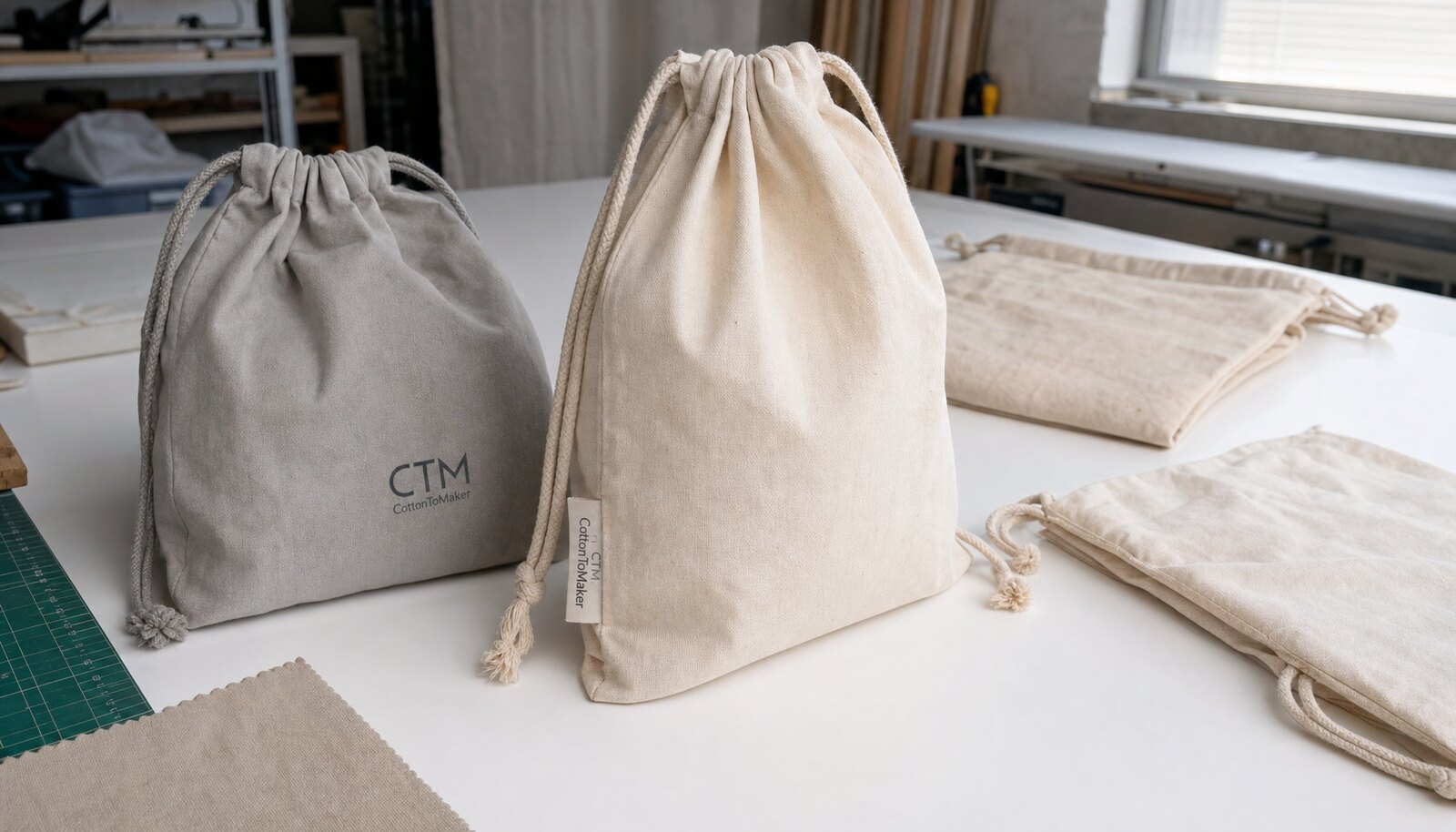
Start With the Job the Bag Has to Do
Promotional string bags only look generic until they are used in a real program. A giveaway handed out at a trade show, a retail insert that sits beside a premium product, a mailer component, and a reusable grocery-style pouch all ask for different fabric, seam, and print decisions. If the brief starts with a generic product name, the factory fills in the blanks for you, and that is where quality drift begins.
The most useful procurement input is not a bag description. It is a clear statement of fill weight, expected reuse, visibility distance, and packing environment. A thin cotton bag can carry brochures well but still look weak in a retail photo. A heavier canvas bag may feel premium, yet the extra weight and cost may be unnecessary if the bag is only moving through an event booth. Once the use case is clear, the supplier has less room to substitute a lighter fabric, a cheaper cord, or a packing format that does not fit your channel.
- State the expected fill weight and whether the contents are soft goods, rigid items, or a mixed kit.
- Say whether the bag is meant for one-time distribution or repeated reuse.
- Specify the viewing distance for the logo, because that affects print size and placement.
- Name the end use: giveaway, retail insert, shelf product, mailer component, or resale item.
Choose Fabric and Construction Before You Choose Price
Fabric weight is the fastest lever on both price and perceived quality. For light promotional use, 80-100 GSM cotton is often enough if the bag carries only a few small items. For most general promotional programs, 120-150 GSM is the safer middle ground because it improves opacity, reduces seam distortion, and gives the print a cleaner surface. If the bag has to feel premium or survive repeated use, 180-240 GSM canvas or duck cloth is a better fit, but it increases material cost, sewing time, and freight weight.
GSM is not the whole story. Ask about weave, shrinkage after finishing, cord diameter, and how the drawstring channel is constructed. Two samples with the same nominal weight can behave very differently if one is cut from narrower cloth, one uses a weaker channel stitch, or one is finished with a process that changes size after washing or steaming. For brand-facing use, the hand feel is part of the product. A buyer who only checks the sales quote and ignores construction usually ends up paying for hidden weakness later in the program.
- 80-100 GSM: fit for low-cost giveaways and brochure packs.
- 120-150 GSM: practical for most promotional orders and moderate reuse.
- 180-240 GSM: better for premium positioning, heavier contents, and repeated use.
- Confirm shrinkage and finishing effects before approving the sample.
- Ask for cord diameter and seam detail, not only fabric weight.
Match the Print Method to the Artwork
Screen print is still the most efficient choice when the artwork is simple, the color count is limited, and the order size is large enough to absorb setup. It gives strong opacity on cotton and usually offers the best balance of durability and cost for bold logos, short taglines, and clean one-position branding. The risk is not just color count. Placement matters, curing matters, and registration matters. If the print sits too close to a seam or the cord channel, the bag can look rushed even when the logo itself is technically correct.
Heat transfer and digital transfer are better when the artwork has gradients, thin lines, or more colors than a normal screen setup should carry. They are also useful for short runs where the setup cost would dominate the order. The tradeoff is durability and hand feel. A transfer that is not cured correctly can crack, shine, or peel after folding and handling. For some programs, a woven label or restrained embroidery on a side panel gives a better result than forcing a complex artwork onto the front panel.
- Use screen print for simple logos, bold type, and larger production runs.
- Use transfer methods when the design has gradients, fine detail, or several colors.
- Use woven labels or embroidery when the bag needs a more premium signal.
- Request a print placement drawing before sampling if the logo sits near a seam, curve, or channel.
- Ask the supplier to print on the same fabric weight you plan to buy.
Supplier Type Matters More Than Most Buyers Admit
Promotional string bags can come from a direct factory, a trading company, a stock decorator, or a local fulfillment partner. These routes are not interchangeable. A direct factory usually gives the best control over fabric, stitching, print, and carton packing, but only if the factory is truly making the bag and not just reselling blanks. A trading company can simplify communication and coordinate more moving parts, yet the buyer still needs to know who actually owns the quality risk when the bulk lot misses the mark.
A stock decorator or local fulfillment partner is often the right choice when the deadline is fixed or the order is small enough that setup cost matters more than process control. The tradeoff is less flexibility on exact fabric shade, seam finish, or carton format. The best way to compare routes is to ask for evidence rather than promises: sewing line photos, print room photos, a packed-carton photo, and a sample made from the same blank that will be used in bulk. If the supplier cannot show the actual base bag, the quote is not ready for a serious comparison.
- Direct factory: best for process control and repeat orders.
- Trading company: useful when you need one contact point across multiple SKUs.
- Stock decorator: useful for low MOQ or short deadlines, but check the blank carefully.
- Local fulfillment partner: useful when domestic speed matters more than factory-level cost.
- Ask who handles defect replacement and who signs off the final sample.
- Request the same blank bag in sample and bulk, not a substitute.
Write an RFQ That Forces Clean Quotes
The goal of a better RFQ is not more pages. It is fewer degrees of freedom. For promotional string bags, the supplier should not have to guess the finished size, fabric weight, cord type, print position, number of colors, pack style, or destination market. If those items are not fixed, the quote will look complete but still be impossible to compare. That is why the cheapest number often belongs to the loosest interpretation of the spec.
Ask every supplier to quote the same structure: product cost, setup cost, sample cost, carton cost, unit price breaks, lead time, and Incoterm. Split separate line items for each color, size, or artwork version. If the order includes a special finish or a different packing style, price it separately. One-line quotes are convenient, but they bury the exact assumptions that procurement needs to see. Clean comparison starts with clean scope.
- Include the artwork file format and whether the supplier is quoting one color or multiple colors.
- Specify the acceptable pack style: bulk, folded, banded, polybagged, or kit packed.
- Ask for price breaks at realistic thresholds such as 500, 1,000, 3,000, 5,000, and 10,000 pcs.
- Tell the supplier the destination market so freight and duty assumptions stay visible.
- Require the supplier to state whether setup, screens, transfer plates, and sampling are separate.
- Ask for carton size, pack count, and gross weight on the same quote sheet.
Build a Landed-Cost Example Before You Approve the Supplier
Factory price is only one part of the decision. A promotional string bag can look cheap at the source and still land expensive once freight, duty, customs brokerage, inland delivery, and any repack labor are added. For light products, the hidden logistics line can be large enough to change the supplier ranking. That is especially true when one supplier uses larger cartons, loose bulk packing, or a pack style that forces the warehouse to sort and relabel the goods after arrival.
Illustrative example: Order A is 5,000 pcs at $0.72 FOB, or $3,600 at source. Add $620 freight because the cartons are bulky, $150 brokerage, $432 duty at 12 percent of goods value, $120 inland delivery, and $180 receiving or repack labor. Landed cost is $5,102, or about $1.02 per bag. Order B is 5,000 pcs at $0.79 FOB, or $3,950 at source. Add $320 freight because the cartons are tighter, $150 brokerage, $474 duty, $120 inland delivery, and no repack charge. Landed cost is $5,014, or about $1.00 per bag. The higher FOB quote lands cheaper because it avoids the extra handling. That is the comparison procurement should care about.
- Compare quotes on the same Incoterm and the same pack style.
- Add freight, duty, brokerage, inland delivery, and warehouse receiving before award.
- Watch carton cube and gross weight because they affect transport cost.
- Treat repack labor and relabeling as real landed cost, not a back-office detail.
- If a quote is lower only because it assumes different packing, recalculate before deciding.
Use MOQ and Price Breaks as a Negotiation Tool
MOQ matters, but not because a smaller number is automatically better. It matters because it tells you where setup cost stops dominating and where real scale begins. For a simple one-color cotton promotional string bag, 500 pcs is usually a setup-heavy order, 1,000 pcs is the first level where the quote begins to normalize, 3,000 to 5,000 pcs is often the practical sweet spot, and 10,000 pcs is where you should question how much lower the supplier can still go without changing the spec. Those are not universal numbers, but they are a useful benchmark for comparison.
Watch the shape of the discount. If the price only drops a little between 3,000 and 10,000 pcs, the supplier may already be near the true cost floor. If the price falls sharply, ask what changed: fabric weight, cord quality, print area, packing format, or inspection standard. Buyers sometimes chase the lower break and end up paying for excess inventory or a weaker bag. A better negotiation is the one that gets the right spec at a quantity the business can actually use.
- Use 500 pcs as a setup check, not a target for good unit economics.
- Treat 1,000 pcs as the first meaningful quote comparison point.
- Use 3,000 to 5,000 pcs to test whether price and quality settle into a stable range.
- At 10,000 pcs, ask the supplier exactly what cost element is still moving.
- If the discount is unusually steep, verify that the fabric, print, and packing are unchanged.
Make the Sample Pull Its Weight
A sample is not a courtesy item. It is the first production decision. For promotional string bags, the pre-production sample should use the final fabric, final cord, final print method, and final packing style. A blank bag or fabric swatch only proves that the supplier can source material. It does not prove that the sewing line can hold the seam, that the cord channel will stay straight, or that the print will cure well on the real surface.
The sample review should be practical and fast. Measure the bag flat and cinched. Check the logo placement against a drawing, not memory. Pull the cord several times and look for channel collapse or uneven movement. Fold the bag the way it will be packed or distributed and see whether the artwork still looks clean. If the program is retail-facing, inspect the bag under the same light conditions the customer will use. The goal is not perfection. The goal is to discover problems before the bulk lot is already in process.
- Approve one sample that uses the final fabric and final decoration method.
- Compare the sample to a printed spec sheet, not only to a verbal description.
- Check the bag both flat and cinched closed.
- Keep the signed sample as the bulk reference.
- Reject any sample that hides seam distortion, print misplacement, or weak cord action.
Set QC at Measurable Levels
QC for promotional string bags should be measurable, not adjectival. Use a defined sampling plan such as ANSI/ASQ Z1.4 or ISO 2859-1, and set the defect thresholds before production starts. A typical structure is AQL 2.5 for major defects, AQL 4.0 for minor defects, and zero tolerance for critical defects. That gives the supplier a clear target and gives procurement a clean basis for release or rejection. If the buyer never defines a threshold, the factory will default to its own standard, which may be good enough for a giveaway but not for a retail or brand-sensitive program.
The most useful acceptance checks are the ones that can be repeated by a warehouse or third-party inspector without debate. Print must stay in position. Seams must stay straight. Cord channels must not twist or collapse. Cartons must match the PO. The bag should pass a simple functional test, not just a visual one. If the supplier wants to claim premium quality, it should survive basic measurement, handling, and abrasion checks without requiring a long argument about what the sample looked like under ideal lighting.
- Finished size: stay within plus or minus 5 mm on smaller bags and plus or minus 8 mm on larger ones.
- Seams: keep seam allowance within plus or minus 2 mm, with body seams at 7-9 stitches per inch and stress seams at 8-10 stitches per inch.
- Print: keep artwork placement within plus or minus 3 mm of the approved drawing.
- Durability: pass 10 dry rub cycles and 5 wet rub cycles with no visible transfer, cracking, or tackiness.
- Cord: keep length within plus or minus 10 mm and prevent slippage or pull-out after repeated open-close cycles.
- Appearance: no more than two loose threads over 5 mm on the face panel and none in the logo area.
- Cartons: exact count, correct labels, no open flaps, no crushed corners, and no moisture damage.
- Inspection: use a D65 light box or equivalent when shade matching is brand-critical.
Lock Packaging and Release Only After Final Checks
Packing is where a lot of otherwise acceptable orders go wrong. A string bag can be well made and still create a receiving problem if the pack count is inconsistent, the cartons are oversized, or the labels do not match the PO. For bulk giveaway programs, a simple master-carton pack may be enough. For retail, marketplace, or kit work, you may need the bags folded to a fixed size, banded or polybagged, and labeled by SKU with a barcode and carton number. The warehouse cost of fixing a bad pack can exceed the savings from the original quote.
Before award, confirm the final spec sheet, artwork file, sample approval, QC plan, carton marking, and any support needed for claims such as recycled or organic content. If the order is going across multiple distribution points, ask for carton-level consistency and a photo of the first packed carton. The buyer does not need more documentation for its own sake. It needs just enough control to make the order repeatable, receivable, and defensible if the program is audited later.
- Fix the packing format before production starts.
- Confirm carton labels, barcode format, and carton numbering.
- Ask for first-carton photos and packed-carton dimensions.
- Keep the approved sample, spec sheet, and claim support together.
- Release the order only after the QC thresholds are written into the file.
Specification comparison for buyers
| Spec decision | Recommended option | When it fits | Buyer risk to check |
|---|---|---|---|
| High-volume giveaway order | Direct factory with one-color screen print on 80-100 GSM cotton and bulk packing | Campaign handouts, event inserts, or mailers where unit cost matters more than premium hand feel | Check that setup, packing, and carton charges are separated from the unit price |
| Short deadline launch | Stock blank bag plus local print or fulfillment partner | Launches with a fixed ship date and limited time for sample rounds | Check blank color consistency before committing and confirm the exact decoration method |
| Retail-ready premium pouch | Cut-and-sew factory with 120-180 GSM fabric, woven side label, and clean inside finish | When the bag sits near product on shelf, in a PR kit, or in a retail display | Check seam finish, label placement, carton cleanliness, and print alignment |
| Multi-color artwork | Supplier with digital transfer or heat transfer capability | When the logo has gradients, thin lines, or more than three colors | Check rub resistance, fold cracking, and whether the print turns shiny after handling |
| Very low MOQ test run | Trading company or stock decorator sourcing blank bags | When you want to validate demand before a larger production order | Check that sample quality matches the final blank and not a different base bag |
| Multi-warehouse distribution | Factory or fulfillment partner that can prepack by SKU, barcode, and carton mark | When bags ship to several DCs, marketplace nodes, or regional distributors | Check carton labeling accuracy and pack count consistency across cartons |
| Sustainability-led positioning | Factory that can document fiber origin and segregate recycled or organic lots | When the claim appears on retail packaging or campaign messaging | Check that the wording on the bag matches the support documents you can actually keep on file |
| Heavy-use reuse | Factory with 140-200 GSM fabric, reinforced seams, and stronger cord | When the bag is expected to be reused many times, not just handed out once | Check seam strength, shrinkage, and cord pull-out after repeated opening |
Buyer checklist before sampling
- State the finished size, flat size, fabric type, GSM, cord material, print method, and print area in the RFQ.
- Separate line items by color, size, or artwork version so quotes are directly comparable.
- Ask for one approved pre-production sample made on the same fabric and print method as bulk.
- Confirm whether the bag is a giveaway, retail insert, or shelf product, because that changes the spec.
- Define the packing format: bulk pack, folded pack, individual polybag, banded pack, or kit insertion.
- Request unit price breaks, setup charges, sample charges, carton spec, and lead time on the same quote sheet.
- Tell the supplier the ship-to market and Incoterm so freight and local charges do not distort the comparison.
- Set the acceptance tolerance for size, print placement, shade, seam quality, and carton condition before production starts.
- Ask for the stitches per inch, seam allowance, and inspection standard the factory uses before you award the order.
- Confirm whether any sustainability claim is supported by documents you can keep on file.
Factory quote questions to send
- What exact fabric, weave, GSM, and finishing process will you use for the bulk order?
- What is the MOQ for one-color print, multi-color print, and each bag size?
- Can you quote product price, setup cost, sample cost, carton cost, and freight assumptions separately?
- What pack count, carton size, and gross weight do you recommend for this order?
- Will the pre-production sample use the same fabric, cord, label, and print method as bulk?
- What seam allowance and stitches per inch do you run on body seams and stress points?
- What lead time do you need after sample approval, and what could extend it?
- Which QC checks do you perform before shipment, and can you share inspection photos?
- What rub, pull, and open-close tests do you run on the printed bag?
- Can you support barcode labels, SKU separation, or retailer-specific carton marks if needed?
Quality-control points to confirm
- Inspect to ANSI/ASQ Z1.4 or ISO 2859-1 single sampling, with AQL 2.5 for major defects, AQL 4.0 for minor defects, and zero tolerance for critical defects.
- Finished size must stay within the agreed tolerance, typically plus or minus 5 mm for smaller bags and plus or minus 8 mm for larger formats.
- Seam allowance should stay within plus or minus 2 mm of the approved pattern, with body seams at 7-9 stitches per inch and stress seams at 8-10 stitches per inch.
- Print placement must stay within plus or minus 3 mm of the approved drawing, with no bleed, pinholes, ghosting, or jagged edges visible at arm's length.
- Print durability should pass 10 dry rub cycles and 5 wet rub cycles with no visible transfer, cracking, or tackiness after cure.
- Cord length should match within plus or minus 10 mm, knots must stay secure, and the cord should not slip or pull out after repeated open-close cycles.
- No more than two loose threads longer than 5 mm should appear on the face panel, and none should appear in the logo area.
- Cartons must match the PO count exactly, carry the right SKU and carton number, and arrive without open flaps, crushed corners, or moisture damage.