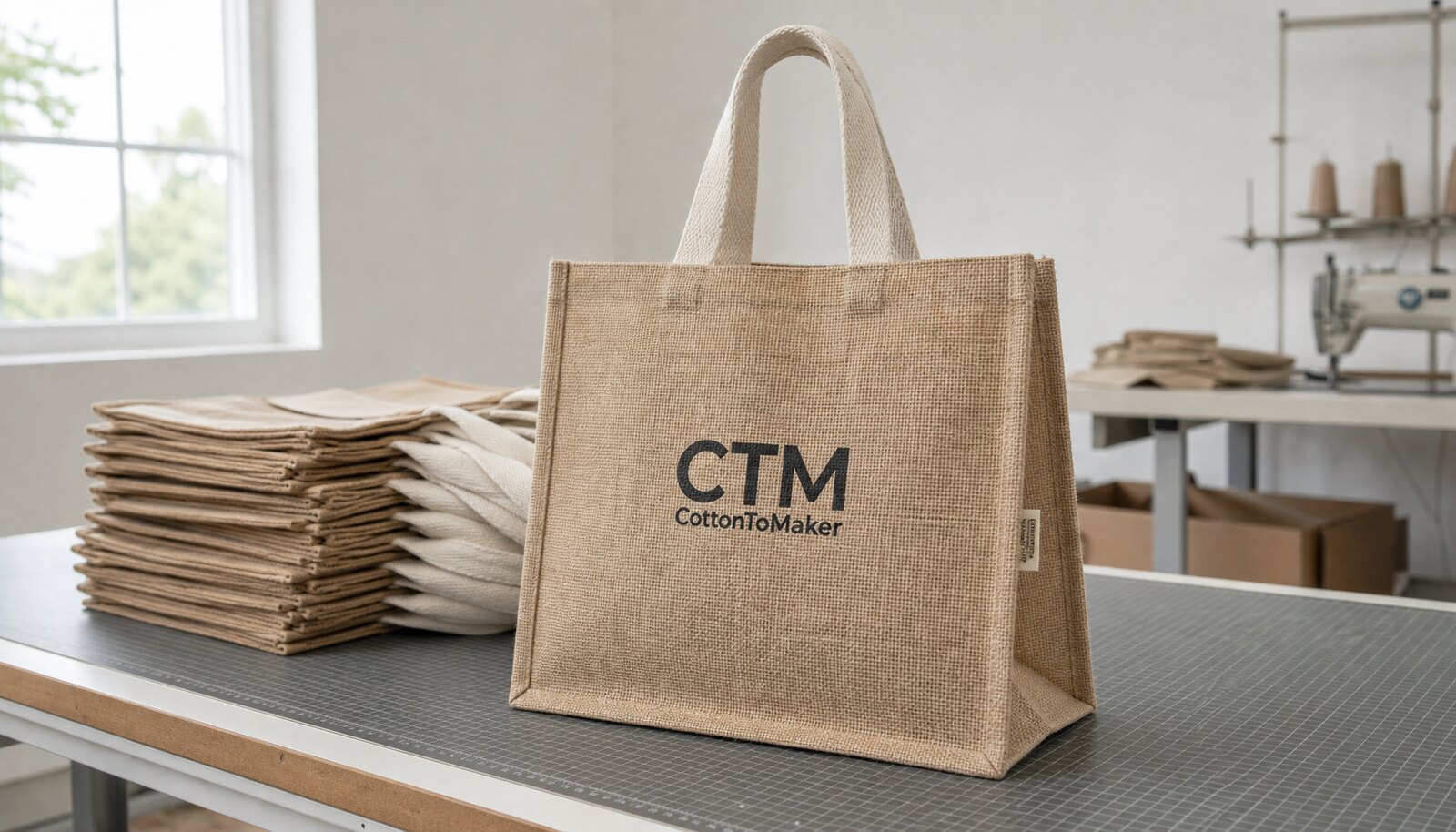
Why promotional jute tote bags need a tighter spec than they first appear
Promotional jute tote bags look simple at first glance: a natural-fiber body, handles, and a printed logo. In procurement, though, simplicity is exactly what creates quoting errors. One supplier may assume a light open-top event bag, another may price a heavier retail-style carrier, and a third may include a different handle build or packing method. The result is a set of quotes that cannot be compared cleanly because they are not actually the same product.
['For B2B buyers, the buying job is not just to find a low price. It is to define the bag tightly enough that the quote reflects the same fabric, the same decoration method, the same packing, and the same quality target across suppliers. That is especially important with jute because the material itself is naturally variable: weave texture, fiber slub, color tone, and surface smoothness can all change how the bag looks and how the logo prints.', 'The best RFQ for promotional jute tote bags should read like a usable production brief. It should tell the factory what the bag is for, how heavy it needs to carry, whether the end user is a trade-show attendee or a retail shopper, and what quality threshold the bag must meet on arrival. That is the difference between a quote that is easy to approve and one that becomes a round of clarification emails.']
- If the use case is vague, the quote will usually be vague too.
- A low price can come from lighter fabric, narrower handles, fewer stitches, or simpler packing.
- The logo should be specified for the jute surface, not copied from a smooth-fabric specification.
Start from the end use: event giveaway, retail carrier, or branded gift bag
The right construction depends on how the bag will be used after it leaves the factory. A trade-show giveaway bag does not need the same reinforcement as a retail carrier that will be reused many times. Likewise, a premium gift bag may need a better hand feel and cleaner finishing than a simple conference tote. If procurement defines the use case first, the supplier can recommend a suitable build instead of guessing upward or downward on cost.
For event distribution, buyers usually care about unit price, print visibility, and fast availability. For retail or gift programs, buyers should also care about shape retention, seam neatness, handle comfort, and the way the bag sits on a shelf or in a hand. If a bag is intended to carry brochures or samples, load distribution matters more than it does for lightweight leaflets. That should be reflected in the RFQ and sample review.
A practical way to think about it is by product life. One-use or low-reuse bags can stay on the simpler side, but once the tote is part of a store program or a brand merchandising plan, quality becomes part of the brand promise. In that case, a bag that is only a little more expensive can be much better value if it reduces complaints, visual defects, or replacement orders.
- Event giveaway: prioritize simple structure, faster sewing, and flat packing.
- Retail carrier: prioritize body shape, cleaner seams, and stronger handles.
- Gift program: consider lining, better edge finishing, and a more premium fabric basis.
Fabric weight, jute grade, and finish: the quote usually changes here first
Fabric weight is the first spec that affects both performance and price. For many promotional jute tote bags, 280-320 gsm is a workable light-to-mid option, 330-360 gsm is a common balanced range, and 400 gsm or above is used when the buyer wants more structure or a more substantial feel. That said, gsm alone does not tell the full story. Two fabrics with the same gsm can behave differently if one uses a finer weave, a different yarn count, or a more open texture.
Buyers should also ask what jute grade or appearance class is being quoted. A supplier may describe a bag as natural jute, but the actual base could be burlap-style coarse weave, a finer hessian look, or a blended construction that includes cotton or another fiber for handling or print performance. If you care about slub visibility, color tone, or a more polished retail appearance, ask for a sample swatch and not just a price list.
If the bag is laminated or lined, clarify what the gsm number refers to. Some quotes refer to base fabric only; others describe the finished composite. That distinction changes the interpretation of cost, feel, and freight weight. It also affects load-bearing behavior, because a laminated or lined tote may feel stiffer even if the underlying jute is not especially heavy.
In practical sourcing terms, buyers should define the expected result rather than just the raw spec. For example, if the goal is a crisp-looking promotional bag that stands up on a table, the supplier needs to know that. If the goal is a soft, natural look for an eco campaign, the spec should allow for the natural irregularity that is characteristic of jute.
- 280-320 gsm: useful for lower-cost promotional runs and light carry use.
- 330-360 gsm: a strong middle ground for shape and print stability.
- 400+ gsm: better when you need a premium feel or heavier contents.
- Always ask whether gsm refers to base fabric or the finished composite.
Print method should follow artwork complexity, not habit
Screen printing is still the most common decoration route for promotional jute tote bags because it works efficiently for one- or two-color logos at volume. On textured jute, however, decoration quality depends heavily on artwork preparation. Fine letters, thin lines, and tight spacing may disappear into the weave unless the logo is adjusted for the substrate. That means the supplier should review the artwork before the quote is finalized, not after the sample arrives.
For buyers, the most important print questions are practical: How many colors are there? How large is the print area? Is the artwork centered relative to the bag body, or offset to avoid seams and gussets? What stroke width is the smallest element in the logo? These details determine whether the print is producible without distortion. If they are left out of the RFQ, suppliers may quote differently and then revise the price later.
Heat transfer can be useful for short runs or more complex artwork, but it should be tested carefully on jute texture. The buyer should ask about adhesion, cracking, and whether the print survives folding and handling. Embroidery is less common on flat promotional jute totes because the structure and texture of the fabric can make stitch quality inconsistent, and it usually adds cost without improving the bag’s primary use.
The safest approach is to simplify artwork where needed. A small typeface that looks clean on a digital proof may not be readable on woven jute. Procurement should ask marketing or the brand owner whether a thicker stroke version of the logo is acceptable for the tote, because that can avoid production waste and protect the logo from becoming muddy or uneven.
- Screen print: best for volume and bold artwork.
- Heat transfer: better for short runs or more detailed graphics, but test adhesion.
- Ask for minimum stroke width and a print-position drawing before approval.
- Do not approve artwork only from a flat digital proof; request a substrate-specific mockup.
Supplier route comparison: direct factory, trading company, and landed-cost reality
The same promotional jute tote bags can be offered through a direct factory or a trading company, but the commercial structure is different. A direct factory quote is often easier to audit when you need exact material control, repeat production, and clearer visibility into sewing and decoration steps. A trading company can be useful when you are consolidating several product categories, need flexible coordination, or want one interface for multiple factories. Neither route is automatically better; what matters is how well the quote can be normalized.
To compare quotes properly, buyers should separate product price from the cost of doing business. Sample charges, print setup fees, carton costs, and freight assumptions can hide in different parts of the offer. Two offers with the same unit price can still have very different landed costs if one includes export cartons and the other does not, or if one quote is FOB and another is EXW. A procurement review should list the same assumptions for each supplier before any ranking is made.
Another useful distinction is control. If your program needs a precise color tone, a specific handle stitch, or a repeated annual reorder, direct factory sourcing usually gives better visibility into what is actually being made. If your main need is speed across multiple SKUs, a trading company may reduce coordination burden. The risk is that some trading quotes mask the underlying material choices. Ask for a breakdown when the quote is unusually low or unusually broad.
The comparison should also include change management. Who approves artwork revisions? Who owns the sample? Who is responsible if the printed position shifts or the carton count is wrong? If those answers are unclear, the quote is not yet a procurement-ready offer.
- Normalize every quote to the same gsm, size, print method, and packing plan.
- Separate unit price from setup, cartons, and freight before comparing offers.
- Ask who controls fabric booking, printing, and final inspection.
- If a quote will not break down inclusions, it is harder to audit for landed cost.
How to write a sample approval plan that prevents production disputes
A good sample for promotional jute tote bags is not just a logo check. It should represent the final material, the final handle, the final stitch pattern, and any lining, lamination, or closure that was quoted. A blank stock sample can help with size and feel, but it cannot prove how the finished product will print or perform. Procurement should insist on a true pre-production sample where the production intent is visible.
The sample approval process should be used to lock down the details that commonly trigger disputes. Measure the finished dimensions, check the gusset depth, confirm print placement from the top edge and side seam, and inspect handle length in relation to the intended carry style. If the bag is expected to stand upright, test that. If it needs to pack flat, check how the fold affects the print area. A sample that is only visually acceptable but not functionally checked can still become a mass-production problem.
It is also useful to keep a sealed reference sample on both sides. That gives procurement and the factory a common physical standard if there are later disagreements about color tone, print density, or the roughness of the jute surface. A good practice is to keep both a pre-production reference and one retained piece from the first bulk lot. That makes future reorders much easier to compare.
If the supplier offers only a stock blank and says the final order will be “same as sample,” pause and clarify. Ask what exactly will match the sample and what may vary. If the answer is broad, the sample plan is not yet tight enough for bulk approval.
- Approve a sample made from final materials, not a generic blank.
- Check size, gusset, print position, handle length, and finish quality.
- Retain a sealed reference sample for both buyer and supplier records.
- Clarify what is fixed and what remains variable before sign-off.
QC thresholds that matter in mass production: dimensions, stitching, print, odor, and moisture
Quality control for promotional jute tote bags should be defined in measurable terms. A dimension tolerance without a control point is not enough; buyers should say whether the bag is measured flat, after light filling, or both. In many promo programs a small variance may be acceptable, but if bags are too inconsistent the packing plan, shelf presentation, and print position all become harder to manage. The practical standard is repeatability, not just one good sample.
Stitching deserves formal attention because jute seams are easy to inspect and easy to get wrong. Buyers should ask for stitch density guidance, reinforcement at handle points, and a seam finish that does not unravel under normal use. If the bag will carry heavier contents, the buyer should specify a pull or fill test that reflects actual use. Not every order needs laboratory testing, but every order should have a documented acceptance check for seam slippage, top-fold tearing, and handle stretch.
Print quality should be judged on legibility and placement rather than on a perfect flat-surface comparison. On textured jute, slight texture show-through is normal; what is not acceptable is blurred text, missing strokes, off-center placement, or obvious color inconsistency between cartons. Color variance should be assessed against an agreed reference, not a vague verbal description. If the brand is sensitive to tone, ask for a physical swatch reference or an approved lab dip equivalent for the base material.
Natural fibers can also carry odor and moisture issues if storage or transit is poor. Buyers should define unacceptable conditions: mildew smell, damp cartons, visible staining, excessive loose fiber shedding, or evidence of water exposure. For carton handling, ask about crush resistance, secure outer marks, and whether the cartons can survive normal warehouse handling and transit stacking. If an AQL process is used, the buyer should document which defects are critical, major, and minor so that inspection decisions are consistent and not improvised at the dock.
For procurement teams, the strongest QC file is one that can be used again on the next order. Keep the approved sample, the agreed artwork file, the tolerance sheet, and the carton spec together. That prevents the next reorder from becoming a new negotiation.
- Set dimension checks on both flat and lightly filled bags.
- Define stitch density, seam finish, and handle reinforcement points.
- Use a practical load test tied to the real end use.
- Reject odor, mildew, damp cartons, major shedding, and visible staining.
- If AQL is used, assign critical, major, and minor defects before inspection begins.
Packing, carton loading, and freight choices that affect total cost
Packing matters more on jute bags than many buyers expect because the product is light in value but bulky in volume. A bag can be competitively priced at factory level and still become expensive once cartons are loaded, stacked, and shipped. That is why procurement should ask not only how many units are in a carton, but also how the bags are folded, how much empty space remains, and whether any accessory such as lining or closure affects the fold pattern.
Flat packing is usually the default for promotional jute tote bags, but the right method depends on the construction. A reinforced or lined bag may need a different fold direction to prevent distortion or print marking. If the bag is printed on both sides, the buyer should ask how the print faces are separated in the carton so one face does not rub against another. If a polybag is used, it should be justified by cleanliness or moisture protection rather than added by habit.
Moisture control is another important issue because jute is a natural material. Humid warehouses, long sea transit, or poorly sealed cartons can create odor or discoloration even when the bags are otherwise well made. Ask whether desiccants are used on humid routes and whether cartons are export grade. If the shipment passes through multiple handling points, carton crush resistance and carton marking accuracy become more important because re-handling can damage the product or slow receiving.
For landed cost, freight efficiency should be calculated alongside product price. A slightly cheaper unit that ships in much larger volume may lose the cost comparison. Procurement should ask for carton dimensions and gross weight so the total shipment can be estimated realistically before approval.
- Specify folding direction to protect the print and reduce carton height.
- Ask for carton dimensions and gross weight so freight can be estimated early.
- Use moisture protection when the route, climate, or storage conditions justify it.
- Confirm carton labels show size, color, PO number, and quantity.
Lead time planning: split the schedule into approval, material booking, production, and dispatch
Lead times for promotional jute tote bags are often misunderstood because the quoted number may only describe sewing time, not the full procurement cycle. In reality, the schedule starts earlier: artwork must be approved, the sample must be reviewed, and the correct fabric or accessories must be available. If the jute weight, lining, or handle type is non-standard, material booking can be the true bottleneck. That is why a single lead-time number is not enough for planning.
A procurement-ready schedule should be broken into stages. First is artwork and specification lock. Second is sample or pre-production approval. Third is material booking and bulk production. Fourth is final inspection, packing, and shipment release. When a supplier gives one all-in number, buyers should ask which stage is already included and which stage is still open. This avoids the common mistake of assuming production will start immediately after purchase order issuance.
For seasonal campaigns, the safest approach is to protect against revision time. Even a small artwork change can require a new screen, a new proof, or a revised sample. If the campaign date is fixed, the order should be placed early enough to absorb one round of corrections without compromising shipping. Buyers should also confirm whether the quoted lead time begins from deposit receipt, artwork approval, or sample sign-off, because those dates can differ by weeks in real-world planning.
Late orders are often delayed by missing detail rather than by factory capacity. The faster the buyer can confirm size, print, packing, and document requirements, the faster the supplier can commit a real schedule instead of a tentative one.
- Ask for lead time by stage, not just one total number.
- Confirm when the clock starts: deposit, sample approval, or artwork sign-off.
- Protect time for one correction cycle on seasonal or brand-sensitive orders.
- Material booking can be the bottleneck when the jute basis is non-standard.
Compliance and document requests for procurement buyers
Because promotional jute tote bags are often used in retail, gifting, or branded campaigns, the buyer may need more than a commercial invoice and packing list. The required documentation depends on destination market, customer policy, and whether the bag is being sold, given away, or bundled with other goods. Procurement should ask the supplier what documents can be issued and which ones need to be prepared before mass production. Waiting until shipment is ready can create avoidable delays.
At minimum, buyers should consider asking for a material declaration, country of origin statement, and a product description that matches the PO language. If the buyer or end customer has sustainability or restricted-substance requirements, the documentation should be aligned to those requirements rather than copied from another product. A generic “eco-friendly” statement is not enough for a retailer audit or a strict brand onboarding process.
If the order is going to a regulated or audit-heavy customer, ask upfront whether any test reports, labeling rules, or packaging declarations are needed. The key is to match the document pack to the actual buying context. A simple giveaway campaign may need only basic trade documents, while a retail project may require much tighter records. In either case, the supplier should be able to state clearly what is available and what is not.
Procurement teams should keep documentation aligned with the exact bag structure. If the product is lined, laminated, printed, or uses a specific closure, those details should appear in the spec sheet and supporting paperwork so there is no mismatch between the commercial order and the physical product.
- Request a material declaration and country-of-origin statement when relevant.
- Match paperwork to the exact bag build, not a generic tote description.
- Ask early if test reports or retailer-specific forms are required.
- Do not rely on broad sustainability language without supporting documentation.
Specification comparison for buyers
| Buyer decision | Best-fit specification | Commercial impact | Supplier quote items to compare | Key risk to check |
|---|---|---|---|---|
| Fabric weight and jute grade | 280-320 gsm for value promo; 330-360 gsm for balanced structure; 400+ gsm for premium feel. Ask whether the base is burlap jute, finer hessian, or a jute-cotton blend. | Heavier fabric usually improves body and print appearance but raises material, sewing, and freight cost. | Base material type, gsm basis (base fabric vs composite), weave count if available, and whether the quote includes washing or finishing. | A quote can look cheaper only because it uses a lighter base or a looser weave that changes drape and load performance. |
| Handle construction | Cotton webbing or reinforced jute handles stitched through the top fold with bar-tacks or box stitching where needed. | Handle material and reinforcement affect labor time, comfort, and load capacity. | Handle width, handle length, stitch pattern, reinforcement points, and whether handles are color-matched or natural. | Thin handles or weak stitch patterns can fail at the seam even if the bag body looks substantial. |
| Print method and artwork | 1-color or 2-color screen print for most volume programs; heat transfer only when artwork detail or short-run flexibility justifies it. | Print setup charges, screen count, and rejection risk vary by method. | Number of colors, print size in mm, print position tolerance, minimum stroke width, and whether artwork needs underbase. | Fine text, gradients, and small legal copy can blur on textured jute if artwork is not adapted for the surface. |
| Lining / lamination / reinforcement | Unlined for simple giveaways; inner lining or lamination for retail packaging, better shape retention, or product protection. | Adds material and sewing steps, but can improve perceived quality and cleanability. | Lining material, lamination thickness, seam finishing, internal binding, and whether the composite affects recycling or disposal messaging. | A lined bag can hide loose fibers, but poorly finished seams or delamination create claims and rework. |
| Closure type | Open top for event handouts; zipper, button loop, or magnetic closure only when retail presentation or item security matters. | Closures increase labor and can reduce packing efficiency. | Closure type, zipper gauge if used, button or loop material, and the impact on bag opening size. | A closure may interfere with fill volume or printed area if it is added without rechecking the whole spec. |
| Supplier route | Direct factory for repeat volume and tighter construction control; trading company for mixed SKUs, multi-category consolidation, or compressed sourcing calendars. | Supplier route changes transparency, MOQ flexibility, and the way hidden costs appear in quotes. | Incoterm, who owns material booking, whether decoration is in-house, and whether the supplier can show line-item costing. | A lower quote from a trading route can conceal lower fabric grade, extra handling, or a wider tolerance band. |
| MOQ and price break | Start with one size, one artwork version, and one print color if possible; expand once construction is approved. | Lower MOQ usually carries a higher unit price and fewer options for custom fabrics or extras. | MOQ by size and color, incremental cost for extra artwork versions, and price breaks at higher volume. | Artificially low MOQ offers may shift risk into print quality, fabric choice, or lead time. |
| Packing and carton plan | Flat packed in export cartons; add inner packing only if cleanliness, moisture, or surface protection requires it. | Packing affects carton efficiency, freight cost, and arrived condition. | Carton count, gross weight, carton size, folding direction, and whether desiccants or polybags are included. | Bulky packing can turn a good unit price into a weak landed cost. |
| Sample approval route | Approve a full pre-production sample built from final materials, not a stock blank or a generic mockup. | Reduces mismatch between quoted spec and factory reality. | Sample type, approval timeline, photo evidence, sealed reference sample, and whether corrections require a second sample. | Approving the wrong sample can lock in the wrong gsm, print position, or handle construction. |
Buyer checklist before sampling
- Define the final bag size, gusset depth, and intended fill weight before asking for quotes.
- State the fabric target in gsm and ask whether the figure applies to the base fabric or the finished composite.
- Specify jute grade or appearance preference if you care about fiber fineness, slub visibility, or a more premium hand feel.
- Confirm handle width, length, material, stitch pattern, and whether reinforcement is through-fold or bar-tacked.
- Lock the print method, number of colors, logo size, and position tolerance in millimeters.
- Request a sample based on final materials, not a generic stock bag.
- Ask for carton quantity, carton dimensions, gross weight, and folding method.
- Confirm whether the quote includes lining, lamination, labels, hangtags, setup charges, and export cartons.
- Request lead time by stage: artwork approval, sample, material booking, production, inspection, and dispatch.
- Agree in advance on QC acceptance for dimensions, print clarity, stitch quality, odor, moisture, and carton condition.
Factory quote questions to send
- What exact jute grade and fabric basis did you quote, and can you share the gsm reference used for this price?
- Is the quoted gsm for the base fabric only or for the finished laminated/lined composite?
- What are the handle material, handle width, and stitch pattern included in the price?
- Does the quote include print setup, screens, plates, or transfer film, and what is the cost for additional colors?
- Which item is excluded from the quote: lining, lamination, internal binding, labels, hangtags, or carton printing?
- What is the MOQ by size, by color, and by artwork version?
- How are goods packed, how many per carton, and what is the carton gross weight?
- Can you provide a full pre-production sample built from production materials before mass cutting?
- What documents can you provide for customs or retail onboarding, such as country of origin and material declaration?
- What is the expected schedule from sample approval to finished goods ready for shipment?
Quality-control points to confirm
- Measure finished dimensions flat and after a light fill test; define acceptable variance before production starts.
- Confirm stitch quality by checking stitch density, seam alignment, and reinforcement at handle attachment points.
- Use a basic load test that reflects real use, not a generic stress test; observe seam slippage, handle stretch, and top-fork tearing.
- Set a practical print acceptance standard: legibility, registration, position, and no obvious ink cracking or bleed on the agreed artwork.
- Check for loose threads, uneven trimming, slub contamination in print areas, and visible oil or moisture marks.
- Agree on odor and moisture acceptance: reject bags with mildew smell, damp cartons, or visible condensation damage.
- Inspect carton build quality, carton marks, and count accuracy; cartons should survive normal handling without collapse.
- If the bag is lined or laminated, confirm seam coverage, edge finishing, and no delamination at corners or folds.
- If an AQL is used, align it to the order criticality and document critical, major, and minor defects separately.