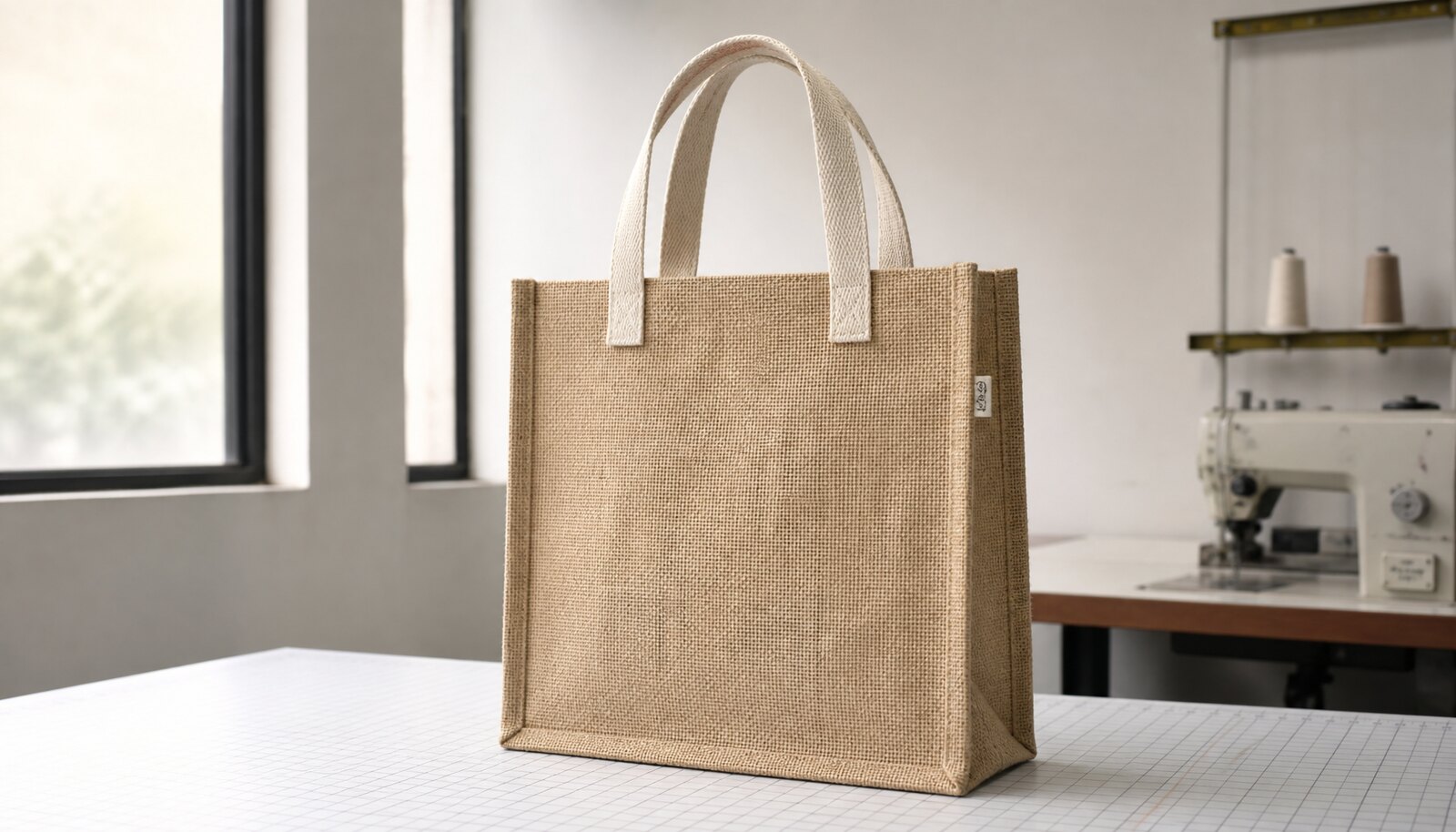
Start With the Use Case, Not the Logo
Promotional jute shopping bags are not one product. A trade-show handout, a supermarket-style carry bag, a retail gift bag, and a campaign tote that needs to survive repeated use all start from the same material, but they should not be bought the same way. The quote changes because the job changes. Before artwork is shared, define the bag's purpose, expected load, distribution method, and service life. A bag handed out loose at an event does not need the same construction discipline as a bag sold on a shelf or reused in weekly grocery trips.
A useful RFQ starts with a one-line use case and a practical load target. For light promotional use, many buyers aim for about 5 to 7 kg static hold. For reusable retail bags, 8 to 10 kg is a more realistic planning target, and anything above that should trigger stronger seam and handle reinforcement plus a formal load test. If the bag must stand upright, be folded flat, or fit into a gift box, say so now. That one paragraph usually removes more quote noise than any artwork revision.
- State the channel first: event giveaway, retail shelf, supermarket carry, or premium gift.
- Define the heaviest realistic load in plain terms, such as groceries, catalogs, or folded apparel.
- Say whether the bag must stand upright, fold flat, or fit a specific box or display pack.
- Clarify whether the bag is disposable, reusable, or meant to be resold as a retail product.
Choose the Construction That Matches the Channel
Construction choices matter more than most buyers expect. A simple open-top tote with self-fabric handles is usually the cheapest route, but it will not behave like a structured retail bag. Gusset depth, base shape, handle style, lining, lamination, and closure all change the final function. If the bag needs to hold shape, protect the contents, or look clean after several touches, ask for reinforcements at the bottom panel, handle root, and side seams. These are not cosmetic extras; they are what keep the bag from failing in use.
The common sourcing error is to overbuild a campaign bag or underbuild a retail bag. Buyers often approve a premium sample and later ask for a lower-cost version without resetting the spec, which makes price comparisons meaningless. Decide whether the order needs a laminated interior, a fabric lining, a base board, a zipper or button closure, or a flat-bottom profile before you ask for quotes. If the bag will be used around food, moisture, or premium merchandise, the inner finish and edge control matter as much as the outer appearance.
- Use a deeper gusset when the bag will carry boxed goods or irregular retail items.
- Choose cotton webbing or reinforced handles when user comfort matters more than raw material cost.
- Add a base board or bottom reinforcement if the bag must stand upright.
- Keep event-grade and retail-grade builds separate so the quote stays comparable.
Specify Fabric Weight, Finish, and Sewn Details
Jute is often quoted as if one GSM number explains the whole bag, but that is too shallow for procurement work. The finished product depends on fabric weight, weave density, fray control, lamination or lining, and the amount of sewing needed around the edges and handles. For promotional jute shopping bags, a practical planning range is roughly 230 to 280 GSM for lighter campaign bags, 280 to 350 GSM for reusable retail bags, and 350 GSM or more for heavier structured builds, provided the supplier can still keep the seams clean and the print readable. Always confirm the exact cloth sample, because two fabrics with the same nominal weight can behave very differently.
Sewing details are where weak bags fail first. Ask the factory for the stitch count on load seams, not just a generic promise of strength. A useful benchmark is about 3 to 4 stitches per cm on high-stress seams, with bar-tacks or box-X reinforcement at the handle root. That gives you a concrete standard for comparison and inspection. Also specify handle width, handle drop, thread type, and whether cut edges will be bound, turned, or left raw. Raw edges can be acceptable on low-cost promotional bags, but they should be a deliberate decision, not an accident.
- Request cloth specification by component, not only the finished bag price.
- Use actual sample cloth for print approval because jute surfaces vary by weave and finish.
- Confirm whether lamination is inside, outside, or absent, since each changes print behavior and stiffness.
- Treat handle reinforcement, seam construction, and edge finishing as costed items, not vague features.
Printing That Actually Works on Jute
Screen print is still the default choice for most promotional jute shopping bags because it balances cost and readability. It works best with bold logos, limited spot colors, and simple layouts that do not depend on hairline detail. On a coarse weave, thin lines can break up, fill in, or look uneven after the print dries. If the brand logo relies on subtle gradients, tiny text, or delicate outlines, the factory may need to shift the mark to a woven label, sewn patch, or side tag to keep the result clean. In other words, the artwork should adapt to the material, not the other way around.
Good print approval starts with the real cloth, not a flat mockup. Ask for a strike-off or a finished sample using the actual jute surface and the final print method. Keep small text away from seams and folds, and avoid placing the logo where the bag will crease in packing. A practical rule is to keep fine linework above about 1 mm and small text at 6 to 7 pt or larger, then verify readability on the actual weave. If Pantone matching matters, ask whether the supplier can hit it consistently on jute rather than assuming standard print accuracy will transfer from paper or cotton.
- Use one or two solid colors when the weave is open and the logo must stay legible.
- Avoid text smaller than 6 to 7 pt unless the supplier proves it on the actual cloth.
- Keep artwork away from seams, handles, and fold lines.
- For premium presentation, compare screen print against a woven label or sewn patch before locking the spec.
Supplier Routes, MOQ, and Where Price Moves
The supplier route changes the quote as much as the bag spec does. Factory direct sourcing usually gives the best control over cloth, sewing, print, and packing, which matters when the order has custom construction or repeat-order expectations. Trading companies and sourcing agents can be useful when the buyer needs coordination across multiple items, language support, or a single project manager, but they can add cost layers and may not always expose the actual production site. Stock distributors are the fastest route, yet they rarely solve a deeper customization problem. For stitched products like jute bags, the manufacturing route is part of the product definition.
MOQ is not one fixed rule. It moves with cloth color, print complexity, handle type, lining, and packing method. Standard natural jute with one-color print usually has a much easier MOQ than a bag with custom lining, a special handle, and retail packaging. Ask for the MOQ by variant, not just the headline minimum. Also ask what the supplier counts as a variant: design, print color, handle color, pack format, or carton label. That is the easiest way to expose hidden cost drivers before the buyer commits to art or timing.
- Factory direct is strongest for repeat orders and detailed construction control.
- Trading companies help when the buyer needs coordination across several SKUs or sites.
- Stock routes work only when customization is light and the timeline is tight.
- Ask for MOQ by design, by print color, by handle style, and by pack format so the real limit is visible.
Write an RFQ the Supplier Can Actually Price
A clean RFQ removes guesswork. Include a dimension sketch, clear artwork files, the intended use case, target quantity by size or color, desired packaging, and the approval path for samples. Add the incoterm and destination port or warehouse if you want useful delivered comparisons. If the buyer wants multiple suppliers compared on the same basis, every supplier must quote the same scope line by line. That is the only way to see whether one quote is cheaper because it uses lighter cloth, a simpler handle, or a less demanding pack format.
The strongest RFQs for promotional jute shopping bags also call out the decisions that usually trigger delay. State whether Pantone matching is mandatory or approximate, whether the label must be sewn or loose packed, whether a barcode is needed, and whether the bags will be used in humid or food-adjacent conditions. Then ask the supplier to separate bag body, handles, print setup, sampling, packing, and carton charges. If a vendor only gives one all-in number, you still do not know whether the quote is commercially valid.
- Attach a flat sketch with all finished measurements and any seam allowances relevant to the build.
- Send artwork in editable and print-ready formats when available.
- List quantity by size, color, and packing type so the MOQ is visible.
- State whether the supplier may propose substitutions or must quote strictly to spec.
Samples and Approval Gates
Sample approval should prove more than logo position. A proper jute bag sample needs to show the real cloth weight, final handle build, seam quality, and how the bag behaves under load. Ask for a production-like sample rather than a sales sample made with lighter cloth or a different thread. The best approval flow is three steps: artwork proof, sewn sample or strike-off, and pre-production sample using the final material, print method, and packing method. If any of those stages differ, the bulk run can still drift even when the sample looks acceptable in hand.
Set the approval gate in writing. The factory should not start bulk production until the sample matches the approved spec sheet and the key measurements are within tolerance. For most tote projects, a size tolerance of about plus or minus 5 mm on smaller bags and up to plus or minus 10 mm on larger bags is a practical starting point, but the buyer should set the actual band based on use and brand sensitivity. Keep a signed golden sample in the file and make it the reference for print placement, stitch quality, handle symmetry, and overall finish.
- Approve only if cloth, thread, handles, and print method match the planned bulk order.
- Keep a signed golden sample and a written tolerance sheet as the production reference.
- Ask for a pre-production sample if the first sample was made before final materials were locked.
- Reject any sample that looks right visually but uses a different cloth weight or handle build.
QC Thresholds That Give You Something to Inspect Against
Quality control should be specific enough that the factory can work to it without guessing. Start with the obvious failure points: size, handle symmetry, seam alignment, print registration, fraying, and carton count. Then add measurable thresholds. A simple in-house load check can be 5 kg for light promotional bags and 8 to 10 kg for reusable retail bags, with the handles and side seams holding without tearing or obvious distortion. If your program needs more than that, write the higher threshold into the spec instead of assuming the supplier will understand the use case.
Inspection should also reflect the material. Jute can shed fibers and show surface variation, so not every irregularity is a defect. But loose threads, skipped stitches, open seams, wrong print color, and visible misregistration are real defects and should be classified before production begins. If the bag is for retail display, add checks for surface marks, fold lines, dust, and odor. For food-adjacent or premium-gift programs, those secondary issues can matter as much as structural performance. The result is a QC sheet that actually helps the factory fix the right problem.
- Measure finished size against the approved spec and keep the tolerance band fixed in the RFQ.
- Check handle symmetry, stitch density, and reinforcement at the handle root on both sides.
- Inspect print registration, edge sharpness, and small text readability on the weave.
- Load-test the bag so the bottom panel, side seams, and handle attachments do not distort early.
- Record defects as critical, major, or minor before bulk production starts.
Packing, Cartons, and Shipping Efficiency
Packing changes both appearance and landed cost. Bulk-packed promotional bags are efficient for events and warehouse use, but they are not ideal for retail because the product can crease, collect dust, or lose shape. If the bags will be sold, a clean polybag, barcode label, and consistent fold are often worth the added pack cost. If the bag has a base board, insert, or structured form, the pack plan should protect that shape during transit. Jute bags are bulky, so carton cube matters a lot; an oversized carton can quietly make freight more expensive even when the unit price looks good.
A usable packing spec includes the number of bags per inner pack, the number of inners per master carton, carton marks, and the required label language. Many buyers also set a gross carton weight limit around 15 kg so warehouse handling stays practical, although the right limit depends on your receiving process. For medium totes, an inner pack of 10, 20, or 25 pieces is common when individual packing is required, while bulk packs may use higher counts if the product remains protected. The important point is consistency: stable pack counts, stable folds, and carton dimensions that fit the warehouse and the freight plan.
- Use bulk packing for events and individual packing for retail or resale.
- Keep carton counts consistent across cases so receiving is simple.
- Ask how the fold method affects print marks and bag creasing.
- If humidity is a concern, consider moisture-aware packing or desiccant for long transit lanes.
Landed Cost and the Final Supplier Decision
The cheapest FOB quote can become the worst landed-cost result when the bag is overpacked, weak at the handle, or missing retail-ready details. Landed cost includes more than factory price. It includes carton volume, freight cube, repacking work, the risk of claims, and whether the bags arrive ready for the next stage of the supply chain. A slightly better construction can sometimes reduce landed cost if it lowers damage, cuts rework, or avoids repacking at destination. Buyers should compare the full route to market, not just the line item that comes from the factory.
The most common mistake is comparing unlike orders. One supplier quotes a simple one-color logo bag. Another quotes a laminated, lined version with a sewn patch and retail polybag. Those are not alternatives; they are different products. Put the quotes on the same scope sheet, confirm the exact cloth weight, print method, handle build, and pack format, then compare unit price, setup charges, and carton cube together. Once the scope is clean, supplier selection becomes easier: choose the vendor who can repeat the same bag, answer technical questions clearly, and show discipline in sample approval and packing detail.
- Compare unit price, carton volume, and packing scope together.
- Do not separate artwork approval from construction approval.
- Focus QC on handle root, seam strength, print placement, and carton count.
- Treat a low quote without packing detail as incomplete, not cheap.
Specification comparison for buyers
| Spec decision | Recommended option | When it fits | Buyer risk to check |
|---|---|---|---|
| Supplier route | Factory direct | Best when you need control over cloth, sewing, print, packing, and repeat orders | Confirm the factory is actually making the bags, not forwarding the order |
| Supplier route | Trading company or sourcing agent | Useful when you buy mixed SKUs, need project management, or need language support | Watch for hidden subcontracting and unclear margin layers |
| Supplier route | Stock bag distributor | Works when speed matters more than deep customization | Stock levels can change and branding options are usually limited |
| Material build | Natural unlaminated jute | Fits short-life promotions or a rustic, low-cost look | Fraying, dusting, and softer print edges can appear quickly |
| Material build | Laminated or lined jute | Better for retail use, moisture resistance, and a cleaner shelf presentation | Adds stiffness, weight, and more sewing time |
| Print method | 1-color screen print | Strong choice for bold logos and moderate to larger runs | Fine detail can fill in on coarse weave |
| Print method | Sewn woven label or patch | Good when the bag body is too rough for crisp print or the brand wants a premium look | Extra labor, extra inspection points, and higher setup effort |
| MOQ strategy | One design, one base color, standard handles | Best for market tests and campaign orders with tight timing | Changes added after quotation can break the cost logic |
| Packing format | Bulk packed in master cartons | Suitable for events, warehouse distribution, and lowest pack cost | Can crease the bag and look weak for retail handover |
Buyer checklist before sampling
- Lock the end use first: event giveaway, retail shelf, supermarket carry bag, or branded gift.
- Specify finished size, gusset depth, handle drop, and whether the bag must stand upright.
- State fabric build clearly: natural jute, laminated jute, lined jute, or a mixed construction.
- Define print method, print area, number of colors, and whether Pantone matching is mandatory or approximate.
- Require the quote to separate bag body, handles, print setup, packing, and carton markings.
- Request a pre-production sample and a photo or video of the approved sample before bulk production.
- Set acceptable tolerances for size, logo placement, seam alignment, and handle symmetry.
- Confirm inner pack count, master carton count, and whether individual polybags are needed.
- Ask for the incoterm, production lead time, and shipment readiness date in writing.
- Compare landed cost, not only unit price, because carton volume and packing can change the total materially.
Factory quote questions to send
- What is the exact bag construction, including fabric weight, lining or lamination, handle material, and reinforcement points?
- Which print method will you use, how many colors are included, and what artwork limits apply to jute weave?
- What is the MOQ by design, by print color, and by handle or packing variation?
- Can you quote at multiple quantities and separate unit price from setup, sampling, packing, and carton charges?
- What sample stages do you offer before mass production, and what is the approval point for the final sample?
- What are your production lead time, packing lead time, and shipment readiness date after sample approval?
- How many bags per inner pack and per master carton, and what are the carton dimensions and gross weight?
- Can you share photos of similar jute shopping bags, plus your QC points for seam strength, print registration, and final count?
- Which tests do you run on handles, seams, and load performance before shipment?
- Will you accept a signed golden sample and a written tolerance sheet as the production reference?
Quality-control points to confirm
- Measure finished size against the approved spec and keep the tolerance band fixed in the RFQ.
- Check handle symmetry, stitch density, and reinforcement at the handle root on both sides.
- Inspect print registration, color consistency, edge sharpness, and whether small text remains readable on the weave.
- Review fraying at cut edges, seam puckering, loose threads, and any skipped stitches.
- Load-test the bag to confirm the bottom panel, side seams, and handle attachment do not distort early.
- Verify the sample uses the same cloth weight, lining, and handle build as the planned bulk order.
- Inspect carton packing count, label accuracy, and whether the master carton matches the packing list.
- Check fold lines and surface marks if the bag is meant for retail display.
- Confirm the material odor, dust level, and surface cleanliness before approval if the bags will touch food or premium goods.
- Record defect classification so the factory knows which issues are critical, major, and minor before bulk production starts.