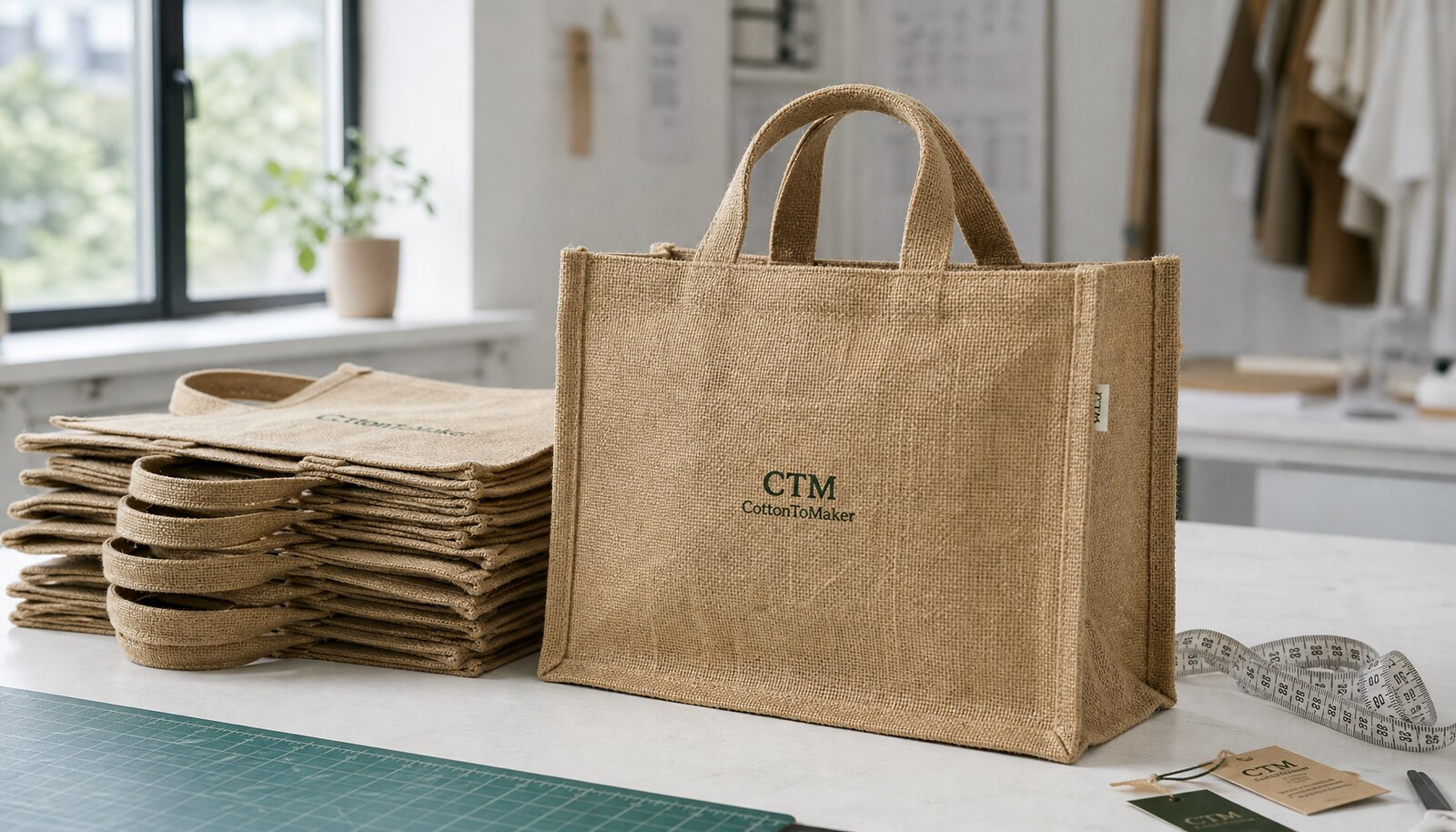
Why promotional jute bags need tighter buyer specs than they first appear
A promotional jute bag looks simple, but procurement risk sits in the details that are easy to leave vague in the first quote request. The same broad label can describe a thin giveaway tote, a reusable shopping bag, a retail-ready gift carrier, or a branded event pack. Those uses do not share the same fabric weight, stitch standard, handle build, or packing expectation, so they should not be priced as if they do.
The fastest way to clean up the buying process is to stop treating the item as a generic tote and start treating it as a controlled build. For jute bags promotional orders, the buyer should define the end use, contents, required carry strength, print area, and packing format before asking for price. When those inputs are missing, each supplier fills the gaps differently and the quotes stop being comparable.
- Define what the bag will carry, not just the size of the bag.
- State whether appearance, load strength, or both are commercial priorities.
- Ask suppliers to quote against one written specification, not a product name alone.
Choose the build around the job, not around the cheapest fabric line
The right build depends on how the bag will be used after delivery. A flat promotional bag that holds brochures or folded inserts can be economical and easy to carton. A gusseted bag makes more sense once the contents are bulky, uneven, or likely to shift. If the bag is intended for repeated use or premium retail presentation, reinforcement at the base or handle points becomes more valuable than shaving a few cents from the fabric line.
Heavier fabric is not automatically better. A 300-320 GSM bag can be a better procurement choice than a heavier build if it balances appearance, cost, and carton efficiency for the campaign. Once you move into laminated or lined construction, the bag may feel more premium, but you also need to check stiffness, odor, moisture behavior, and whether the finish changes print adhesion. The best spec is the one that matches the contents and the brand use case without unnecessary overbuild.
- Use a flat body for flatter contents and lower freight volume.
- Use a gusset when the bag needs real internal volume or a steadier base.
- Move to reinforcement only when the use case actually needs repeated carry or heavier loads.
Compare bag-spec trade-offs before you compare suppliers
A useful comparison table has to compare bag specifications, not just sourcing routes. If one supplier quotes a 250 GSM flat tote and another quotes a 320 GSM gusseted bag with webbing handles, the price difference is not a margin issue. It is a different product. The buyer should normalize size, fabric construction, handle material, print method, packing, and carton basis before making a procurement decision.
The table above is designed to show the trade-off behind each design choice. Fabric weight changes feel and durability. Gussets change usable volume and carton efficiency. Handle material changes comfort and cost. Decoration method changes artwork fidelity and order size behavior. Retail-ready packing changes unit labor and transit protection. The more explicit the spec, the easier it is to spot a quote that looks low because it quietly removed scope.
- Compare the same size, same fabric construction, same handle type, and same decoration method.
- Make every supplier quote the same packing basis and carton count.
- Treat any quote that omits a build detail as incomplete, not competitive.
Match the decoration method to the artwork and the fabric
Screen print remains the most common option for promotional jute bags because it handles simple logos well and scales efficiently at volume. It is usually the cleanest commercial choice when the artwork is one or two solid colors and the buyer is comfortable with the natural weave showing through slightly. The print request should state the number of colors, print area, curing expectation, and whether the supplier is pricing setup separately from per-piece production.
If the artwork is detailed, small, or full of fine line work, the buyer has to decide whether to simplify the design or change the decoration method. Transfer and digital decoration can work for shorter runs and more complex graphics, but they need a physical strike-off on the actual jute surface before approval. The same logo that looks sharp on a screen can spread, crack, or lose edge definition once it meets rough natural fiber, so artwork approval should always include a real sample.
- Use screen print for simple logos and medium to large production runs.
- Use transfer or digital decoration when the artwork needs detail that screen print cannot hold cleanly.
- Approve a strike-off on the real bag surface before bulk production starts.
Write the quote request so every supplier prices the same thing
A clean quote request does not need to be long, but it does need to be specific. Include finished size, gusset depth, fabric construction, handle dimensions, logo size, number of colors, packaging format, carton requirement, and the target delivery window. If any of those variables are left open, the factory will fill them with its standard assumption, which may not match the way you plan to use the bags.
The commercial side matters as much as the physical spec. Ask the supplier to separate the bag body, decoration setup, sample cost, packing, and freight basis. If you are comparing quotes across regions or supplier types, keep the Incoterm and delivery point consistent. A quote that looks cheaper can become the more expensive option once hidden packing labor, courier samples, or freight volume are included.
- Ask for a line-item quote instead of a single blended number.
- Keep Incoterms, carton basis, and packing format identical across suppliers.
- Force any exclusions onto the quote sheet so they are visible before PO release.
Treat sample approval as a control gate, not a formality
The sample is the last place to remove ambiguity before production starts. It should use the same fabric range, handle material, print method, and packing basis as the bulk order. If the factory changes any of those elements later, the batch can drift even if the sample looked fine. That is why photo approval alone is weak for jute: weave tone, handle feel, stitch balance, and print density need to be seen and handled in person.
A useful buyer practice is to mark the approved piece as the gold seal sample and keep the approval record tied to it. Then the factory and the buyer both know what the bulk run is supposed to match. If there are multiple versions, such as different print placements or colorways, approve each one separately. The goal is not paperwork for its own sake. It is to prevent a later dispute where both sides are looking at different references.
- Approve a physical sample that matches the actual production route.
- Measure the sample against the written spec, not just the artwork proof.
- Check the bag loaded with real contents before you sign off.
Set QC thresholds that match the order risk
Quality control becomes useful only when the acceptance criteria are written in measurable terms. For standard promotional orders, many buyers start with AQL 2.5 for major defects, AQL 4.0 for minor defects, and zero tolerance for critical defects. That is a practical baseline for a common tote order, not a universal rule. Tighten the plan if the bag is part of a retail program, a VIP gift, or anything where the brand impact is higher than the unit price suggests.
The inspection should match the way the bag will actually be used. A giveaway tote that carries brochures does not need the same load test as a reusable bag that will be used repeatedly at retail. Ask the supplier to name the rub test method used for the print and to map its result to your artwork and finish. If the test method cannot be explained clearly, the number is not very useful.
- Set a load test that matches the actual contents, not a generic marketing claim.
- Use the same print-rub method and acceptance level across all quotes.
- Treat odor, dampness, and loose fiber shedding as real quality issues, not cosmetic noise.
Packing and cartonization can protect or destroy the margin
Jute is a natural fiber, so it responds badly to vague packing instructions. If cartons are overfilled, stored in damp conditions, or packed without a clean bundle logic, the bags can arrive creased, dusty, or with an odor that should have been avoided. Bulk packing is often the right commercial choice for importers and distributors, but the buyer still needs to define inner bundle counts, carton marks, and how mixed sizes will be separated.
If the bags are going to retail shelves, event kits, or direct distribution, retail-ready packing may be worth the extra labor. In that case, specify whether the bag needs a polybag, barcode sticker, insert card, desiccant, or a particular carton label format. Also check carton dimensions, because oversized cartons can waste freight space while cartons that are too tight can deform handles and body panels.
- State the inner bundle count and carton quantity on the purchase order.
- Require carton markings that match the SKU and packing list exactly.
- Use moisture protection when the route includes humid storage or long sea transit.
Ask for the documents that support your claim and your QC file
A procurement file should do more than record price. It should show what was ordered, what was approved, and what evidence supports the order claims. For promotional jute bags, that usually means the specification sheet, approved sample reference, packing plan, and inspection record. If you plan to make a sustainability or material claim, ask for the documents that support it before the order is placed, not after the goods arrive.
If the supplier is using a recycled-content claim, a dye claim, or any other material statement, make sure the wording is something you can defend in your own marketing and compliance review. You do not need to overcomplicate the order, but you do need enough documentation to know what was actually purchased. In procurement terms, that means less ambiguity in the event of a customer complaint, a chargeback, or a re-order.
- Keep the approved spec sheet and sample reference with the PO file.
- Ask for any claim-supporting documents before production starts.
- Confirm whether any part of the order was subcontracted and document who owns final sign-off.
Release the order only when the pack is complete
A clean promotional jute bag order has five parts: a written build spec, an approved sample, a priced quote with exclusions visible, a QC plan with measurable limits, and a packing plan that matches the destination. If any one of those pieces is missing, the order can still move forward, but the buyer is accepting avoidable risk. The lowest-friction suppliers are usually the ones who can answer these points directly and in the same language you used in the RFQ.
Before you release the PO, check one last time that the commercial version, the sample version, and the QC version all describe the same bag. If they do not, the order is not ready. That is the simplest way to prevent a cheap-looking quote from becoming a costly exception later.
- Confirm the spec, sample, quote, QC plan, and packing plan all match.
- Reject any order that still relies on assumptions about fabric, handle build, or decoration.
- Treat unclear answers from the supplier as a signal to slow down, not to improvise.
Specification comparison for buyers
| Spec choice | Best fit | Cost / lead-time effect | Buyer trade-off to check |
|---|---|---|---|
| 250-280 GSM unlaminated jute | Light giveaways, brochure carriers, low-cost event handouts | Lower unit cost and usually quicker sampling | Can look thin under dark print; check opacity and wrinkling |
| 300-320 GSM unlaminated jute with gusset | General-purpose promo tote for mixed contents | Balanced cost and lead time | Confirm the bag stands up and does not twist under load |
| 350+ GSM or laminated backing | Premium retail-style tote or heavier contents | Higher cost and longer lead time | Can feel stiff or hold odor; ask for a sample on the exact finish |
| Flat body | Leaflets, catalogs, or flat inserts | Simpler sewing and better carton efficiency | Less internal volume for bottles or boxed items |
| Gusseted body | Lunch kits, merchandise bundles, or bottle packs | Adds material and sewing steps | Check base shape and side seam consistency |
| Cotton webbing handles | Longer carry comfort and repeated use | Adds cost and may affect color matching | Verify attachment strength and handle twist |
| Self-fabric jute handles | Budget runs and rustic look | Usually cheaper but rougher in hand | Check for fraying, stiffness, and load fatigue |
| Screen print, 1-2 solid colors | Simple logos and medium to large quantities | Lowest decoration cost at volume | Weave texture can show through; approve strike-off |
| Transfer or digital decoration | Short runs or detailed artwork | Higher per-piece cost and more testing | Confirm adhesion, edge sharpness, and rub behavior |
Buyer checklist before sampling
- Define the end use first: event giveaway, retail promotion, welcome kit, or reusable shopping bag.
- State the target contents and load, such as brochures, bottles, folded apparel, cosmetics, or mixed samples.
- Lock finished dimensions, gusset depth, base shape, and whether the bag must stand upright when filled.
- Specify fabric weight or construction range, not just labels like premium or heavy duty.
- Confirm whether the bag is unlaminated, laminated, lined, reinforced, or a combination of these.
- Define handle material, width, length, attachment method, and whether bar-tacks or extra stitching are required.
- Approve the print method, logo size, color count, placement area, and acceptable placement tolerance.
- State the packing format: bulk packed, inner bundle count, polybagged, retail-ready, or labeled for distribution.
- Request a pre-production sample that uses the same fabric, handle, print method, and packing basis as bulk production.
- Ask for a quote that separates bag body, decoration setup, sample cost, packing, carton spec, and freight basis.
Factory quote questions to send
- What exact fabric weight range and construction are you quoting, and is the bag body unlaminated, laminated, lined, or reinforced?
- What finished size, gusset depth, and base construction are included in the quoted price?
- What handle material, handle width, handle length, and stitch pattern are included, and are bar-tacks or extra reinforcement part of the base spec?
- What print method are you quoting, how many colors are included, and what is the setup charge per color?
- What is the print placement tolerance, and will you approve the placement against a physical sample or only artwork?
- What is the MOQ by size, print design, and packing format, and does MOQ change if I add labels, inserts, or individual polybags?
- What sample will you provide before bulk production, and will it match the actual production material and decoration method?
- What packing format is included, how many pieces per inner bundle and carton, and what are the carton dimensions and gross weight?
- What quality checks do you perform on dimensions, stitching, print adhesion, odor, moisture, and carton count?
- Is any part of the order subcontracted, and who owns final QC approval before shipment?
Quality-control points to confirm
- Check finished dimensions against the approved spec on a representative sample from the lot, not just a single showroom piece.
- Set a size tolerance before production starts; for standard promo totes, many buyers begin around +/- 5 mm on key dimensions, then tighten it for premium or highly visible branded runs.
- Confirm the actual fabric weight or thickness used on the production lot, especially if the order was quoted from a sample board or marketing description.
- Inspect seam allowance and stitch consistency across the bag. The exact allowance should be agreed in the spec sheet, but consistency matters more than any single number.
- Verify handle attachment with bar-tacks, multi-row stitching, or the agreed reinforcement pattern at the load points.
- Run a static load test that matches the use case. A 5-6 kg check is a practical starting point for giveaway or brochure bags, while reusable retail-style bags usually need a higher threshold such as 8-10 kg or the buyer's own contents weight plus margin.
- Ask the supplier which rub test method they used for the print and judge the result against that method, not a generic score without context.
- For standard promotional orders, many buyers use AQL 2.5 for major defects, AQL 4.0 for minor defects, and zero tolerance for critical defects. Tighten that plan if the bag represents a retail program or a high-visibility event.
- Inspect for odor, dampness, discoloration, loose fibers, and fiber shedding before cartons are sealed.
- Open cartons from different pallet positions and pack depths so compression damage, mixed sizes, or poor stacking do not hide in only one sample area.