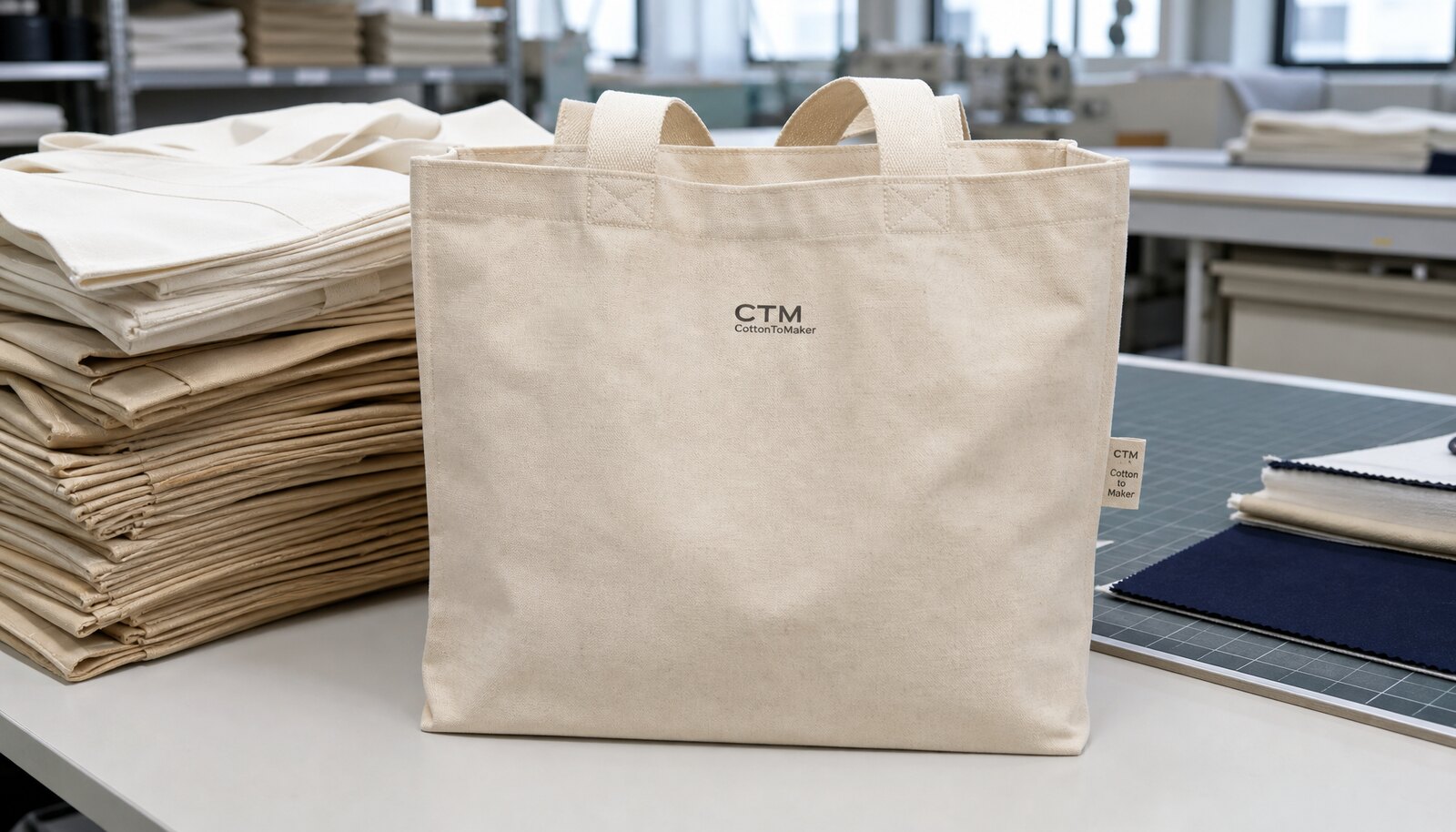
What procurement teams actually mean by promotional eco cotton bags
Promotional eco cotton bags are usually simple cotton tote bags bought for brand visibility, event distribution, corporate gifting, retail promotions, or campaign merchandising. In sourcing terms, they are not a complex product category, but they are easy to buy badly. The reason is straightforward: two bags can look similar in a quotation and still differ in fabric weight, print method, stitching, packing, and even the source mill that supplied the cloth. That is why procurement teams should treat the brief as a commercial specification, not as a marketing note.
The buying question is rarely 'Can the factory make a tote?' The real question is whether the supplier can make the same tote repeatedly, within the same cost basis, with the same look and feel, and deliver it in a way that works for the downstream team. A bag handed out at a trade show can tolerate a simpler build than one sold in a retail environment or packed into a customer kit. The more clearly the use case is stated, the easier it is to compare suppliers on meaningful terms instead of on vague promises.
When writing the RFQ, define the bag as a finished product with a use case, not just a logo carrier. A supplier who understands whether the bag is for a one-time giveaway, a retail shelf, a conference pack, or a repeated-carry shopping bag will usually quote more accurately and flag tradeoffs early. That is especially important if the order is large enough that rework, freight, or packing variation could create real cost leakage.
A useful way to think about this category is that the bag is both a physical item and a brand surface. Procurement needs both sides under control. The brand team may care most about visual impact, but the buyer has to care about stitch durability, carton counts, and reorder consistency. Promotional bags fail more often on presentation and logistics than on basic strength, so a good sourcing plan has to cover both.
- Define the end use before asking for price.
- Treat the bag, print, and packing as one sourcing system.
- Use the RFQ to remove guesswork, not to invite it.
Start with fabric: GSM, weave, shade, and how buyers should test the cloth
Fabric weight is one of the first things to settle because it changes both the unit cost and the perceived quality. For most promotional programs, 140–160 GSM is a light, economical range that suits giveaways and event bags where the tote is unlikely to carry heavy loads. If the brief is closer to retail presentation or repeated use, 170–180 GSM is often the better compromise. At 200 GSM and above, the bag starts to feel more premium and structured, but material cost, sewing time, and freight weight rise quickly. If the bag is meant to carry books, bottles, or bulkier inserts, a heavier cloth is usually easier to justify than replacing failed bags later.
For procurement, the critical point is not just the number itself but whether the supplier can prove it. Ask whether the GSM is measured on the finished fabric or estimated from a nominal spec, and request the method if you need verification. A simple supplier statement is not enough when the order is tied to a campaign launch or retail season. A cut swatch photo with a scale reference is helpful, but for important programs the better request is a measured sample, a test note, or incoming inspection documentation from the supplier's own QC process.
Weave and surface finish matter just as much as GSM. A loosely woven cotton may seem acceptable on a sample table, but it can make solid print look patchy and can reduce opacity, especially on natural or off-white cloth. Buyers who need crisp logos or small text should ask for high-resolution close-up photos of the weave. If the bag is dark printed or uses dense spot colors, check whether the cloth shows through the ink. That issue is often invisible in a compressed quote and obvious only on a physical sample.
Shade variation is normal in natural cotton, but uncontrolled variation is not. Procurement teams should separate acceptable natural character from lot-to-lot inconsistency. A workable approach is to approve one physical sample as the reference and then ask the supplier to keep fabric lots matched to that sample for the whole run. If the program will reorder later, keep the approved sample sealed and tagged with the order number. That simple control often saves time when the second order does not look quite like the first.
One practical threshold: if the bag will be used by customers rather than just distributed once, do not let fabric be the cheapest line item in the quote. Small savings on cloth can create a bag that wrinkles badly, prints poorly, or feels too limp. Once that happens, the brand may still spend the same amount on the campaign, but the tote no longer does the job of representing the brand well.
- 140–160 GSM: economical promo use.
- 170–180 GSM: balanced choice for most branded tote programs.
- 200 GSM+: premium feel, better structure, higher cost and freight.
- Request proof of measured GSM, not just a catalog claim.
Match the print method to the artwork, the volume, and the durability requirement
Screen printing is still the most common choice for promotional eco cotton bags because it handles simple logos well, scales efficiently, and gives buyers a fairly predictable unit cost once setup is done. It is usually the right answer for one- to three-color branding, especially when the artwork uses bold shapes, clean outlines, and limited detail. The buyer should still ask how many screens are needed, whether each color is a separate setup charge, and whether the supplier keeps screens for reorders. Those details determine whether a first order quote can actually support future replenishment.
Digital printing and heat transfer have a place when artwork is complex, multicolor, or likely to change. They can be better for short runs, pilot launches, and promotional programs where the design is not fixed long enough to justify screen setup. The tradeoff is that the buyer must verify durability. Ask whether the print has been tested for rub resistance, folding, and cracking after repeated handling. A tote used at an event may be folded into a bag, stuffed, and carried home, so the print needs to survive normal treatment rather than just look good on day one.
Embroidery can add a premium feel, but it is not automatically the best option for cotton totes. It can stiffen the panel, distort the fabric, and add complexity if the logo is large or uses fine detail. For a premium corporate gift, embroidery may be suitable if the artwork is simple and the bag construction is robust enough. For a standard promotional program, however, embroidery often raises cost and risk without improving the buyer outcome enough to justify it.
A procurement-quality RFQ should specify more than 'print logo on front.' Define print size, placement, number of colors, artwork file type, and whether the print should be centered from the top seam, from the side seam, or by another fixed reference. Ask for a print proof that shows exact placement on the finished bag dimensions, not just a floating artwork file. That prevents surprises when the logo is smaller than expected or placed too low once the tote is sewn.
If the order is brand-sensitive, ask for a daylight photo of the pre-production sample. That is often the simplest way to check whether the ink density is strong enough, whether edge registration is clean, and whether the print is aligned to the bag body. For buyers managing multiple suppliers, it also makes the comparison easier because the same logo can be judged on the same visual basis.
- Use screen print for stable artwork and repeat volume.
- Use digital or transfer print for short runs or changing artwork.
- Reserve embroidery for premium cases where panel stiffness is acceptable.
- Ask for placement proof on the finished bag dimensions.
MOQ is a commercial threshold, not just a factory rule
MOQ matters because it defines how much setup cost the supplier can spread across the order. In promotional tote sourcing, the most common mistake is to ask for a low quantity without understanding what has to be reset behind the scenes. A factory may have to cut fabric, prepare screens, align prints, set sewing lines, and adjust packing. If the order is too small relative to that effort, the quote rises or the supplier quietly simplifies the build. Buyers should therefore ask what exactly drives the MOQ: design, color, cloth, size, or packing format.
A direct factory usually offers the cleanest repeatability when the program is stable and the spec is clear. If the supplier is willing to keep the same cloth and screens for reorder, the buyer benefits from fewer surprises. But many factories will push MOQ upward when the order needs multiple colors, mixed sizes, or customized packing. A trader or distributor may get around those constraints by sourcing from a stock line or by splitting production, which can be useful for pilots or urgent buys. The tradeoff is lower visibility into what is actually being sewn and packed.
One useful decision rule: if the tote is part of a recurring brand program or a retail line, prioritize repeatability over the smallest possible MOQ. If it is a one-off event with no reorder expectation, a lower MOQ can be worth accepting even if the unit cost is higher. The best commercial choice depends on whether the buyer is optimizing the first shipment or the whole program cycle.
It also helps to make the MOQ logic visible in the quote comparison. Ask each supplier to state whether the minimum applies per design, per print color, per fabric color, or per order line. That one line can explain why two quotes differ so much. A quote that looks expensive may actually be more flexible, while a cheap quote may be locked to a specific color or packing style that does not fit the buyer’s downstream schedule.
In practice, procurement teams should treat very low MOQ offers with healthy skepticism. Low quantity can be perfectly legitimate, but it often comes with simplified options, higher setup fees, or a narrower tolerance for change. If the supplier cannot explain how the order remains controlled at the low quantity, that is a sign the quote may not be structured for stable bulk buying.
- Ask what drives MOQ: design, color, size, or packing.
- Low MOQ often means higher setup cost or fewer customization options.
- For repeat programs, keep repeatability ahead of the lowest first-order price.
Build the quote so the real cost drivers are visible
A strong quote for promotional eco cotton bags should separate the elements that buyers actually need to compare. At minimum, that means fabric weight, bag size, print method, number of colors, handle construction, packing style, and lead time. If the supplier only gives one blended price, procurement loses the ability to compare different factories on a like-for-like basis. The result is usually a false winner: the lowest unit price on paper, but not the lowest real cost once the missing items are added back in.
One-time charges should always be separated from recurring charges. Screen or plate fees, artwork setup, sampling, and sometimes cutting or pattern charges should be shown clearly. That matters because the first order and reorder economics are often very different. A quote with a higher unit cost but no setup fee can be better for a pilot run, while a lower unit cost with high setup fees may be the better choice for a repeat campaign. Buyers who do not ask for this split often cannot tell which supplier is truly cheaper after the second order.
The most procurement-useful line in the quote is not the price itself but the basis of that price. For example, ask whether the quote is based on a 160 GSM natural cotton bag, one-side one-color screen print, bulk carton packing, and sample approval before production. Without that basis, the quote is not comparable. If one supplier includes a thicker cloth, more robust stitching, or individual polybagging and another does not, the price spread tells you very little about value.
Lead time also needs a clear starting point. Is the delivery timeline counted from artwork approval, sample approval, deposit receipt, or purchase order confirmation? Those are not the same thing. A buyer managing a launch date needs to know where the clock starts and what can stop it. That is especially important when the supplier needs to wait for fabric availability or print screen approval before sewing can begin.
A good commercial habit is to ask suppliers to quote the same specification sheet, not to interpret a vague email. The more the supplier has to fill in from assumption, the less comparable the offer becomes. Procurement teams save the most time when the RFQ already names the critical variables and asks the factory to confirm them rather than invent them.
- Separate one-time charges from recurring unit cost.
- Make the quote basis explicit: GSM, print area, colors, and packing.
- Define when the lead time starts and what can delay it.
Compare sourcing routes before you compare prices
The route you buy through affects more than the invoice total. A direct factory is usually the best option when you care about consistency, traceability, and reorder control. You are more likely to get stable cloth sourcing, clearer stitching control, and direct answers on what caused a delay. For procurement teams that manage recurring branded programs, that visibility is often worth more than a small price difference.
A trader, distributor, or sourcing office can still be the right choice in some cases. If you need a mixed assortment, if the order is too small to interest a factory directly, or if you want a single contact to manage artwork, packing, and shipment coordination, a middleman can reduce administrative load. The downside is that the buyer may have less visibility into upstream sourcing decisions. That matters when the tote is sensitive to fabric finish or print durability, because small changes in the upstream source can change the final appearance even if the order sheet looks identical.
This is where supplier evidence matters. If a trader is quoting the bag, ask for the factory name, recent production photos, and details of who is actually controlling fabric, print, and packing. If the supplier says the same order can be repeated later, ask how they will preserve the source and QC settings. Buyers do not need every commercial secret, but they do need enough transparency to compare risk. A quote with no source trail is difficult to manage once the program scales.
For longer-term programs, the best route is the one that can hold the spec steady across reorder cycles. If the product is simple and the volume is meaningful, direct factory buying generally offers the cleanest path. If the campaign is experimental or the design may change, the convenience of a sourcing partner may be more valuable than full transparency. Procurement should choose based on control needs, not on habit.
The key question is whether the supplier can prove continuity. Can they show a similar bag made on the same line, with the same cloth, and with the same packing style? If not, a lower price may simply reflect a different upstream source rather than a better process.
- Direct factory: better traceability, better repeatability, usually stronger control.
- Trader/distributor: useful for mixed programs and smaller or faster buys.
- Ask who actually controls fabric, print, and packing before comparing quotes.
Sample approval should test the tote as a real product, not just as a print proof
A photo proof can confirm the artwork, but it cannot confirm the bag. For a proper sample process, procurement should request a pre-production sample made from the same fabric, with the same print method, same handle construction, and the same folding or packing method planned for bulk. That sample should be judged as if it were a production unit, because that is what it is meant to represent. If the bag is for retail or gifting, request the intended packing format as well, since folding method and presentation can change the final impression significantly.
The sample review should cover practical use, not only appearance. Load the bag with the kind of item it will actually carry and check whether the handles sit evenly and whether the top edge distorts under weight. Inspect the inside seams, the handle anchoring points, and the printed surface under daylight. A logo can look acceptable in a screen capture and still appear too light or too low on the actual bag. If the artwork is brand-critical, compare the sample against the approved artwork file and the approved reference bag side by side.
If color matters, the approved sample should become the master reference. That is especially important for natural or undyed cotton, where minor shade variation is common. Keep one sealed master sample and one open working sample. The sealed sample helps later when a supplier says the current lot is 'normal' but the buyer can see the difference immediately. This is one of the simplest and most effective controls in tote sourcing.
Procurement teams should also ask for pre-production photos before bulk starts. Close-ups of the stitching, handles, and print placement help catch issues that might not be visible in a single front-view image. If the supplier sends the wrong sample too early, the buyer can stop the order before the whole run is affected. That is far cheaper than repairing a mistaken print or rejecting cartons after arrival.
The sample step is also the best time to confirm what the factory considers an acceptable tolerance. Ask what variation they allow for finished size, handle length, print placement, and color shade. If the supplier cannot define the limit, the buyer has no usable standard for acceptance later.
- Request a true pre-production sample, not a photo proof.
- Test load, handle balance, print opacity, and seam finish.
- Keep sealed and open master samples for future comparison.
- Ask the supplier to state the tolerance before bulk production starts.
Packing details often decide whether the order lands smoothly or turns into a receiving problem
Packing is easy to overlook because it does not change the look of the tote on a spec sheet, but it can change the receiving experience completely. For low-touch promotional distribution, bulk packing in cartons is usually the most economical route. It keeps the order simple and avoids unnecessary material use. However, bulk packing only works when the buyer is comfortable with minor wrinkles and when the distribution team can count and sort quickly at destination. If the bags are going straight into campaigns or handouts, this may be perfectly fine.
Retail and kit programs need more control. If the tote is going into a gift box, being sold through a store, or distributed through a fulfillment center, the folding method, inner pack count, polybag type, insert cards, and carton labels matter a great deal. Buyers should specify these details in the RFQ rather than after the price is set. Once the factory quotes the order on a bulk basis, it can be expensive to add individual packing later.
Carton quality matters too. Cotton tote bags are not fragile, but they can be bulky. A heavier cloth, such as 180–200 GSM, can push carton weight up quickly, and weak cartons may fail in transit or during pallet stacking. Ask for carton dimensions, net and gross weight, quantity per carton, and external marks. If the warehouse needs to receive by style, color, and size, the carton labeling should support that workflow. Mixed counts or unclear labels are not minor issues; they slow down the entire receiving chain.
For buyers who care about presentation, request photos of the folding method and carton loading pattern. A neat fold can improve first impression, but only if the factory can keep the fold consistent. If the order is large, ask the supplier whether they count bags manually or by weight and how they reconcile carton counts. That may sound operational, but it is often the difference between a smooth delivery and a day spent re-counting every carton.
A practical rule: the more hands the product passes through after arrival, the more explicit the packing spec needs to be. If the bags go straight from port to a warehouse and then to a customer-facing channel, small packing shortcuts become expensive quickly.
- Bulk packing suits low-touch promotions and lower cost.
- Retail and kit programs usually need folding, inserts, and carton labeling.
- Ask for carton size, gross weight, quantity per carton, and external marks.
- Treat mixed counts and vague labels as receiving risks, not minor conveniences.
Lead time risk is usually in fabric, print setup, and packing approval—not sewing
Many buyers assume the sewing line is the bottleneck, but in this category the schedule often gets delayed earlier. The supplier may be waiting for the right fabric roll, print screens, artwork approval, or packing confirmation. If natural cotton shade is important, the mill or fabric warehouse may need time to match rolls. If the print has multiple colors or tight registration, the setup stage can take longer than the actual sewing. That is why a serious lead-time discussion should separate pre-production work from mass production.
A better quote will show time by stage: sample making, sample approval, bulk production, and final packing or inspection. That breakdown makes it easier to manage a launch date and to see where the risk is. For example, a supplier might quote 5 to 7 days for sample development and 15 to 20 days for bulk, but the real schedule can slip if artwork changes twice or if the packing spec is not approved on time. Procurement buyers should treat the quoted lead time as conditional unless the supplier clearly states otherwise.
If the delivery date is fixed, simplify the order. Reduce the number of print colors, avoid unusual bag dimensions, and keep the packing style standard. Those changes can save more time than asking the factory to 'rush' the sewing line. In practice, rushing is often less effective than removing unnecessary complexity. Buyers who insist on a custom bag, custom print, and custom packing on a tight timeline are usually creating the delay themselves, even if it does not feel that way at the time.
It is also worth asking what part of the timeline is most likely to move. Honest suppliers will tell you where they usually slip: material readiness, sample approval, print alignment, or carton packing. That answer is useful because it tells procurement where to focus follow-up. A supplier who claims every step is equally fast may simply be glossing over the risk.
For urgent promotional campaigns, the safest approach is to select standard materials and a straightforward print. If the supplier is asked to deviate from standard cloth, standard handle length, or standard packing, the buyer should expect the schedule to stretch. That is not a problem by itself, but it should be managed explicitly rather than discovered at the last minute.
- Break lead time into sample, bulk, and packing stages.
- Artwork changes and fabric approval often delay the order more than sewing.
- Simplifying print and packing is often the fastest way to protect delivery dates.
- Treat quoted lead time as conditional unless the supplier states the assumptions clearly.
Land the cost before you approve the purchase order
Unit price is only one piece of the commercial picture. For promotional eco cotton bags, landed cost should include the product price, one-time setup or sampling charges, international freight or local transport, customs-related costs if applicable, receiving charges, and a realistic allowance for rework or replacement. Buyers sometimes save a few cents on the unit price and then lose the advantage in freight because the cartons are bulky or the packing is inefficient. In some cases, thicker cotton also means higher freight density, which changes the final landed number more than expected.
The most reliable way to compare quotes is to normalize every offer to the same specification. That means the same bag size, same fabric weight, same print size, same number of colors, and same packing format. If one quote is for a bulk-folded bag and another is for individually polybagged bags with inserts, the lower number may not be a real comparison at all. Procurement teams should insist that the supplier states the exact assumptions behind the price so that the landed-cost calculation is not distorted.
Landed cost also includes risk cost. A supplier with a slightly higher price but a stronger sample process, better carton control, and better reorder discipline can save money over time. That is especially true if the tote is part of a recurring brand program. Reorders often cost more in staff time than in product price, because teams have to chase artwork, compare shade, and check whether the old spec was actually followed. The more stable the supplier's process, the lower the hidden cost.
If the program has a second phase or a follow-on reorder, ask the supplier to quote both first-order and reorder pricing. That makes the setup cost visible and helps you evaluate whether the factory intends to support the program properly. A line-item quote that clearly shows screen fees, sample fees, and unit price by volume is far easier to manage than a single blended number.
A final practical point: do not approve on price until the quote is tied to an approved sample. The sample tells you whether the supplier can actually deliver the stated value. The quote tells you what it will cost. You need both to make a procurement decision that holds up after the goods arrive.
- Compare quotes only after normalizing spec and packing.
- Include freight, receiving, and rework risk in landed cost.
- Ask for first-order and reorder pricing to expose setup charges.
- Approve price only after sample alignment is confirmed.
Specification comparison for buyers
| Spec decision | Recommended option | When it fits | Buyer risk to check |
|---|---|---|---|
| Fabric weight | 140–160 GSM for light giveaways; 170–180 GSM for most branded programs; 200 GSM+ if the bag must feel premium or carry repeated load | Trade shows, campus promotions, retail giveaways, and corporate campaigns where hand-feel and print quality matter | Ask for the measured GSM from a cut swatch or lab report, not just a catalog claim. Check whether the quoted fabric weight includes tolerance, and ask what the supplier accepts as normal variation from roll to roll. A bag that samples at 180 GSM may still ship at 165–170 GSM if the factory is not controlling incoming cloth tightly. |
| Cotton type | Standard natural cotton for price-sensitive promotions; combed or better-finished cotton when print clarity, surface consistency, and lower lint matter | Programs with simple branding, medium order volume, and a need for a consistent visual finish | Request fabric photos in daylight, plus a close-up of the weave and yarn slubs. Natural cotton shade variation is normal, but buyers should reject harsh panel-to-panel contrast, visible contamination, or a surface so rough that fine print closes up. |
| Print method | Screen print for solid logos and stable repeat runs; heat transfer or digital print for short runs, gradients, or artwork changes; embroidery only for premium use cases | Most brand promotions with one to three spot colors and repeatable artwork | Ask for rub, crack, and wash-resistance evidence if the bag will be reused. Print that looks sharp in a photo may still crack, bleed, or lose opacity after folding and handling. Also confirm whether the supplier prints on one side only or both sides, because that changes both cost and registration risk. |
| Handle construction | Cross-stitch or box-stitch handle attachment with at least two to three rows of stitching and reinforcement at the stress points | Bags expected to carry books, bottles, catalogues, or event kits | Request a close-up photo of handle bartacks or reinforcement stitching and ask the supplier to show the stitch count per attachment point. Single-row handle stitching is a common failure mode in low-cost runs. If the tote is long-handled, check whether both handles are cut to identical length within the agreed tolerance. |
| Bag size | Around 38 x 42 cm with 60–70 cm handles for general promotional use; add gusset only if the load or shelf fit requires it | Most giveaway, conference, and retail promo programs | Over-specifying size raises fabric use, freight, and sewing cost. Under-sizing makes the bag look cheap and can reduce usable print area. Ask for finished measurements after sewing, not cut-panel dimensions, and specify whether the dimensions are measured flat or open. |
| MOQ route | Direct factory MOQ is often 1,000–3,000 pcs per design/color; mixed sizes or colors may push MOQ higher | Programs with stable artwork and enough volume to absorb setup and screening costs | Ask what drives MOQ: fabric color, print color, bag size, or packing method. Low MOQ quotes may include higher setup fees or limited QC attention. If the supplier promises a very low MOQ, ask what they are doing differently upstream—stock fabric, stock size, simplified packing, or partial outsourcing. |
| Sampling path | Pre-production sample made with exact fabric, print, handle, and packing; lab dip only when color matching is critical | Any order with retail-facing branding, repeat orders, or strict visual standards | A photo sample is not enough for procurement. Request a physical pre-production sample and confirm whether it represents bulk stitching and fabric lot. If color is critical, ask for a lab dip or fabric swatch approval before cutting the order. |
| Packing method | Bulk packed in cartons for low-touch promotions; individual polybagging, folding spec, and insert cards only when presentation or retail distribution requires it | Wholesale distribution, e-commerce kits, and retail merchandising | Packing inconsistency causes count disputes, wrinkles, and receiving delays. Ask for carton quantity, inner pack count, folding method, carton marks, and whether polybags are clear, recycled, or omitted entirely. Mixed carton counts should be treated as a quality issue, not a harmless convenience. |
| Supplier route | Direct factory for stable specs and repeatability; trader or distributor only when you need mixed items, lower admin effort, or very small volume | Procurement teams that care about repeat supply, controlled finish, and clean change management | Trading quotes can hide the true source of cloth, print, and packing, which makes reorders harder to control. If you buy through a trader, ask for factory identification, production photos, and evidence that the same upstream source can be repeated on reorder. |
Buyer checklist before sampling
- Confirm exact finished bag size, fabric GSM, weave type, handle length, and whether a gusset is included.
- Define the target use case: giveaway, retail sale, event kit, catalog insert, or repeated carry use.
- Specify logo size, print placement, number of colors, artwork file format, and acceptable color tolerance.
- State whether the quote must include sample cost, screen or plate fees, packing, carton marks, and freight assumptions.
- Request recent production photos, close-ups of stitching and print, and at least one similar order reference with the same fabric weight.
- Ask for the supplier’s measurement tolerance, print registration tolerance, and stitch QC method before approving the order.
- Set acceptance criteria for loose threads, stains, odor, needle damage, print bleed, and carton count.
- Keep one sealed master sample and one open reference sample for reorders and dispute resolution.
Factory quote questions to send
- What exact fabric GSM and weave construction are you quoting, and how do you verify it at incoming inspection?
- Is the quote based on one print color, and what is the added cost for each extra color or larger print area?
- What one-time charges apply for screens, plates, artwork preparation, or sampling, and are any of those refundable on reorder?
- What is the MOQ by fabric color, print color, bag size, and packing style?
- What packing method is included in the base price: bulk folding, individual polybag, insert card, or custom hangtag?
- What are the finished size tolerances after sewing, and what is your allowable variance for handle length and gusset depth?
- What is the sample approval process, and will the pre-production sample match the final bulk fabric, stitching, and packing?
- What is the lead time after sample approval, and which step is most likely to delay shipment: fabric readiness, print setup, sewing, or packing?
- What QC standard do you use for stitch density, print registration, odor, measurement, and carton count?
- Can you provide real production photos of the same or a very similar order, including close-ups of seams, handles, and print?
Quality-control points to confirm
- Use the approved pre-production sample as the benchmark for fabric feel, print density, color tone, and handle finish. A bag that feels visibly lighter or more limp than the sample should be reviewed before shipment.
- Check fabric weight with a measured swatch or supplier test report. Buyers should not accept vague claims such as 'heavy cotton' without a number and tolerance.
- Inspect handle attachments for even reinforcement. For bulk buys, look for consistent bartacks or box stitching, no skipped stitches, and no loose thread bundles at the stress points.
- Measure finished dimensions on a representative sample lot. Typical control should cover bag height, width, gusset depth if any, and handle length so the bag hangs level.
- Review print quality at arm’s length and in daylight. Reject obvious logo slant, color bleed, pinholes in solid areas, cracked transfer edges, or visible misregistration between colors.
- Ask for rub or adhesion evidence for the selected print method if the tote will be reused. For screen print, check ink coverage and edge sharpness; for transfers, ask how cracking is tested; for embroidery, check backing stiffness and panel distortion.
- Verify carton count and packing consistency. Cartons should be labeled clearly with style, size, quantity, and lot details, and the count should match the purchase order plan.
- Inspect for presentation defects that matter in promo programs: odor, dust, oil stains, loose threads, uneven folding, and mixed color shade within one carton.
- If using third-party inspection, specify a practical AQL or equivalent inspection approach for dimensions, appearance, and workmanship, and make sure the supplier knows which defects are critical versus minor.
- For repeat orders, compare against the retained master sample and note any change in cloth finish, shade, stitch density, or print appearance before approving mass packing.