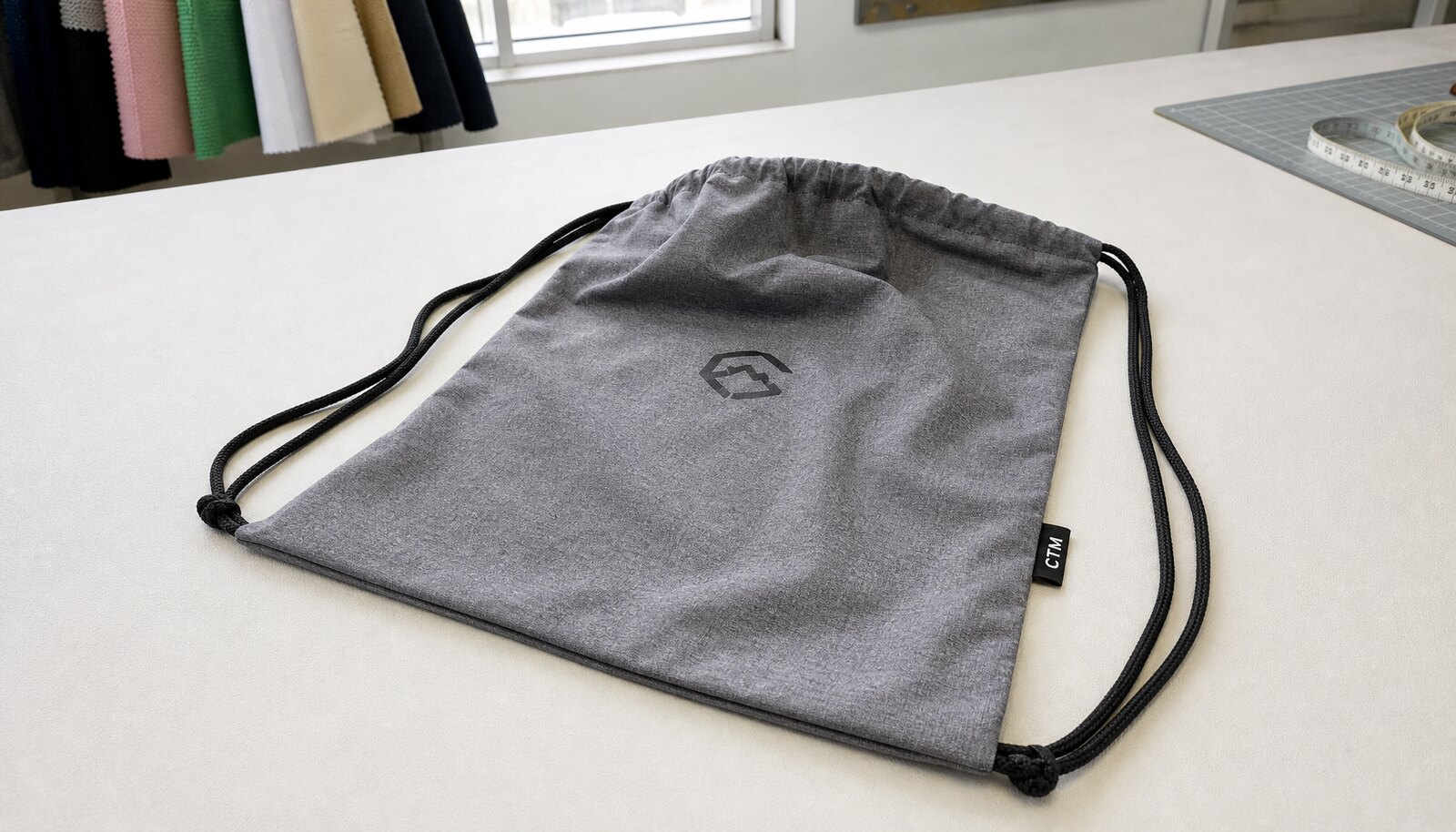
What Buyers Actually Need From a Promo Sportpack
A promotional drawstring sportpack is usually bought for speed, brand visibility, and low handling cost. The problem is that buyers often write the RFQ as if every supplier already means the same thing. They do not. One factory may quote a thin 210D polyester bag with a basic cord tunnel, another may assume a heavier fabric, and a third may substitute a cheaper blank that only looks close in a photo. If the use case is a trade show handout, the bag can be simple. If the bag will be reused for sports, school, or retail add-on programs, you need better structure, a cleaner print surface, and more consistent packing.
The right buying question is not "how cheap can this bag be?" It is "what specification will survive the intended use and still compare cleanly across quotes?" For a promotional run, the critical variables are finished size, fabric weight or denier, print method, cord quality, and packing format. Get those wrong and the supplier quote is meaningless because every line item is built on a different assumption. The buyer who controls those assumptions gets a usable comparison and fewer post-order arguments.
- Define the end use first: event giveaway, gym bag, school pack, or retail promotion.
- Treat size, fabric, print, and packing as quote drivers, not as optional details.
- Do not compare unit prices until the spec is frozen on both sides.
Choose the Base Material That Matches the Job
For a promotional drawstring sportpack, 210D polyester is the usual starting point because it balances price, printability, and basic tear resistance. If you only need a light promotional item, it is enough. If you want a bag that feels more substantial in hand, 300D polyester gives a denser surface and usually prints cleaner on simple logos. Canvas blends or cotton canvas are better if the brand wants a more natural look, but they increase fabric cost, sewing time, and shipping weight. Nonwoven can work for the lowest-cost campaigns, but it is less durable and often looks less refined after a few uses.
GSM or denier should be written into the RFQ because vague fabric descriptions invite substitution. A supplier may say "high quality polyester" and still quote very different cloth than the sample you imagined. For buyer clarity, ask for the exact fabric code, coating if any, and the target weight range. If the bag will carry shoes, water bottles, or promotional kits, the cord tunnel and bottom panel need enough structure to avoid stretching out. The material must fit the load, not just the budget.
- Use 210D polyester for standard promo use where cost and print area matter most.
- Use 300D polyester when you want better body, better hand feel, and less transparency.
- Avoid unspecified fabric language such as "good polyester" or "standard quality".
Construction Details That Change Real-World Failure Rates
Most field failures on a drawstring sportpack happen at the top opening, cord exit points, and seams under repeated pull. That means construction details matter more than many buyers expect. A reinforced cord tunnel, consistent stitch density, and a cleanly finished top edge prevent the bag from twisting or tearing when users overfill it. If the bag uses eyelets, the metal needs to be seated cleanly with no burrs. If it uses stitched cord channels, the stitching must be straight enough that the cords travel evenly and do not bind. Small problems here become visible very quickly in a giveaway program because hundreds or thousands of people handle the bag in the same short window.
Lock these details before sample approval. Ask for cord diameter, cord material, end finishing, reinforcement method, and whether the bag has single-sided or double-sided seams at key stress points. If the bag will be used as a promotional sports pack, the user will probably pull it open with one hand, toss items in, and cinch it shut fast. That is a harsher use pattern than a display-only item. A slight increase in sewing time is often cheaper than replacing a bad run or handling complaints from distributors.
- Specify whether the cord is polyester, cotton, or blended, and ask for the actual diameter.
- Require reinforcement at top stress points and cord exit points.
- Reject samples with crooked tunnels, loose top seams, or sharp metal edges.
Print Method Should Match Artwork, Volume, and Wear
Screen print is still the default for many promotional drawstring sportpack orders because it is cost-effective and durable on simple artwork. It works best when the design is bold, uses one or two spot colors, and does not depend on tiny text or fine gradients. If the logo is busy or multi-color, heat transfer or DTF may produce a cleaner result at lower setup effort, especially in smaller runs. The tradeoff is tactile feel and long-term resistance. Some transfer finishes look too flat or too plastic for a brand that wants a softer appearance, so the print method should be chosen with the marketing team and the production team looking at the same approved sample.
The common mistake is asking for "printed logo" without saying how much print area is needed, how many colors are involved, or whether the print must survive light washing or abrasion. A supplier will optimize for the wording you give them. If the bag will be distributed at a sports event and likely stuffed into lockers or gym bags, rub resistance matters. If the bag is mainly a brand handout, the artwork may matter more than the abrasion spec. Either way, require a pre-production print strike on the actual fabric, not a digital mockup.
- Use screen print for bold, repeatable logos with stable brand colors.
- Use DTF or heat transfer for short runs, complex artwork, or multi-color graphics.
- Ask for print placement dimensions and allowed tolerance in millimeters.
Compare Supplier Routes Before You Compare Unit Prices
The same promotional drawstring sportpack can come from very different sourcing routes, and those routes change the risk profile. Factory-direct custom production usually gives the best control over fabric, sewing, print, and packing, but it also requires a proper approval cycle. A stock blank plus local print partner is faster and useful when deadlines are tight, yet the blank bag may not be identical between lots and the print partner may not control the original sewing quality. Trading companies can be useful if you buy multiple bag types or need one commercial contact, but you still need to know which factory is actually sewing the bag and who owns the QC standard.
A clean quote comparison should show not only unit price, but also where the control points sit. Ask whether the supplier is quoting ex-works, FOB, or another Incoterm, whether the sample fee is refundable, whether setup charges are included, and whether packaging is part of the unit price. If one quote includes a woven label, inner polybag, carton marks, and one approval sample while another quote excludes all of those items, the lower price is not really lower. Compare route, not just number.
- Factory-direct is best when you need repeatability and can manage sample approval carefully.
- Stock blank plus local print is best when speed matters more than full specification control.
- Trading companies are useful only if factory identity, QC ownership, and cost breakdown are transparent.
Build the RFQ So Every Supplier Quotes the Same Item
A usable RFQ for a promotional drawstring sportpack is short but precise. It should state finished size, fabric, cord, print method, print area, label or tag requirements, packing format, destination country, and target ship date. If you leave out the fabric weight, one supplier may quote 210D and another 300D. If you leave out packing, one quote may be bulk packed while another includes individual polybags and barcode labels. When that happens, the unit prices are not comparable and procurement loses the ability to rank suppliers on value.
Good quote data also includes operational details that normally get forgotten until late in the process. Ask for carton quantity, carton dimensions, gross weight, and lead time from sample approval. If you need multiple colors, state whether the MOQ applies per color or per total order. If you need artwork variants, state whether each variant counts as a separate SKU. The supplier should be able to turn that into a clear line-item quote, not a vague promise. If a vendor cannot break the item down, the risk usually reappears later in the production cycle.
- Include finished size, material, cord, print method, packing, and destination in the same RFQ.
- State MOQ by color and by artwork version if the order has variants.
- Request the quote as a line-item breakdown, not only a single unit price.
Approve the Sample Like a Production Gate, Not a Marketing Prop
The sample stage is where many buyers lose money by approving the wrong thing. A sales sample or photo sample may look fine, but unless it uses the actual fabric, actual cord, actual print method, and real packing plan, it is not a reliable approval basis. A proper pre-production sample should be made by the same factory that will run bulk, with the same sewing line and the same subcontracted decoration process if one exists. For a promotional drawstring sportpack, the sample must prove more than appearance. It should confirm hand feel, closing action, print alignment, label placement, and the way the fabric sits when the bag is loaded.
Treat sample approval as a gate with written pass-fail points. Check the dimensions, the placement of the logo, the evenness of the cord pull, and the clean finishing of the inside seams. If the sample has a woven side label or a small CTM brand marker, verify stitching quality and edge finish on that piece as well. Keep one signed sample from both buyer and supplier, and use that physical reference when resolving disputes during bulk inspection. This step is faster than debating a phone photo after production has already started.
- Approve only a pre-production sample made from bulk materials.
- Mark the sample with date, buyer name, supplier name, and approved version number.
- Keep a sealed control sample on both sides for final inspection reference.
Packing, Cartons, and Retail Readiness Change Freight Cost
Packing is not a small detail. For a promotional drawstring sportpack, bulk packing usually reduces cost and carton volume, which helps if the bags are going straight into distribution or event kits. If the bag is for retail or a branded resale channel, you may need individual polybags, barcode stickers, insert cards, or a hangtag. Each of those choices affects labor time, material cost, and carton density. A supplier who quotes only the bag body may appear competitive, but the real landed cost can rise quickly once the packing requirement is added.
Ask the factory for carton count, master carton dimensions, gross weight, and whether cartons are single-SKU or mixed-SKU. This matters for warehouse receiving and for freight planning. If the cartons are too large, they may be inefficient on a pallet or incur avoidable volumetric charges. If the labels are unclear, receiving teams may need to open cartons to verify contents. For retail programs, insist on barcode readability and consistent outer labeling. For promotional bulk, optimize for density and clean carton marks.
- Use bulk pack for low-cost promotional distribution unless retail presentation is required.
- Use individual polybags and barcode labels when the item moves through retail or fulfillment channels.
- Ask for carton dimensions early so freight and storage costs can be estimated correctly.
Plan Lead Time and Landed Cost With Buffers, Not Hopes
Lead time on a promotional drawstring sportpack should be planned from sample approval, not from the date you send the PO. That sounds obvious, but it is where many programs slip. If the artwork changes, the fabric source changes, or the packing changes, the schedule can move by more than a week without anyone noticing until the order is already late. A realistic plan includes sample signoff, material reservation, production, inspection, carton consolidation, and export booking. Each step needs time, especially if the order is custom printed and the factory is running more than one campaign at once.
Landed cost should also be compared on a route basis. The cheapest ex-works quote may not be the cheapest delivered option if it uses higher freight density, more packaging, or slower approval cycles. A reliable comparison includes unit price, sample fee, print setup, packing materials, inland freight, export docs, inspection cost if used, and the freight mode you actually need. For a short promotional window, paying a little more for a cleaner supply chain can be the correct commercial decision because the hidden cost of a late campaign is often larger than the bag itself.
- Build schedule buffers around sample approval, not just sewing time.
- Compare landed cost by route, packing density, and freight mode.
- Treat late delivery risk as a real cost, especially for event-driven promotions.
Specification comparison for buyers
| Spec decision | Recommended option | When it fits | Buyer risk to check |
|---|---|---|---|
| Sourcing route | Factory-direct custom production with named QC owner | Repeat campaigns, color control matters, and you can wait for a real sample approval cycle | Make sure the quote names the actual factory, not just a sales office, and that the inspection responsibility is written down |
| Sourcing route | Stock blank bag plus local print partner | Short deadlines, low artwork complexity, and small promotional runs | Confirm blank shade consistency, print adhesion, and whether the blank bag is truly the same model across lots |
| Sourcing route | Trading company managing the factory | Multi-SKU programs, mixed order sizes, or buyers that need one point of contact | Ask which factory will sew the bag, who inspects it, and whether the trading margin is embedded in the unit price |
| Fabric choice | 210D polyester for standard promotion, 300D polyester or canvas blend for a better hand feel | Giveaways, event bags, school promotions, and general retail promotion use | Too-light fabric can distort the print, show stress marks, and feel inconsistent between batches |
| Fabric weight | Target a stated GSM or denier range on the PO, not a loose description | Any order where you need quote comparability across suppliers | If the quote only says custom drawstring bag, you cannot compare fabric strength or print results |
| Print method | One or two color screen print for simple logos | Large-volume promotions with bold branding and long wear requirements | Fine text, gradients, and tight registration can break down if the artwork is not simplified |
| Print method | Heat transfer or DTF for short runs and multi-color artwork | Artwork with more colors, small batches, or variable names and campaign marks | Check rub resistance, wash resistance if relevant, and whether the finish feels too plastic for the brand |
| Closure and cord | 3 to 4 mm polyester cord with reinforced eyelets or stitched cord tunnels | Event use, gym use, and bags that will be pulled repeatedly | Weak eyelets, rough grommets, or thin cord can fail before the campaign ends |
| Packing route | Bulk pack with size sticker, inner count, and carton marks unless retail presentation is required | B2B distribution, warehouse handling, and lower-cost promotional programs | Retail-ready programs may need individual polybags, barcode labels, and shelf-ready carton ratios |
Buyer checklist before sampling
- State the end use: giveaway, sports event, school promotion, retail add-on, or mailer insert.
- Lock the finished size, fabric type, GSM or denier, cord type, and closure style before requesting quotes.
- Provide print artwork in vector format, with Pantone references and exact placement dimensions.
- Confirm whether you need one-sided print, two-sided print, or print plus woven label.
- Specify packing: bulk pack, individual polybag, insert card, barcode label, or retail hangtag.
- Ask for a pre-production sample made with the actual fabric, cord, print method, and label construction.
- Define the acceptable defect standard, such as AQL 2.5 for major defects or a tighter internal limit for retail.
- Request carton size, carton quantity, gross weight, and palletization details before booking freight.
- Clarify lead time from sample approval, not from order placement.
- Confirm Incoterms and which costs are excluded, including tooling, setup, inland trucking, and export documents.
Factory quote questions to send
- What exact fabric code, denier, and GSM will you use for the bag body and cord?
- What is the finished size, and what tolerance do you allow after sewing and cutting?
- Which print method are you quoting, how many colors are included, and what is the setup fee?
- What is the MOQ by color and by artwork version, and does MOQ change if I add a woven label or hangtag?
- Will the sample be made in the same factory and with the same materials as bulk production?
- Can you show carton count, carton dimensions, gross weight, and packing ratio per carton?
- What is your standard quality inspection method, and do you support AQL 2.5 or a customer-specific standard?
- What compliance or test reports can you provide for fabric, colorfastness, or restricted substances if required?
- What is the production lead time after sample approval, and what happens if artwork approval is delayed?
- What is included in the quoted price, and which items are billed separately?
Quality-control points to confirm
- Finished dimensions should stay within an agreed tolerance, commonly around plus or minus 1 cm for small promotional bags.
- Fabric weight or denier should match the approved sample and stay within the agreed range on the purchase order.
- Print position should be centered and aligned to the artwork spec, with no obvious skew, cracking, or pinholes.
- Color should match the signed sample under daylight or controlled light, with no noticeable shade shift across the lot.
- Cord length on left and right sides should be even enough that the bag closes symmetrically.
- Eyelets, stitched tunnels, or grommets should be secure, smooth to the touch, and free of sharp edges or burrs.
- Top seams and stress points should show no skipped stitches, loose threads, or seam puckering that weakens the bag.
- If a woven label, side label, or hangtag is included, its placement and spelling must match the approved artwork exactly.
- Packaging should match the PO count, barcode, carton mark, and polybag warning requirements where applicable.
- Bulk cartons should be dry, clean, and undamaged, with no compression that could crease print or deform the bag shape.