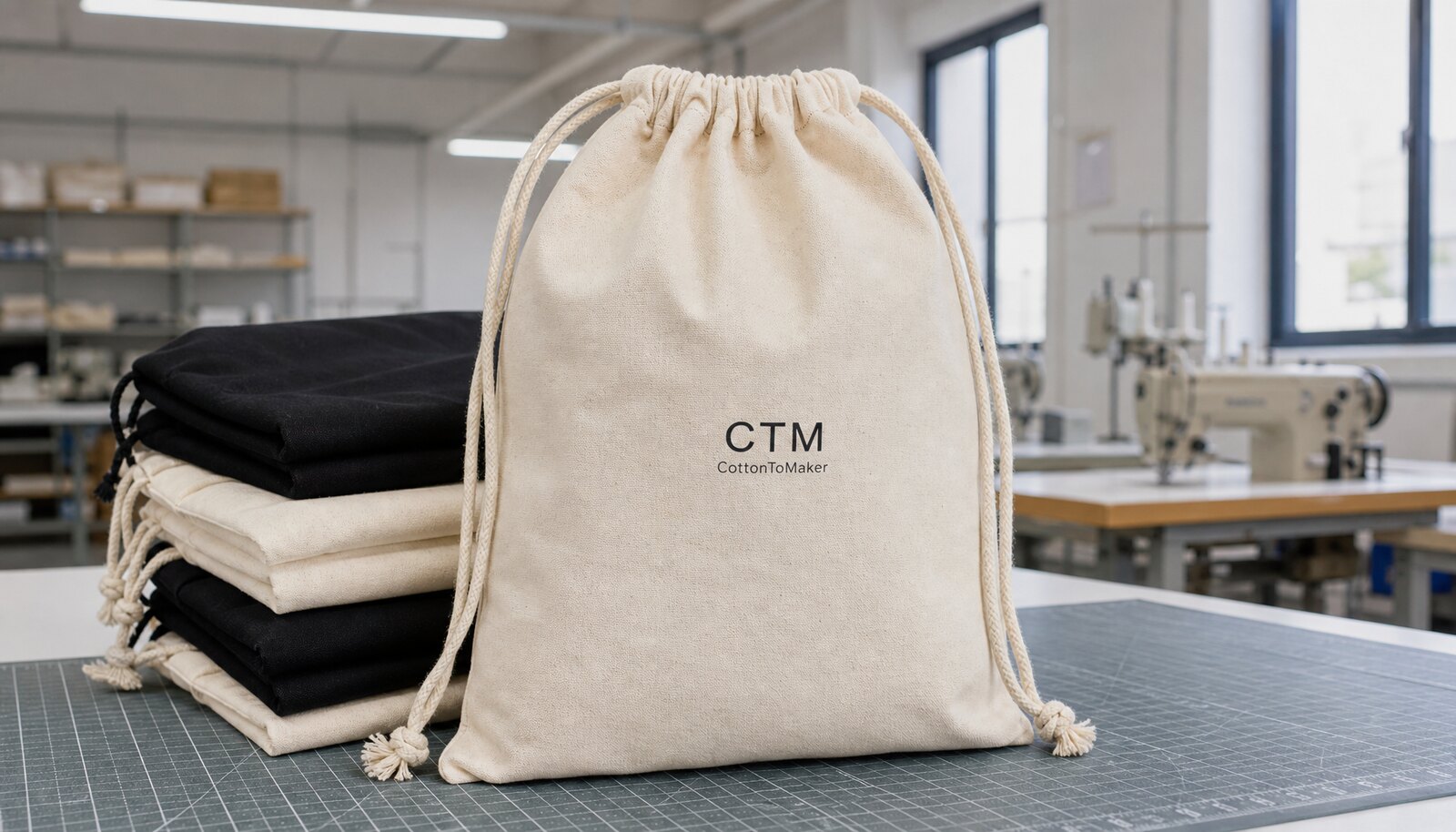
Start with the use case, not the bag shape
Promotional drawstring bags with logo are easy to describe but easy to misbuy. The bag itself is simple; the sourcing risk sits in what the buyer assumes is obvious and what the factory is free to interpret. A low quote can still hide a lighter fabric, a cheaper cord, a different print method, or a packing method that changes freight cost. For procurement, that means the bag should be treated as a controlled product spec, not as a generic giveaway line item.
The first question is not 'What is the bag made of?' but 'What will it carry, how often will it be reused, and what brand impression has to survive the handoff?' A conference kit bag for brochures and a retail presentation pouch have different requirements even if both are drawstring bags. One can tolerate more variability and lighter construction. The other may need cleaner print alignment, stronger seams, and a more stable fabric hand feel. If the use case is not written down, the rest of the order tends to drift.
Buyers also need to decide whether the item is meant to disappear into the kit or stand in for the brand. That decision affects nearly every other spec: fabric weight, logo size, number of colors, whether the bag should feel premium, and whether the print needs to survive repeated use. If the campaign depends on the bag being kept and reused, the minimum viable spec is usually too weak.
- Define the carrier content before choosing the bag size.
- Decide whether the bag is a disposable giveaway or a reusable branded item.
- Write the brand outcome as a procurement requirement, not a marketing wish.
Choose fabric by function, not by habit
Fabric choice should follow the contents and the setting where the bag will be used. Cotton is often preferred when the buyer wants a natural look and a more tactile presentation. A 120-140 gsm cotton bag usually feels more substantial than a very light promotional bag and gives print a better visual base. For lighter, budget-sensitive programs, 80-100 gsm cotton can still be suitable if the contents are not heavy and the buyer is comfortable with a thinner hand feel. Those are planning ranges, not universal standards; the final choice should always be tied to the actual item being packed.
Polyester, particularly 210D construction, shifts the product into a more utilitarian category. It can make sense for sports events, travel kits, moisture-prone environments, or branded packs that need a bit more abrasion resistance. It will not create the same textile impression as cotton, and that matters when the bag is part of the brand statement. A buyer looking for an organic or artisanal presentation should not let a low-cost polyester quote substitute for the desired look unless that tradeoff is intentional and approved.
The sourcing conversation should also cover fabric finish. Natural, bleached, dyed, and washed surfaces all behave differently in print, color consistency, and perceived quality. A natural cotton bag can be appropriate, but it may have more visible fiber variation than a finished white bag. If the order is color-critical, ask for the relevant color reference and say how much variation is acceptable. If it is not color-critical, say that too. Vague expectations are what create disputes later.
- Ask for gsm or denier, not just a material name.
- Match fabric choice to the intended contents and reuse expectation.
- Specify the finish and color reference if appearance matters to the brand.
Treat decoration as a technical choice
The logo method is one of the biggest commercial drivers in the order, and it should be selected after the artwork has been checked against the bag, not before. Screen printing is usually the most efficient route for simple, solid artwork and larger volumes. It gives a clean cost structure when the logo has one or two colors and a stable print area. Heat transfer is more flexible for small runs, multi-color graphics, or artwork with fine detail, but buyers should confirm how the transfer behaves on the chosen fabric and whether the visual finish matches the brand standard. Woven labels, sewn patches, and embroidery can create a more premium impression, though they bring more process variation and need stronger control over placement and fabric thickness.
The mistake many buyers make is to ask only for the logo to be 'centered' or 'printed nicely.' That is too loose. The RFQ should specify the print size in millimeters, the number of colors, the exact position from the top edge or side seam, and whether the decoration is one-sided or two-sided. If the logo crosses a seam or sits near a drawcord channel, the risk of distortion rises. On a small bag, even a few millimeters of drift can make the decoration look careless.
Samples should reflect the final process. A beautiful mockup on the wrong substrate is not useful for production approval. Ask the supplier for a strike-off or sample on the actual fabric with the actual decoration method. If the bag will be washed, repeatedly handled, or packed into other goods, ask what durability check the factory uses for print rub or adhesion. Avoid broad claims like 'long-lasting print' unless they are tied to a test method or an approved sample.
- Screen print works best for simple artwork and larger runs.
- Heat transfer is often better for small runs or detailed graphics.
- State logo size, position, and color count in millimeters and written placement terms.
- Approve the final fabric and final decoration method together.
Get the size and construction right before discussing price
A small bag can look acceptable in a photo and still fail in use if the opening is too tight, the body is too shallow, or the seam layout steals usable space. The buyer should specify the finished dimensions, not just a nominal size name. Also state whether dimensions are measured flat, after sewing, or as usable internal space. That sounds tedious, but it eliminates one of the most common causes of supplier disagreement. If the bag has to hold a bottle, a brochure set, or a boxed item, the fit requirement should be written explicitly.
Construction matters as much as the outer appearance. The mouth of the bag and the cord channel carry the load, so weak stitching or poor reinforcement will show up quickly. Ask for stitch density, seam allowance, and any reinforcement at the top edge or stress points. For utility use, buyers often care more about seam stability and consistent closure than about decorative extras. If the drawcord is meant to run smoothly under repeated opening, the channel should be wide enough and the cord finish should not create friction or snagging.
A good procurement practice is to connect construction to the expected hand use. A conference bag that will carry a brochure and pen set does not need the same build as a pouch that will be opened fifty times at an event booth. If the order is for frequent reuse, it is worth paying for better seam control and a more stable cord. If the bag is a short-life handout, keep the structure simple and spend the money where it matters most: print clarity and sizing consistency.
- Specify finished size, flat size, or usable opening clearly.
- Ask for stitch density and reinforcement details at the mouth and cord channel.
- Match the construction level to how often the bag will be opened and reused.
Compare quotes by cost driver, not by unit price alone
A quote for a branded drawstring bag is only useful if it compares the same product on each line. Different suppliers may include different fabric weights, different decoration areas, different cord types, or different packaging assumptions. A lower unit price can simply mean the supplier is quoting a thinner bag, a smaller print area, or a packing format that changes the landed cost. That is why procurement should normalize the specification before comparing prices.
The main cost drivers are usually fabric, decoration setup, color count, packaging, and the degree of customization. Stock fabric with one-color printing is generally easier to source than custom-dyed fabric with multiple decoration positions. A special cord color or a retail-ready inner pack may look minor, but it can change the process enough to raise MOQ and lead time. If the supplier cannot explain what is driving the price, the quote is not yet procurement-ready.
For recurring programs, ask the factory to separate one-time setup from per-unit cost. That matters when a bag is ordered in waves over a season or across several campaigns. A quote that seems expensive on the first order may be cheaper on repeat if the setup cost is lower or if the factory can hold a stable material spec. The inverse is also true: a low first-order price can become expensive if each reorder requires reapproval or fresh tooling. Buyers need to see the commercial path across the full program, not only the first shipment.
- Normalize size, fabric, logo method, and packing before comparing quotes.
- Separate one-time setup costs from recurring unit cost.
- Check freight impact if carton dimensions differ materially between suppliers.
Set MOQ expectations from the material and setup reality
MOQ is rarely arbitrary. It usually reflects the factory's ability to source the fabric, load the print line, and keep a stable packing operation. If the order uses stock natural cotton and one simple logo, the MOQ can often stay relatively low. Once the order adds custom dyeing, multiple print colors, special cord color, or mixed SKUs, the MOQ rises because the supplier has to hold more material and manage more setup steps. That is not a negotiation failure; it is the structure of the job.
From a procurement perspective, it is useful to separate a pilot order from the replenishment plan. The pilot order should prove that the approved spec can be repeated without hidden changes in fabric, ink, or stitching. The replenishment plan should test whether the supplier can run the same job again without surprise variation. If the first run is approved but the second run changes the hand feel, print tone, or pack count, the low MOQ did not actually reduce risk. It just delayed it.
If volume is uncertain, ask the supplier what feature drives MOQ the most. Sometimes the answer is simple: a custom color fabric or a specialized print screen. Once you know the driver, you can decide whether to simplify the spec, split the order, or accept the MOQ as the cost of control. That is better than arguing about the number itself without understanding the constraint behind it.
- Stock fabric and one-color print usually support the lowest MOQ.
- Custom dyeing, multiple colors, and mixed pack formats usually raise MOQ.
- Ask the supplier which feature is driving MOQ before you try to negotiate it.
Make sample approval a production test, not a visual courtesy
A sample is only useful if it mirrors the actual production route. If the sample is made from different fabric, different thread, or a different print process, it can hide defects that appear later in mass production. The safer approach is to ask for a pre-production sample or strike-off made with the final fabric, final cord, final decoration method, and final packing format when packing is important. That gives procurement a real reference point instead of a cosmetic one.
The sample should also be handled the way the final product will be handled. Load it with the intended contents, close and open it several times, inspect the cord movement, and look at the logo under real handling conditions. If the design uses fine text or a small logo, check readability at normal viewing distance and after basic rub handling. The objective is not to certify perfection; it is to make sure the factory has the right target before bulk production starts.
A clean sample approval process also helps later in dispute resolution. Keep a signed reference with the approved artwork, the sample date, and any agreed tolerances. If the supplier later claims that a slight variation is normal, the approved reference gives you a clear comparison point. That is much more reliable than relying on email threads or generic product photos.
- Use the final fabric, cord, print process, and packing format in the approved sample.
- Test the bag with the actual intended contents before sign-off.
- Keep a signed sample reference with the artwork and tolerance notes.
Define QC in defect terms the factory can actually inspect
Good QC does not start with a broad statement like 'please make sure the quality is good.' It starts with a defect taxonomy the supplier can inspect against. For promotional bags, the most useful categories are usually critical, major, and minor. A critical defect is one that makes the bag unusable or materially wrong, such as the wrong artwork, a torn seam, or a closure that fails. A major defect affects brand presentation or function, such as the wrong size, severe print misalignment, missing logo, or a broken cord. A minor defect is cosmetic and does not affect use, such as a loose thread or a small wrinkle that stays within the agreed visual limit.
The buyer should also define what the supplier must check in process and at final inspection. In-process checks are useful for print alignment, stitch consistency, and cord-channel behavior because those defects are cheaper to catch early. Final inspection should confirm counts, carton marks, packing quality, and whether the product matches the approved sample. If the order size justifies it, use AQL-based sampling and record the inspection standard in the PO or QC note. The exact AQL number matters less than the fact that both sides agree on the defect categories before the inspector enters the room.
It is also worth asking the supplier for a tolerance sheet before mass production. That sheet should cover size, color variation, logo position, stitch density, and pack count. If the factory cannot produce a practical tolerance sheet, the order is probably being managed informally, which is a problem when the logo needs to be exact and the bag is going into a branded program.
- Classify defects as critical, major, or minor before production starts.
- Check logo position, stitch consistency, cord behavior, and carton count in separate steps.
- Use AQL sampling when the order size justifies formal inspection.
- Request a tolerance sheet before bulk production begins.
Packing and freight are part of the product, not an afterthought
Packing choices affect cost, warehouse handling, and the condition in which the bags arrive. Bulk packing is usually the most practical format for campaign distribution and wholesale programs because it reduces labor and keeps carton volume lower. Individual polybags make more sense when the bags will be retailed, distributed through e-commerce, or packed into a presentation kit where appearance and hygiene matter more. The wrong assumption here can inflate freight cost or create unnecessary unpacking work at receiving.
Ask for carton count, inner pack count, carton dimensions, and gross weight before the order is placed. Those numbers matter because small bags can be deceptively cube-heavy if packed loosely. A poor packing plan can damage print surfaces, crease the fabric, or waste freight space. If the bags are printed on one side, the pack method should minimize abrasion between printed surfaces. The goal is not just to fit the order into a carton. It is to preserve the approved appearance through transport.
If retail-style packaging is required, specify the details rather than relying on supplier defaults. State whether the polybag should be clear, recyclable, vented, or moisture-protective, and whether barcode labels or insert cards are needed. These extras can introduce labor, lead time, and additional quality checks. They should be priced and approved as part of the product, not treated as an assumption.
- Bulk pack is usually best for campaign and distributor orders.
- Specify carton dimensions and pack count before approving the quote.
- Define polybag and label requirements explicitly if retail presentation matters.
Vet the supplier's process ownership before you place the PO
A factory can quote competently and still lose control if sewing, printing, inspection, and packing are spread across different sites without clear ownership. For simple bags, that risk is easy to underestimate. For procurement, the key question is who actually controls the process. Ask for the production site name and address, the process flow, and the person responsible for print control and final inspection. If a trading company is involved, clarify whether it owns the production workflow or only the commercial relationship.
The supplier should be able to explain practical details without hesitation: how they check stitch quality, how they control print alignment, how they handle rejected pieces, and how they separate approved stock from work-in-process. You do not need a long audit report to see whether the process is under control. You need enough transparency to know who is accountable when the sample is approved and the bulk run starts. If the answer is vague, the risk of mismatch grows.
For higher-volume or recurring programs, it is also worth asking whether the factory keeps reference samples, signs off a production board, and documents final packing. Those are not luxury controls. They are the basic tools that keep a simple product from becoming a repeated sourcing problem. The bag may be low complexity, but the procurement discipline around it should not be.
- Confirm who sews, who prints, who inspects, and who packs.
- Ask for the actual production site and process owner, not just the sales contact.
- Check whether the supplier can explain in-line QC and rejection handling clearly.
Specification comparison for buyers
| Spec decision | Typical buyer recommendation | Measurable spec to request | Acceptance / rejection check |
|---|---|---|---|
| Fabric and hand feel | Use 120-140 gsm cotton when the bag needs to feel substantial; 80-100 gsm cotton for light giveaway use; 210D polyester for utility-oriented or moisture-prone settings | State gsm or denier, weave type, finish, shrinkage allowance if relevant, and whether the fabric is dyed, bleached, or natural | Accept only if measured weight and appearance match the approved reference; reject if the bag feels notably thinner, varies carton to carton, or shows visible shade inconsistency |
| Finished size | Select the smallest size that still fits the intended contents without forcing the opening or distorting the logo area | Give finished width and height in cm or mm, identify whether the measurement is flat or usable opening, and define a tolerance band | Accept if the target item fits without strain and the actual size stays within the written tolerance; reject if the opening is too tight or the bag is undersized |
| Decoration method | Screen print for simple solid logos, heat transfer for small runs or multi-color artwork, patch or woven label for a more premium reuse signal, embroidery only on heavier fabrics | Specify print size in mm, placement from seam or top edge, color count, one-sided or two-sided decoration, and curing or wash expectation where relevant | Accept if the logo is centered, legible, and matches the approved artwork; reject if the print shifts, bleeds, cracks early, or is clipped by a seam |
| Stitching and seam build | Use straightforward construction with reinforcement at the mouth and cord channel rather than decorative complexity | Ask for stitch density, seam allowance, thread type, and whether stress points are reinforced | Accept if stitches are even, secure, and free of skipped sections; reject if the top edge frays, seams open, or thread tails are excessive |
| Cord and closure | Braided polyester or cotton cord is usually more reliable than very soft or underspecified cord; PP cord can work when cost pressure is high | Define cord diameter, length, knot retention, end finish, and whether the bag uses single or double drawcords | Accept if the bag opens and closes smoothly, the cord does not slip, and knots or end stops stay secure; reject if the cord frays or binds in the channel |
| Packing format | Bulk pack for campaigns and distributor orders; individual polybag only when retail presentation, hygiene, or e-commerce handling requires it | State carton count, inner pack count, polybag thickness if used, carton dimensions, gross weight, and carton marking text | Accept if counts are exact and cartons arrive dry and intact; reject if counts mismatch, cartons are crushed, or mixed artwork appears |
| Lead time | Separate sample time, material sourcing, production, and inspection rather than accepting a single delivery promise | Request dated milestones for sample approval, production start, finishing, packing, and shipment | Accept if the supplier can explain the critical path and approval deadlines; reject vague claims such as 'fast delivery' without milestone dates |
| Supplier route | Factory direct is usually better for repeatability; a trading company can still work when the spec is clear and the order is mixed; local converters can help on urgent small volumes | Ask who sews, who prints, who inspects, and who packs, plus the actual site name and address | Accept only if responsibility is explicit and process ownership is clear; reject if the quote hides subcontracting or the production site cannot be named |
Buyer checklist before sampling
- Confirm whether dimensions are finished size, cut size, or usable opening size.
- Write fabric gsm or denier, weave type, finish, and color standard into the RFQ.
- Specify the logo method, artwork size in millimeters, number of colors, and exact print position.
- Ask for a pre-production sample or strike-off made on the final fabric and final decoration method.
- Request written tolerance limits for size, stitch density, print position, and color variation.
- Define carton pack count, inner packaging, carton dimensions, and whether individual polybags are required.
- Separate unit price from one-time setup, screen, plate, transfer, or artwork charges.
- Ask the factory to identify the production site, print line, and inspection owner.
- Request available test evidence where relevant, such as seam strength, colorfastness, or print rub resistance.
- Clarify who pays for remake, reprint, or replacement if the approved spec is not met.
Factory quote questions to send
- What is the exact fabric specification, including gsm or denier, weave, finish, and any shrinkage allowance?
- Are the quoted dimensions finished size or cut size, and what tolerance do you allow on length, width, and opening?
- Which decoration method are you quoting, and is there any setup, screen, plate, or artwork fee?
- How many colors and print positions are included, and what is the surcharge for extra colors or a second location?
- What is your sample charge policy, and is the fee refundable against bulk production or separate from it?
- Will the pre-production sample use the final fabric, cord, thread, ink, and packing configuration?
- Can you provide a tolerance sheet for size, color, print position, and stitch quality before production starts?
- What test results or in-house checks can you share for seam strength, colorfastness, or print durability, if available?
- What is the MOQ by fabric color, decoration method, and packaging type?
- Who is responsible if the delivered goods miss the approved sample, tolerance sheet, or signed artwork?
Quality-control points to confirm
- Fabric weight should match the approved spec within an agreed tolerance, commonly around ±5%, and the fabric should be consistent across the lot with no obvious thin areas, slubs, or unexpected shade jumps unless the design intentionally uses a natural finish.
- Finished size should remain within the written tolerance, and the bag should still fit the intended item without distorting the opening or print area.
- Stitching should be straight, even, and dense enough to support the cord channel; look for no skipped stitches, no open seams, and no loose thread tails beyond the agreed allowance.
- A simple pull or handling check should confirm seam stability and cord-channel integrity on a sample basis; the bag should not pop open or lose shape under normal handling loads.
- The logo should match the approved artwork location and remain legible without smearing, cracking, edge lift, or major color shift; print near seams deserves extra scrutiny because distortion risk is higher.
- If the bag is dyed, define the color tolerance against an approved swatch, lab dip, or strike-off; visible shade variation within a carton should stay within the agreed acceptance standard.
- Cord length, cord diameter, and knot retention should be consistent; cords should move smoothly and not slip back through the channel during repeated opening and closing.
- If packing is bulk, carton counts should match the packing list exactly; if individual polybags are used, they should be clean, intact, and consistent in thickness and sealing method.
- Cartons should be dry, undamaged, and marked correctly with PO number, item code, size, color, and carton count; mixed lots should not ship without written approval.
- Use an AQL-based inspection plan where appropriate and define which defects are critical, major, and minor before inspection starts.