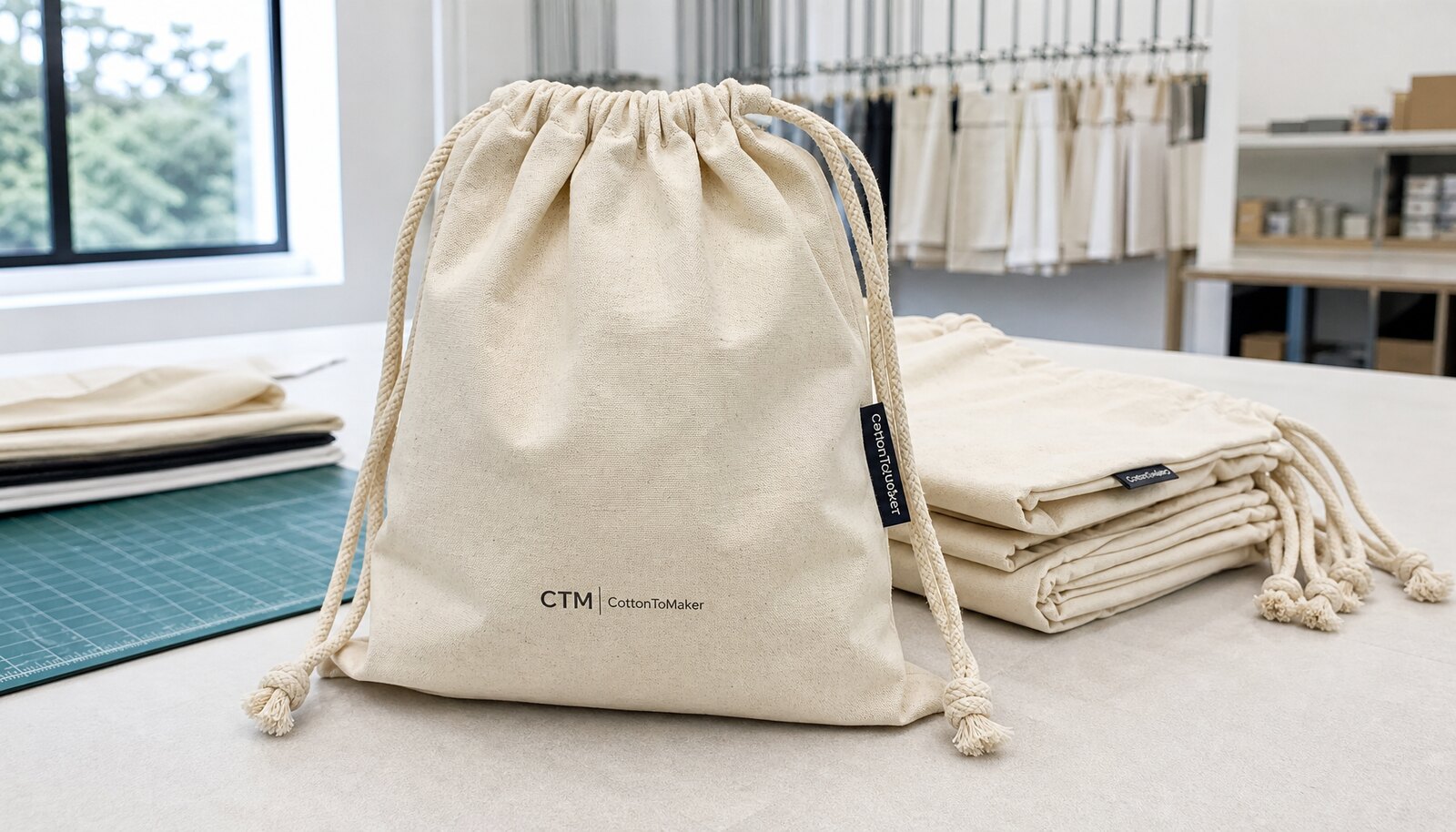
What cheap should mean for promotional drawstring bags
In procurement terms, cheap means the lowest acceptable total cost for the job, not the lowest quote on the page. A trade-show handout, a retail-ready brand pack, and an internal onboarding pouch all tolerate different levels of finish, print durability, and packing control. If the use case only requires a bag to hold brochures, the buyer should not pay for premium fabric or ornate finishing. If the bag has to survive repeated reuse, present well at shelf, or support a higher-value brand, then a narrow focus on unit price is usually the wrong decision.
The main mistake is buying a specification that is mismatched to the channel. Thin fabric can be perfectly acceptable for a one-day event, but the same bag can look cheap in a sales kit or break down after a few uses. A procurement team gets better results when it defines the operating requirements first: expected load, desired lifespan, artwork complexity, packaging format, and whether the program will reorder. Once those are fixed, the supplier can quote a product that is genuinely economical rather than merely inexpensive.
Choose fabric and GSM by use case, not by habit
Fabric is the biggest driver of both cost and perception. For budget promotional programs, cotton sheeting in the roughly 90 to 140 GSM range is often the sweet spot because it balances cost, printability, and acceptable hand feel. Around 90 to 110 GSM works for very light giveaways or small pouches where the bag only carries a few items. Around 110 to 140 GSM is the more common commercial range for standard promotional bags because it improves opacity and stability without moving the product into a premium price tier. If the bag is meant to feel sturdier or be reused often, 200 to 280 GSM canvas or drill is more suitable, but sewing time, folding effort, and material cost rise quickly.
Buyers should also look at how the fabric behaves, not only the advertised weight. A loosely woven 120 GSM fabric can feel weaker than a tighter 110 GSM fabric, and some lower-cost cloths lose shape after the first fold. For small drawstring pouches, a smooth weave matters because the closure has to operate cleanly and the print area tends to be limited. For larger bags, the stress sits at the seam and cord channel, so construction matters as much as the cloth. The best practice is to request actual swatches and confirm how the fabric drapes, frays, and accepts ink before you lock the purchase order.
- Light giveaway bags: around 90-110 GSM cotton, usually for low load and short lifecycle use.
- Standard promotional bags: around 110-140 GSM cotton, a common balance of cost and presentation.
- Heavier or retail-facing bags: about 200-280 GSM canvas or drill, with higher unit cost but better reuse potential.
- If the supplier proposes a lower GSM, ask for the finished fabric weight after dyeing, shrinking, and finishing, not just the raw cloth number.
Decoration method changes the economics more than many buyers expect
Decoration is often the hidden cost center. Screen printing is usually the best value when the design is simple, the colors are solid, and the order is stable enough to justify setup. It scales well, looks clean, and is generally the safest choice for common promotional logos. Digital printing or heat transfer is better for short runs, gradients, and artwork with many colors, but the finish can feel heavier on thin fabrics and the durability profile may be different from a traditional print. Buyers should not assume the cheaper decoration method is the better one; it is only better if it matches the artwork and the expected handling of the bag.
Embroidery, woven labels, and sewn badges add perceived value, but they also increase labor and the risk of variation. Embroidery can work well on heavier cloth, where the stitch density will not distort the panel. Woven labels are useful when the bag needs a more retail-like appearance or when the brand standard requires a repeatable label graphic. The commercial question is not which method looks best in isolation. It is which method produces the least risk of rejectable variation at the target quantity and delivery date. For promotional drawstring bags cheap, the best choice is usually the one with the fewest moving parts.
- Use screen print for one- or two-color logos, repeated campaigns, and lower decoration risk.
- Use digital or transfer print for short runs, multi-color art, or personalized programs.
- Use woven labels when the bag needs a stronger brand signal than ink alone can provide.
- Avoid combining too many decoration steps unless the retail or presentation value clearly offsets the added cost.
Sourcing route drives both landed cost and repeatability
The same bag can be cheap or expensive depending on the route. A local stockist with overprint can be the fastest path to delivery, but the base bag quality is limited to what is already on hand and the price is usually higher than factory direct. A regional converter can be convenient for domestic programs or replenishment, but the added labor and overhead often push the unit cost up. A direct factory usually becomes the better value when the order is large enough to absorb setup and shipping, and when the buyer can manage sampling and approvals tightly. Trading companies can help when the order is complex or mixed, but the buyer should understand where the real production control sits.
The landed-cost view is the only comparison that matters. Ex-works price is just one part of the total. Cartons, inner packs, labels, packing labor, inspection, domestic freight to port, export documentation, and destination freight all change the final number. A quote that appears lower by a few cents can become more expensive if the supplier cannot hold the agreed size, if the cartons are overfilled, or if the packing format needs rework on arrival. That is why the buying decision should compare the route, not just the line item. Cheap only counts if the order arrives in spec and ready to use.
MOQ is a setup equation, not a supplier mood issue
MOQ should be treated as a cost recovery mechanism. Every extra operation adds setup time: cutting, screen preparation, material reservation, label sewing, folding, inner packing, and carton marking. If the order uses stock fabric and a simple one-color print, the MOQ can be relatively low. If the order needs a custom-dyed cloth, a special cord color, or retail-grade packing, the MOQ rises because the factory has to commit material and labor up front. The useful procurement question is not whether the MOQ is high or low. It is which part of the job is driving the minimum and whether that cost is justified by the campaign value.
The best quote request asks for more than one quantity break. That exposes the price curve and helps procurement decide whether a slightly larger buy reduces enough unit cost to justify buffer stock. It also separates real factory pricing from first-quote padding. For example, a pilot run, a mid-volume order, and a projected reorder volume often reveal whether the supplier is using stock material efficiently or charging heavily for one-off setup. A cheap promotional bag order is rarely optimized by accident; it is optimized by seeing the price behavior at more than one volume.
Write the RFQ so every supplier quotes the same job
A weak RFQ creates fake price competition. If one supplier quotes a 110 GSM bag, another quotes 130 GSM, and a third includes polybags and carton labels while the others do not, the lowest price is meaningless. The RFQ should define the bag size, target GSM or acceptable fabric options, cord type, print method, artwork file version, print sides, packing format, and delivery destination. If the program allows substitutions, those substitutions should be written as options rather than left open-ended. The goal is to make every supplier quote the same product, not a loosely similar one.
It also helps to state the non-negotiables. If the bag must stay within a specific hand feel, do not invite a lighter substitute. If the logo must remain one-color screen print, say so. If the order will repeat, name the first approved sample as the reorder benchmark. This removes unnecessary back-and-forth and reduces the chance that sales reps quote aggressively on one interpretation while production later builds another. Procurement teams get better leverage when the RFQ is short, measurable, and hard to misread.
Sampling should lock the spec, not just approve the look
A sample is the production standard in miniature. It should prove the bag can be made correctly, not merely photographed attractively. The sample should confirm fabric hand feel, seam quality, cord movement, logo placement, and packing style. A photo alone is not enough, because image compression hides stitch issues, print texture, and subtle color drift. The most useful sample review marks the actual physical sample with artwork version, date, fabric reference, and any special packing instruction so the production team can reproduce the same result in bulk.
Tolerance should be defined in terms that the factory can inspect and the buyer can verify. Small pouches usually need tighter dimensional control than large drawstring bags because the proportions are more noticeable and the closure depends on clean alignment. The buyer should decide what matters most: centered print, consistent cord length, a clean seam, or a specific shape when folded. Once that is chosen, the acceptance criteria should separate critical defects from cosmetic variation. For a promotional bag, a slightly uneven fiber texture may be acceptable; a smeared logo, broken cord, or open seam is not.
Packing and cartonization affect the real cost more than most buyers budget for
Packing is often where a low unit price gets diluted. Bulk-packed bags are usually the cheapest option and can be fine for internal handouts, conference kits, or warehouse distribution. Retail or fulfillment programs often need individual polybags, barcode labels, inner counts, and stronger carton protection. Each of those steps adds material, labor, and time. If the buyer does not define the packing method at RFQ stage, the factory will default to its habit, which may be acceptable for production but wrong for the destination channel.
Carton dimensions and pack counts are not administrative details. They affect freight efficiency, carton integrity, and whether the receiving warehouse can process the goods without repacking. Overfilled cartons can crush cords and crease printed panels. Underfilled cartons waste freight and increase handling cost. Buyers should ask for master carton size, gross weight, inner pack count, carton mark format, and whether the goods need moisture protection. For international shipments, even a small packing error can create avoidable labor on arrival that completely offsets the savings from a cheaper factory quote.
Lead time is a chain of dependencies, not one single number
Lead time should be broken into milestones: sample approval, material allocation, cutting, printing, sewing, packing, inspection, and handoff to the carrier. The total number only makes sense if each step is visible. A factory that quotes a simple calendar number without explaining the bottleneck is giving you a guess, not a schedule. Stock fabric and standard print can move quickly once approved. Custom fabric, special cord, or detailed retail packing all add time because they rely on different inputs and sometimes different workstations.
Procurement should also plan around calendar risk: holiday shutdowns, fabric stock gaps, artwork revisions, and shipping cutoffs. The fastest way to lose a savings opportunity is to under-budget approval time. If the buyer needs to move from sample to bulk in a tight window, the order should be built around stock inputs and simple decoration. If the program has a firm launch date, add buffer and ask the supplier to show where the schedule can slip. In practice, cheap drawstring bags are usually delayed by approvals and packing decisions rather than by sewing capacity.
Compare quotes line by line before you choose the lowest number
A good quote should split the product into visible cost components: bag body, decoration, labels, packing, cartonization, and export preparation. If the supplier only gives one all-in figure, the buyer cannot see which part is driving cost or where the risk sits. A line-by-line quote also makes future reorders easier because the buyer can tell whether the next run is truly the same spec. This matters when budget pressure pushes the team toward promotional drawstring bags cheap, because a clear quote prevents savings from being lost to hidden scope changes.
The final comparison should be landed cost, not just purchase price. Add packing materials, inspection, domestic freight, destination freight, and any expected rework or repacking cost. Then compare that number against the quality risk. A quote that is slightly higher but backed by a tighter sample, better QC, and clearer packing spec can be the lower-risk commercial choice. That is the procurement standard that matters: not which supplier sounds cheaper, but which one can repeat the approved product at the right total cost and on time.
Specification comparison for buyers
| Spec decision | Typical ex-works band | MOQ example | When it fits | Buyer risk to check |
|---|---|---|---|---|
| Local stockist with overprint | About $0.65-$1.50 each | 100-500 pcs | Urgent campaigns, simple one-color branding, tight delivery window | Color and size consistency can drift between stock batches; logo placement is often fixed |
| Direct factory with custom spec | About $0.30-$1.20 each depending on fabric and print | 1,000-5,000 pcs | Repeat programs that need a controlled spec and stable replenishment | Sampling and approvals take longer; every detail must be locked before bulk |
| Trading company or sourcing agent | About $0.40-$1.40 each | 500-3,000 pcs | One PO covering mixed products, mixed destinations, or multi-step coordination | Margin may be embedded in the quote; identify the real factory and QC owner |
| Regional converter or decorator | About $0.90-$2.00 each | 100-1,000 pcs | Domestic events, retail-top-up orders, or fast turn programs | Unit cost is higher and base bag quality is often outside buyer control |
| Low-MOQ digital print route | About $0.80-$2.50 each | 25-200 pcs | Pilot launches, personalized campaigns, complex artwork, or sample sell-in | Print feel, wash resistance, and color match need pre-production approval |
| High-volume screen print line | About $0.25-$0.80 each | 2,000-20,000 pcs | Giveaways with one or two solid logo colors and repeatable demand | Setup error, registration drift, and limited color count can create rejects |
| Woven label plus sewn tag | About $0.45-$1.60 each | 500-3,000 pcs | Brand programs where presentation matters more than the lowest unit price | Label size, placement, and fray control must be signed off on the sample |
| Fully custom fabric and packing spec | About $0.70-$2.50 each | 3,000-10,000 pcs | Managed brand programs where the bag is part of a broader spec standard | Lead time expands when fabric, cord, labels, or packing are non-stock |
Buyer checklist before sampling
- Define the use case first: trade show giveaway, retail pack, internal kit, or resale item.
- Lock size, fabric, cord, and print area before asking for price, or the quotes will not be comparable.
- Ask whether the quote is based on stock fabric, custom fabric, or stock fabric with custom decoration.
- Request price breaks at two or three quantities so you can see the real cost curve, not just the headline number.
- State whether the price must include polybags, carton labels, barcodes, export marks, and palletization.
- Request one pre-production sample and keep it as the reorder reference if the program will repeat.
- Compare landed cost, not only ex-works price: packing, inspection, inland freight, and corrective rework can erase savings.
- Confirm artwork file format, Pantone targets, and acceptable substitutions before production starts.
- Set clear acceptance rules for stitching, print alignment, cord length, odor, shade variation, and carton count.
Factory quote questions to send
- What fabric options do you have at the target GSM, and which are stock versus made-to-order?
- What is the MOQ by size, print method, color count, and packing format?
- What setup fees apply for screens, plates, woven labels, embroidery, or sample development?
- Can you quote the same job at 1,000, 3,000, and 5,000 pcs so we can compare the price curve?
- What exactly is included in the unit price: bag body, print, label, polybag, carton, and export marks?
- Which decoration method do you recommend for this artwork, and what durability tradeoff should we expect?
- What are the standard size tolerances, print position tolerances, and stitch inspection criteria?
- How many production days follow sample approval, and which materials or steps create delay risk?
- Can you share a pre-production sample photo, a physical sample, and the carton spec before bulk approval?
- What packing configuration and carton size do you recommend for the destination channel?
Quality-control points to confirm
- Fabric weight should match the approved GSM band and not feel thinner than the approved sample.
- Body dimensions should stay within the agreed tolerance after sewing and after a normal fold for packing.
- Stitching should be even, with no skipped stitches, loose thread tails, open seam corners, or broken stress points.
- Print color, position, opacity, and edge sharpness should match the approved reference on all printed sides.
- Cord length and cord loop symmetry should be consistent, and drawcord movement should not snag or bind.
- Cord ends should be sealed, knotted, or finished exactly as specified, with no fraying or unraveling.
- Labels, woven tags, and hangtags should be centered, secure, and free of puckering, tearing, or glue bleed.
- Bulk cartons should match the agreed count, gross weight, mark format, and pallet or stack pattern.
- Units should arrive free of moisture damage, odor issues, crushed corners, and visible transit abrasion.