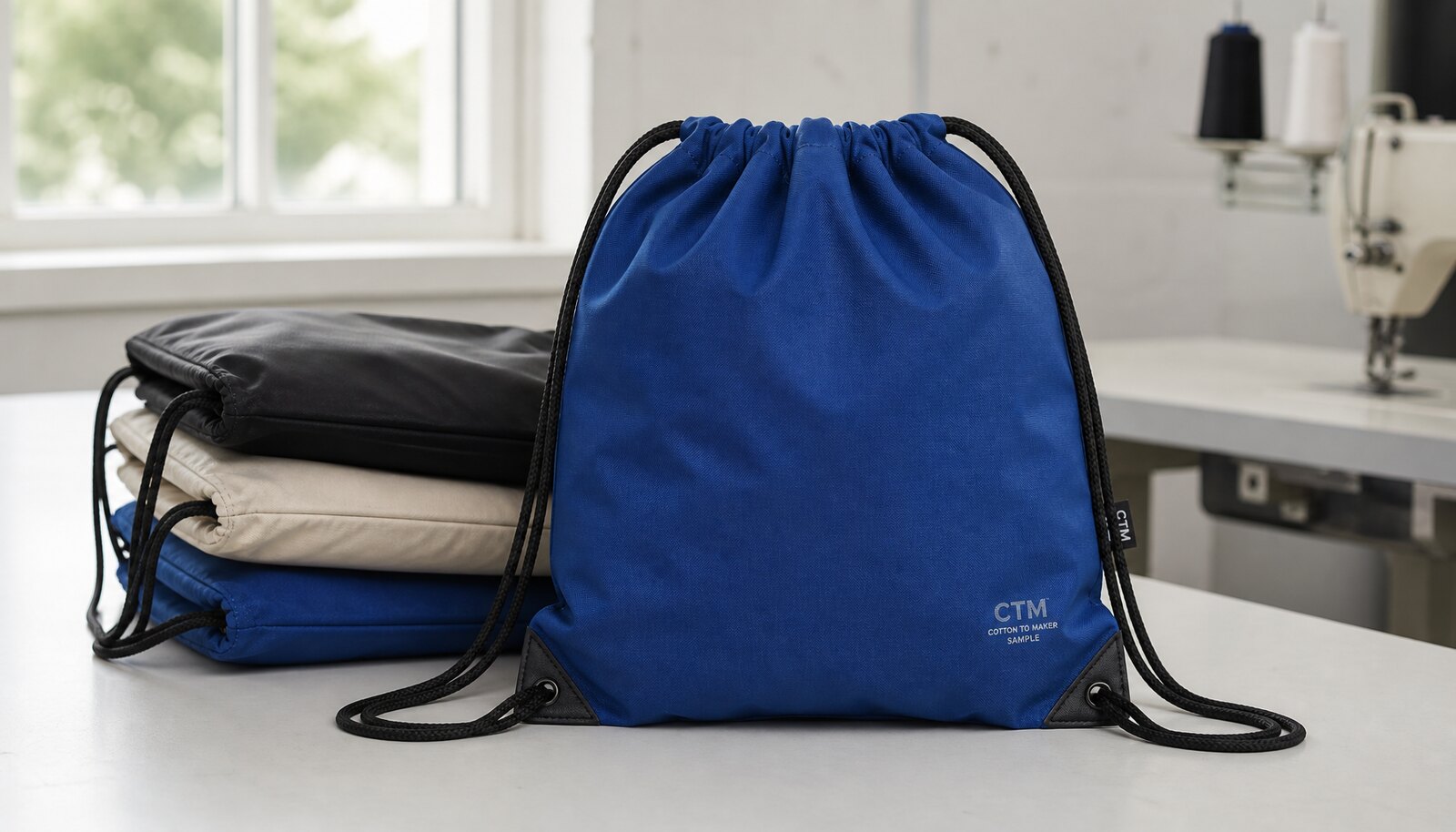
Start With the Launch Job, Not the Bag Type
Promotional drawstring backpacks for brand launches should be specified from the job they need to do, not from a generic product category. A launch bag may need to hold a T-shirt and leaflet pack, a small sample kit, a welcome set, or a retail giveaway that will be judged by how it looks when handed over. That use case determines the bag size, the print method, the fabric weight, and how much reinforcement the supplier needs to build in.
The most common sourcing mistake is to treat logo decoration as the main decision and leave the functional basics vague. Buyers often approve artwork while skipping size tolerance, cord reinforcement, carton count, and packing format. Those gaps force the supplier to guess, and the quote comparison becomes unreliable. For a launch, the correct sequence is: define the contents, define how the bag will be handled, then lock the bag spec.
It also helps to decide whether the bag is disposable, reusable, or part of a premium brand touchpoint. A large internal event may tolerate a lighter build. A consumer-facing launch may not. If the bag will circulate through warehouses, field teams, and multiple venues, the spec needs to reflect the actual route rather than an idealized one.
Practical buyer questions at this stage are simple: what goes inside, who receives it, how many times will it be used, and how visible is the bag in the customer journey? Those answers will save more money than shaving a few cents off the unit price.
- Define the carry load first: leaflet pack, T-shirt, bottle, or mixed promo kit.
- Decide whether the bag is a giveaway, a retail-facing promo item, or an event utility piece.
- Set the launch date before comparing quotes, because schedule risk changes the real cost.
- Ask who will handle packing, labeling, and carton distribution after production.
Choose Fabric for Image, Opacity, and Print Behavior
For most launch programs, the practical fabric choices are 210D polyester, 300D polyester, nonwoven, and cotton canvas. A 210D polyester bag, usually around 70-90 GSM, is the common balance point for cost, printability, and structure. It holds shape well enough for a clean campaign presentation without pushing freight or unit cost too far.
When the bag must feel sturdier or carry a heavier kit, 300D polyester, often around 110-140 GSM, gives a more substantial hand feel and usually prints with better body. Nonwoven, commonly about 80-120 GSM, can keep cost down for very large giveaways, but it wrinkles more easily and can read as disposable. Cotton canvas, often around 180-240 GSM, is the strongest choice for a more natural or premium image, but it raises freight weight and sometimes complicates decoration choices.
The right comparison is not just cost per piece. It is opacity, crease resistance, print sharpness, and whether the bag feels consistent with the brand story. If the contents should not show through, ask the supplier to confirm opacity or add a lining. If the launch will be photographed, insist on a sample from the actual fabric, because the same logo can look more washed out or more saturated depending on cloth texture and weave.
Specify the cloth in measurable terms. Ask for denier or GSM, weave or nonwoven type, finish, dye lot control, and whether the sample and bulk will come from the same material source. If you expect repeat orders, ask about shade consistency across future runs, because a launch series is often reused in later waves or regional rollouts.
- Use 210D polyester for broad distribution and moderate carry weight.
- Use 300D polyester when the bag must feel sturdier or survive repeated use.
- Use nonwoven only when the launch tolerates a more disposable appearance.
- Use cotton canvas when the launch wants a more premium or natural look.
Specify Size, Cord, and Reinforcement in Measurable Terms
A drawstring backpack is small enough that a few millimeters matter. The quote should state the finished flat dimensions, the tolerance, and the measurement method. If the bag has to fit a specific kit, define that fit first and work backward to the finished size. One supplier measuring a relaxed bag and another measuring a stretched bag is a common source of bid noise.
Cord choice affects both comfort and failure rate. Do not stop at drawstring. Specify the cord material, diameter, cut length, and tip finish. For launch use, the cord should pull smoothly, sit comfortably on the shoulder, and stay visually even from left to right. If the cord is too short, the bag looks awkward. If it is too rough, staff and attendees notice immediately.
Reinforcement matters more than buyers often expect. The opening should have a stable hem, and the cord entry needs bar tacks, stitched channels, or another reinforcement detail that matches the expected load. The corners and stress points should be specified too, because thin construction can survive a handout but fail after a few repeated openings or when the bag is overfilled.
If the bag will carry a bottle or dense sample pack, ask the supplier to state the maximum practical load and what the bag was tested against. That request forces the factory to think about seam allowance and cord channel performance instead of treating the order as a flat decoration job.
- State whether dimensions are measured flat, relaxed, or filled.
- Add a tolerance in writing so the supplier knows what counts as acceptable.
- Specify cord diameter, length, and tip finish instead of using a generic drawstring note.
- Require reinforcement at the cord entry and bottom corners where stress concentrates.
Match Decoration to Artwork and Launch Visibility
The decoration method should follow the artwork and the campaign goal. For simple logos and one- or two-color artwork, screen print is still the most practical route because it is efficient and easy to repeat. If the artwork contains gradients, small text, or many colors, heat transfer or digital transfer is usually safer. If the campaign wants a cleaner premium cue, a woven label, patch, or badge can be more controlled than forcing detailed art onto textured fabric.
The main risk is choosing the method first and the artwork second. A dense logo can look acceptable on a flat proof and still become fuzzy or crowded when placed on a soft bag panel. That is why the approval sample must show the actual logo size, the actual placement, and the actual fabric surface. If the supplier proposes a different process than the one you asked for, make them explain the tradeoff in durability, unit cost, and lead time.
For procurement, the useful spec is specific. Include the print area in millimeters, the allowed distance from seams and edges, the number of colors, the color reference if Pantone or an internal standard is used, and whether the bag front is the only printable panel. A print coverage limit is worth stating explicitly, because some suppliers will quietly enlarge the print area until it begins to affect hand feel or seam shape.
If the launch is tied to a brand color standard, request a physical approval against the reference rather than relying only on digital artwork. Monitor how the ink sits on the cloth after curing, because a color that looks correct on-screen can behave differently on polyester, cotton, or nonwoven.
- Use screen print for simple, high-volume artwork with limited colors.
- Use heat transfer when the artwork has gradients, many colors, or small text.
- Use woven labels or patches when the launch wants a cleaner premium cue.
- Approve decoration at actual size and actual placement, not only from a vector file.
Build a Quote That Can Be Compared Line by Line
A usable quote for promotional drawstring backpacks should separate the real cost drivers: fabric, decoration setup, packing, sample fee, and trade term. A single all-in number hides scope differences. One supplier may include carton marks and inner packs. Another may leave them out. The unit price can look lower while the total landed cost is higher.
MOQ should be tied to the production logic, not presented as a vague factory policy. Ask for MOQ by color, by logo version, and by packing configuration. If the launch may scale from one region to several, request volume bands so you can see how the price changes at different quantities. That matters when the campaign expands after the first release.
Supplier offers should also state exactly where the price stops. EXW, FOB, and delivered quotes are not comparable unless freight, duty, testing, and domestic handling are normalized. If the order crosses borders, add a rework allowance to your decision model. A cheap quote with no coverage for defects is not actually cheaper if the launch date is fixed.
The fastest way to clean up quotes is to ask for a line-item response. If the supplier cannot separate the bag body, decoration setup, and packing cost, they are probably building hidden assumptions into the number. That is fine for a rough market check, but not for an award decision.
- Ask for line-item pricing instead of a single all-in unit number.
- Separate sample fee, setup cost, unit price, and packing cost.
- Request MOQ by color, logo version, and pack configuration.
- Compare landed cost, not just factory price.
- Ask for volume bands so you can see how the price moves if the launch scales.
Compare Supplier Routes Before You Compare Prices
The right sourcing route depends on how much control the launch needs and how much internal time your team can spend managing it. A direct factory usually gives the best visibility into fabric, stitching, print, and packing. A trading company is useful when several products need to be coordinated under one timeline. A local stockist or importer is often the fastest route for a rush order, but customization and cost transparency are weaker.
For buyers sourcing from East or Southeast Asia, the process matters as much as the route. Direct factory sourcing usually gives the best sample-to-bulk control, but it also requires clearer specifications, tighter artwork signoff, and a longer buffer for sampling, correction, and shipment cutoffs. Local stock or domestic sourcing reduces transit time and can simplify communication, but there is usually less flexibility on fabric choice, print position, or carton format. The right answer depends on whether the launch is optimizing for control or speed.
Ask who owns sample approval, who owns the print screens or transfer files, who confirms carton contents, and who pays if the bulk deviates from the approved sample. If those responsibilities are not named, the route is too indirect for a launch-critical order. The lowest bid often comes from the source with the most ambiguity.
Use the route choice to normalize the quote, not to score prestige. A factory quote and a trading-company quote can both be valid if the scope matches. They become misleading only when one includes packing, inspection, and domestic handling while the other does not.
- Use a direct factory when you need technical control and repeatability.
- Use a trading company when you need coordination across multiple SKUs or suppliers.
- Use a stockist or importer when speed matters more than custom specification.
- Confirm who owns the sample, the decoration setup, and defect liability.
Use a Route Matrix to Normalize the Bid
A supplier comparison only works if every bid is measured against the same assumptions. One supplier may quote the bag only, another may include inner packs and carton marks, and a third may build in testing or palletization. The route matrix should strip the offer back to a common basis so the comparison is real.
The most useful procurement habit is to tie the RFQ, sample approval, and inspection notes to one spec version. That creates a clean chain from quote to production to QC. If the factory quoted 210D polyester, a front-panel screen print, and bulk packing, but the sample arrived in 300D cloth with a different print method, the order should be corrected before bulk starts. Anything else invites dispute later.
A simple bid review can be enough: compare cloth weight, decoration method, print area, carton spec, sample parity, and lead time. If those six elements do not match, the price is not a like-for-like comparison. That is the level procurement buyers need for launch work, because the launch date leaves little room for cleanup after the award.
- Normalize each quote to the same fabric, decoration, packing, and trade term.
- Keep one spec version tied to the quote, sample, and inspection record.
- Ask for sample photos and one physical approval sample for important launches.
- Do not compare a bare bag price against a fully packed and inspected offer.
Lock Sample-to-Bulk Parity Before Production Starts
A launch order should not move into bulk on the strength of a mockup alone. The pre-production sample needs to use the production fabric, the production cord, the final print method, and the final packing style. Proofs and renders are only artwork checks. They do not prove cloth behavior, ink adhesion, or seam appearance.
The approval step should answer practical questions. Does the bag fit the intended contents without bulging? Is the logo placed where the brand team expects it? Does the color hold up under normal light? Does the cord pull smoothly and hang evenly? Is the fold and carton format acceptable for receiving? If any answer is uncertain, hold the bulk order until it is fixed.
For tighter control, ask the supplier to mark the approved sample and keep one sealed reference against the bulk run. If there is a later dispute, that sample is the cleanest evidence of what was agreed. It also makes it easier for a factory to maintain parity when the order is split across shifts or when repeat production happens later in the season.
A good buyer does not try to eliminate all variation. The goal is to eliminate unapproved variation. If the sample and bulk are built from the same inputs, the launch team gets repeatable results and the QC team has a fair standard to use.
- Approve a physical sample made with the final materials and decoration process.
- Check actual fit with the real contents, not a placeholder load.
- Seal one approved sample as the bulk reference.
- Reject any sample that relies on later assumptions or verbal fixes.
Set QC Criteria With Test Methods and Clear Rejection Triggers
QC should not be a generic promise to inspect quality. It should define what counts as acceptable, what counts as rework, and what triggers a stop-ship decision. For this product, the core checks are size tolerance, print placement, print durability, seam strength, cord function, and packing accuracy. If the launch is retail-facing, add cleanliness, odor, and surface appearance.
Make the testing concrete. A practical seam check is a filled-bag load test using the expected contents weight plus a margin, then a visual inspection for seam opening, skipped stitches, or deformation at the opening and bottom corners. A print check can include a light rub test after curing or drying. A cord check should confirm smooth pull on both sides, equal tension, and no fraying at the cut ends or tip area. Those are simple tests, but they catch most launch failures.
Set acceptance and rejection examples in advance. Accept a small placement offset only if it remains within tolerance and is not visible from normal viewing distance. Reject a logo that is obviously off-center, blurred, cracked, or smeared. Accept a seam only if the stitches are continuous and the stress points stay closed under the load test. Reject any unit with broken bartacks, open seams, raw-edge fraying, or a cord that binds through the channel.
Escalation should also be written before production begins. If the inspection finds a critical defect, quarantine the lot, pause shipment, and require a corrective action note. If the issue is repairable, define who sorts, who reworks, and how re-inspection happens. A supplier that cannot explain that process is not ready for a timeline-sensitive launch.
- Define critical, major, and minor defects before the order is placed.
- Measure size, print placement, and packing against the approved sample.
- Use a loaded-bag test that reflects the real launch contents plus a margin.
- Hold shipment if any critical defect appears until the corrective action is documented.
Plan Packing, Freight, and Launch-Day Contingencies
Packing is not an afterthought. The way the bags are folded, bundled, and cartonized affects freight cost, warehouse speed, and the chance of scuffs or missing accessories. For many campaign orders, bulk packing with clear carton marks is the simplest answer. Inner polybags or retail-style wrapping only make sense when cleanliness, presentation, or channel requirements justify the extra handling.
Ask the supplier to confirm the carton count, carton dimensions, gross weight, and label format before production ends. Those details let the logistics team validate freight quotes and receiving capacity. If the order must go to several destinations, make sure the packing plan supports split shipment without confusion over color counts or carton labels. That is especially important when a launch is running in multiple regions at once.
Build a small contingency plan into the schedule. If final inspection finds a problem, decide in advance whether you want rework, partial shipment, or replacement. A launch with a hard date cannot afford a long debate after production is finished. Buyers who set these rules early usually get a faster response when something goes wrong, because the supplier already knows the decision path.
- Confirm fold method, bundle count, carton marks, and gross weight before shipment.
- Use inner packaging only when it adds real value to the launch or channel.
- Plan for split shipments if the order will serve more than one destination.
- Agree in advance whether a defect triggers rework, replacement, or partial ship.
Specification comparison for buyers
| Spec decision | What to specify | Best fit for brand launches | Buyer risk to check |
|---|---|---|---|
| Fabric route | 210D polyester, about 70-90 GSM; 300D polyester, about 110-140 GSM; nonwoven, about 80-120 GSM; cotton canvas, about 180-240 GSM | Use 210D for broad giveaways, 300D when the bag must feel more substantial, nonwoven only for low-cost distribution, canvas when image matters more than freight weight | Ask whether the sample and bulk use the same cloth weight, weave, and finish; thin substitution changes print sharpness, opacity, and hand feel |
| Decoration route | 1-2 color screen print for simple logos; heat transfer for gradients or fine type; woven label, patch, or debossed tag for a cleaner premium cue | Match method to artwork complexity and whether the bag is a utility giveaway or a brand-facing handout | Set a print coverage limit in writing, such as a single front panel or a defined print area, because oversized coverage can crack or distort on curved seams |
| Construction route | Double-needle side seams, bar tacks at cord entry, reinforced corners, and hem width at the opening | Use this when the bag must survive event handling, repeated opening, or heavier contents | Check whether reinforcement is stitched or just heat-set; weak bar tacks and narrow hems are common failure points |
| Cord route | Polyester or PP cord, diameter, cut length, tip finish, and color match requirement | Use for event kits and branded giveaways where cinch action and appearance both matter | Verify smooth pull, no fraying at cut ends, and equal cord length on both sides; short cords and poor tips create complaint risk |
| Size route | Finished flat dimensions, gusset or depth if any, and measurement method with tolerance | Use when the bag must fit a known kit, bottle, or garment pack | If one supplier measures relaxed and another measures stretched, the quotes are not comparable |
| Sample route | Pre-production sample made with production fabric, production print method, production cord, and final packing style | Use for launch-critical orders or any campaign with strict brand standards | Reject approval based only on a mockup or art proof; sample-to-bulk mismatch is the most common avoidable issue |
| Supplier route | Direct factory, trading company, or local stockist, with named owner for sampling, production, and defect resolution | Use direct factory when technical control matters, trading when several SKUs need coordination, stockist when the timeline is compressed | A low price without clear factory ownership often hides lead-time and QC gaps |
| Packing route | Bulk pack, polybag requirement, carton count, carton size, gross weight, and carton marks | Use the lightest packing that still protects the product and supports receiving | Overpacking raises freight cost; underpacking increases scuffs, missing pieces, and warehouse time |
| Cost route | Ex-factory price plus sample fees, setup, freight, duty, testing, and rework allowance | Use before award on cross-border orders | The lowest unit price can become the highest landed cost if scope is missing |
Buyer checklist before sampling
- Final bag size in centimeters, measurement method, and tolerance, with a note on whether dimensions are measured flat, relaxed, or filled
- Fabric denier or GSM, weave or nonwoven type, finish, color reference, and opacity requirement if the contents must not show through
- Artwork placement, size in millimeters, print method, number of ink colors, file format, and the allowed distance from seams and edges
- Cord material, diameter, finished length, tip style, color match rule, and whether the cord must feel soft enough for shoulder carry
- Reinforcement details at cord entry, bottom corners, and opening hem, including stitch type and any bar tack count
- Pre-production sample standard covering fabric hand feel, print sharpness, stitch quality, cord action, and the exact packing format
- Packing spec, units per carton, inner pack or polybag rule, carton marks, barcode needs, and palletization if required
- QC standard, defect categories, inspection level, acceptance criteria, and who pays for rework, replacement, or resampling
- Target ship window, Incoterm, destination list, and whether partial shipment, split cartons, or phased release is allowed
Factory quote questions to send
- What exact fabric are you pricing, including denier or GSM, weave or nonwoven type, finish, and color, and is it the same cloth you will use in bulk?
- What is the MOQ by bag color, logo version, and pack configuration, and does the minimum change if we split the order across regions or destinations?
- What costs are included in the unit price: screen setup, transfer film, ink colors, woven labels, cord tips, carton marks, and inner packing?
- What print area are you quoting, and what is the maximum coverage you will guarantee without seam distortion or cracking risk?
- What is the pre-production sample fee, how long does sampling take, and does the fee convert to bulk if the order is awarded?
- What carton count, carton size, gross weight, and pack method are assumed in the quote, and will you confirm them before shipment?
- Which Incoterm, port, and destination are included in the offer, and what costs are excluded from the price?
- What inspection standard do you use, and can you share in-line or final QC photos before shipment?
- If bulk production deviates from the approved sample, what is the process for rework, replacement, credit, or shipment hold?
Quality-control points to confirm
- Measure bag size against the approved sample using the same method; accept only within the written tolerance, typically no more than plus or minus 5 mm on critical placement and no more than plus or minus 10 mm on overall size unless the spec says otherwise
- Check print placement, registration, and edge clarity; reject if the logo is visibly off-center, blurred, cracked, or shows color bleed that would be obvious at arm's length
- Use a simple load test at the expected contents weight plus a margin, then inspect seams, cord channels, and bartacks for opening, skipped stitches, or deformation
- Reject any bag with broken bartacks, open side seams, raw-edge fraying at stress points, or cord entry damage that exposes the opening to tear under normal use
- Pull each cord side several times to confirm smooth action and equal tension; reject if the cord binds, slips, cuts through the channel, or has uneven length that makes the bag hang crooked
- Inspect print durability with a light rub test on a sample unit after curing or drying; accept only if the image does not smear, peel, or shed ink under normal handling
- Check surface condition for stains, oil, mold, odor, loose threads, or contamination; these are rejection items for any retail-facing handout
- Verify packing count, carton marks, barcode data, color split, and accessory list against the approved packing spec; quarantine the lot if the carton contents do not match the order sheet