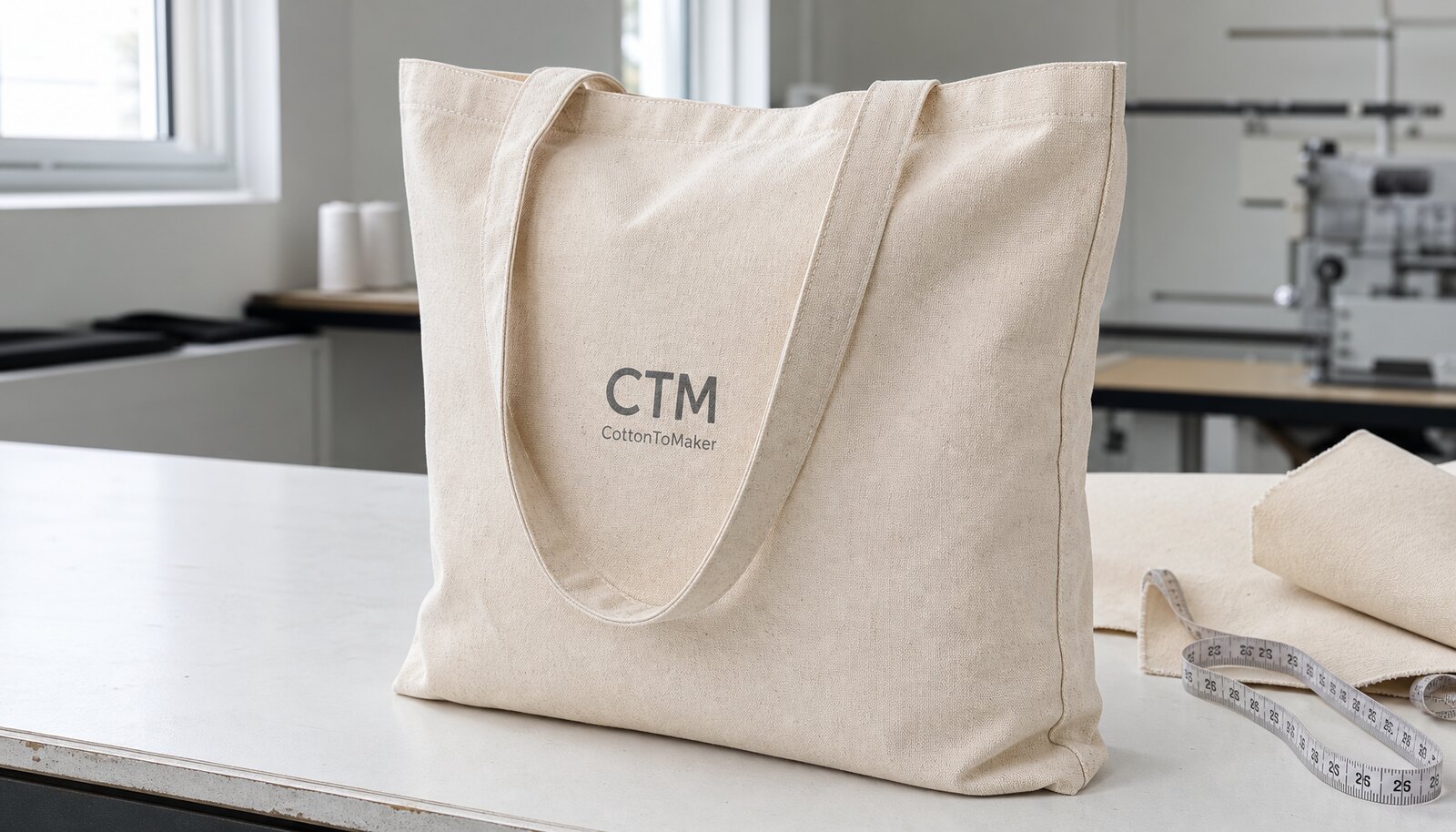
What a useful tote spec actually covers
Promotional cotton tote bags look straightforward until the RFQ leaves too much open to interpretation. A useful spec does not stop at size and logo placement. It gives the factory enough detail to quote the right cloth, stitch the bag to the intended load, and print artwork that survives handling rather than only looking good in a mockup.
For procurement teams, the problem is not over-specifying. The problem is leaving out the few decisions that drive price and failure risk. Start with finished dimensions, fabric type, GSM, handle length, print area, and packing format. If you only give the buyer-side marketing description, suppliers will fill in the gaps with their own default construction, and those defaults are often not aligned with your end use.
- Define the bag by use case: event giveaway, store promotion, mailer insert, or retail-style reusable tote.
- State whether the bag must carry light brochures or heavier grocery loads, because that changes GSM and seam strength.
- Add a simple artwork sheet with exact print dimensions and placement from the top edge and side seam.
Choose fabric weight and construction with the load in mind
Cotton tote quotes are usually distorted by fabric weight. A 140 GSM cloth can be fine for a low-cost event handout, but it will feel thin and may telegraph the contents if the tote is used beyond a one-off giveaway. Moving up to 180-220 GSM gives a better body, better print presentation, and a more retail-ready hand feel, but it also raises fabric cost, sewing time, and freight weight.
Construction matters just as much as GSM. A long-handle tote with self-fabric straps is the most common promo format because it is easy to cut, sew, and print. If the bag will carry books, cosmetics, or packaged food, specify bar-tack reinforcement, a larger seam allowance, and a bottom gusset. Those details are cheap to write into the spec and expensive to correct after production starts.
- 140-150 GSM: lower-cost campaign bags, light inserts, and short-duration use.
- 180-220 GSM: repeated carry, retail promotions, and brand programs where feel matters.
- Reinforced handles and gussets: useful when the bag is expected to carry weight, not just printed literature.
Match the print method to the artwork and order size
Most quote mistakes happen at the print stage, not the sewing stage. Screen print is the default for large runs with one or two solid colors because the setup is efficient and the color edges are usually clean. If the design is multi-color, photographic, or only needed in a short run, heat transfer or DTF can be the safer route, but it changes the cost structure and should be tested for rub resistance.
The artwork itself needs production discipline. Ask for print size in millimeters, not a loose visual reference. Decide whether you want a centered chest print, a lower corner mark, or a vertical side print, and specify the exact safe zone so the printer does not place the logo too close to a seam or too high on the body. If the same artwork will be reused across branches or campaigns, lock the print file and version control before you release sample approval.
- Screen print works best for simple brand marks and larger quantities.
- Heat transfer or DTF is better for short runs or detailed art, but it needs durability review.
- Always approve a physical strike-off or sample print on the actual cloth color, not just a digital proof.
Build the quote around real cost drivers
A useful quote should separate the job into visible parts. You want to see fabric cost, cutting, sewing, print setup, per-piece print cost, packing, carton cost, and any extra charge for mixed artwork or rush scheduling. If the supplier offers only one rolled-up price, you lose the ability to compare changes in GSM, handle length, or print coverage across vendors.
The lowest unit price is not always the lowest landed cost. A cheaper bag can become more expensive if it arrives overpacked, prints poorly, or triggers rework because the supplier used a lighter cloth than expected. Push the quote toward real commercial comparisons: price at 1,000, 3,000, and 5,000 units; surcharge for extra colors; and the freight impact if the carton count changes because the bag is bulkier than planned.
- Ask for pricing breakpoints so you can see the MOQ logic, not just the headline number.
- Compare carton dimensions and gross weight, because they affect freight and warehouse handling.
- Make sure any setup fee is clearly tied to artwork changes or screen count, not hidden in the unit price.
Compare supplier routes before you price the job
For promotional cotton tote bags, the supplier route changes the risk profile. A direct factory with print capability usually gives better control on cloth, stitching, and decoration sequence, which matters when the tote is a campaign item with a fixed deadline. A trading company can be useful when the buyer needs one source for multiple bag categories, but the quote may hide where the real production happens and who owns quality decisions.
The right route depends on whether the program is a one-off promotion or a repeat supply line. If you expect reorders, direct factory sourcing makes it easier to lock a stable spec and avoid surprise substitutions. If your team is still exploring bag formats, a sourcing partner can help you compare options quickly, but you still need production evidence: current sample photos, line capability, and a clear answer on which process is done in-house.
- Direct factory: better for repeatability and cost control when the spec is stable.
- Trading company: better for multi-line programs, but verify who handles production and QC.
- Ask for recent production photos, not just sample-room images, to see the real finishing standard.
Set MOQ, sampling, and approval rules early
MOQ for cotton totes is rarely just one number. It can be tied to fabric color, print version, or total quantity across a style. If you need three logo variations for different regions, the factory may accept the total order but still charge separately for each screen or transfer setup. That is normal; what matters is seeing the rule before the quote is locked.
Sampling should protect the bulk run from avoidable surprises. A practical approval flow is: size and construction sample, then print strike-off, then pre-production sample on the final fabric and final artwork. On approval, record the exact cloth, thread color, print position, and carton pack count. If any of those drift later, the factory should treat it as a change order, not a quiet substitution.
- Use a pre-production sample as the legal reference for bulk output.
- Confirm whether MOQ is per color, per print, or per order total.
- If artwork changes after sample approval, make the cost impact explicit before bulk starts.
Plan packing and retail readiness before the order starts
Packing is often treated as an afterthought, but it affects warehouse efficiency, carton damage, and how the customer receives the tote. Bulk-packed cotton bags are economical and usually fine for trade or campaign distribution. If the bags are going to a retail shelf or a premium brand handout, you may need individual polybags, insert cards, barcode stickers, or an alternate fold direction so the print displays cleanly when opened.
Specify the pack count and carton standard up front. A carton that is too full crushes the bag and makes unloading messy; a carton that is too loose wastes freight and risks wrinkling. Ask the factory to state carton dimensions, gross weight target, and label text in the quote. That lets procurement and logistics review the order before it hits the dock.
- Bulk pack is cheapest, but not always suitable for retail presentation.
- Individual polybags add cost and plastic, but they protect print and fold quality.
- Carton marks, item codes, and quantity per carton should match the PO line for line.
Protect lead time with a realistic production schedule
Lead time on promotional cotton tote bags is usually short enough to feel simple and long enough to be disrupted by one weak link. Fabric availability, print setup, and sample approval are the usual bottlenecks. If the supplier needs to source a specific cotton shade or your art requires multiple screens, the calendar can move quickly from workable to tight.
The safest schedule is to plan backward from the delivery date and leave room for approvals. Sample production, artwork signoff, bulk sewing, print curing, packing, and inspection each need their own window. Buyers who release the PO before approving the pre-production sample usually end up compressing inspection time, which is where defects get missed or air-shipped at extra cost.
- Reserve time for sample approval before the production line is booked.
- Treat rush orders as a risk premium, not as a default expectation.
- If the order is seasonal, confirm how the factory will protect line capacity during peak demand.
Inspect the shipment by use case, not by hope
QC for a cotton tote should reflect what the buyer promised the end user. A promo tote for brochures can tolerate a lighter finish than a grocery-style reusable bag, but both still need measurement accuracy, clean seams, and stable print quality. The inspection standard should be written before production, not invented after the first carton opens.
A practical incoming check covers size, fabric weight, handle symmetry, print placement, stitch strength, and carton count. For high-risk orders, ask for a pre-shipment photo set that shows front, back, inside seams, carton labels, and random sample pieces under flat light. That is not a substitute for inspection, but it catches obvious mistakes before freight leaves the factory.
- Measure a random sample for width, height, gusset, and handle length.
- Pull-test handles and seam points on a small sample set to catch weak reinforcement.
- Reject obvious print shift, heavy smearing, broken stitches, and carton count mismatch.
Specification comparison for buyers
| Spec decision | Recommended option | When it fits | Buyer risk to check |
|---|---|---|---|
| Source route | Direct factory with in-house cutting and printing | Mid to large runs, repeat orders, tighter control on spec and lead time | Confirm the print line is actually in-house, not subcontracted after the quote |
| Source route | Trading company or sourcing agent | Multi-product programs or buyers who need one contact across bag categories | Watch for added markup, vague process ownership, and slower sample feedback |
| Fabric weight | 140-150 GSM cotton for light promotional use | Cheap handouts, mailers, and event giveaways where low unit cost matters | Thin fabric can show contents and feel weak once the tote is packed |
| Fabric weight | 180-220 GSM cotton for retail-style promotion | Brand campaigns, store giveaways, and re-usable everyday carry | Heavier cloth improves feel but can expose weak stitching or raise freight cost |
| Handle construction | Self-fabric long handles with bar-tack reinforcement | General promotional use and shoulder carry | Check stitch density and handle fold width so straps do not twist under load |
| Print method | Screen print for 1-2 solid colors | Large-volume brand marks and simple logos with clean edges | Confirm color count, registration tolerance, and whether print size changes pricing |
| Print method | Heat transfer or DTF for detailed art or small runs | Short runs, variable artwork, or multi-color graphics | Test rub resistance and wash behavior if the tote will be reused often |
| Packing route | Bulk packed with carton labeling and carton marks | Cost-sensitive export orders and warehouse-friendly intake | Make sure every carton count, barcode, and ratio is written into the packing instruction |
Buyer checklist before sampling
- State the exact tote size in finished dimensions, not only a nominal bag size.
- Specify fabric weight in GSM and whether the cloth is bleached, natural, or dyed.
- Define handle length, width, seam reinforcement, and whether the bag has gusset or bottom gusset.
- Provide print placement with measured dimensions from edge to artwork and the number of print colors.
- Request the quote to separate fabric, cutting, printing, sewing, packing, and carton charges.
- Set the MOQ by color, print version, or total order, and confirm what happens if you exceed it.
- Ask for pre-production sample, color proof, and shipping sample before bulk release.
- Confirm packing method, carton pack count, carton size, gross weight target, and label text.
Factory quote questions to send
- What fabric GSM and weave count are you quoting, and what tolerance do you allow on the incoming cloth?
- Is printing done in-house, and what is the exact print method for this artwork and order quantity?
- What is your MOQ by fabric color and by print version, and do you charge extra for mixed artwork runs?
- Can you break the quote into fabric, cutting, sewing, print setup, unit print cost, packing, and carton cost?
- What is the lead time for sample, pre-production sample, and bulk order, and what is the critical path?
- What packing format are you using, how many pieces per carton, and what carton dimensions do you expect?
- What QC checks do you perform before shipment for seam strength, print registration, and measurement tolerance?
- If we change handle length, print size, or fabric weight after sampling, which costs will re-open?
Quality-control points to confirm
- Finished size matches the approved spec within the agreed tolerance on width, height, and gusset.
- Fabric GSM and hand feel match the approved swatch and do not drift into a thinner or more translucent cloth.
- Stitching is straight, secure, and clean at stress points, especially handle joins and side seams.
- Print placement is centered and aligned, with acceptable color density and no obvious pinholes or smearing.
- Handle length and symmetry match from bag to bag, and both handles carry load without twisting.
- Carton count, inner packing, and carton labels match the packing list and purchase order exactly.
- No major stains, oil marks, loose threads, broken needles, or edge fraying appear in the packed cartons.
- Random pull-test and visual inspection results are recorded before final release, not after the shipment leaves.