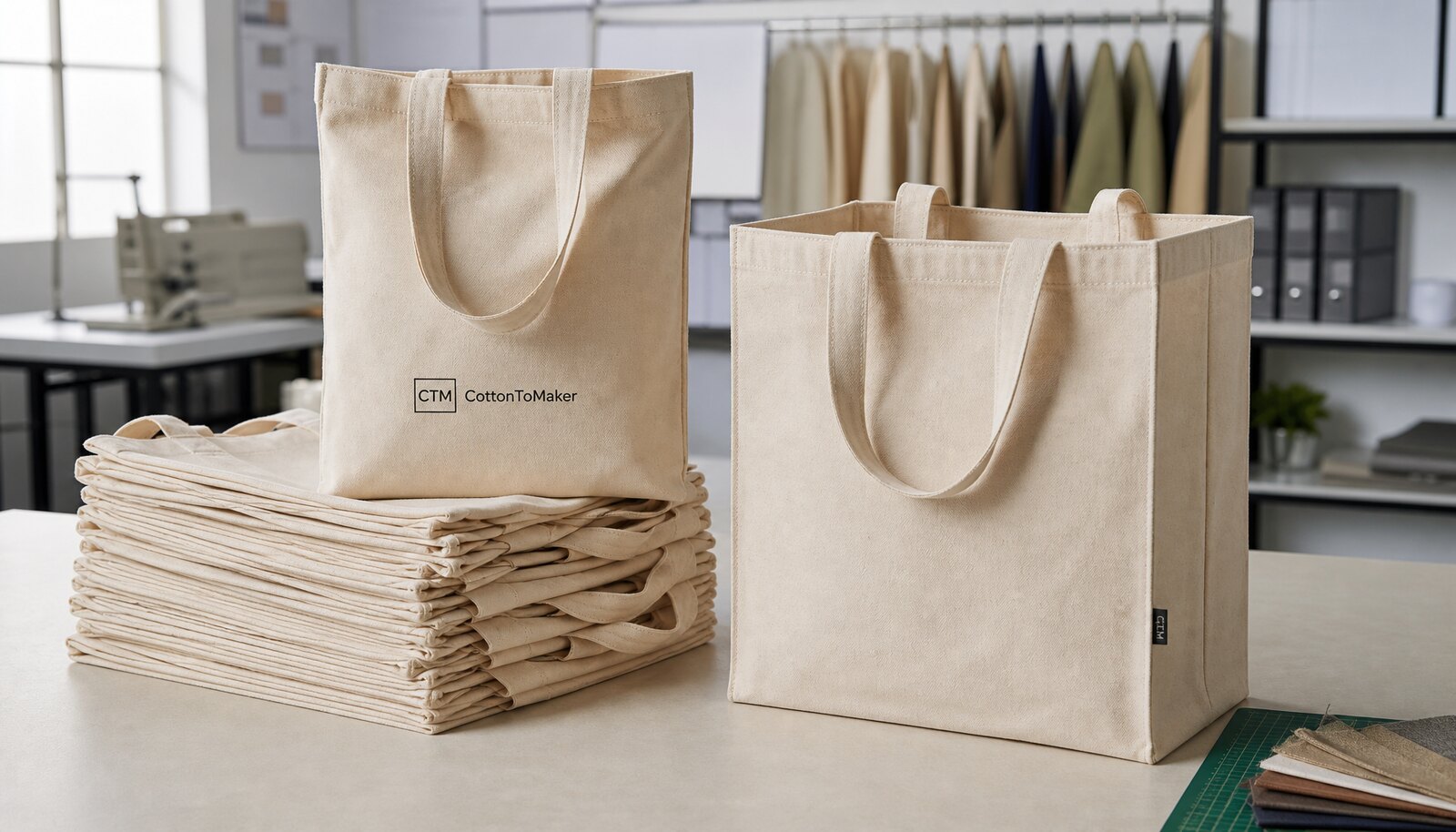
What buyers mean by promotional cotton shoppers
Promotional cotton shoppers are usually simple tote-style bags made for giveaways, store promotions, trade shows, campaign packs, or low-cost retail resale. The buyer problem is not the shape; it is whether the bag can be quoted, printed, packed, and shipped at the right cost without becoming too thin, too flimsy, or too expensive for the channel.
For procurement teams, these bags often sit in the middle of two categories: cheap promotional handouts and heavier retail totes. That is where most sourcing mistakes happen. If the spec is too weak, the bag looks poor in use. If the spec is too strong, the campaign budget gets consumed by fabric weight, embroidery, or overpacking that adds no real customer value.
- Best fit: brand promotions, exhibitions, bookshops, lifestyle retail, and event kits
- Common issue: buyer sends a logo and size only, then receives quotes that are impossible to compare
- Goal of the RFQ: pin down fabric, handles, print coverage, packing, and freight-ready carton data
Choose the right cotton spec before you compare prices
The biggest cost driver is fabric weight. For standard promotional use, 140–180 GSM cotton is the normal range. Below that, the bag may feel soft and economical, but it can wrinkle heavily, show the contents, and wear faster at the handles. At 200 GSM and above, the bag starts to behave more like a retail tote and can carry more weight, but fabric cost and sewing cost rise with it.
Size and construction matter just as much. A flat bag without a gusset is cheaper and more compact for giveaway campaigns. A side or bottom gusset improves usable volume and perceived value, but increases cutting, sewing, and packing bulk. Handle style is another cost step: self-fabric handles are the low-cost route, while cotton webbing handles improve strength and retail appearance.
- Typical promotional range: 140, 150, 160, 180 GSM
- Higher-load retail programs: 200 GSM or heavier, especially if products are boxed
- Flat bags are cheaper; gusseted bags offer better product capacity and presentation
- Self-fabric handles reduce cost, but webbing handles improve carry comfort and durability
How print method changes cost, lead time, and risk
For promotional cotton shoppers, screen printing remains the default for large volume orders with one to two colors. It gives good opacity and a clean commercial look if the artwork is simple and the factory understands the fabric surface. The buyer should specify print size, number of colors, print position, and whether the logo must sit a fixed distance from the top edge or side seam.
If the artwork has fine detail, more colors, gradients, or a short run, digital print or heat transfer may be more practical. These methods can save setup time on small orders, but the ink feel, wash resistance, and unit cost can differ from screen print. Buyers should never compare a screen-print quote against a digital-print quote without separating setup charges, print area, and color count.
- Screen print: best for simple logos and repeat volume
- Heat transfer: useful for short-run multicolor artwork, but verify durability and edge finish
- Digital print: good for detailed art, but not always the lowest-cost choice at scale
- Always request a strike-off or pre-production print sample before bulk approval
MOQ logic: what really changes the minimum order
MOQ for promotional cotton shoppers is rarely just a factory preference; it is usually tied to fabric source, cut size, print setup, and packing requirements. A factory may accept a lower MOQ if you use stock natural cotton, one print position, and a standard size with existing cutters. MOQ rises when you need custom dyed fabric, multiple sizes, special labeling, or a complex pack-out.
A buyer should separate MOQ by design, not by total bag count only. If one campaign needs three sizes or two print versions, the quote may look fine on paper but the real unit cost will climb once the factory splits fabric lots and print screens. Ask for price breaks at each quantity tier so you can see whether the order is truly efficient at 3,000, 5,000, or 10,000 pieces.
- Lower MOQ is usually possible with stock fabric and simple decoration
- Custom dye, special trim, or multiple SKU packs will raise the true minimum
- Ask for tiered pricing by 1,000 / 3,000 / 5,000 / 10,000 pieces when comparing suppliers
A useful supplier comparison for cotton shopper sourcing routes
Not every quote comes from the same type of supplier. Some buyers prefer a direct factory because they need tighter control over GSM, print quality, and repeat production. Others use a trading company when the order combines bags with labels, hangtags, or mixed packaging from different sources. The best route depends on how standard the bag is and how much control you need over the final carton-ready product.
The table below is not about brand labels or generic supplier claims. It compares the practical sourcing routes a buyer actually faces when requesting promotional cotton shoppers. Use it to decide whether the quote is cheap because the spec is lean, or cheap because a step is missing.
- Direct factory: best for repeatable specs and clean cost control
- Trading company: useful for mixed-item sourcing, but spec transparency must be stricter
- Regional converters: helpful if you need short transit time or local compliance support
- Always compare route, not just unit price
Why quote breakdowns matter more than headline unit price
A good quote for promotional cotton shoppers should separate the bag body, handles, print, packing, and carton work. If all those items are bundled into one number, the buyer cannot tell what drives the difference between suppliers. Two quotes may both say the same unit price, but one may use a lighter GSM, smaller print area, or lower stitch count.
For landed-cost planning, ask for incoterm clarity and carton data. The bag itself is only part of the bill. Carton size affects chargeable volume, packing format affects labor, and print setup can make a low-MOQ order far more expensive than it first appears. A quote should be useful for internal approval, not just attractive in a spreadsheet.
- Request separate line items for bag, print, packing, carton, and optional labeling
- Ask for carton dimensions and gross weight to estimate freight accurately
- Compare quotes on same GSM, same print area, same handle type, same pack count
Sample approval: what a good pre-production sample should prove
For cotton shoppers, sample approval is where many preventable defects are caught. The sample should show the exact fabric hand feel, the real print density, the final handle length, and the true seam finish. A flat image or a fabric swatch alone is not enough if the order will be shipped in bulk with exact promotional timing.
A buyer should treat the sample as a production reference, not as a promotional piece. Measure the bag width, height, and gusset after sewing. Inspect whether the logo is centered, whether the print surface is smooth, and whether the handle stitching holds when the bag is loaded with representative weight. If the supplier cannot align the sample to the approved spec, the bulk order will usually repeat the same issue.
- Check measurement tolerance against the approved spec sheet
- Load test one sample with expected product weight before sign-off
- Reject samples with obvious print shift, weak handle joins, or crooked side seams
- Keep one sealed approved sample for bulk inspection reference
Packing and carton planning for bulk importers
Packing decisions affect both product presentation and freight cost. Many promotional cotton shoppers are shipped in bulk cartons with size/count labels and moisture protection. This is the most efficient route for importers and distributors. If retail packaging is required, the buyer should state whether each bag needs a polybag, barcode sticker, insert card, or hanging header, because those steps change labor time and carton volume.
For export orders, ask the factory to confirm the bag fold direction, carton count, and whether cartons are compressed or left loose. A sloppy fold can create wrinkles that look like print defects on arrival. Over-packed cartons can distort seams or crease the print, while under-packed cartons waste freight and create inconsistent counts.
- Bulk carton packing is usually best for wholesale and import consolidation
- Retail-ready packing needs more labor and should be costed separately
- Confirm carton maximum weight for warehouse handling and parcel compliance
- Specify moisture protection if the route includes humid storage or sea transit
Production timeline and the schedule risks buyers miss
A standard timeline for promotional cotton shoppers is usually sample in 5–10 days and production in 20–35 days after sample approval, assuming the fabric is available and artwork is final. That schedule can slip quickly if the buyer changes the print file, adds a label, or upgrades packaging after approval. The safest way to protect the launch date is to lock the spec before the sample run starts.
The hidden risk is not sewing time; it is waiting for confirmation. Color approval, packaging details, barcode rules, and carton text often sit in separate departments on the buyer side. If those items are not resolved together, the factory may hold production even when the bag structure is ready. For seasonal campaigns, that delay can be more expensive than a slightly higher unit price from a faster supplier.
- Late artwork approvals are the most common cause of missed ship dates
- Custom dyed fabric and specialty labels can add days or weeks
- Set one internal owner for spec sign-off to avoid stalled production
Buyer's decision rule: when to choose the cheapest quote and when not to
The cheapest quote is acceptable only when the spec is truly standard: stock natural cotton, one-color print, one size, bulk carton packing, and no unusual performance requirement. In that case, the buyer is mostly optimizing for procurement efficiency and freight volume. If the campaign depends on presentation or heavier use, the lowest unit price often means thinner fabric, weaker handles, or less reliable packing.
For a better sourcing decision, compare value against the likely failure point. If the bag is for a short event and the audience will carry leaflets only, a lighter GSM may be fine. If the bag will hold books, bottles, or store purchases, price should be evaluated against seam strength and return risk, not just the first invoice. The right quote is the one that matches the use case with the fewest hidden corrections.
- Cheapest works for simple giveaways with low load and short life
- Do not optimize unit price if the bag must support retail image or repeated use
- Use sample approval and carton data to expose hidden quote differences
Specification comparison for buyers
| Spec decision | Recommended option | When it fits | Buyer risk to check |
|---|---|---|---|
| Fabric weight | 140–180 GSM cotton for standard promotional use; 200 GSM if bag must carry heavier retail items | Events, trade shows, store giveaways, book-sized retail packs | Thin fabric can look good in photos but fail after repeated loading or cause print show-through |
| Handle style | Same-fabric self-fabric handles for low-cost campaigns; cotton webbing handles for stronger carry performance | Mass giveaways vs. retail resale or higher-value brand programs | Handle seam failure if bar-tack count and stitch length are not defined |
| Print method | 1–2 color screen print for large runs; heat transfer or digital for short runs and complex artwork | Simple logos, fast replenishment, multi-color artwork, small test orders | Artwork distortion on woven cotton and ink bleed if pre-treatment is not agreed |
| Bag size | 38 x 42 cm or similar standard shopper size for general promotion; custom width/gusset for product-fit use | Bookshops, grocery promotions, exhibition packs, apparel stores | Overly small bags create complaints; oversized bags raise freight cost and fabric consumption |
| MOQ route | Factory-direct MOQ with one approved fabric and one print position; use stock natural cotton for lower entry volumes | Brands testing a new design or needing a seasonal drop | Low MOQ can hide higher unit cost, weak QC attention, or limited customization |
| Packing format | Bulk packed by carton with size/color ratio counts and moisture protection; retail polybag only if required by channel | Wholesale distribution, import consolidation, retail-ready programs | Polybagging every piece adds labor and carton volume; loose packing can create dirt marks and creases |
| Supplier type | Direct factory for spec control and repeat volume; trading company only if sourcing from multiple mills or mixed accessories | Stable programs with forecasted reorders vs. one-off multi-item sourcing | Middleman quotes can obscure true fabric GSM, print area, or seam construction |
| Lead time model | Sample in 5–10 days, production in 20–35 days after approval for standard cotton shoppers | Normal bulk orders with confirmed artwork and fabric | Artwork delays, color matching, and accessory sourcing often extend the schedule |
| Quote structure | Separate fabric, printing, sewing, packing, and carton costs with clear incoterms | When comparing suppliers across regions or order sizes | All-in quotes make it hard to see what changed if the supplier later raises costs |
Buyer checklist before sampling
- Confirmed bag size, fabric GSM, handle length, and whether the bag needs gusset, bottom reinforcement, or inner seams finished.
- Final artwork file with print size, Pantone references if relevant, and the approved number of print colors and print sides.
- Target order quantity by size/color, plus a forecast for reorders so the factory can quote MOQ and price breaks correctly.
- Packing requirement: bulk pack, retail polybag, insert card, barcode label, carton count, and master carton limit.
- Acceptance standard for sample approval, including print alignment, stitching density, handle pull strength, and shade tolerance.
- Requested commercial terms: incoterm, lead time from sample approval, carton dimensions, and any optional surcharge items.
Factory quote questions to send
- What is the exact fabric GSM, and is it before or after washing/shrinkage?
- Is the quote based on self-fabric handles or cotton webbing handles, and what is the handle width and stitch construction?
- How many print colors, print positions, and maximum print area are included in the unit price?
- What is the MOQ per size and print design, and does the MOQ change if we use stock natural fabric instead of custom dyed fabric?
- Please separate bag cost, print cost, packing cost, carton cost, and any surcharge for labeling or barcodes.
- What sample types are available: fabric swatch, pre-production sample, and full production sample, and what is the sample lead time?
- What carton pack count and carton dimensions are planned, and what is the gross weight per carton for freight estimation?
- Which QC checks are performed before shipment, and what defect level or AQL standard do you normally apply?
Quality-control points to confirm
- Fabric GSM within agreed tolerance, with no excessive thin spots, holes, or uneven slub that affects print or strength.
- Stitching even and secure at handle joints, side seams, and bottom fold; no skipped stitches, loose threads, or seam puckering.
- Print position centered and within agreed tolerance; no major color shift, bleeding, cracking, or wash-like abrasion before use.
- Handle length matched across the pair and measured after sewing; twisted or uneven handles should be rejected if they affect carry comfort.
- Carton count verified against packing list, with correct size ratio and label information on outer cartons.