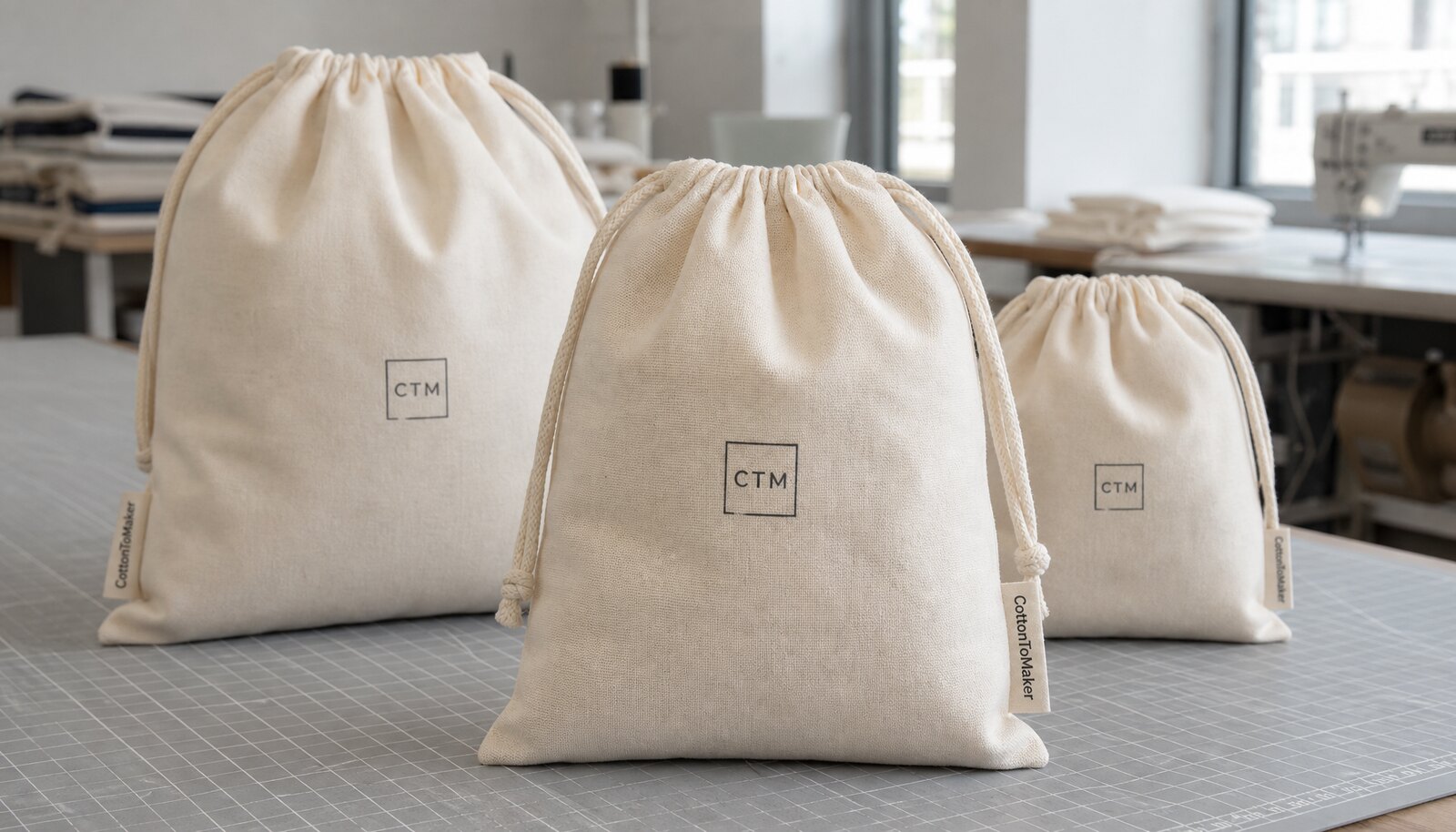
What promotional cotton drawstring bags have to do in procurement terms
Promotional cotton drawstring bags look simple, but the buying decision is usually more complicated than it first appears. The bag is doing several jobs at once: protecting the item inside, carrying a logo clearly, feeling credible in the hand, and arriving in a packing format that your warehouse or distributor can process without rework. The wrong spec usually shows up as a quote problem first and a quality problem later. Thin fabric can save cents but create transparency, weak presentation, and print show-through. Overbuilt fabric can improve handfeel but push the order into a price band that no longer fits the campaign economics.
The best RFQs are written around the item, not the bag alone. If the pouch will hold cosmetics, apparel, candles, samples, or event inserts, the buyer needs a spec that reflects how the bag will be handled in real use. A team buying for a trade show may care most about unit cost and fast pack-out. A retail buyer may care more about print sharpness, clean folding, and how the cotton reads on shelf. Once the use case is explicit, the rest of the sourcing conversation becomes much more disciplined.
- Use case should drive fabric weight, weave, cord type, and packing format.
- A reusable promotional bag needs more structure than a one-time giveaway pouch.
- If the supplier cannot explain how the bag is used, the quote is probably too generic to trust.
Fabric weight, weave, and shrinkage: the details that separate a real spec from a guess
For promotional cotton drawstring bags, GSM matters, but GSM alone is not enough. A 120 GSM plain weave can feel very different from a 120 GSM light canvas because weave structure changes the way the bag drapes, prints, and holds its shape. Plain weave is usually the cleanest choice for volume programs because it is easy to cut, sew, and print consistently. Light canvas adds more body and can improve perceived quality, but it also raises material cost and can slow the sewing line. Twill is less common for simple promo orders, but it can create a more premium surface if the buyer is willing to pay for it.
Shrinkage is the piece many RFQs miss. Cotton can move after washing, steaming, or aggressive finishing. If the bag is not pre-shrunk or otherwise stabilized, the buyer may see the opening narrow, the body shorten, or the print shift slightly after production. For custom orders, ask the supplier to state the expected shrinkage range and whether the fabric was finished before cutting. A procurement team should not accept vague language like 'normal shrinkage' without a number. A practical target for controlled orders is often under 5% after finishing, but the real rule is that the tolerance must be documented, matched to the end use, and consistent across the order.
The surface itself matters for print quality. Natural cotton with visible fiber variation is acceptable if the buyer agrees on a realistic shade window, but large lot-to-lot swings can make the bags look mismatched on the same shelf. Ask whether the fabric is bleached, natural, washed, or dyed, and whether all panels are cut from one shade lot. If the supplier mixes lots to save waste, the buyer should require that any acceptable variation is clearly defined before production starts.
- Plain weave is the easiest structure to source and compare across factories.
- Light canvas and twill improve body, but they add cost and can slow production.
- Ask for a shrinkage target in writing, not just a statement that the fabric is finished.
Stitch spec and construction quality: where cheap bags usually fail first
The difference between a decent promo pouch and a frustrating one is often hidden in the sewing details. A clean seam with an appropriate stitch density gives the bag shape and helps it survive repeated loading. A weak channel or loose seam can make the drawcord wear out early or cause the opening to skew to one side. For buyers who treat the pouch as a throwaway item, this may not matter much. For buyers using the bag as part of a retail pack, subscription kit, or brand gift, it matters immediately.
A useful RFQ should include seam allowance, stitch density, and stress reinforcement. Many buyers are satisfied if the bag 'looks okay' in a sample, but that is not a production standard. A more defensible spec is to define the seam allowance, such as 8-10 mm, and ask for a consistent stitch density in the range of about 3-4 stitches per cm on the main seams. The top channel should be even and strong, with bar tacks or equivalent reinforcement if the bag will be repeatedly opened and closed or carry heavier inserts.
The buyer should also ask how the factory trims threads and whether the production line checks for open seams and skipped stitches before packing. A bag can pass a casual visual check and still fail when the first customer cinches it tight. That is why the spec should include both appearance and function. If the order is large enough to justify formal inspection, the buyer should define a defect count or AQL standard and make the supplier confirm the method before production begins.
- Ask for seam allowance, stitch density, and reinforcement details in the quote.
- A good sample is not enough if the production line cannot match the same stitch control.
- If the bag will carry heavier items, include a pull test or seam-strength expectation.
Print method: choosing what will survive bulk production and daily handling
Screen print remains the default for many promotional cotton drawstring bags because it is scalable, durable, and economical for simple artwork. It performs best when the logo is built from solid spot colors and the artwork has enough size to hold clean edges on woven cotton. Heat transfer is useful for shorter runs or more detailed artwork, but it needs good film quality, proper pressing, and enough wash and rub resistance for the intended use. A buyer should not assume every factory's heat transfer line performs the same way; the same art can look sharp on a sample and weak in a rushed production batch.
The practical question is not which method is fashionable. It is which method matches the artwork and the order size. If the logo has thin text, small legal copy, or a narrow icon, the buyer should ask the factory to confirm the minimum readable line width and whether the fabric texture will distort the art. For multi-color graphics, registration tolerance matters. A measured tolerance of around +/-5 mm on print placement is easier to manage than a vague 'same position as sample' instruction. If the bag will be stacked, inserted into retail kits, or handled often, ask about rub resistance and whether the ink or transfer film will crack on the first fold line.
The cleanest way to avoid quote confusion is to lock the artwork assumptions before quoting. Require the supplier to confirm the print area, exact number of colors, print method, and whether any underbase or special curing is needed. If the quote hides these details, the factory is leaving room to change the process after order placement, and that is where disputes begin.
- Screen print is usually best for simple, stable logos and larger orders.
- Heat transfer can work for shorter runs, but the quality depends heavily on film and pressing control.
- Define logo placement and print tolerance in millimeters so the factory has a real target.
Supplier route: direct factory, trader, or hybrid, and how each affects control
The route you use to source promotional cotton drawstring bags changes more than just the price. A direct factory usually gives better visibility into fabric booking, cutting, printing, sewing, and packing. That matters when you need to solve a defect fast or when you want repeat orders to stay consistent. A trading company can be useful if you want one contact point for multiple product lines, but the buyer should understand that a trader may not control every production step. If a problem appears, it can take longer to identify whether it came from the fabric mill, the print line, the sewing floor, or the packing team.
Hybrid sourcing can work when the trading layer is strong and the factory is stable, but it only works if responsibility is written clearly. The buyer should know who owns the sample, who owns the bulk approval, and who is accountable if the size, print, or carton count is wrong. It is also worth asking whether the same factory will run the bulk order that produced the sample. If the sample came from a different workshop or a different fabric lot, the approval is less meaningful than it looks. Procurement teams often save time by using a trader, then spend it later chasing defects that should have been owned by the actual production site.
For repeat programs, direct factory sourcing usually becomes easier to defend because the buyer can compare lot-to-lot performance over time. That does not mean a trader is a bad option. It means the buyer should choose the route that best fits the level of process control required, not the route that looks simplest on the first inquiry.
- Direct factory routes usually provide better process visibility and defect accountability.
- Traders can be useful, but they add another layer between the buyer and production reality.
- If the sample and bulk order do not come from the same line, the approval carries less weight.
How to compare quotes without being fooled by the headline price
A quote for promotional cotton drawstring bags should be readable, not just cheap. The supplier should separate product price, print setup, sample fee, packing, carton cost, and any special handling. A single all-in number makes it hard to know whether the factory is quoting a low fabric spec, a lower print standard, or a different packing method. The buyer should normalize every offer to the same size, same GSM, same weave, same print colors, and same pack-out before comparing. Otherwise, the cheapest quote may simply be the least complete one.
Procurement teams should also compare the quote on a landed-cost basis. A higher unit price with tighter packing, better carton labeling, and cleaner print control can outperform a lower quote that creates rework, repacking, or damage claims. Ask the supplier what is included in the unit price and what is not. If the supplier says samples are free but hides the setup in the bag price, that is still a real cost. If the supplier includes freight, ask for the shipping basis and whether export cartons, outer marks, and customs documents are part of the offer or charged separately.
A useful internal rule is to reject quotes that cannot be traced back to a spec sheet. If the factory cannot tell you which fabric lot, which print method, which cord diameter, and which packing format produced the number, the quote is not stable enough for procurement work. Price comparison only becomes useful when the underlying product definition is locked.
- Normalize quotes to the same size, fabric, print, and packing before comparing.
- Ask for separate lines for product, setup, sample, carton, and special packing.
- Compare landed cost, not just ex-factory price.
Sample approval: what to check before the order is released to bulk production
The sample is the control point where procurement gets leverage. A sales sample can look excellent and still be the wrong reference if it was made from different fabric, different cord, or a different print setup. For promotional cotton drawstring bags, the pre-production sample should be built from the same materials and process path intended for mass production. If the supplier substitutes one element, the sample should not be treated as final approval. This is especially important when the bag is part of a branded kit, because the sample can hide problems that only appear when the bag is folded, packed, or shipped in quantity.
The approval should test more than appearance. Fill the bag with the intended product weight or volume and check whether the opening cinches evenly, whether the seam keeps its shape, and whether the logo still looks centered when the bag is stuffed. Confirm the fold and pack method too. Some bags look clean when laid flat but lose the visual line once folded for carton packing. Ask the supplier to send photos or short video of the sample at the same fold state that will be used in bulk packing. That reduces ambiguity later.
A good sample approval note should include measurable points: size, print position, bag opening, cord action, stitch appearance, and pack format. If the buyer only writes 'approved,' the factory will assume broad discretion. If the buyer records the sample dimensions and the acceptable tolerance, there is much less room for disagreement once production starts.
- Approve the sample only if it matches the intended bulk fabric, cord, and print method.
- Test the bag with the real insert weight or volume, not just by looking at it empty.
- Keep measured sample photos and dimensions as part of the production record.
Packing, labeling, and carton decisions that affect damage and warehouse speed
Packing is not a cosmetic detail. It directly affects print abrasion, count accuracy, carton weight, and how fast the goods move through your warehouse. Bulk carton packing is usually the most efficient option for distributors and importers, but the factory must fold the bags consistently and avoid overstuffing cartons. If the cartons are too tight, the drawcord channel can deform and the fabric can crease the logo. If the cartons are too loose, the bags shift in transit and the count becomes harder to verify. Individual polybags add labor and material cost, but they help with retail presentation, cleanliness, and pack count control.
The quote should state the carton dimensions, gross weight target, inner bundle count, and outer mark format. Buyers who use palletization or have container loading constraints need this information early, not after production is finished. If barcodes, size stickers, or SKU labels are required, confirm the label size and placement before the goods are packed. A mismatch at this stage can force repacking, which is usually more expensive than getting the spec right up front.
If the order is going into a multi-channel program, think through the downstream process. A wholesale buyer may want bulk cartons with minimal handling. A retail customer may need each bag individually folded and barcoded. The supplier should be able to pack to either requirement, but the method has to be clear in the PO. Packing is where many orders become operationally messy even when the product itself is acceptable.
- Bulk carton packing is efficient, but the folding and carton density need control.
- Individual polybags raise cost while improving presentation and count accuracy.
- Require carton dimensions, gross weight, and label format in the quote.
MOQ, lead time, and the production schedule risks buyers should actually watch
MOQ is usually shaped by cutting efficiency, print setup, and packing labor, not by an arbitrary factory preference. A simple one-color logo on one standard size can support a lower MOQ than a multi-color design on a custom size with special labels. Buyers sometimes chase the smallest possible order and end up paying more per bag than necessary because setup costs are spread too thinly. If the program is repeatable, it is often better to standardize the size and artwork so the factory can run the order efficiently and quote it more predictably.
Lead time has more moving parts than sewing. The common delay points are artwork approval, print screen or transfer setup, fabric booking, sample sign-off, cutting queue, and packing changes. Ask the supplier when the clock starts. 'After deposit' and 'after sample approval' are not the same timeline, and that difference can matter if your launch date is fixed. Peak season matters too. Even a basic cotton drawstring bag can sit in line behind larger orders at the printing or sewing stage. If the program is date-sensitive, build a buffer and freeze changes once the sample is approved.
For procurement planning, a simple rule works well: the more customization you add, the less flexible the schedule becomes. Extra colors, special labels, custom size changes, and individual packing all add coordination risk. If you need speed, simplify the spec. If you need premium presentation, accept that the lead time and QC burden will increase. The mistake is trying to optimize for both extreme speed and highly customized packaging at the same time.
- MOQ usually rises with extra colors, custom sizing, labels, and special packing.
- Lead time slips most often at artwork approval, setup, and packing changes.
- If the launch date is fixed, freeze the spec early and add a buffer for factory queue time.
QC and acceptance criteria: how to keep the order from drifting after approval
Quality control for promotional cotton drawstring bags should be based on measurable acceptance points, not general impressions. The buyer should define what counts as a conforming bag before production starts, then verify that the factory can inspect to that standard. Good QC is not just about rejecting obvious defects. It is about preventing small spec drift from becoming a shipment-wide problem. Natural cotton makes this especially important because the material can vary in shade, texture, and shrink behavior from lot to lot.
A useful QC checklist includes fabric GSM, size tolerance, seam appearance, print position, cord function, odor, contamination, and carton count. If the order is significant, ask whether the factory uses an AQL standard and what level it applies. Even if you do not run a full third-party inspection, the supplier should be able to explain how many pieces are checked during in-process and final review. For printed bags, rub resistance is worth checking because stacked cartons and repeated folding can expose weak ink or poor curing. For sewn bags, a small pull test on the channel or seam is a practical way to catch weak construction before shipment.
The buyer should also look for the hidden issues that turn into customer complaints later. Loose lint, thread tails, oil spots, inconsistent folding, and odor all reduce perceived quality even when the bag technically meets size. If the bag will be handed out at an event or included in a retail package, those details matter. QC should therefore balance measurable tolerance and presentation quality, because both affect how the bag is received in the market.
- Define size, print, seam, and packing tolerances before production.
- Ask the factory how it inspects fabric variation, print alignment, and stitch quality.
- Check odor, lint, thread tails, and folding quality, not just dimensions.
Specification comparison for buyers
| Spec decision | Recommended option | When it fits | Buyer risk to check |
|---|---|---|---|
| Fabric weight | 120-150 GSM cotton | Most promotional programs that need a better handfeel than a giveaway pouch but do not justify canvas-heavy construction | Below 120 GSM, the bag can read as thin or semi-transparent; above 150 GSM, cost rises quickly and the bag may pack poorly unless the item is genuinely heavy |
| Weave type | Plain weave for standard promo use; light canvas or twill only when more body is required | Plain weave is the easiest to source, print, and compare across factories; canvas or twill makes sense for premium retail inserts or reusable kits | A loose plain weave can distort under load; heavier canvas can increase shrinkage, slower sewing, and higher gram cost |
| Shrinkage control | Pre-shrunk or washed cotton with a stated shrinkage target under 5% after the first wash | When the bag needs repeat use, retail presentation, or close size consistency after finishing | Uncontrolled shrinkage can reduce opening width, shorten the drawstring channel, and move print placement off-center |
| Stitch spec | Side seams at roughly 3-4 stitches per cm with reinforced top channel and bar tacks at stress points | When the bag must survive repeated cinching, packing, and light retail handling | Loose stitch density can cause seam creep, while overly tight stitching can pucker the fabric and skew the logo panel |
| Print method | 1-2 color screen print for volume; heat transfer only for small runs or complex art | Simple logo use, events, trade shows, and stable artwork | Fine text can fill in on screen print, while poor transfer film can crack or lift after folding |
| Logo placement tolerance | Centerline and vertical placement tolerance within +/-5 mm on approved production spec | Any order where the logo must look symmetrical and polished in retail photos or gifting | If the factory works to a loose eye-match instead of a measured tolerance, the brand mark can drift bag to bag |
| Cord type | Cotton cord or cotton-blend cord with confirmed diameter and dye lot | Brands that want a natural look and a consistent texture story | Thin cord can cut into the channel, while polyester cord can look off-brand if the rest of the bag is natural cotton |
| MOQ route | Direct factory with one stable size and one artwork version per colorway | Repeat buyers, forecasted programs, and orders where process control matters more than the lowest headline price | Too many custom variants raise setup cost and make it harder to hold a reliable color and print standard |
| Packing format | Bulk carton packing with size label, carton count, and master carton weight defined in the quote | Distributor orders, container fills, and buyers who repack downstream | Loose folding can mark the print, and overfilled cartons can crush the channel or distort the drawcord ends |
Buyer checklist before sampling
- Confirm the end use first: giveaway, retail insert, brand gift, product bundle, or light carry bag, because that determines fabric weight, weave, and seam strength.
- Specify cotton construction in writing, including GSM, weave type, whether the fabric is pre-shrunk, and the acceptable shrinkage limit after finishing or first wash.
- State the required bag size with a tolerance, such as +/-5 mm for premium retail presentation or +/-10 mm for simpler promo use.
- Define the stitch requirement: seam allowance, stitch density, bar tacks, and whether the top channel must be double-stitched or reinforced.
- Send final artwork in vector format and require the supplier to confirm print size, print position, number of colors, and the accepted registration tolerance.
- Ask the factory to quote the cord type, cord diameter, color, and whether the cord is inserted before or after the side seams are closed.
- Request a pre-production sample made from the same bulk fabric, same cord, and same print method, not a generic sales sample.
- Ask for the factory's defect standard, inspection method, and AQL level if the order is material enough to justify a formal QC check.
- Require separate quote lines for unit price, print setup, sampling, carton cost, label cost, and any individual polybag or bundle packing.
- Confirm packing details: bulk carton count, inner bundle count, carton dimensions, gross weight target, outer marks, and barcode label format.
Factory quote questions to send
- What exact cotton construction will you use: plain weave, canvas, or twill, and what is the GSM measured after finishing?
- Is the fabric pre-shrunk, enzyme washed, or untreated, and what shrinkage range do you expect after sewing and packing?
- What is the stitch specification on the seams and top channel, including stitches per cm, seam allowance, and any bar tack reinforcement?
- What cord material, diameter, and color will you quote, and is the cord dye lot matched to the body fabric or intentionally contrasting?
- Which print method is quoted, how many colors are included, and what is the maximum print area and placement tolerance?
- Can you split the quote into product cost, print setup, sample charge, carton cost, label cost, and any polybag surcharge?
- What is the MOQ per size, per color, and per artwork version, and how does the unit price move at the next tier?
- Will the pre-production sample use bulk fabric and bulk cord, or only similar stock material?
- What is the lead time from artwork approval, from sample approval, and from deposit, and which step usually creates delays?
- How do you inspect stitch quality, channel width, print alignment, and finished dimensions before packing?
Quality-control points to confirm
- Fabric GSM is within the agreed tolerance, and the fabric panel shows no thin spots, broken yarns, oil marks, or visible shade banding across the order.
- If the fabric is pre-shrunk, the factory can state the expected shrinkage after finishing; for untreated cotton, the buyer has a documented allowance for first-use movement.
- Finished size is within tolerance on width and height, and the opening is not warped by poor pressing or uneven seam tension.
- Seam density meets the agreed spec, with no skipped stitches, loose loops, open seams, or puckering at the channel and side seams.
- Cord channel width is even, the cord moves freely, and both sides cinch at the same rate without one side pulling shorter than the other.
- Print position is centered or positioned within the approved tolerance, with no color bleed, ghosting, broken edges, or registration drift between colors.
- Print rub resistance is acceptable for the use case; stacked bags should not transfer ink under light dry rubbing.
- Bar tacks or reinforcement at stress points are secure if the bag is intended to hold heavier inserts or repeated retail use.
- Packed cartons match the approved count, label, and barcode format, and the carton weight stays within the agreed shipping limit.
- There is no strong chemical odor, dust contamination, loose lint clumps, or visible foreign fiber in the packed bags.