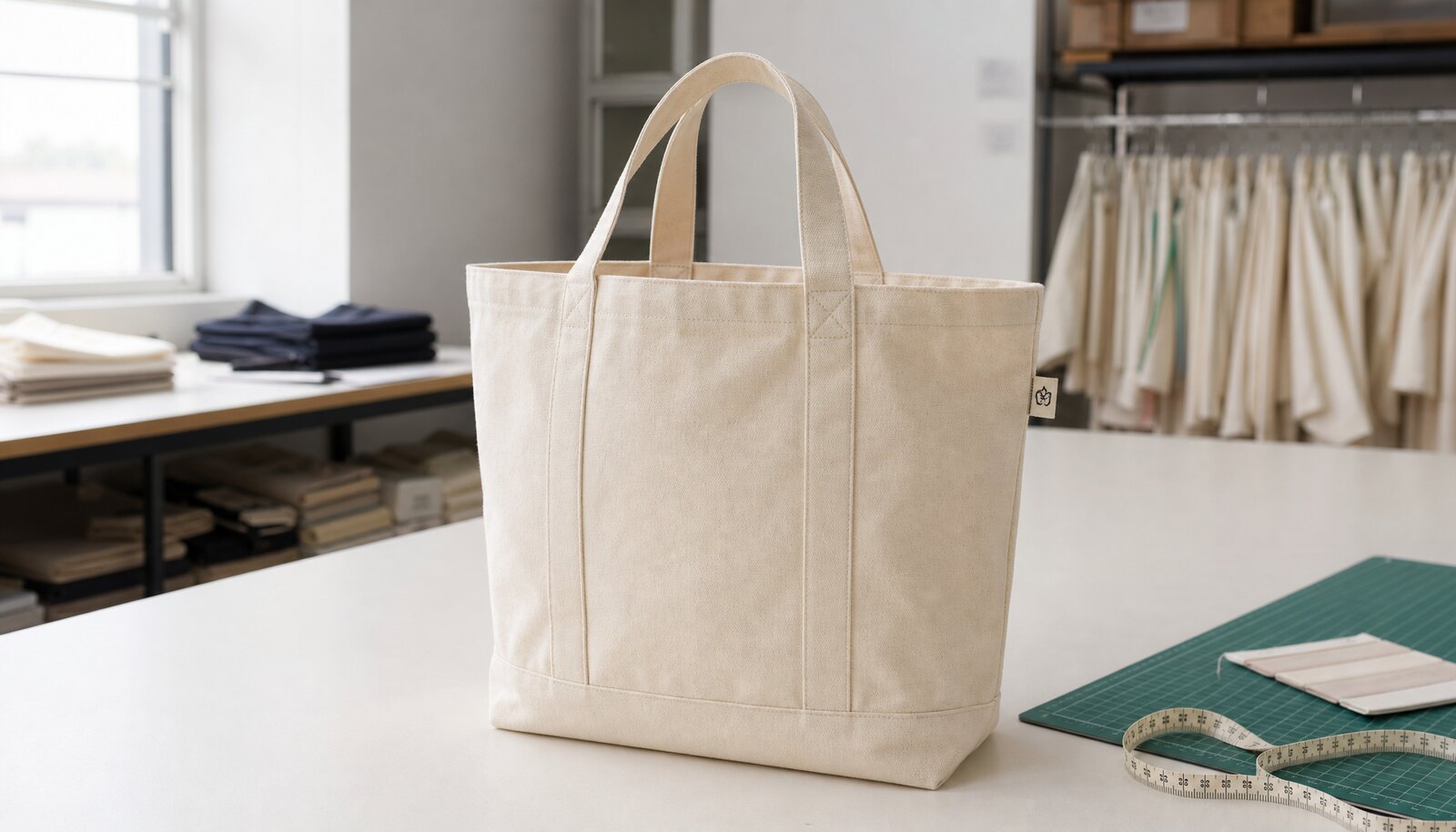
Start With a Frozen Spec, Not a Generic Tote
Promotional canvas tote quotes drift the moment the brief says only tote with logo. Suppliers can change fabric weight, handle length, gusset depth, seam finish, and packing without technically breaking the request. If you want clean comparisons, freeze the finished size, construction, print area, and packing before asking for price. For most promo programs, the useful starting range is 8 oz per square yard, about 270 gsm, for simple giveaways, 10 oz, about 340 gsm, for a stronger everyday tote, and 12 oz, about 410 gsm, when the bag needs a firmer body and better shelf presence.
The RFQ should name the finished measurement, not just a market name like medium tote or large shopper. It should also say whether the bag is flat, gusseted, lined, or unlined, and whether the handles are self-fabric or webbing. If those points are vague, two samples can look close while one is materially cheaper and weaker. A buyer who freezes the spec early gets fewer surprises in quoting, sample approval, and inbound quality control.
- Use one measurement system for every supplier.
- State whether dimensions are flat or finished after sewing.
- Include a single artwork file with the RFQ, not screenshots.
- Define the use case, such as giveaway, retail, or subscription insert.
Choose Fabric Weight Around Use, Not Only Appearance
For a promotional canvas tote, fabric weight controls the real buying experience more than the logo does. Lightweight canvas around 220 to 260 gsm works for event handouts and flat inserts, but it can show print shadow and distort at the handle attachment. Midweight material in the 300 to 350 gsm range usually gives the best balance for repeat use, better opacity, and acceptable freight cost. Heavy canvas above 380 gsm feels premium, yet it increases cutting waste, sewing labor, and carton weight.
Ask the factory to quote the finished GSM, not only the ounce rating, and to confirm whether the number is based on greige cloth or finished fabric. A bag can feel thick in the hand and still collapse if the weave is loose. Look for even yarn count, stable edge finishing, and a top hem that does not flare after loading. If the tote will carry catalogs, bottles, or sample kits, specify reinforcement at the handle base and a bottom seam that can tolerate repeated lift cycles.
- 8 oz or about 270 gsm fits low-cost giveaways and event handouts.
- 10 oz or about 340 gsm is the most practical middle ground.
- 12 oz or about 410 gsm suits premium retail and heavier loads.
- Ask for a physical swatch, not only a fabric description sheet.
Match the Print Method to the Artwork and Volume
Most promotional canvas tote programs use screen printing because it gives clean solids, predictable color, and manageable setup cost at medium volume. It is the default choice for one to three spot colors and simple logos. When the design uses gradients, fine linework, or a full-bleed look, digital transfer or heat transfer can reduce setup friction, but the factory needs to prove wash adhesion and edge durability. Embroidery is best reserved for small brand marks or premium retail programs, not large decorated panels.
The print method should match how the bag will be packed, folded, and sold. A dense screen print can crack if the tote is creased hard across the logo, while a weak transfer can look fine on day one and fail after repeated folding. The RFQ should state Pantone references, print size, print position, and whether decoration is on one side or both. Require a strike-off or photo proof before bulk production, especially when natural canvas shade varies from one batch to the next.
- Use screen print for simple logos with one to three colors.
- Use transfer for gradients, fine detail, or lower-volume runs.
- Use embroidery only when the mark is small and premium-looking.
- Approve a strike-off before the full run starts.
Use MOQ as a Pricing Signal, Not a Surprise
MOQ for a promotional canvas tote is rarely one single number. Factories often set separate minimums for fabric color, print color count, handle style, and packaging. A 1,000-piece order may look acceptable on paper, but if the artwork has two print positions and custom belly bands, the real economic MOQ can be higher. Buyers should ask whether the quoted minimum applies per design, per color, or per shipment, because those are very different production constraints.
Pricing tiers make more sense when fixed setup cost is separated from variable labor. Screen setup, plate making, sampling, and carton labels behave like fixed costs that spread across volume. Fabric waste, cutting, sewing, and packing are variable. That is why a quote can look high at 500 pieces and normal at 3,000. Ask for at least three price breaks and the assumptions behind them. If the supplier only gives one number, the quote is incomplete.
- Request price tiers at 500, 1,000, and 3,000 pieces if your volume is flexible.
- Separate setup charges from per-piece costs in the quote.
- Confirm whether packing, labels, and master cartons are included.
- Compare the quoted MOQ against your reorder plan, not only the first shipment.
Compare Supplier Routes Before You Compare Prices
Promotional canvas tote buyers usually source through four routes: direct factory, trading company, local promotional supplier, or sourcing agent. Each route changes the quote structure, the transparency of workmanship, and the speed of issue resolution. The cheapest first quote is not always the best route if the order needs repeat stability, artwork control, or direct access to production photos and pre-shipment checks.
Use the comparison table to match your buying situation to the right route. If the order is large and repeatable, direct factory pricing usually wins because setup cost spreads better and spec control is stronger. If the first order is small or the deadline is tight, a local supplier may be practical, but accept the tradeoff in unit cost and construction control. The right route depends on volume, risk tolerance, and how many hands you want between the artwork and the sewing line.
- Compare like with like: same fabric, same print method, same packing, same incoterm.
- Ask for factory photos or a recent inspection report when you are not buying direct.
- Treat a very low quote as a signal to inspect what was left out.
- Use the same specification sheet across all suppliers.
Approve the Sample Like a Production Run
A sample is not only a visual reference. It is the only chance to test seam behavior, print registration, handle length, and how the canvas sits after pressing or folding. For a promotional canvas tote, request a pre-production sample built with the final fabric weight, final artwork file, final handle length, and final packing method. A photo sample is not enough if the bag is going into retail, a trade show, or a branded campaign with tight approval standards.
Inspect the sample under normal light and load it with a realistic weight. The bag should open square, sit flat when empty if that is the intended look, and not twist when lifted by one handle. Measure the finished size, check print edge crispness, and confirm that the approved swatch matches the bulk cloth. Keep one signed master sample in procurement and another in the factory file so later claims can be tied back to the same approval.
- Measure the finished size after pressing, not before.
- Load the bag with a realistic weight and check handle behavior.
- Inspect print alignment, density, and edge quality.
- Keep a signed master sample on both sides of the order.
Specify Packing So the Tote Arrives Saleable
Canvas totes are often damaged by poor folding, not by sewing defects. If a bag is packed too tightly, the print crease can become permanent, especially on heavy ink coverage. If it is packed too loosely, the carton count becomes unreliable and the bags rub against one another during transit. The RFQ should state whether each bag is polybagged, tissue-wrapped, banded, or bulk packed, and whether the goal is shelf readiness or the lowest possible freight cost.
Carton marking matters for importers and distributors because it controls warehouse receiving speed. Ask for carton net and gross weight, carton dimensions, pack count, and whether the cartons are export-grade with corner protection. If the tote carries retail barcodes or hangtags, define whether those are applied at the factory or at destination. Any packing line not written into the order can disappear from the quote and return later as a change charge.
- Define the fold method and whether the logo can be creased.
- State the pack count per carton and any inner packaging.
- Confirm barcode placement, hangtag position, and carton marks.
- Require export-grade cartons when the shipment will travel far.
Build the Schedule Around Setup, Not Just Sewing Time
Promotional canvas tote lead times are often lost in pre-production work rather than in the main sewing line. Artwork confirmation, screen making, sample sign-off, dye lot allocation, and carton label approval can add more time than the actual sewing. A realistic plan counts every step and leaves buffer for corrections. The risk rises when the order combines new artwork, a new fabric color, and a new packing spec in the same purchase order.
Ask the supplier for a working calendar with dates for sample approval, material reservation, cutting, printing, sewing, packing, and ex-factory handoff. If the supplier cannot map those milestones, the delivery date is only an estimate. For seasonal promotions, freeze the artwork before the bag spec. A late logo revision can reset screens, strike-offs, and packing labels, which is why many on-time orders are won or lost in the first week of the project.
- Reserve time for sample approval before bulk cutting starts.
- Block fabric early if the order uses a seasonal color or shade.
- Treat artwork freeze as a hard milestone, not a soft target.
- Add buffer for customs, port congestion, and document review.
Use Landed Cost, Not Unit Price, to Choose the Winner
A promotional canvas tote quote should be compared as a landed-cost project, not as a unit number in isolation. Final cost depends on fabric weight, print setup, packing, freight, duties, destination delivery, and the internal time spent fixing errors. A lower unit price can become more expensive if the bag arrives with inconsistent shade, weak handles, or missing carton marks. Procurement should compare the whole path from factory gate to warehouse shelf.
When quotes are close, rank them by total procurement risk. The best supplier is the one that can repeat the same bag without spec drift, document what was approved, and keep packing stable across reorders. If the program is likely to repeat, pay close attention to handle reinforcement, fabric lot control, and the supplier's willingness to retain a sealed sample. That is where long-term savings usually come from, not from shaving a few cents off the first order.
- Compare freight, duty, and destination charges on the same basis.
- Add the cost of rework, delays, and internal handling to the decision.
- Look for reorder consistency, not only first-run neatness.
- Choose evidence and repeatability over vague promises.
Send a Complete RFQ Package, Not Just a Logo
The cleanest quote requests contain one spec sheet, one artwork file, one packing note, and one target delivery window. When the buyer sends only a logo and size idea, the supplier fills in the gaps with assumptions. Those assumptions are where price gaps and later disputes begin. A serious RFQ makes the supplier quote the same bag every time and gives procurement a stable base for comparison across vendors.
The brief should also say what the bag is for, because use case drives construction. A tote for conference handouts is not the same as a tote for retail resale or a subscription box insert. Build the request around actual load, shelf expectation, and reorder plan. That keeps the factory from overbuilding the bag and keeps your team from buying a low-cost spec that fails in use.
- Include finished measurements, GSM, decoration method, and print placement.
- State the target quantity, reorder expectation, and delivery window.
- Add packing instructions, incoterm, and destination warehouse or port.
- List any test reports, labeling rules, or retailer compliance needs.
Specification comparison for buyers
| Spec decision | Recommended option | When it fits | Buyer risk to check |
|---|---|---|---|
| Lowest unit cost at scale | Direct factory with in-house printing | Repeat orders above 3,000 pcs with one or two simple logos | Late artwork changes can reset screens and delay the order |
| Small pilot run | Local promotional supplier or domestic decorator | 100 to 500 pcs for a test event, launch, or market check | Higher unit cost and less control over fabric weight |
| Best audit trail | Direct factory with sealed sample and QC photos | Retail programs or importers that need repeatable specifications | Communication gaps if the buyer does not freeze every detail |
| Complex promo kit | Trading company or sourcing agent | Totes bundled with pouches, notebooks, or mixed packaging | Hidden margin and weaker visibility into the actual plant |
| Fastest repeat reorder | Regional supplier using stock blanks | Short deadlines and same-market reorders | Shade, size, and lot variation across stock batches |
| Detailed artwork or wrap print | Factory with proven screen or transfer line | Multi-color logos, fine lines, or large decorated panels | Method limits and color shift if the artwork is too ambitious |
| Lowest internal workload | Distributor or trading company | Procurement wants one PO and one contact point | Less transparency on fabric origin and line capacity |
| Best landed-cost control | Direct factory quoted on the same incoterm every time | Import programs with repeat volume and freight planning | Freight, duty, and destination costs get missed in unit-price comparisons |
Buyer checklist before sampling
- Finished size in flat dimensions, with gusset and handle drop
- Fabric weight stated in gsm and whether it is finished or greige weight
- Canvas color, weave type, and whether bleaching or dyeing is included
- Handle construction, handle length, and attachment reinforcement method
- Print method, print size, print placement, and Pantone references
- MOQ per design, per color, and per packing format
- Sample type required, approval owner, and sign-off deadline
- Packing method, carton count, carton marks, and barcode placement
- Incoterm, destination port or warehouse, and target ship date
- Any compliance documents, testing needs, or retailer-specific labeling rules
Factory quote questions to send
- What exact fabric weight, weave, and finish are you quoting, and is the GSM measured on finished fabric?
- Is the handle made from self-fabric, webbing, or a folded strap, and how is it reinforced at the stress point?
- What is the quoted MOQ per artwork, per print color, and per packing style?
- Which costs are fixed setup charges, such as screens, plates, sampling, or labels, and which are per-piece?
- Does the quote include one sample, a pre-production sample, or only a photo approval?
- What is the lead time for sample, bulk production, and final packing after sample approval?
- Which printing method are you using, and what limits does it create for color count or print size?
- What packing is included by default, and what changes if we request polybags, tissue, hangtags, or barcodes?
- Which AQL or inspection standard do you normally work to, and can you share inspection photos from recent orders?
- Can you confirm the incoterm, carton dimensions, gross weight, and any extra charge for export marking or compliance documents?
Quality-control points to confirm
- Fabric weight should stay within an agreed tolerance of the approved swatch, not just look similar in photos.
- Finished size should be checked flat after pressing, with left and right gussets matching and no visible twist.
- Handle attachment should use box-x stitching, bar-tacks, or another agreed reinforcement at both ends.
- Print registration should stay aligned to the approved artwork, with no blur, ghosting, or patchy ink coverage.
- Color should match the approved reference under normal light, with natural canvas shade variation kept within the allowed range.
- Seams should be straight, with no skipped stitches, loose threads, open ends, or puckering at the corners.
- Packing should match the approved fold, count, and carton marks, with no crushed prints or damaged edges.
- Carton count, barcode placement, and outer carton strength should be checked before shipment release.