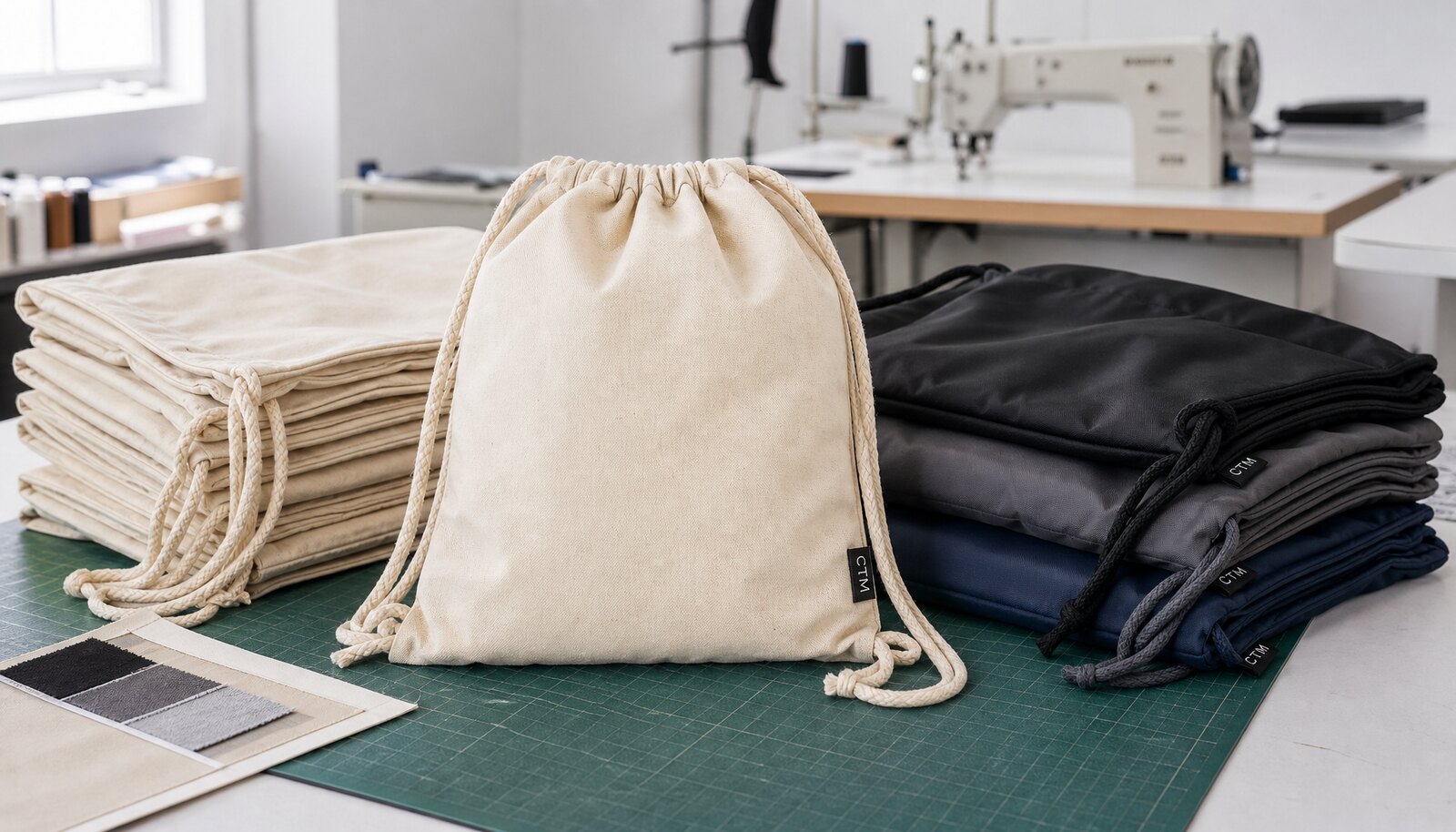
Start with the use case, not the bag
Promo drawstring bags fail in sourcing when the product is treated as a generic giveaway instead of a functional item with a specific job. A conference handout bag, a retail insert, an onboarding kit carrier, and a light carry bag all have different requirements. If those use cases are collapsed into one vague request, the supplier has too much freedom to fill in the blanks, and the quote becomes hard to compare. The result is usually a low number that does not hold up once the sample, packing, or freight assumptions are made visible.
For procurement teams, the first decision is not fabric or print. It is what the bag must carry, how often it will be handled, and how visible the brand needs to be. A bag that only holds a T-shirt and brochure can be lighter than one that needs to carry samples, a bottle, or a stack of catalogs. Once that use case is fixed, the rest of the RFQ gets simpler: the buyer can specify usable capacity, target handfeel, and a realistic stress level instead of asking for a decorative object that happens to close with a cord.
The operational rule is straightforward: define the job, then define the product. Ask suppliers to quote against the same drawing, the same size, and the same pack format. If the sample is being used in a public-facing campaign, insist on a physical sample before bulk approval. That one step removes most of the hidden assumptions that make promo bags look comparable on paper and behave differently in production.
- Write the use case in the RFQ: giveaway, retail insert, event kit, or light carry bag.
- Specify usable internal capacity, not just flat dimensions.
- Limit the first order to one size and one artwork version unless the campaign requires more.
- Require the supplier to quote against a drawing or approved reference sample.
Choose the fabric for handfeel, opacity, and freight efficiency
Fabric choice drives both perception and production risk. Cotton usually wins when the buyer wants a softer handfeel, a more natural look, and a surface that presents branding in a less technical way. In practical terms, 80-100 gsm cotton is a reasonable starting point for standard promos, while 100-120 gsm cotton gives more body, less show-through, and a cleaner drape. Very thin cotton can still work for light inserts, but it often reads as low value once the customer touches it.
Polyester is often the better operational choice for larger distribution programs. A construction such as 210D woven polyester tends to hold shape, pack efficiently, and resist dimensional drift better than very light cloth. That helps when the bag needs to be stacked, palletized, or shipped in high volume. The tradeoff is brand perception: synthetic fabric can look more functional than premium, so it fits internal events, conference kits, and broad distribution better than luxury-facing campaigns.
The useful buyer question is not which material sounds better in a catalog. It is which material can be repeated, measured, and shipped without surprise. Ask the supplier for actual gsm or denier, the tolerance they hold on incoming fabric, whether the fabric is pre-shrunk or treated, and what finish is used on the surface. If the supplier cannot describe the fabric beyond a generic name, the quote is too loose to compare with confidence.
- 80-100 gsm cotton is a practical baseline for standard promotions.
- 100-120 gsm cotton improves body and reduces show-through.
- 210D polyester usually gives better shape retention and freight efficiency.
- Do not accept a quote that names only the fabric type without weight or construction detail.
Construction details determine whether the bag survives real use
The failures that matter most are structural. A promo drawstring bag can print cleanly and still fail if the top hem is weak, the cord channel is narrow or twisted, or the side seams are not reinforced. Those problems rarely show up in a glossy quotation. They appear later, after the bag has been loaded, pulled, and handled more than once. That is why the construction spec has to be specific enough for the factory to build the same way every time.
Start with the top hem. A narrow, lightly stitched hem may save a little sewing time, but it creates a weak point where the channel can distort or open under load. A reinforced hem with consistent stitch spacing reduces the chance of fraying and gives the drawstring a cleaner pull. If the bag uses eyelets, ask how those eyelets are set and whether the edge is reinforced to keep the cord from cutting into the opening. This matters more on bags that will be opened and closed repeatedly.
Cord selection is the other point that is often under-specified. A cord that looks fine on the sample can fray, stretch, or pull unevenly across a production run. Buyers should ask for cord material, diameter, cut finish, and length after assembly. If the bag will carry heavier inserts, add a simple load requirement to the RFQ and ask the factory to validate it on the sample. A promotional item does not need over-engineering, but it does need enough structure to avoid obvious failure in the field.
- Specify top hem width, stitch density, and reinforcement method.
- Confirm whether the cord channel uses eyelets or stitched openings.
- Ask for cord material, diameter, and finished length after assembly.
- Add a load or pull requirement if the bag will carry heavier inserts or kits.
Print method sets the tone, the cost, and the risk
Print is where the quote often spreads the most. A one-color screen print on a stable fabric is usually the least complicated option for a clean logo and a repeatable order. It is a strong default when the artwork is bold, the logo area is moderate, and the buyer needs a practical result instead of a showcase finish. Once the artwork becomes finer, multicolor, or gradient-heavy, the buyer has to compare other methods, but the approval risk goes up with the complexity.
Heat transfer and digital print can preserve more detail, but they come with their own tradeoffs. Surface feel may differ from the fabric, edge lift can appear after folding or handling, and color may vary more between batches if the process is not tightly controlled. That does not make those methods bad. It means the buyer should ask how the image is fixed, what adhesion test is used, and whether the finish will still look clean after use rather than just on the day of packing.
For quote comparison, the art must be frozen before pricing starts. Lock the final file, the print area, the number of colors, and whether there is one side or two. Then ask the supplier to price setup, unit print, and any extra charge for larger coverage. A quote on the wrong art scope is not cheaper; it is just less comparable. In procurement terms, the best printing decision is the one that meets the visual brief without adding unnecessary setup or approval risk.
- Use screen print for simple logos and repeatable runs.
- Use transfer or digital print only when the art actually needs it.
- Freeze the artwork, print area, and color count before collecting quotes.
- Ask how the print is cured or fixed and what rub or adhesion check is used.
Compliance and supplier proof belong in the RFQ, not after award
A sourcing package for promo drawstring bags should include more than artwork and a price request. Buyers need enough documentation to keep the order moving through internal approvals, customs, and downstream distribution. At minimum, ask for material composition, country of origin, carton data, and any product declarations the destination market requires. If the bag will enter a regulated channel, the supplier should be able to provide the documents that match that market, not a generic statement that does not tie back to the shipment.
The exact compliance set depends on where the bags are going and how they will be used. For some programs, a composition declaration and packing list may be enough. For others, the buyer may need test reports or chemical declarations, especially if the bag has metal parts, special coatings, or a destination market that expects additional paperwork. If the bags are intended for children or school-related use, the requirements become stricter and the design should be reviewed against the relevant safety rules before the order is placed. Do not assume a promotional bag is exempt from documentation just because the product is simple.
The practical approach is to ask the supplier what they can already supply and what they need time to arrange. A factory that routinely exports has a different compliance posture than one that only sells domestically. The quote should say whether documentation is included or billed separately, and whether tests were performed on the exact material used for the order or on a previous batch. That distinction matters when the buyer is trying to clear a shipment on time.
- Request composition, origin, and carton data with the quote.
- Match compliance documents to the destination market and the actual use case.
- If the supplier mentions existing test reports, confirm they cover the same material and finish as the quoted bag.
- For regulated channels, ask for the document list before PO award, not after production starts.
MOQ is usually set by setup logic, not just factory policy
MOQ on promo drawstring bags is often treated as a factory preference, but the real drivers are more operational than that. Fabric roll usage, cutting efficiency, print setup, packing labor, and inventory exposure all influence the number. A factory can reduce MOQ by limiting fabric choices, simplifying the artwork, or using stock materials, but each of those choices changes either the cost or the scope. The buyer needs to see the tradeoff clearly instead of being told that a number is simply the number.
The cleanest way to structure an RFQ is to separate blank MOQ from printed MOQ and then break each by size, color, and artwork version. If the campaign has three colors and two logo treatments, the order is not one line item. It is multiple production combinations, each with its own cutting and setup cost. That is why a first order should usually be narrow: one core size, one artwork version, and a realistic color set. Once the bag proves itself in market, a second order can expand the range.
Price itself also has a shape that buyers should understand. On a simple run, cost is usually split across fabric, sewing, print setup, unit print, packing, and freight. On a small order, print setup and labor can dominate. On a larger run, fabric quality, packing density, and shipping efficiency become more important. A useful buyer question is not only how low the quote is, but which line item is carrying the cost and whether that line item can be reduced without changing the bag into something else.
- Ask for MOQ by size, color, and print version.
- Separate blank MOQ from printed MOQ.
- Treat every extra artwork variation as a separate setup cost.
- Review the cost stack: fabric, sewing, print, packing, and freight.
Sample approval should measure fit, function, and finish
A sample is not approved just because the logo is centered. The sample should prove that the bag can be used the way the campaign intends. Load the bag with the actual contents or a realistic substitute, pull the cord open and shut several times, and check whether the fabric bunches awkwardly around the print or whether the cord drags unevenly through the channel. A bag that looks acceptable on a table can feel clumsy in the hand once it is used.
A two-step sample process is usually the most efficient route when time allows it. A blank sample confirms bag size, fabric body, cord behavior, seam layout, and whether the dimensions are correct against the drawing. A printed pre-production sample then confirms artwork placement, color, and finish. That sequence catches the most common failures early: a bag that is too small, a print area that is too cramped, and a cord channel that behaves differently from the seller's description.
The approval record should be explicit. Keep the approved sample or a documented reference sample, the final artwork file, the agreed tolerance band, and the sign-off date. If the buyer approves from photos alone, the risk goes up, especially on small print areas or color-sensitive branding. Photo approval can speed up a simple reorder, but it should not replace a physical sample for a first run or a high-visibility campaign.
- Approve a blank sample before print if size or fabric is still in question.
- Approve a printed pre-production sample against the final art file.
- Test the bag with the intended contents before sign-off.
- Keep a dated reference sample and the final spec together for repeat orders.
Packing and carton spec can change landed cost more than the bag itself
Packing is a sourcing decision, not an afterthought. For B2B promotional runs, flat-packed bulk cartons are usually the most efficient option because they maximize carton density and reduce handling. That keeps freight lower, simplifies counting, and makes warehouse receipt easier. For internal events, channel distribution, and replenishment orders, this is often the right default.
Individual polybags, inserts, belly bands, or retail-style folding only make sense when the presentation requirement is real. If the bag is being sold at retail, included in a premium kit, or shipped through a direct-to-consumer workflow, the extra labor may be justified. But the buyer should treat that as part of the product spec. Adding retail packing late in the process often changes carton count, slows the line, and adds cost that was never visible in the initial quote.
Carton data matters because freight and warehouse cost are driven by volume as much as by unit price. Ask for inner pack count, master carton dimensions, gross weight, and the label format. If the carton is too large, freight space is wasted. If it is too tight, the bags may crease, the print may be compressed, or palletization may become awkward. A good supplier can explain how the product will pack before the order is committed, and that answer should be part of the evaluation, not an afterthought.
- Use flat-packed bulk cartons unless the use case needs retail presentation.
- Treat individual polybagging and inserts as real labor and material costs.
- Request master carton dimensions, gross weight, and pack count with the quote.
- Make sure carton labels align with the PO, size, color, and total quantity.
QC needs an AQL plan, measurable tolerances, and clear rejection rules
Quality control for promo drawstring bags should be simple enough to run and strict enough to matter. A common procurement starting point is normal inspection under ISO 2859-1 or ANSI/ASQ Z1.4, with AQL 2.5 for major defects, AQL 4.0 for minor defects, and zero tolerance for critical defects. That framework gives the buyer a shared language with the factory and prevents vague arguments after inspection. If the supplier uses a different standard, ask them to map their internal method to the same major/minor/critical structure.
The measurable checks should focus on what a recipient will actually notice. Confirm bag size against the approved tolerance, inspect stitch lines for skipped stitches or opening seams, and verify the print window against the approved placement. For print quality, a simple dry-rub check on a white cloth is often enough to catch weak adhesion before shipment. If the bag is expected to carry more weight than a typical giveaway, add a load test on the approved sample and require the seam, cord, and channel to survive at least 1.5x the expected working load without failure.
Rejection criteria should be written before inspection starts. Critical defects should stop the lot: structural failure, contamination that cannot be cleaned, or anything that would make the bag unsafe or unfit for use. Major defects should trigger rework or sorting if they exceed the agreed AQL threshold: seam opening, print misplacement, wrong size, cord failure, or visible damage. Minor defects can be tolerated only within the AQL plan and should still be tracked. The point is not luxury perfection. The point is to prevent obvious customer-facing failures and to make the acceptance decision defensible.
- Use ISO 2859-1 or ANSI/ASQ Z1.4 as the inspection framework.
- Start with AQL 2.5 major, AQL 4.0 minor, and zero critical defects.
- Set measurable checks for size, print position, stitch quality, and cord function.
- Reject or rework the lot if defects exceed the agreed threshold or if any critical defect appears.
Build the RFQ so suppliers can quote the same bag
The best quote is the one that can actually be compared. For promo drawstring bags, that means the RFQ should contain the final artwork file, a dimensioned drawing or approved sample photo, the fabric specification, the print method, the packing method, and the destination market. If any of those are missing, suppliers fill in their own assumptions and the price spread becomes noisy. A tighter RFQ usually produces fewer follow-up questions and a cleaner commercial comparison.
A good buyer package also gives the supplier room to show where cost is coming from. Ask for separate lines for body price, print setup, print unit cost, packing, sample cost, and freight basis. If the supplier can only offer one lump sum, ask them to break it out. That is not bureaucracy. It is the difference between a quote you can negotiate and a quote you can only accept or reject. On repeat orders, this structure also makes it easier to identify which cost moved and why.
For procurement teams that order promotional items regularly, the real gain is repeatability. Once the approved bag, print method, and packing format are locked, the next order should be faster, not more ambiguous. Keep the approved sample, the AQL plan, the carton spec, and the final artwork file together. That record is what prevents a second order from drifting away from the first one, even when the commercial team changes or the supplier rotates account staff.
- Include the final art file, dimensioned drawing, fabric spec, and packing spec in the RFQ.
- Ask for separate pricing on body, print setup, print unit cost, packing, and freight basis.
- Keep the approved sample and AQL plan with the PO for repeat orders.
- Use one reference package so later reorders match the first approved run.
Specification comparison for buyers
| Spec decision | Decision-grade recommendation | Cost / performance tradeoff | What to verify in the quote |
|---|---|---|---|
| Fabric route | 80-100 gsm cotton for a softer brand handfeel; 210D polyester for lighter freight and better shape retention | Thinner cotton is usually cheaper up front but can feel flimsy; 100-120 gsm cotton improves body; 210D polyester is often easier to ship and more dimensionally stable | Ask for actual gsm or denier, roll tolerance, and whether the quoted fabric is pre-shrunk or calendared |
| Print method | 1-color screen print for simple logos; heat transfer or digital print for artwork with fine detail or multiple colors | Screen print is usually the lowest-risk setup for repeated runs; transfer/digital may preserve detail better but can raise unit cost and surface-finish risk | Confirm print area, color count, cure/fix method, and whether rub or adhesion testing is included |
| Top hem and cord channel | Reinforced top hem with even stitching and clean cord exits; double-cord draw for daily-use or heavier kits | A stronger hem usually adds little weight but reduces seam failure, cord pull-through, and warranty complaints | Request hem width, stitch density, reinforcement method, and whether cord ends are heat-sealed or cut cleanly |
| MOQ logic | Quote by size, color, and print version separately; start with one size and one artwork version if the campaign is unproven | Each extra SKU raises cutting loss, setup time, and inventory risk; too many variants also weaken price comparisons | Ask for blank MOQ, printed MOQ, and any surcharge for extra colors, sizes, or artwork revisions |
| Packing format | Flat-packed bulk for B2B distribution; individual polybagging only when presentation or protection is required | Bulk packing improves carton density and usually lowers freight; individual packing can add material and labor cost and slow throughput | Request inner pack count, master carton size, gross weight, and whether labels match PO, size, and color |
| Supplier route | Direct factory with sample room and in-house print control for repeat orders and tighter quality control | Brokers can simplify communication, but process ownership can be opaque; direct factories usually give better traceability on defects | Ask who cuts, who prints, who assembles, who packs, and who signs off before shipment |
| Compliance docs | Match documents to market and use case: composition declaration, test reports, and market-specific compliance as applicable | Missing documents can delay customs, retail onboarding, or internal vendor approval even when the bag itself is acceptable | Request composition, country of origin, colorfastness or chemical test reports if relevant, and any declarations required by the destination market |
| Landed-cost route | Compare sea freight for replenishment and air freight only for urgent launches or short windows | A low ex-factory price can disappear once carton density, freight class, repacking, and duties are added | Ask for the same Incoterm, carton dimensions, and packing assumptions across every supplier quote |
Buyer checklist before sampling
- Final bag size with usable internal capacity, not just flat dimensions
- Fabric type and actual gsm or denier, plus an allowed tolerance range
- Print method, number of colors, print area, and the approved artwork file version
- Color control: Pantone reference, acceptable delta if the supplier uses lab dips or visual matching, and who signs off on the sample
- Cord material, cord diameter, cord length, and whether the ends are sealed or frayed-cut
- Top hem width, stitch density, reinforcement method, and whether the cord channel uses eyelets or stitched openings
- Packing method, inner pack count, master carton dimensions, gross weight, and carton label content
- Sample approval standard for logo placement, size tolerance, print registration, and cord function
- Target MOQ by color, size, and print version
- Lead time for blank sample, printed pre-production sample, bulk production, and shipment booking
Factory quote questions to send
- What is the actual fabric gsm or denier, and what tolerance do you hold on incoming roll goods and finished bags?
- Is the logo printed in-house or outsourced, and who owns color approval if there is a mismatch?
- What is the MOQ per color, per size, and per print version, and is there a separate MOQ for blank bags?
- Can you quote the same bag as bulk-packed and individually packed, with carton dimensions and gross weight for each option?
- What is the lead time for a blank sample and a printed pre-production sample, and what approvals are required before bulk starts?
- What top hem width, stitch density, and reinforcement method do you use on the channel and cord exits?
- What print area is included in the base price, and what is the upcharge for a larger logo, a second location, or more colors?
- What inspection steps are completed before shipment, what AQL do you work to, and what happens if defects exceed the limit?
- What documents can you supply with the shipment, including composition, carton list, and market-specific compliance paperwork if needed?
- Can you confirm the Incoterm, packing basis, and who is responsible if carton count or label data is wrong at dispatch?
Quality-control points to confirm
- Use ISO 2859-1 or ANSI/ASQ Z1.4 normal inspection as a starting point; a common procurement setup is AQL 2.5 for major defects, AQL 4.0 for minor defects, and zero tolerance for critical defects
- Finished bag size stays within the agreed tolerance, commonly within +/- 5 mm on small dimensions or +/- 1% on larger dimensions unless the spec says otherwise
- Fabric weight or denier matches the approved sample and does not drift outside the agreed tolerance band
- Logo placement stays inside the approved print window, with no visible drift, ghosting, or major registration shift
- Print is clean at the edges, with no smearing, pinholes, obvious banding, or ink that transfers under a simple dry-rub check
- Top hem, side seams, and cord channel stitching are straight, secure, and free of skipped stitches or seam opening
- Cord length is even on both sides, pulls smoothly, and does not snag or cut into the channel under repeated open-close cycles
- Bag opening and closure function normally after repeated use, and the bag does not twist or bunch excessively when loaded
- A simple load test on the approved sample should pass at 1.5x expected working load without seam failure, cord pull-through, or uncontrolled deformation
- Carton count, carton labels, and master carton dimensions match the shipping plan and the approved packing list