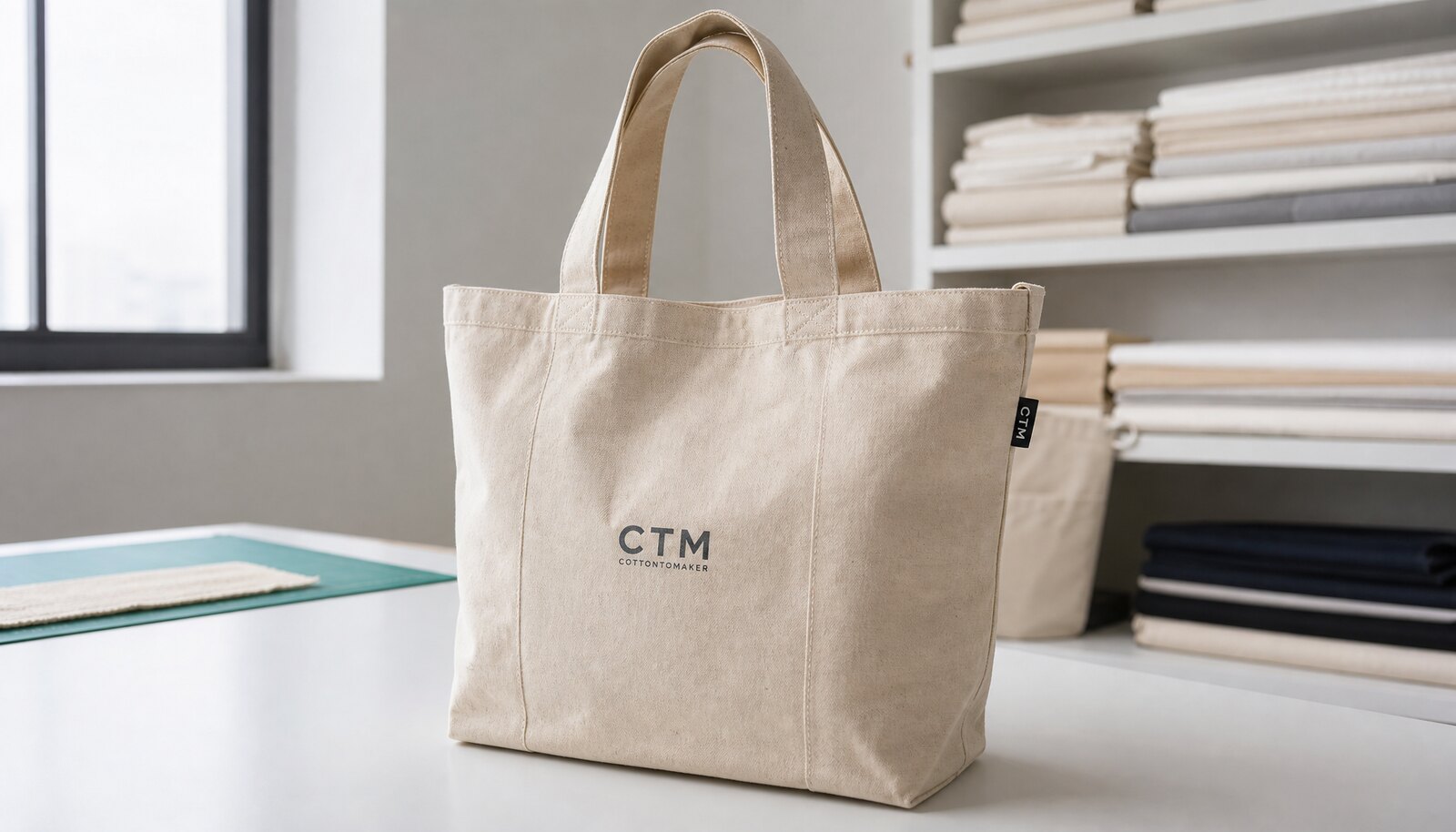
Start with the job the bag has to do
Promo canvas bags look simple, but procurement gets expensive when the use case is vague. A bag for an event giveaway, a staff welcome kit, a retail purchase, and a client gift are not the same product even if they share a shape. The giveaway version can usually tolerate lighter cloth, simpler stitching, and bulk pack-out. The retail or gift version usually needs a cleaner finish, tighter sewing, more controlled print placement, and packaging that looks intentional on arrival.
The first sourcing mistake is asking for price before the buyer has decided how the bag will be used. That forces the supplier to guess on fabric weight, handle strength, seam reinforcement, print method, and carton pack. A better brief starts with the carrying load, the brand perception target, and the distribution path. If the bags go directly into event bags, the factory can optimize for speed and unit cost. If they are resold or included in a premium kit, the spec should support appearance and repeat use rather than just first-pass cost.
- State the end use: giveaway, retail, internal merch, or client gifting.
- Define the expected load so handle width and seam reinforcement are not guessed.
- Decide whether the bag needs to look premium in hand or only perform as a low-cost carrier.
Choose fabric weight and finish before artwork review
For promo canvas bags, fabric weight is the first real design decision. An 8 oz build can be acceptable when the budget is tight and the bag will carry light items. A 10 oz build is often the practical middle ground because it gives the bag more body without pushing freight and material cost too high. A 12 oz or heavier build usually makes sense when the order is retail-facing, the load is heavier, or the buyer wants a stiffer bag that stands upright more reliably.
Weight alone is not the full answer. The weave, yarn density, finishing treatment, and shrink behavior can change the way the same nominal weight performs. Natural unbleached canvas tends to read more casual and can be a good print base, but buyers should ask how much shrink is expected after washing, steaming, or humid transit. Bleached and dyed options improve visual control but can increase cost and change the hand feel. If a supplier will not state whether the cloth is stock or custom woven, the quote is incomplete.
- Use 8 oz only when price and freight matter more than structure.
- Use 10 oz when you want the safest balance of body, cost, and print quality.
- Use 12 oz or above when the bag must feel substantial or carry heavier contents.
- Ask for finish details: natural, bleached, dyed, washed, or recycled.
Compare construction details that affect strength
The difference between a usable promo bag and a complaint is often hidden in construction. A direct comparison on fabric alone misses the more important variables: seam type, bar-tacks, handle width, top hem finish, gusset depth, and stitch density. A supplier can use the same canvas weight but build a bag that feels either tidy and durable or loose and fragile. Procurement teams should treat those details as line items, not as vague manufacturing choices.
For most programs, double-needle side seams with bar-tacks or reinforced stitching at the handle joins are a safer baseline than a simple single-needle build. Handle width matters as much as seam style. Narrow handles can feel cheap and dig into the hand when the bag is loaded. Wider handles spread the load better and often signal better quality to the end user. If the bag has a gusset, ask for the exact gusset depth and whether the bottom seam is reinforced, because the load-bearing behavior changes as soon as the bag starts carrying bottles or books instead of a flat leaflet.
- Require the supplier to state seam type and where reinforcement is added.
- Ask for handle width in millimeters and handle attachment method.
- Do not accept a vague tote description when you need a specific gusset or hem finish.
- If the bag is for heavier use, ask for a load-bearing construction detail rather than a style name.
Match the print method to the artwork and order size
The print method is where many low-price quotes stop being comparable. Screen printing is still the strongest default for simple logos, spot colors, and repeat orders because the setup cost is usually justified once the quantity rises. Digital print or heat transfer can work well for short runs, gradients, or artwork with fine detail, but the buyer has to check how the finish behaves on canvas after folding, shipping, and use. Some transfer films look sharp in photos and then crack or lift too early in real use.
Procurement should force the quote to define print area, number of colors, registration tolerance, and color standard. If the brand needs a close match, ask whether color matching is to a Pantone reference, a physical swatch, or a prior approved sample. Also ask how the supplier handles second-side printing or wrap prints, because registration risk increases when print coverage expands. The best quote does not just say printed bag; it explains what print system is being used, what setup cost applies, and what durability standard the factory will stand behind.
- Use screen print for one to three spot colors and larger quantities.
- Use digital or transfer only when the artwork or volume makes setup cost the bigger issue.
- Ask for the exact print area and tolerance for placement.
- Require a durability expectation, not only an artwork proof.
Compare supplier routes before comparing unit price
Promo canvas bags are commonly sourced from a direct factory, a decorator working on imported blanks, or a trading company coordinating several factories. Those are different buying models and should not be treated as interchangeable. A direct factory is usually the strongest choice when the buyer wants control over construction, custom sizing, repeatability, and change management. A decorator using blanks can be a good fit for simple campaigns where the body spec is standard and only decoration changes. A trading company can help consolidate mixed products or support buyers without a local sourcing team, but it adds another layer between the order and the actual line.
Supplier route matters because it changes accountability. If the sewing happens in one location and the printing somewhere else, defect ownership can become blurred. If the fabric is outsourced, the quote may hide variability in the blank bag itself. Buyers should ask for the factory name, address, what is actually done in-house, and what is subcontracted. If the supplier is unwilling to answer that clearly, the quote may be cheap because the production chain is fragmented, not because the bag is efficient to make.
- Direct factory: best for custom spec control and repeat orders.
- Decorator on blanks: best for simple artwork and standard bodies.
- Trading company: useful for consolidation, but verify who owns production quality.
- Ask which stages are outsourced before you compare price.
Read the quote as a landed-cost sheet
A usable quote for promo canvas bags should show the full cost stack, not just one unit number. Fabric, sewing, print setup, color change, sample fee, packing, cartons, labels, export paperwork, and any special finishing need to be visible. If the supplier bundles everything into one line, you cannot tell whether the price is genuinely strong or just incomplete. The quote should also separate factory price from freight, duty, local delivery, and destination handling so the buyer can compare landed cost across suppliers on the same basis.
Hidden charges are common in this category. Typical examples include screen charges, plate or digitizing fees, extra color charges, retail folding, barcode label setup, inner pack changes, carton upgrades, and sampling that is not deducted from the bulk order. Another easy miss is the cost of changing the pack format after approval. A factory may quote bulk flat pack and then add labor once the buyer asks for folded retail presentation. Procurement should ask for the quote to identify one-time fees and recurring per-unit charges explicitly.
- Request quantity breaks at the levels that matter to your forecast.
- Ask the supplier to separate one-time setup from recurring unit cost.
- Keep freight, duty, customs clearance, and local handling outside the factory line item.
- Compare suppliers only after all packaging assumptions are aligned.
Write an RFQ that removes assumptions
The RFQ for promo canvas bags should read like a production brief. It needs finished dimensions, fabric weight, finish, handle dimensions, seam construction, print method, artwork file format, packing style, carton marks, target quantity, and destination. The more detailed the RFQ, the less the supplier can fill in missing information with its own standards. That is where most quote drift begins. A vague request produces a vague quote, and a vague quote is not a buying decision.
If you need options, keep them controlled. Ask for two or three structured alternatives instead of an open invitation to redesign the bag. For example, compare 10 oz versus 12 oz canvas, or screen print versus digital print, while keeping the rest of the spec fixed. That gives you a useful price tradeoff without turning the quote into a moving target. A clean RFQ also helps the factory spot schedule risk early, because fabric lead time, print setup, and packing expectations are visible before sampling starts.
- Attach vector artwork and note color references clearly.
- State whether the buyer wants bulk pack, retail fold, or individual polybag.
- List the destination so shipping assumptions are realistic.
- Ask for controlled alternatives, not a freeform redesign.
Set sample approval rules before production begins
A sample only solves a problem if it reflects the real build. For promo canvas bags, the pre-production sample should use the actual fabric or a formally approved equivalent, the actual print method, and the intended pack-out. A digital mockup is useful for artwork review, but it does not tell you whether the canvas drapes properly, whether the print sits cleanly on the weave, or whether the handles feel balanced. The sample review should be treated as a quality gate, not a courtesy step.
Procurement teams should define what is acceptable before the factory starts sewing. That means the buyer should approve the golden sample, record the final artwork file version, and keep a retained reference sample on file. If the sample shows a slight shift in print placement, weak reinforcement, or a finish that differs from the brief, that issue should be corrected before mass production. Small deviations are easiest to fix when the order is still at the sample stage.
- Approve a golden sample before the line starts.
- Record the exact artwork version and print position in writing.
- Reject substitute fabric or a different print system unless it is formally approved.
- Retain a signed sample for later inspection comparisons.
Build packing into the spec, not the afterthought
Packing changes cost, damage risk, and warehouse efficiency. Promo canvas bags are often flat packed, but that still leaves open decisions about fold direction, bag count per polybag, carton count, moisture protection, and label placement. If the bags will be repacked or kitted after arrival, a simple bulk pack may be enough. If they go straight to shelves or into gift kits, the packing standard becomes part of the product, not an optional extra. Buyers who leave packing undefined usually pay for the mistake later in labor or rework.
The carton spec should be written in practical terms. The factory should know the count per carton, the outer mark format, the expected gross weight range, and whether printed surfaces need extra protection from rubbing. Ask for carton dimensions early so freight planning is not based on guesswork. If the order is going into a warehouse or a retailer with inbound rules, confirm barcode placement and master carton labeling before packing starts. Changing labels after the goods are finished is a slow and expensive correction.
- Specify flat pack or retail fold with exact counts per inner and outer carton.
- Define whether each bag needs a polybag, insert, sticker, or barcode label.
- Ask for carton size and gross weight so shipping is not guessed.
- If the bags are for retail, confirm label and fold rules before production.
Plan lead time around the slowest step and the region
The production timeline for promo canvas bags usually moves through fabric sourcing, sample approval, print setup, sewing, packing, inspection, and dispatch. The quoted lead time only matters if you know which step is the bottleneck. Custom fabric can take longer than sewing. Multi-color artwork can become the critical path if screens or plates are not approved early. Packing changes can also add time if the factory has to source inserts, labels, or special cartons after the main order is already on the floor.
Regional risk is mostly about timing, documentation, and communication, not stereotypes. If you are sourcing across borders, ask how the factory handles holiday shutdowns, port congestion, weather delays, and document cutoffs. For buyers sourcing from South or Southeast Asia, seasonal shipping delays and monsoon timing can matter. For buyers sourcing from China or other large export hubs, holiday closures and the difference between a real factory and a trading layer can affect the schedule. The safer approach is to require a stage-by-stage timeline and to build buffer time into the order rather than assuming the first promised date is the real ship date.
- Ask for a timeline by stage, not one total number.
- Treat custom fabric, multi-color print, and special packing as schedule risks.
- Confirm the supplier's holiday calendar and shipping cutoffs.
- Approve artwork and pack-out before cutting starts.
Specification comparison for buyers
| Spec decision | Recommended option | When it fits | Buyer risk to check |
|---|---|---|---|
| Supplier route | Direct bag factory with in-house sewing and print | Best for custom sizes, repeat programs, and tighter production control | Confirm sewing, printing, and packing are actually in-house; ask which steps are outsourced |
| Supplier route | Decorator using imported blanks | Works when the body spec stays standard and only decoration changes | Check blank fabric weight, shrinkage, and handle reinforcement before artwork approval |
| Supplier route | Trading company or sourcing agent | Useful for multi-item consolidation or buyers without local staff | Watch for hidden margin, slower sample loops, and weak accountability if defects appear |
| Fabric weight | 8 oz canvas | Lower cost and lighter freight for giveaway bags | Can look limp, distort under load, and show large print areas less cleanly |
| Fabric weight | 10 oz canvas | Balanced option for most promo programs | Verify it still stands up after packing and that the weave is not too open for fine logos |
| Fabric weight | 12 oz canvas | Better structure for premium promos and retail resale | Higher unit and freight cost; ask whether handle and seam reinforcement also increase |
| Seam construction | Double-needle side seams with bar-tacks at handle joins | Best when the bag will carry books, bottles, or repeated daily use | Single-needle seams or weak bar-tacks can open under load and create inconsistent shape |
| Handle spec | 25-38 mm handle width with reinforced attachment | More comfortable for heavier loads and better perceived quality | Narrow handles can dig into the hand; thin reinforcement can fail before the body does |
| Finish option | Natural, bleached, dyed, washed, or recycled canvas | Choose based on brand look, print contrast, and shrink sensitivity | Unwashed cotton can shrink; ask for shrink allowance and post-wash size tolerance |
Buyer checklist before sampling
- Lock the finished size, fabric weight, handle width and length, and seam construction before asking for price.
- State whether the canvas is natural, bleached, dyed, washed, or recycled, because each option changes hand feel, shrink behavior, and print contrast.
- Ask the supplier to quote fabric weight in GSM or oz and to state whether it is stock cloth or a special weave order.
- Define the print method, number of colors, print area, and whether the design must stay centered within a stated tolerance.
- Ask for a pre-production sample made from the actual fabric and actual print process, not only a digital proof.
- Request unit pricing at multiple quantity breaks so you can see where setup cost drops out.
- Ask for every one-time charge separately: screen fees, plates, digitizing, sample fees, carton changes, and label setup.
- Specify pack-out: bulk flat, individual polybag, folded insert, barcode label, hangtag, or retail master pack.
- Confirm carton count, carton size, gross weight target, and how the supplier protects printed surfaces in transit.
- Ask for stitch, load, and print acceptance criteria before mass production begins.
Factory quote questions to send
- What exact fabric weight in GSM or oz will you use, and is it stock fabric or a special weave order?
- What is the finished size after sewing, not the cut size, and what tolerance do you allow?
- What seam construction will you use on the body and handle attachment, and how many rows of stitching are included?
- How wide and long are the handles, and is any reinforcement added at the attachment points?
- What finish is used on the canvas, and what shrink allowance should we expect after washing, steam, or humidity exposure?
- How many print colors are included, what is the print area, and are screen charges or plate fees separate?
- Is the logo printed, woven, embroidered, embossed, or sewn as a label, and what durability test supports that method?
- What is the MOQ by color, by artwork, and by packaging format?
- Can you quote at three quantity breaks so we can compare setup cost against unit cost?
- What is included in the sample fee, and will it be deducted from the bulk order if approved?
Quality-control points to confirm
- Finished size should match the approved spec within the agreed tolerance. Measure at least 10 pieces across different cartons, not only the first sample bundle.
- Fabric weight should be within the agreed range for the supplied cloth. Verify by mill certificate or by weighing a cut swatch against the purchase spec.
- Handle length and width should match the drawing within the agreed tolerance, and both handles should be visually even on a flat lay check.
- Handle attachment should not show skipped stitches, loose thread tails longer than the buyer allows, or distortion after a manual pull test.
- Use a load test at the agreed target weight, typically 5 to 8 kg for many promo bags, and reject any seam opening, bar-tack failure, or handle tear under that load.
- Check side seams, bottom seams, and top hem for straightness, puckering, and open gaps. Set an acceptance rule for visible seam gaps, such as no opening beyond the buyer-defined limit.
- Print alignment should stay within the approved placement tolerance, commonly within 2 mm for simple logos, with no tilt that is obvious to the eye.
- Print should show no smearing, pinholes, heavy ghosting, cracked ink, or transfer lift after fold and rub checks.
- Color should match the approved sample under the same light source used for approval, and large runs should be checked against a retained golden sample.
- Canvas surface should be free of major slubs, stains, oil marks, holes, and broken yarns on the front panel and visible side areas.