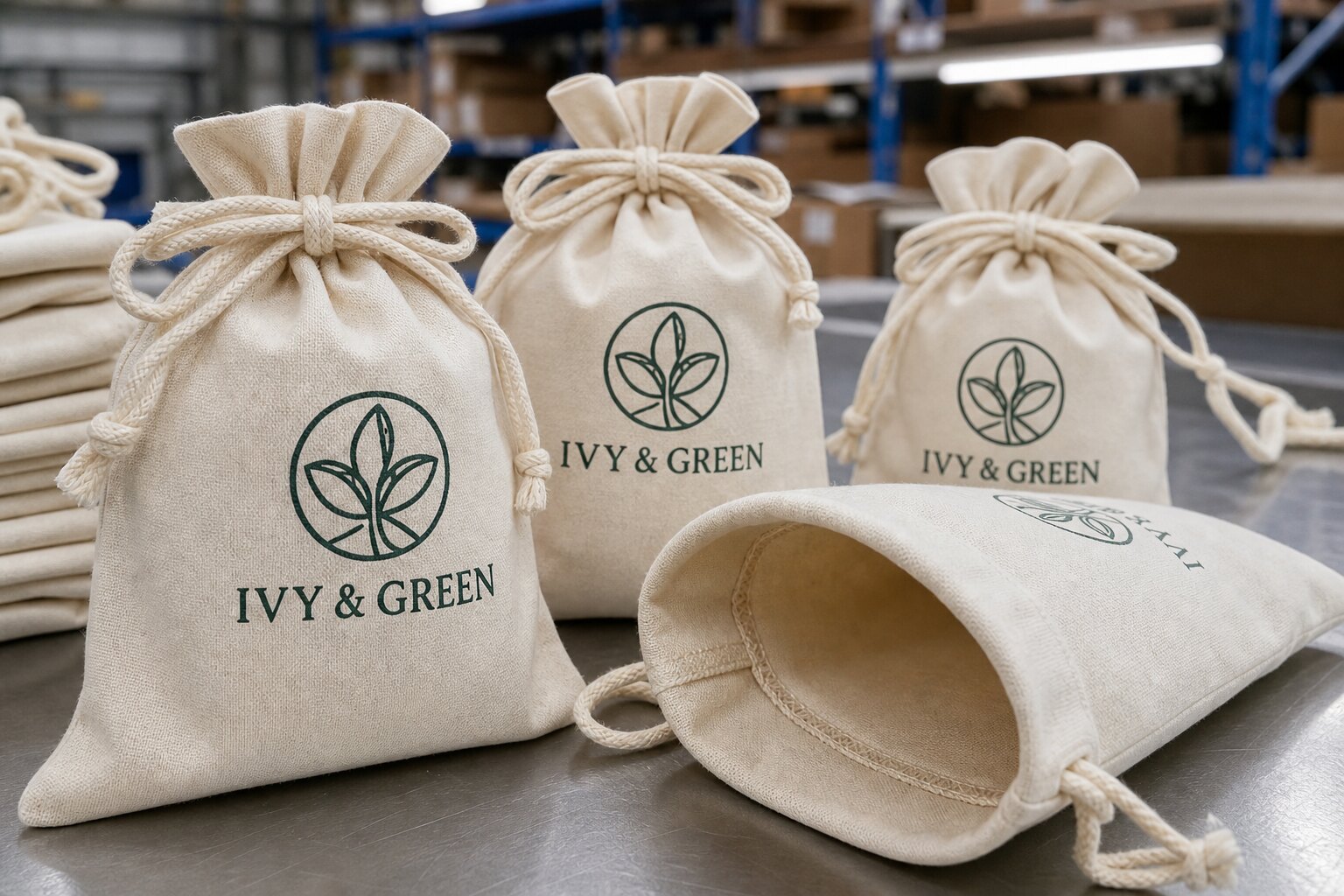
Why MOQ and Pricing Change So Much for Printed Pouches
For printed drawstring pouches, MOQ and pricing depend on more than the number of pieces. Fabric type, pouch size, print area, print color count, sewing construction, packaging method, and delivery schedule all affect the factory cost.
A buyer may ask for 1,000 printed pouches and receive very different prices from different suppliers because the specifications are incomplete. One quote may assume lightweight cotton with one-color screen printing, while another may include thicker canvas, custom dyed fabric, woven drawcords, and individual polybag packing.
The buying problem is simple: if the RFQ does not define the pouch clearly, the MOQ and price are not reliable.
- MOQ is usually driven by fabric availability, printing setup, cutting efficiency, and labor batching.
- Unit price is affected by material weight, pouch size, print complexity, finishing, inspection, and packing.
- Small changes such as adding a second print color or changing to custom dyed fabric can move both MOQ and lead time.
- The most useful quote request gives the supplier enough detail to price the order without repeated clarification.
Main Cost Drivers for Printed Drawstring Pouches
Procurement teams should separate the pouch cost into material, printing, sewing, finishing, and packing. This makes it easier to compare supplier quotations on the same basis.
For most cotton or canvas pouches, fabric is the largest part of the base cost. Printing becomes more important when the design has multiple colors, large coverage, tight registration, or special effects.
- Fabric: cotton, canvas, organic cotton, recycled cotton, jute, polyester, or blended fabric all have different base costs.
- Fabric weight: 4 oz cotton is cheaper and softer, while 8 oz or 10 oz canvas gives a heavier retail feel but increases cost.
- Size: larger pouches require more fabric and may reduce cutting efficiency.
- Print method: screen printing, heat transfer, digital print, embroidery, woven label, and debossing each have different setup and running costs.
- Drawcord: standard cotton cord is usually economical; ribbon, jute cord, dyed cord, or branded cord increases cost.
- Packing: bulk carton packing is cheaper than individual OPP bags, barcode labels, hangtags, or retail-ready packaging.
Printed Pouch MOQ Comparison by Specification
The table below is a practical structure buyers can use when comparing printed pouch MOQ and pricing. Exact MOQ depends on factory capacity and current material stock, but these ranges show why one pouch specification can be easy to produce while another requires a higher starting quantity.
When sending an RFQ, state whether you can accept stock fabric and standard drawcord. This often gives more flexibility on MOQ.
- Specification | Typical MOQ impact | Pricing impact | Buyer note
- Stock natural cotton pouch with one-color logo | Lower MOQ | Lower setup and material cost | Good for promotional campaigns and quick replenishment
- Custom size cotton pouch | Medium MOQ | Higher cutting and sampling cost | Confirm finished size tolerance before approval
- Thick canvas pouch with two-color print | Medium to higher MOQ | Higher fabric cost and print setup | Suitable for retail packaging or premium gift sets
- Organic cotton pouch with certification request | Higher MOQ | Higher fabric and documentation cost | Confirm whether certificate is for fabric, factory, or transaction scope
- Custom dyed pouch with printed logo | Higher MOQ | Dyeing, lab dips, and color control add cost | Pantone matching requires time and approval samples
- Pouch with embroidery or woven label | Medium MOQ | Higher decoration cost per piece | Better for premium branding but less economical for very small orders
- Retail packed pouch with barcode and hangtag | Medium MOQ | Higher labor and packing cost | Specify carton mark, barcode position, and packing ratio early
How Print Method Affects MOQ and Unit Price
The decoration method is one of the fastest ways to change the price of a pouch. A simple one-color screen print on natural cotton is usually the most cost-efficient option for bulk orders. More detailed artwork may need another method.
Buyers should send the logo file before asking for final pricing. A JPG preview is useful for discussion, but production pricing normally needs vector artwork or a high-resolution file.
- Screen printing is economical for simple logos, solid colors, and medium to large quantities.
- Heat transfer works for detailed or multi-color designs, but the hand feel and wash resistance should be checked on the actual fabric.
- Digital printing can support complex artwork, but cost depends on print area and fabric compatibility.
- Embroidery gives a premium finish but is slower and less suitable for very small text or fine lines.
- Woven labels work well when the pouch fabric is textured or when the logo must remain sharp across repeat orders.
- Debossing or embossing is more relevant for PU, leather-like, or special materials than standard cotton pouches.
Quantity Breaks: What Buyers Should Ask For
A useful pouch quotation should show quantity breaks, not only one price. Buyers often discover that increasing from 1,000 pieces to 3,000 or 5,000 pieces reduces the unit price because setup, printing, and handling costs spread across more units.
However, the lowest unit price is not always the best buying decision. If the campaign needs only 1,500 pieces, ordering 5,000 pieces may create storage cost, cash flow pressure, and obsolete branded stock.
- Ask for pricing at three quantities, such as 1,000, 3,000, and 5,000 pieces.
- Request that setup charges, sampling charges, and shipping terms are listed separately.
- Confirm whether the quoted price includes logo printing or only the blank pouch.
- Ask whether the same unit price applies to mixed colors, mixed sizes, or split shipments.
- Check whether overproduction or underproduction tolerance applies, especially for custom dyed or printed orders.
RFQ Checklist for Accurate Printed Pouch Pricing
The fastest way to get a reliable price is to send a complete specification. This also helps procurement teams compare suppliers fairly, because every factory is quoting the same pouch.
If some details are not decided, state the target use and ask the supplier to recommend a cost-effective specification. For example, a jewelry pouch, cosmetic pouch, tea pouch, and event giveaway pouch may all need different fabric weight and closure details.
- Finished pouch size: width x height, plus gusset if required.
- Material: cotton, canvas, organic cotton, recycled cotton, jute, polyester, or other fabric.
- Fabric weight: specify gsm or oz if known.
- Color: natural, bleached, black, stock color, or custom dyed Pantone color.
- Drawstring style: single cord, double cord, cotton cord, jute cord, ribbon, or custom color cord.
- Logo artwork: file format, print size, print position, number of colors, and Pantone references.
- Print method: screen print, transfer print, digital print, embroidery, woven label, or supplier recommendation.
- Packing: bulk pack, individual polybag, retail bag, hangtag, barcode label, carton quantity, and carton marks.
- Compliance needs: azo-free dye, REACH, CPSIA, organic certification, recycled content document, or brand-specific testing.
- Target quantity, delivery date, destination port or address, and preferred trade term.
Common Reasons a Printed Pouch Quote Changes After Sampling
Price changes after sampling usually happen because the final approved sample is different from the original RFQ. This is common when buyers start with a rough idea and refine the product during development.
To control cost, record every change between quotation, sample approval, and purchase order. The factory should confirm whether the change affects MOQ, unit price, mold or screen cost, lead time, or packing volume.
- The pouch size is increased after the first quotation.
- Fabric weight is upgraded from lightweight cotton to heavier canvas.
- The logo changes from one color to two or more colors.
- Print size becomes larger than originally stated.
- Custom dyed fabric is requested instead of stock natural fabric.
- Individual packing, barcode labels, or hangtags are added late.
- The delivery date becomes urgent and requires overtime or air freight.
How to Compare Supplier Quotes Without Looking Only at Unit Price
A low printed pouch price may exclude important items such as sampling, artwork setup, testing, inner packing, or export carton requirements. Before choosing a supplier, procurement teams should check what is included and what is not included.
For importers and distributors, repeatability matters. If the pouch is part of a retail packaging system or a recurring promotional program, the supplier should be able to hold fabric, print color, sewing tolerance, and packing method consistent across batches.
- Compare the same fabric weight, finished size, print area, and packing method.
- Check whether quoted MOQ is for one design, one size, and one colorway.
- Confirm sample cost, sample lead time, bulk lead time, and production capacity.
- Ask for photo or video confirmation of fabric, printing, sewing, and packing before shipment.
- Review acceptable size tolerance, print position tolerance, and color tolerance.
- Confirm whether the supplier can support repeat orders with the same material and print standard.