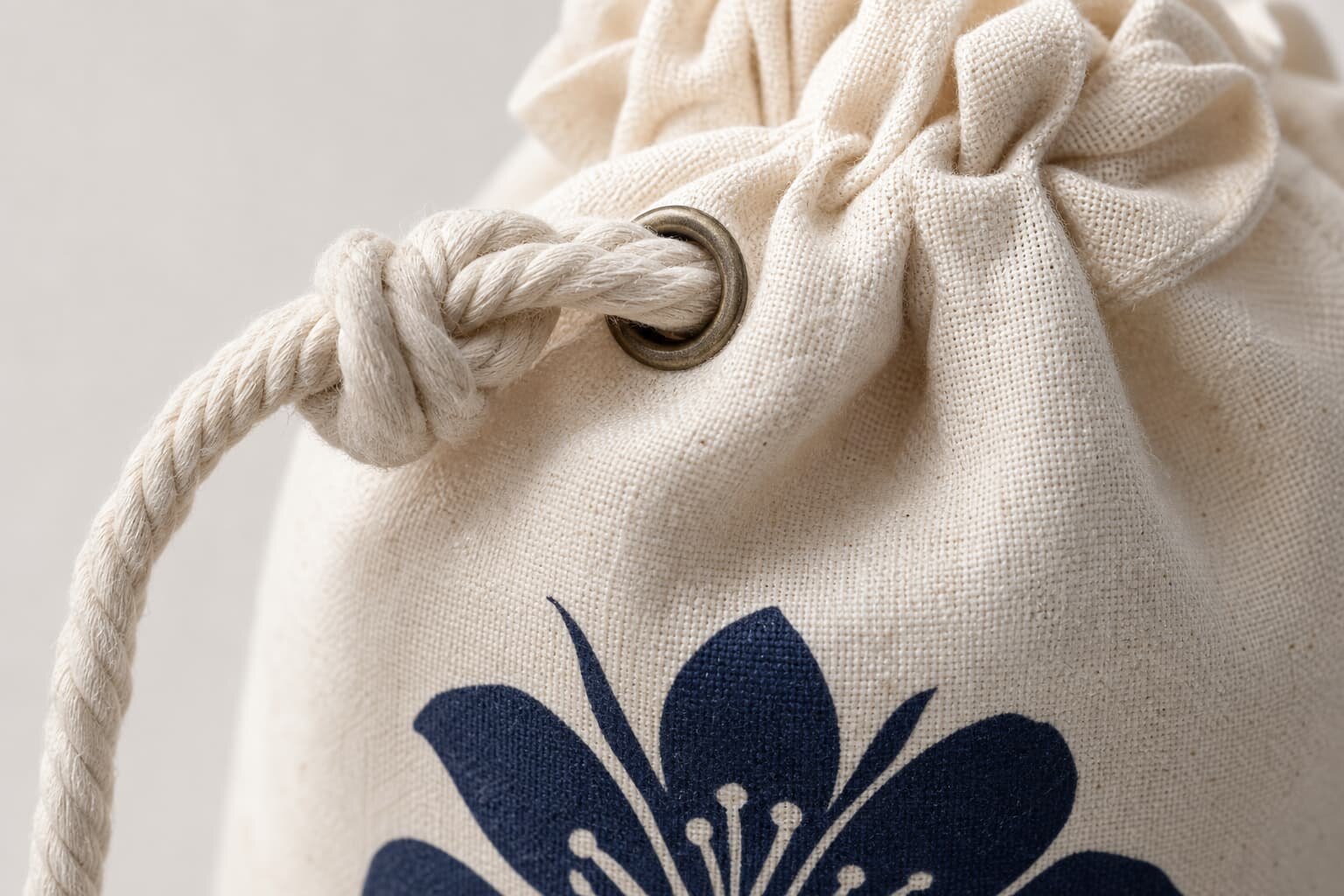
Why Printed Pouch Pricing Is Easy to Misread
Printed drawstring pouch bulk pricing looks simple because the product is small: fabric, two side seams, a drawcord channel, and a logo. In real quoting, small changes in GSM, print size, cord type, packing method, and MOQ can move the landed cost more than buyers expect. A quote for a 10 x 15 cm cotton pouch in 120 GSM fabric cannot be compared fairly with a quote for a 15 x 20 cm 8 oz canvas pouch, even if both suppliers write "cotton drawstring pouch" in the description.
The most common purchasing mistake is asking several factories for "best price for printed pouch" and then trying to negotiate from inconsistent offers. One supplier may include screen setup, another may exclude it. One may quote bulk packing, another individual polybag packing. One may use thin cotton sheeting, while another uses heavier canvas. The right goal is not the lowest first number. The goal is a comparable quote that protects the buyer from sample surprises, production delays, and freight changes.
- Use finished size, fabric weight, print method, and packing as the base of every RFQ.
- Ask for tiered pricing because pouch unit cost changes sharply when setup and cutting labor are spread over more pieces.
- Compare total order value and landed cost, not only the factory unit price.
- Make factories state what is excluded, especially setup charge, sample fee, retail packing, and inland delivery.
Set the Pouch Specification Before Asking for Price
A good bulk pricing guide starts with the physical specification. For drawstring pouches, the main cost drivers are finished size, fabric consumption, fabric weight, drawcord, printing, sewing difficulty, and packing volume. If the buyer only gives an approximate size and logo file, the factory must make assumptions. Those assumptions create a quote that may look attractive but cannot be held during sample approval.
For most promotional and retail packaging use, buyers should define the finished flat size in width x height, not the cutting panel size. The drawcord channel takes fabric and can reduce usable internal height. A pouch for a 100 mm product should not be specified as 100 mm high unless tight fit is acceptable. Add room for product thickness, easy closing, and the fold area near the drawcord.
- Small jewelry pouch: often 8 x 10 cm, 10 x 12 cm, or 10 x 15 cm, usually lighter cotton or velvet depending on positioning.
- Cosmetic or amenity pouch: often 12 x 16 cm, 15 x 20 cm, or 18 x 24 cm, with medium cotton or canvas for better presentation.
- Shoe, apparel, or kit pouch: often 25 x 35 cm, 30 x 40 cm, or larger, where fabric GSM and carton volume become important.
- Wine or bottle style drawstring bags should be quoted separately because base construction, height, and cord position are different.
Fabric Weight and Material Choices That Affect Cost
Cotton pouch pricing is heavily influenced by fabric weight. A 120 GSM cotton pouch can be suitable for light giveaway packaging, but it may look too thin for a premium retail item. A 5 oz cotton canvas gives better hand feel and print surface for many brand projects. A 6 oz to 8 oz canvas feels more durable, but the additional fabric weight increases material cost, sewing resistance, and shipping weight. The best specification depends on product weight, brand positioning, and whether the pouch is expected to be reused.
Buyers should be careful with vague fabric terms. "Cotton" can mean thin sheeting, twill, canvas, muslin, brushed cotton, recycled cotton blend, or dyed fabric. The same word can produce different quotes. If the material is natural cotton, shade variation is normal between fabric lots. If exact brand color is required, dyed fabric or printed full surface color may be needed, both of which affect MOQ and lead time.
- 120-140 GSM cotton: economical for light items, inserts, event giveaways, and simple packaging.
- 150-180 GSM cotton: better opacity and handling for cosmetics, accessories, and mid-range retail packaging.
- 5 oz canvas: common balance for printed pouches needing stronger hand feel without heavy freight penalty.
- 6 oz to 8 oz canvas: stronger and more structured, useful for reusable packaging, kits, and larger pouches.
- Natural cotton fabric: attractive and cost-efficient, but buyers should accept shade and speck variation unless otherwise specified.
Print Method Selection: Do Not Quote Artwork Blind
Printing is one of the biggest reasons two pouch quotes differ. Screen printing is usually the practical choice for bulk drawstring pouches with solid logos or simple artwork. It becomes efficient when the same artwork is repeated across hundreds or thousands of pieces. The buyer must state number of colors, print side, print size, and Pantone references. A one-color 60 x 40 mm logo is not the same cost as a two-side 180 x 220 mm print.
Heat transfer, digital print, embroidery, woven labels, and sewn labels may be better for certain artwork or brand positioning, but each changes price and risk. Heat transfer can reproduce gradients but may add a film feel. Digital print can be useful for lower quantities and detailed artwork, but fabric color and texture affect final output. Embroidery is less common on small thin pouches because it can pucker fabric, but it may work on heavier canvas with simple designs.
- Screen print: best for solid logos, repeat orders, strong cost control, and 1-3 color artwork.
- Heat transfer: useful for gradients or detailed graphics when a slightly different surface feel is acceptable.
- Digital print: good for complex artwork or small batches, but requires careful color approval on actual fabric.
- Embroidery: consider only on heavier fabric and simple artwork; check reverse side and puckering.
- Woven or side label: good for subtle branding and repeat use, but label MOQ and sewing position must be quoted.
MOQ Logic Behind Factory Pricing
MOQ for printed drawstring pouches is not only about sewing capacity. It is also driven by fabric purchase, fabric dyeing, screen setup, print setup, cutting efficiency, label MOQ, and packing labor. A factory may accept 300 pieces using stock natural fabric and one-color screen print, but require 1,000 or 3,000 pieces for custom dyed fabric, custom cord color, or special hardware. Procurement teams should ask which component is setting the MOQ instead of treating MOQ as a fixed rule.
Price breaks matter because setup time is almost the same for a small order and a larger order. Artwork checking, screen making, sample adjustment, cutting marker preparation, line setup, and packing instruction all take time. At 500 pieces, these costs are concentrated into each pouch. At 5,000 pieces, they are spread across the order. A buyer comparing launch order and replenishment order should request several quantity tiers using the same specification.
- 500 pcs: useful for trial orders, but unit price may be high because setup cost is concentrated.
- 1,000 pcs: common starting point for basic custom printed cotton pouches using available fabric.
- 3,000 pcs: better level for custom details, improved material purchasing, and more stable production planning.
- 5,000-10,000 pcs: stronger pricing position, but buyer should confirm storage, sales forecast, and shelf-life of packed goods.
- Custom dyed fabric, custom cord, metal accessories, or private labels may each have a separate MOQ.
What a Comparable Quote Should Include
A useful supplier quote should read like a production summary, not just a unit price. It should confirm size, material, fabric weight, print method, number of colors, print location, drawcord material, packing, carton data, lead time, payment terms, Incoterm, and quote validity. If one of these items is missing, the quote is not ready for purchasing comparison. Missing information usually becomes a cost discussion later.
For importers and distributors, carton information is especially important. Drawstring pouches are small, but carton quantity and compression affect both freight and product appearance. Over-packed cartons can flatten cords, crease fabric, or make final counting difficult. Under-packed cartons increase volume and freight cost. Buyers should request estimated carton size and weight at quotation stage, then confirm final packing after pre-production sample approval.
- Product name: printed cotton drawstring pouch, with finished size and tolerance.
- Material: composition, weave, fabric weight, color, and whether stock or custom dyed.
- Printing: method, artwork size, number of colors, sides printed, curing or finishing notes if relevant.
- Accessories: drawcord type, cord color, label, hangtag, bead, tip, or any closure detail.
- Packing: pieces per inner bag, pieces per carton, carton size, gross weight, and carton marks.
- Commercial terms: MOQ, price tiers, sample lead time, bulk lead time, Incoterm, payment terms, and validity.
Cost Breakdown Buyers Can Use Internally
When a purchasing manager reports pouch cost internally, it helps to separate the price into cost drivers. This makes negotiation more practical. Instead of asking for an arbitrary discount, the buyer can decide whether to reduce fabric weight, simplify printing, increase order quantity, remove individual packing, or accept stock cord color. This approach protects the brand requirement while reducing unnecessary cost.
A realistic cost breakdown for printed drawstring pouches usually includes fabric, cutting, printing, sewing, drawcord and accessories, trimming and inspection, packing, cartons, and factory overhead. Export handling, inland transport, document charges, and freight may be outside the unit price depending on Incoterm. Buyers should avoid comparing an EXW quote with an FOB quote as if both include the same services.
- Fabric cost increases with pouch size, GSM, waste rate, dyed material, and special finishes.
- Printing cost increases with number of colors, print area, print sides, artwork detail, and setup.
- Sewing cost increases with smaller pieces, thicker fabric, reinforced seams, labels, and tight tolerances.
- Packing cost increases with individual polybags, barcodes, retail inserts, hangtags, and carton sorting.
- Freight impact increases with heavier canvas, lower carton density, and individual retail packing.
Sample Approval: What to Check Before Bulk Production
A drawstring pouch sample is not only for appearance. It is the buyer's chance to lock down construction and prevent disputes. The approved sample should show fabric weight, fabric color, print method, logo size, print position, drawcord type, seam style, channel width, label position, and packing direction if relevant. If the sample uses substitute fabric, the factory should clearly state that and send the exact fabric before production.
Print approval needs practical testing. Rub the print after curing, fold the pouch near the printed area, and check whether the print cracks, bleeds, or feels too heavy. Open and close the cord repeatedly. Put the actual product inside if available. A pouch that looks good when empty may be too tight after filling, especially for boxed cosmetics, irregular accessories, or thick fabric kits.
- Check finished size flat and filled, because usable capacity is less than flat measurement.
- Confirm print position from top edge, side seam, and drawcord channel, not by eye only.
- Review whether natural cotton specks are acceptable for the brand's visual standard.
- Test drawcord function with real product weight, not only empty pouch handling.
- Keep the signed or sealed sample as the reference for mass production and final inspection.
Packing and Freight Details That Change the Landed Cost
Packing is often treated as a minor line item, but it can change both unit cost and shipping cost. Bulk packing is usually the economical choice for distributors or brands that will kit the pouches later. Individual polybag packing protects each pouch and supports retail handling, but it adds material, labor, plastic use, carton volume, and inspection steps. If barcode labels or retail stickers are required, the buyer should provide artwork, placement, and scanning requirements early.
Carton specification should be requested before order confirmation. For small pouches, factories may pack high quantities per carton, but overly tight packing can create heavy cartons that are hard to handle or may fail in transit. For larger canvas pouches, carton volume may become the main freight driver. Air shipments are especially sensitive to dimensional weight, so lightweight pouches with bulky packing can still be expensive to move.
- Bulk pack: lower cost, efficient for wholesale distribution, but less protection for individual retail handling.
- Inner polybag by set quantity: good balance for counting, moisture protection, and warehouse receiving.
- Individual polybag: useful for retail, ecommerce, or kitting, but increases labor and carton volume.
- Retail insert or hangtag: improves presentation but requires artwork control, barcode checks, and packing inspection.
- Export carton marks: should match purchase order, item number, quantity, destination, and any distributor requirements.
Lead Time Planning and Production Risk
Printed drawstring pouch lead time should be split into sample time, approval time, material preparation, printing, sewing, packing, inspection, and shipping. A factory may be able to sew quickly after materials are ready, but delays often happen before sewing starts: artwork clarification, Pantone confirmation, fabric availability, screen making, or buyer approval. Procurement teams should not count only production days when planning a launch or retail delivery window.
Repeat orders are usually faster if the same fabric, artwork, and packing are used, but buyers should still confirm fabric lot and print color. Cotton fabric shade can vary, and screen condition or ink batch can affect logo appearance. If the pouch is part of a larger product kit, schedule it as a component with a buffer. A delayed packaging pouch can hold up the entire finished goods shipment.
- Sample stage: allow time for artwork review, sample making, international courier, and buyer comments.
- Material stage: confirm whether fabric is in stock, greige fabric needs dyeing, or special cord must be ordered.
- Printing stage: include screen setup, ink matching, curing, and first-piece inspection.
- Sewing stage: depends on size, order quantity, seam complexity, label insertion, and line availability.
- Packing stage: can become slow when there are barcodes, mixed colors, assortment ratios, or individual packaging.
Specification comparison for buyers
| Spec decision | Recommended option | When it fits | Buyer risk to check |
|---|---|---|---|
| Fabric weight | 5 oz to 8 oz cotton canvas or 120-200 GSM cotton | Gift packaging, cosmetics, jewelry, accessories, hotel amenities, small retail kits | Too light may show contents or wrinkle badly; too heavy increases freight and makes small pouches bulky |
| Logo printing | Screen print for solid 1-3 color artwork | Most bulk pouch orders with simple brand marks, event logos, and retail packaging graphics | Quote must state print size, number of colors, one-side or two-side print, and whether setup charge is included |
| Fine artwork | Heat transfer or digital print on suitable fabric | Gradient artwork, small details, photo-like graphics, or low MOQ personalization | Transfers can feel plastic-like; digital print color varies by fabric shade and pretreatment |
| Drawcord | Cotton rope or flat cotton tape matched to pouch size | Natural, reusable, retail-friendly presentation | Thin cords can cut into seams; thick cords need wider channel and may raise sewing cost |
| MOQ structure | Price tiers at 500, 1,000, 3,000, 5,000, and 10,000 pcs | Buyers comparing launch order, replenishment order, and distributor stock order | A low unit price may hide higher setup, sample, inland transport, or carton packing cost |
| Packing | Bulk pack in export carton with inner polybag by quantity | Standard wholesale supply where buyer will handle final kitting or distribution | Retail individual packing adds labor, material, carton volume, and inspection time |
Buyer checklist before sampling
- Define pouch dimensions as finished size after sewing, not fabric cut size.
- State fabric composition and weight, such as 100% cotton 5 oz, 6 oz, 8 oz, or 120-200 GSM.
- Send artwork with print size, Pantone or CMYK references, print position, and print side count.
- Ask factories to quote the same quantity tiers, packing method, and Incoterm before comparing unit prices.
- Confirm whether drawcord material, cord color, metal tips, beads, labels, and hangtags are included.
- Request pre-production sample approval for fabric, print sharpness, drawcord function, seam strength, and packing.
- Check carton size, gross weight, and pieces per carton because small pouches can still become volume-sensitive.
- Separate sample lead time, bulk production lead time, and shipping time in the internal purchase schedule.
- Ask for tolerance on size, print placement, fabric weight, and color shade before issuing the purchase order.
- Keep one approved sealed sample for factory reference and one for inbound QC comparison.
Factory quote questions to send
- What fabric weight and composition is your quotation based on, and can you provide actual GSM or oz tolerance?
- Is the quoted size finished pouch size, and what is the allowed size tolerance after sewing?
- Which print method is included, how many colors, what maximum print area, and is screen setup included?
- Does the unit price include drawcord, cord color matching, labels, hangtags, individual packing, or only bulk packing?
- What MOQ applies to the pouch itself, fabric dyeing, custom cord color, and each print color?
- What are the price breaks for 500, 1,000, 3,000, 5,000, and 10,000 pieces using the same specification?
- What sample type will be supplied: stock fabric printed sample, exact fabric pre-production sample, or full custom sample?
- How many days are needed for sample, material purchase, printing, sewing, packing, and final inspection?
- What carton quantity, carton size, gross weight, and net weight will be used for the quoted packing method?
- Which Incoterm, port, currency, payment terms, and quotation validity period apply?
Quality-control points to confirm
- Measure finished pouch width and height flat, including tolerance for seam allowance and drawcord channel.
- Weigh fabric or confirm GSM/oz against the approved sample and purchase specification.
- Check print color, registration, curing, rubbing resistance, edge sharpness, and placement on both approved and random pieces.
- Pull the drawcord open and closed several times to check channel width, cord slippage, knot security, and seam stress.
- Inspect stitching density, skipped stitches, loose threads, seam alignment, and reinforcement at side seams near the cord channel.
- Review fabric defects such as stains, oil marks, slubs outside agreed level, shade variation, and cutting distortion.
- Confirm label, hangtag, barcode, and retail packing placement if included in the order.
- Check inner bag quantity, carton count, carton marking, gross weight, and whether pouches are compressed too tightly.
- Keep approved sample, production sample, and shipment sample under the same light when comparing color.