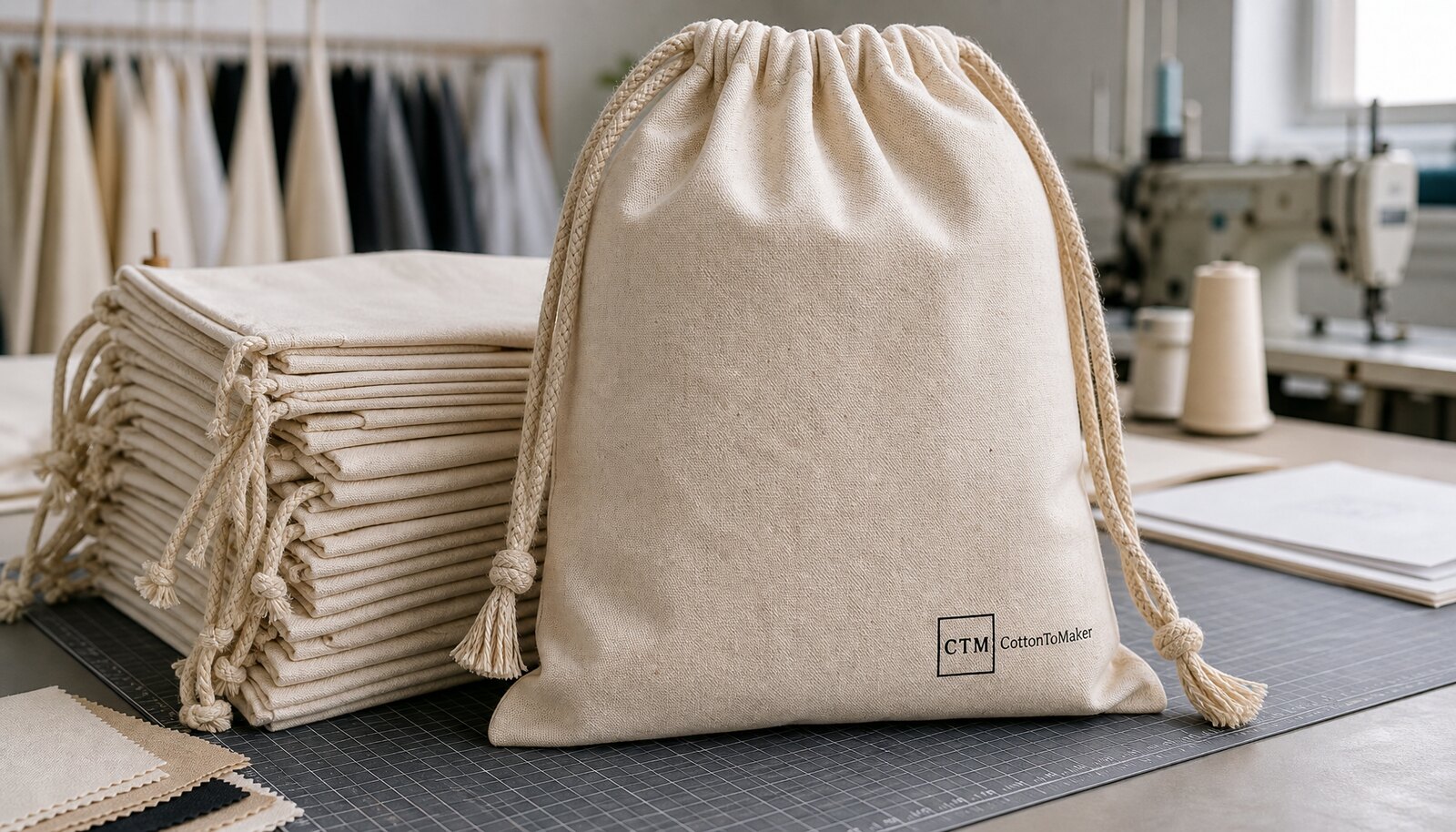
Why procurement teams still get burned on a simple pouch
Printed drawstring bags look uncomplicated, which is exactly why sourcing teams sometimes under-specify them. The bag shape is familiar, the artwork is usually simple, and the unit price appears easy to compare. In practice, though, the finished product can vary a lot in fabric density, cord strength, print sharpness, and carton presentation. A quote can look attractive while quietly assuming a lighter cloth, a different print process, or looser packing than your business actually needs.
The most common failure mode is not dramatic damage—it is mismatch. The buyer expects a retail-ready pouch with a stable print and consistent closure, while the supplier quotes a promotional bag that is only good enough for one-time giveaway use. Once that mismatch reaches production, the cost of correction is usually higher than the cost of writing a tighter specification at the start.
For procurement buyers, the job is to make the requirement measurable. That means defining finished size, fabric GSM, weave, decoration method, color expectations, closure structure, and packaging standard in language a factory can price without guessing. If any one of those items is vague, suppliers will fill in the blank themselves, and quote comparisons stop being reliable.
- A low unit price is not useful if the quote is for a thinner fabric or a different packing standard than your planned use.
- One supplier may be pricing a reusable retail pouch; another may be pricing a short-life promo bag. Those are not interchangeable.
- The first sourcing task is to turn a visual concept into a measurable spec the factory can repeat.
Start with the use case, not the logo file
The correct spec depends on how the pouch will be used after delivery. A trade show kit bag, a cosmetics insert, a gift pouch, and an internal merchandising pack can all use the same general silhouette, but they do not need the same construction. If the bag only holds light inserts for a single campaign, a lighter fabric and a simpler print route may be enough. If the end customer will reuse it several times, the fabric, seam quality, and print durability deserve more scrutiny.
Use-case planning also helps you avoid overbuying. Many buyers default to a premium specification because it sounds safer, but that can waste money if the pouch is just a packaging component. On the other hand, trying to save a few cents on a bag that carries glass jars or premium cosmetics can create breakage, poor presentation, and avoidable returns. The right answer is not to maximize quality everywhere; it is to align quality with the product’s actual duty cycle.
A practical way to start is to classify the order into one of three buckets: disposable promotional, retail presentation, or reusable consumer use. Then map each bucket to a minimum fabric weight, print durability target, and packing standard. That gives the factory a benchmark and gives procurement a clean basis for comparing offers.
- Disposable promotional use: prioritize simple construction, fast lead time, and predictable print visibility.
- Retail presentation use: prioritize fabric appearance, print durability, and carton presentation.
- Reusable consumer use: prioritize seam reinforcement, cord wear resistance, and stronger quality control at the top channel.
Fabric, GSM, and finish: the first line in the quote
Fabric is the largest hidden variable in printed drawstring bags. GSM affects feel, opacity, shape retention, and the risk of print show-through. As a practical procurement reference, 120 GSM cotton is a common entry point for light promotional use, while 140–160 GSM usually gives a better balance of hand-feel and structure. If the pouch needs a more substantial look or will carry heavier contents, 180 GSM or above can be justified. A higher GSM does not automatically mean better performance, but it usually gives more margin for handling and print presentation.
The finish matters almost as much as the weight. Natural unbleached cotton gives a clean, eco-oriented look, but it can vary in tone and can make light-colored print less opaque. Bleached cotton improves visual consistency for branding, while dyed fabric may be needed for a stronger retail identity. Each of those choices affects cost and lead time. If the supplier does not tell you whether the fabric is stock, bleached, dyed, or recycled, your quote is not truly comparable.
Buyers should also ask for a tolerance band, not just a nominal GSM number. In sourcing practice, asking for a tolerance of roughly ±5% around the target fabric weight is more useful than accepting a vague “about 140 GSM.” You should also ask whether the supplier will provide a fabric swatch or lab-style specification sheet, because a swatch can show weave tightness, lint level, and surface consistency that a written quote cannot capture.
- 120 GSM: suitable for entry-level promotional use and light contents.
- 140–160 GSM: common middle ground for retail-friendly appearance and decent structure.
- 180 GSM: better for premium presentation or repeated use, especially when top-channel distortion is a concern.
- Ask whether the fabric is natural, bleached, dyed, or recycled, because each option changes appearance and lead time.
Decoration method: how print choice affects cost, durability, and approval risk
The print method should be chosen after the artwork is finalized, not before. Screen printing remains the most efficient option for simple logos and flat colors, especially when the order is large enough to spread setup cost. It usually gives good opacity on cotton and performs well when the design uses one to four solid colors. The downside is that every additional color adds setup and registration risk, and very fine lines can be less forgiving on textured fabric.
Digital printing and heat transfer solve different problems. Digital print can be useful for more detailed artwork, soft gradients, or many colors, especially in short runs. Heat transfer can work when the design is complex but the order volume is too small to justify full screen setup. The tradeoff is that transfer edges, rub resistance, and long-term wear become more important, so the buyer needs to test more carefully before approving bulk production.
For procurement, the key question is not “Which print is best?” but “Which print is best for this specific artwork, fabric color, and order volume?” A simple logo on natural cotton may be best served by a two-color screen print. The same logo on a dark fabric could require a different ink system or an underbase strategy to maintain opacity. If the supplier cannot explain how they plan to achieve print clarity on your chosen fabric, that is a risk signal, not a minor detail.
- Screen print: strongest choice for flat logos, repeat orders, and lower cost at scale.
- Digital print: useful for detailed graphics, short runs, and artwork with many colors.
- Heat transfer: useful for complex art in smaller quantities, but confirm rub resistance and edge lift.
- Ask for a physical strike-off or sample print on the actual fabric before mass approval.
How to read MOQ, setup charges, and hidden cost drivers
MOQ is often treated like a single threshold, but in reality it is a bundle of conditions. For printed drawstring bags, the MOQ can change based on fabric color, size, print color count, cord selection, and whether the factory must source special accessories or labels. A supplier that quotes a low MOQ may simply be using stock fabric and a standard print setup. If you ask for custom dyeing, special packaging, or a second print location, the minimum may rise quickly.
This is why buyers should ask for the MOQ structure, not just the MOQ number. You need to know whether the same order quantity applies to all sizes, whether there is a color break per artwork version, and whether changing the cord or label changes the minimum. If your business has uncertain demand, the lowest-risk approach is usually to simplify the first order: one fabric, one print area, one artwork version, standard cord, and bulk carton packing.
A useful decision example: if a supplier offers a lower piece price only when you move from one-color to two-color print, that may be worth it if the second color is already part of your brand system. But if the extra color exists only to save a small amount on setup elsewhere, the added registration risk may not be worth it. Good procurement decisions compare total landed cost and reject risk, not unit price alone.
- Lower MOQ usually depends on stock material and minimal customization.
- Higher MOQ often reflects dyeing, special labels, extra print areas, or custom cord colors.
- Ask whether the MOQ changes by size, print version, or packaging method.
- If a quote is unusually low, confirm what it excludes before treating it as a valid comparison.
Construction details that matter in daily use
A pouch can pass visual approval and still fail in use if the construction details are weak. The top channel is the most important structural area because it carries the cord load and sees repeated friction. For buyers, the critical checks are whether the channel stitching is straight, whether the bar-tacks at the cord exits are secure, and whether the seam remains smooth after the bag is repeatedly opened and closed.
Cord selection matters as well. Cotton cord is common and fits the natural look of these bags, but the diameter should match the channel width. Too thin, and the cord may feel cheap or wear too quickly. Too thick, and it can bind in the channel or distort the top opening. Ask the supplier to confirm cord construction, diameter, and end treatment. If the cord ends are frayed or poorly finished, the bag can look low quality even when the body fabric is acceptable.
Eyelets are another area where buyers should think commercially, not just visually. Metal eyelets can improve appearance on some styles, but they add cost, can affect contents, and may not be necessary for light- to medium-duty use. In many cases, a reinforced stitched channel is enough. The right decision depends on whether the pouch is being judged as a packaging component or as a reusable consumer product.
- Check bar-tack placement at both cord exits; that is where failures often begin.
- Make sure cord diameter matches the channel width and intended handling.
- Do not add eyelets by default; use them only when the design or load justifies the extra cost.
- Ask the supplier how they prevent channel twisting and cord slip during sewing and packing.
Comparison table: procurement-grade distinctions by option
The table below goes deeper than a standard materials chart. It is designed to help buyers compare options by cost driver, likely failure mode, and the kind of inspection pressure each option requires. Use it as a pre-RFQ filter so suppliers quote the same baseline. If one supplier is pricing a low-GSM one-color bag and another is pricing a heavier bag with a more durable print system, the two offers cannot be treated as direct substitutes.
The most common procurement mistake is reading the table only as a style guide. It should instead act like a decision matrix. If your order is for a short promotional campaign, some of the premium options may be unnecessary. If the pouch supports a retail SKU, then the lowest-cost route may create more risk than it saves.
- Normalize all quotes to the same fabric, print, cord, and pack assumptions before comparing price.
- Match the option to the downstream channel: event giveaway, wholesale packaging, or retail shelf use.
- Ask the factory to identify the single most likely failure point for the option they are quoting.
Sampling and approval: what a pre-production sample should prove
A pre-production sample is not just a visual approval. It is the buyer’s chance to verify that the factory can reproduce the agreed specification with the actual material and process. If the sample uses different fabric, different ink, or a different cord than the mass order, it should not be treated as a true approval sample. At best, it is a style reference. At worst, it creates false confidence.
A proper sample review should cover size, print placement, surface quality, seam finish, and closure performance. Measure the finished dimensions flat and check whether they sit within the tolerance you can accept. Then inspect the print under normal lighting and, if the artwork is sensitive, compare it against the approved file using a consistent reference point. The sample should also be opened and closed multiple times so you can see whether the cord binds or the channel twists.
For higher-trust orders, it is worth keeping one sealed control sample with your internal records and one retained by the factory. That makes later dispute resolution much easier if the bulk lot shows a problem. It also helps if you re-order later and want to confirm that the next batch matches the approved version rather than a newer, unseen revision.
- Approve only a sample made from the final fabric, final print method, and final cord style.
- Measure size and check print placement against a fixed reference point, not by eye alone.
- Test the cord by repeated opening and closing, not just by pulling once.
- Keep a retained sample on both the buyer and supplier side for future comparison.
Packing, carton marks, and warehouse handling
Packing is often underestimated because it does not change the appearance of the bag on a desktop, but it changes landed cost and warehouse behavior. Bulk packing by count in master cartons is usually the most efficient method for wholesale and distribution orders. If the bags are going into retail or direct-to-consumer packaging, you may need individual polybags, size stickers, barcode labels, and tighter folding control. Each added step costs labor and can increase carton volume.
Before approving the quote, ask for carton dimensions, gross weight, and piece count. This matters because freight charges often respond to volume as much as weight. A bag that folds more loosely can take up more carton space than expected. That means a small change in pack method can change shipping cost even if the factory unit price is unchanged. Buyers should also make sure carton markings identify size, color, print version, and quantity per carton so receiving teams can process the shipment quickly and accurately.
If your operation handles multiple SKUs, carton discipline is part of quality control. Mixed-size cartons, missing stickers, or unclear marks create warehouse delays and can produce avoidable picking mistakes. Those errors are not just a logistics nuisance; they can become customer service issues if the wrong bags are sent to the wrong channel.
- Bulk pack is economical but can increase wrinkle, dust, and handling variability.
- Retail pack improves presentation but adds labor, material, and freight volume.
- Require carton labels that support receiving, storage, and SKU separation.
- Confirm whether the quoted carton count allows for overage or shortpack tolerances, and how discrepancies are handled.
Lead time, schedule risk, and what actually causes delays
A realistic lead time for printed drawstring bags depends on how much of the order is standard. If the fabric is stock, the artwork is finalized, and the pack format is simple, sample turnaround of 5–10 days and production of 20–35 days after approval is a reasonable planning assumption. The schedule can move much faster or slower depending on the build. Custom dyeing, woven labels, special packaging, or complex print approval will extend the timeline.
The factory line is not always the bottleneck. Delays often come from slow artwork confirmation, late Pantone decisions, fabric procurement, carton printing, or a sample that has to be remade because the buyer changed the spec after review. If your launch date is fixed, build a buffer and freeze the specification before mass production begins. Every late change has a ripple effect because it can affect not only the bag itself, but also packing and freight timing.
A buyer-friendly schedule request should ask the supplier to break the timeline into milestones: sample, approval, material booking, sewing, print curing, packing, and final inspection. That makes it easier to see where the risk sits and gives procurement a clearer chance to intervene before a delay becomes unavoidable.
- Fastest route: stock fabric, one print area, standard cord, and bulk carton packing.
- Slower route: custom fabric color, multiple print colors, woven label, or retail-grade folding.
- Ask for a milestone schedule instead of one blanket delivery date.
- Avoid changing artwork, size, and pack format after sample approval unless you can absorb the delay.
Specification comparison for buyers
| Spec decision | Recommended option | When it fits | Buyer risk to check |
|---|---|---|---|
| Fabric | 120–140 GSM cotton for general retail; 140–180 GSM for premium feel or heavier contents | Apparel inserts, gift sets, cosmetics, and retail packaging where hand-feel matters | Too-light fabric can show print strike-through, distort at the cord channel, or fail after repeated pulls; ask for actual GSM tolerance of ±5% and a fabric swatch approval before bulk |
| Weave / finish | Plain weave or a stable twill-like finish with low lint and consistent surface texture | Logos that need clean edges, darker prints, or repeat orders where visual consistency matters | Loose weave can make print edges fuzzy; excessive lint can contaminate curing and cause rub-off issues |
| Bag style | Single drawcord with double string channel for simple packaging; double drawcord with reinforced eyelets for daily use | Promo packs, trade show kits, and retail bundles that need fast opening and closing | Loose channels and weak stitching cause cord slip, uneven closure, and failed QC at the top seam; confirm bar-tack length and seam density |
| Print method | Screen print for 1–4 solid colors; heat transfer or digital print for short runs, gradients, or many SKUs | Brand logos with flat spot colors, seasonal artwork, or limited-color product launches | Fine text, half-tone detail, and exact Pantone matching can vary by method and fabric color; require a strike-off or digital proof plus physical sample |
| MOQ route | Lower MOQ through stock fabric plus standard print setup; higher MOQ for custom dyeing, woven labels, or special cord colors | Brands testing a design before scaling, distributors launching to one channel, or retailers with uncertain demand | A low MOQ quote may hide setup limits, color count surcharges, or a narrow size range; confirm whether MOQ changes by print color, fabric color, and packaging style |
| Closure detail | Cotton cord with bar-tacked channel ends; add metal eyelets only if the design or weight justifies it | Light to medium contents, natural-brand positioning, and low-cost bulk packaging | Eyelets add cost and can scratch contents; weak bar-tacks lead to channel tearing in transit; ask for a pull test target and failure criterion |
| Packaging | Bulk pack by count in master cartons with clear size labels and inner polybags only if needed for retail | Wholesale and distribution orders where carton efficiency affects freight cost | Overpacking raises freight volume; underpacking creates dust, moisture, and wrinkling issues; confirm carton cube, net weight, and count tolerance |
| Supplier route | Direct factory for custom sizes and repeat orders; trading route only when consolidating mixed items or small trial volumes | Importers with stable demand, brand owners with repeat replenishment, and distributors needing consistent specs | Trading quotes may look simpler but can hide fabric substitutions, longer lead times, or weaker QC control; ask who owns material approval and inspection |
| Lead time structure | Sample 5–10 days, production 20–35 days after approval for standard orders | Normal seasonal replenishment with clear artwork and approved materials | Short lead times often exclude artwork revisions, fabric procurement delays, or carton printing time; require a schedule with decision gates |
Buyer checklist before sampling
- Confirm bag size, finished seam allowance, and usable opening width, not just the flat cut size.
- Specify fabric GSM, weave type, and whether the fabric is bleached, natural, dyed, or recycled.
- State print placement, print size, number of colors, Pantone targets, and acceptable registration tolerance.
- Define cord type, cord diameter, channel stitching, and whether cord ends are knotted, heat-sealed, or tipped.
- Set carton pack count, inner packing requirement, and outer carton weight limit for your warehouse or retailer.
- Request pre-production sample approval with the actual fabric, print method, and cord style to be used in bulk.
- Ask for a quote that separates unit price, setup cost, sample cost, packaging cost, and freight assumptions.
- Confirm inspection points for print rub resistance, stitch strength, dimensions, and barcode or label placement if needed.
- Ask the supplier to confirm accepted dimensional tolerance, print placement tolerance, and color tolerance in writing.
- Request one sealed control sample for production reference and one shipment sample retained by the factory.
Factory quote questions to send
- What exact fabric GSM and weave are included in the quote, and can you name the source or fabric specification sheet?
- Which print method is included, how many colors are priced, and what is the surcharge for additional colors or extra print areas?
- What is the MOQ by size, print color count, and fabric color, and do different MOQ levels change the unit price?
- What is the sampling timeline, what sample charges apply, and will the sample use the same fabric, ink, and cord as mass production?
- How are the bags packed for shipment, how many pieces per carton, and what are the carton dimensions and gross weight?
- What are the production lead time and the bottlenecks that could extend it, such as fabric dyeing, artwork approval, or carton printing?
- What QC standards do you apply for print alignment, seam strength, and size tolerance, and can you share your AQL or inspection method?
- Are there any hidden charges for artwork cleanup, plate making, lab dips, woven labels, or rush production?
- Can you provide a fabric swatch, a print strike-off, and a full pre-production sample for approval before mass production?
- If a reprint or remake is needed due to your error, who bears the cost and how is the corrective action handled?
Quality-control points to confirm
- Measure finished size after sewing, not the cut panel size; allow a clear tolerance band for length and width.
- Inspect top channel stitching for straightness, density, and bar-tack strength at both cord exits.
- Rub-test the print after curing to confirm no visible transfer or cracking under normal handling pressure.
- Check print placement against the approved artwork file using a defined center or edge reference.
- Pull-test the cord and top seam to verify the bag closes evenly and the channel does not distort.
- Open and close sample bags repeatedly to see whether the cord frays, slips, or catches in the channel.
- Review carton labeling, quantity counts, and packing method to prevent mixed sizes or SKU confusion.
- Inspect one bag per carton for dust, oil marks, needle damage, broken stitches, or ink smearing.
- Use an AQL plan for final inspection and document critical, major, and minor defects separately.
- Reject any sample lot that shows print shift beyond tolerance, broken bar-tacks, or visible seam puckering at the top channel.