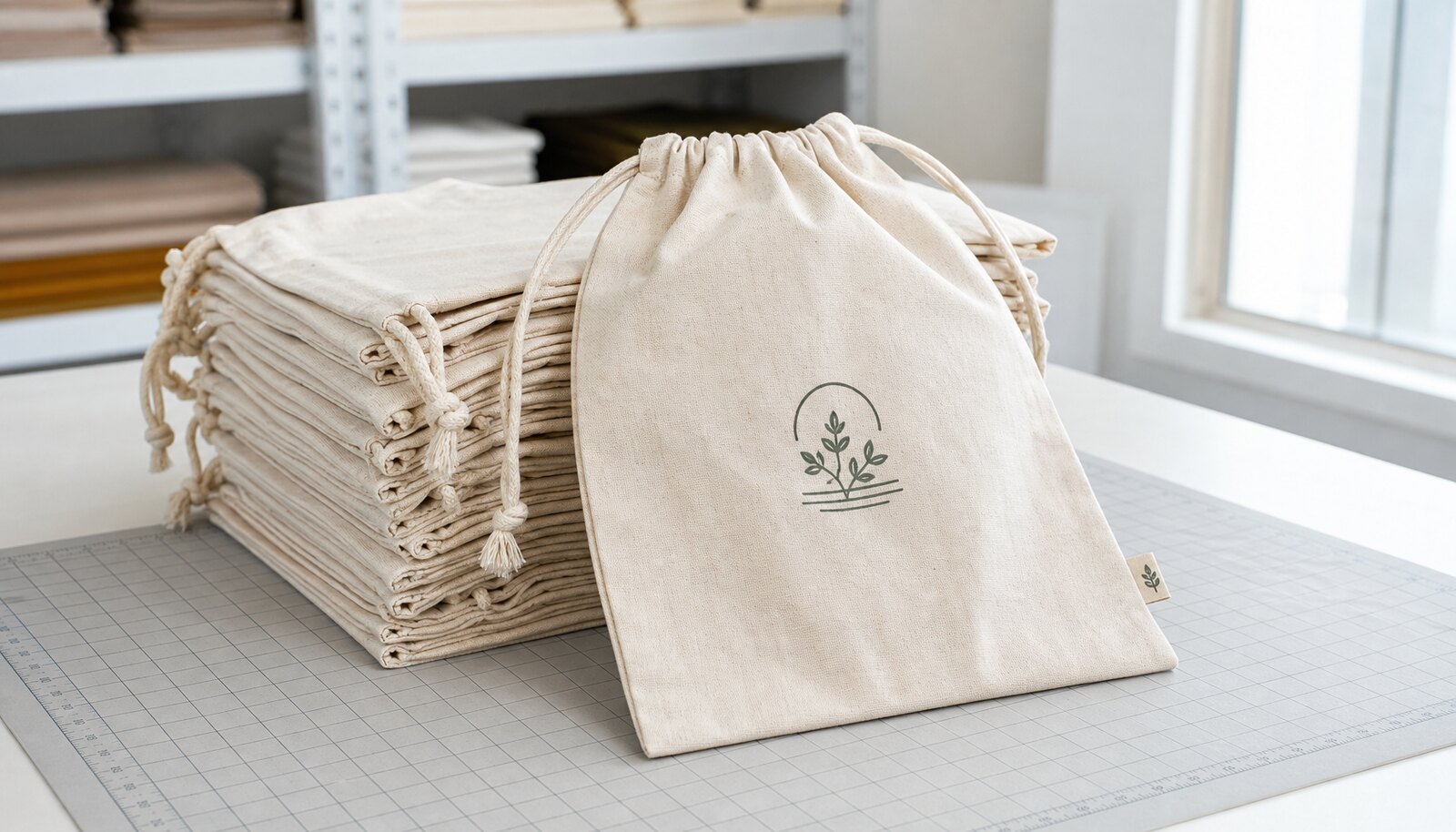
What buyers should mean by a printed cotton drawstring bag
A printed cotton drawstring bag is not one fixed product. In practice, buyers are usually choosing between a light muslin pouch, a midweight cotton gift bag, or a heavier retail pouch with better body and better print hold. The first sourcing mistake is treating all of them as the same item. Once you define the use case, the factory can choose the right cloth, seam allowance, cord, and print process without guessing.
For procurement, the bag spec should read like a production instruction, not a marketing name. State the usable internal size, cotton type, GSM, print position, bag color, closure style, and packing requirement. If the bag will hold cosmetics, candles, jewelry, or small apparel, the spec should also reflect surface feel, stain visibility, and whether the print needs to remain crisp after handling and folding.
- Use the end use to set the spec: giveaway, retail packaging, subscription box insert, or reusable carry bag.
- Treat the fabric and print as one system, because thin cotton can distort a logo that looks fine on paper.
- Ask for the factory's standard cutting allowance and shrinkage assumption before approving dimensions.
- If the product will be shelf-displayed, define the front face and the cord exit position so the logo lands where buyers expect.
Choose the cotton fabric and GSM first
Fabric weight drives almost everything buyers later complain about: hand feel, opacity, seam strength, print appearance, and cost. For printed cotton drawstring bags, light promotional pouches often sit around 110 to 130 GSM, while more durable retail or gift bags usually sit closer to 140 to 180 GSM. Heavier cloth gives a cleaner body and better perceived quality, but it also raises fabric cost, sewing time, and shipping weight.
The base cloth matters as much as the weight. Natural unbleached cotton is common when the buyer wants a neutral, sustainable look, but specks and fiber variation are normal and should be accepted if the material is not bleached. White or dyed cotton gives more predictable print results and stronger contrast for fine logos. If the bag is expected to carry darker products or survive repeated handling, ask for a sample of the exact cloth, not a similar-looking substitute.
- 110 to 130 GSM: suitable for light promotional packaging and low-cost event use.
- 140 to 160 GSM: a balanced range for retail inserts, gift packaging, and repeat use.
- 160 to 180 GSM and above: better when the bag needs more structure or stronger perceived value.
- Natural cotton: lower visual contrast, more texture, and a less uniform base for small text.
- Bleached or white cotton: better for fine-line logos, small type, and higher print contrast.
Pick the print method before you compare quotes
The print method should be chosen based on artwork complexity, quantity, and expected wear. Screen printing is usually the cleanest route for one to four solid colors and medium or higher volume. It has a setup cost, but the unit price becomes efficient once the order size is stable. Heat transfer can work for short runs or multi-color artwork, but buyers should test whether the printed layer feels too stiff or cracks after folding. Direct-to-garment can handle full-color artwork on cotton, but it is not always the most economical option for bulk if the design is simple.
If a supplier offers an unusually low quote, the print method is often where the hidden difference sits. A quote that says 'printed' without naming the process is not complete enough to compare. Ask whether the factory is using screen print, DTG, heat transfer, or another method, and make sure the same artwork is being quoted on the same fabric. If the supplier suggests sublimation on cotton, that is usually a red flag unless the fabric blend and process are clearly explained and proven on sample.
- Screen print: best for simple logos, lower setup risk, and consistent repeat orders.
- DTG: useful for detailed artwork or short runs, but confirm wash and rub performance.
- Heat transfer: good for short lead times, but check hand-feel and cracking after folding.
- For dark cotton, ask how the factory is handling underbase coverage and color opacity.
- Request a printed strike-off on the exact cloth, not just a digital proof.
Construction details that change cost and durability
A drawstring bag fails when the seams, cord channel, or opening dimensions were not defined well enough. Buyers should think through how the bag opens, how much product it needs to hold, and how the cord should feel in hand. If the opening is too narrow, packing speed drops and the customer experience suffers. If the cord channel is too weak, the bag can fray after a few uses or pull out under load. The cheapest quote is often the one that leaves those details out.
The bag body and the closure should match the product inside. For small light goods, a single cord on one side may be enough, but a double drawstring is more common for better opening control and a more balanced look. Ask for the stitch type, seam allowance, and reinforcement at the corners or cord exits. If your team is buying for retail or brand packaging, also define whether the drawcord ends should be knotted, heat sealed, or finished with tips so the bag looks deliberate instead of improvised.
- State usable width and height, not only the flat cut size on the quote.
- Define whether the bag needs a gusset for box-shaped products or a flat body for slim items.
- Ask for reinforcement at the cord openings if the bag will carry repeated load.
- Keep artwork away from seam allowances and cord exits so print placement does not shift after sewing.
- Specify cord material and cord thickness because visual weight affects perceived quality.
Compare sourcing routes, not just unit price
Printed cotton drawstring bags can be sourced through several routes, and each route changes the risk profile. A direct factory is usually best when the spec is stable and the buyer wants lower unit cost and tighter control over fabric, sewing, and print. A trading company or sourcing agent can reduce coordination burden if the order includes multiple packaging items, but the buyer should still understand which factory is actually making the bags. Local decorators and print shops can be useful for speed, yet they often rely on standard blanks that may not fit the product or the brand standard.
The right comparison is not 'who is cheapest' but 'who controls the variables that matter to my order.' For a product with repeatable artwork, a direct factory with in-house printing often gives the most predictable result. For low volume or urgent promotions, a domestic converter can win on speed even if the unit cost is higher. The best quote is the one that makes the hidden work visible: fabric source, print setup, packing detail, and who owns defects if the result misses the approved sample.
- Compare print setup charges, not only unit price.
- Compare MOQ by size and artwork color, not only total order value.
- Compare packing detail, because carton count and individual wrapping affect both labor and freight.
- Compare sample lead time, since a slower sample stage can delay the bulk order more than a small price difference saves.
- Compare who signs off on QC, because unclear ownership creates rework disputes.
Comparison table: supplier routes for printed cotton drawstring bags
Use the table below as a sourcing filter. It is designed for procurement teams that need to compare supplier routes on operational terms, not just on price. The same printed cotton drawstring bag can be quoted very differently depending on whether the supplier owns the fabric, the printing, and the packing line.
If two quotes look close, the differences usually show up in print consistency, sample speed, carton control, and how much manual follow-up your team will need after the PO is issued. That is where budget turns into real landed cost.
- Write decisions in measurable language, not only descriptive wording.
- Ask for sample photos plus one physical approval sample for important orders.
- Keep quotation, sample approval, and inspection notes tied to the same spec version.
MOQ logic and the sample path
MOQ for printed cotton drawstring bags is rarely arbitrary. It usually comes from fabric roll minimums, print screen setup, labor efficiency, and packing configuration. Simple one-color screen prints on a standard size can support smaller MOQs because the factory can run the order through a simple line with limited changeover. Multiple colors, special sizes, woven labels, or custom dyed fabric usually push MOQ upward because the factory has to order or reserve more material and dedicate more setup time.
A clean sampling path prevents expensive misunderstandings. Start with a blank sample if the cloth and size are still open, then move to a printed strike-off on the exact fabric, and finally approve a pre-production sample that reflects the final stitching, print location, and packing. If the supplier only wants to send a digital proof, that is not enough for cotton. Cotton absorbs ink and shifts appearance, so the sample must show the real hand-feel and color behavior.
- Blank sample: confirms fabric weight, feel, and measurements.
- Printed strike-off: confirms artwork size, color, and print quality on the chosen cloth.
- Pre-production sample: confirms full construction, cord finish, and pack-out.
- Set the sample approval owner on your side before the factory starts bulk cutting.
- Ask whether sample fees are credited back against the bulk order.
QC points that stop the common defects
The most common defects in printed cotton drawstring bags are not dramatic. They are the small deviations that make a product feel cheap: print slightly off center, seams wandering at the opening, cords that do not match in length, or stains on light fabric. Buyers should define the defect line before production starts. If a misaligned logo is acceptable for a giveaway bag but not for retail packaging, that distinction should be written into the order. Otherwise the factory will inspect to its own internal standard, which may not match yours.
If your team uses AQL, align the inspection approach to the product's visible surface and end use. A bag with a large centered logo should have a tighter visual standard than a plain utility pouch. The print should be checked under normal daylight or an agreed light box condition, and measurements should be taken from the actual production sample, not from the artwork file. The goal is not perfection; the goal is predictable acceptance criteria that a factory can actually meet at volume.
- Check logo placement, rotation, and registration on every sampled carton.
- Measure bag dimensions across a sample set, not just one piece.
- Inspect seams, cord channels, and knot security for loose ends or weak points.
- Reject visible stains, oil marks, or heavy weave defects unless pre-approved as natural material variation.
- Verify that folded pack shape does not crease or crack the print.
Packing and labeling affect both cost and retail readiness
Packing is part of the product, not an afterthought. A bulk-packed order may be cheaper, but retail and distributor channels often need individual polybags, barcode labels, care labels, or carton marks. If the bag will be sold on a shelf or inserted into another pack, define those requirements in the RFQ so the supplier can price them before production. Otherwise the quote looks competitive until the packing add-ons appear later.
The folding method also matters. Printed cotton can develop crease memory, especially after pressing or tight carton packing. If the logo sits near a fold line, the image can look damaged even when the print itself is fine. Ask the supplier to show a pack-out sample or packing photo before bulk shipment. This is a low-cost step that often prevents complaints from warehouse teams and retail buyers who expect the bag to arrive presentation-ready.
- Specify whether the bags ship bulk, individually polybagged, or retail ready.
- Define carton quantity, gross weight target, and carton size if freight is sensitive.
- Add barcode, SKU, or carton mark instructions before the quote is issued.
- Request a pack-out photo for the final folded bag orientation.
- Confirm any warning labels or country-of-origin marks required in your market.
Lead time and landed cost need to be quoted together
Lead time for printed cotton drawstring bags usually has more than one stage: artwork approval, sample making, material sourcing, bulk production, packing, and shipping. A supplier that quotes only a single calendar number without explaining the stage breakdown gives you too little to manage the order. Fabric availability can be the hidden delay, especially when a specific GSM, color, or finishing method is not in regular stock. Seasonal congestion around holidays can also stretch a normal schedule even when the factory itself is efficient.
Landed cost is where many buyers discover that two quotes are not actually comparable. The real comparison should include the bag unit price, print setup, sample fees, packing format, cartons, inland transport, export documents, and the shipping mode you plan to use. A cheaper FOB quote can become more expensive than a slightly higher ex-works quote if the second supplier has better carton packing, lower defect rate, or fewer reprints. The goal is to compare the total order cost, not the headline number.
- Break lead time into sample, material, production, and shipment stages.
- Ask whether the quote includes overs or a small buffer for printing and sewing loss.
- Request the same Incoterm from each supplier before comparing numbers.
- Include carton size and packing count in your freight estimate.
- Use the approved sample as the benchmark for any rework or rejection claim.
Specification comparison for buyers
| Spec decision | Recommended option | When it fits | Buyer risk to check |
|---|---|---|---|
| Direct factory in a cotton bag region | Best for repeat orders, stable artwork, and lower unit cost once tooling is set | You have a clear spec, enough lead time, and want control over fabric, print, and packing | Confirm whether the factory actually prints in-house or outsources the decoration stage |
| Trading company or sourcing agent | Useful when you need several product types or do not have time to manage factory follow-up | You are consolidating bags with other packaging items or need support across suppliers | Check who owns QC responsibility and whether sample approvals are passed through correctly |
| Local decorator using imported blanks | Good for short runs, domestic delivery, or fast event deadlines | You need quick turnaround and the print itself matters more than custom construction | Verify blank bag quality, seam strength, and whether the blank fabric matches your final use |
| Print shop working from stock blanks | Works for simple logos and promotional giveaways with low customization | You want a fast re-order path and can accept standard bag sizes and colors | Watch for limited size choices, inconsistent blank fabric lots, and weak packing control |
| Integrated bag factory with in-house printing | Strong choice for retail or brand packaging when you need matched fabric and print control | You care about repeatability, carton packing, and tighter defect control | Ask for proof that the print method matches the fabric weight and color you specified |
| Small workshop or artisanal supplier | Can suit niche designs, hand-feel requirements, or very low volumes | You are testing a concept or need special finishing not offered by larger plants | Check sewing consistency, measurement tolerance, and whether capacity scales beyond the sample stage |
| Vertical exporter with QC team | Best for buyers who need export-ready paperwork, pre-shipment inspection, and clear escalation | You want one supplier to manage production, packing, and shipping documents | Confirm inspection standards, photo reporting, and who signs off on rework before shipment |
| Domestic converter using offshore fabric | Can work when you need local communication with lower fabric cost than fully domestic production | You are balancing responsiveness with budget and do not need the absolute lowest landed cost | Verify fabric traceability, print durability, and whether fabric shrinkage was accounted for before cutting |
Buyer checklist before sampling
- Lock the bag size as usable internal dimensions, not just flat cut size, and define whether the bag needs a gusset.
- State fabric weight in GSM and the cotton type, such as unbleached muslin, bleached cotton, or canvas-like cotton.
- Specify print method, print colors, print placement, and the acceptable color tolerance for the logo or artwork.
- Define cord type, cord color, closure style, and whether the cord ends need knots, heat sealing, or metal tips.
- Set the packing method, carton count, polybag requirement, and retail label needs before asking for pricing.
- Request a pre-production sample or approved strike-off before bulk cutting starts.
- Ask for the factory's defect criteria on print registration, seam strength, measurement tolerance, and stain control.
- Confirm Incoterms, lead time by stage, and whether the quote includes overs, spares, and reprint setup charges.
Factory quote questions to send
- What exact fabric composition and GSM are you quoting, and is the weight measured before or after washing and finishing?
- Which print method are you proposing, how many colors are included, and what is the setup charge per design or per size?
- What is the MOQ by size, print color, and carton pack, and does the MOQ change if we approve multiple artwork versions?
- What are the measurement tolerances for bag body, cord length, seam allowance, and print placement?
- Can you send a blank sample, a printed strike-off, and a pre-production sample for approval before bulk?
- What packing format is included in the unit price, and what extra charges apply for individual polybags, barcodes, or hang tags?
- What is your standard production lead time after sample approval, and how much time should we allow for fabric sourcing?
- Which documents and photos will you provide before shipment, including carton count, inspection photos, and packing list details?
Quality-control points to confirm
- Print alignment should stay within the agreed tolerance, especially near center logos and edge-to-edge artwork.
- Color should match the approved sample or strike-off under the agreed lighting reference, not only on-screen artwork.
- Seams should be straight, secure, and free from skipped stitches, loose thread tails, or weak stress points at the cord channel.
- Cord length should be consistent across the lot, with both ends secured the same way unless the spec says otherwise.
- Bag size should fall within the measurement tolerance on width, height, gusset, and usable opening width.
- Fabric should be free from oil marks, weave damage, obvious slubs that were not approved, and visible contamination on white goods.
- Packing should match the carton count and folding direction in the approved pack-out sample, with no mixed sizes unless specified.
- If retail use is planned, labels, warnings, barcodes, and country-of-origin marks should be present and readable on every unit or carton as required.