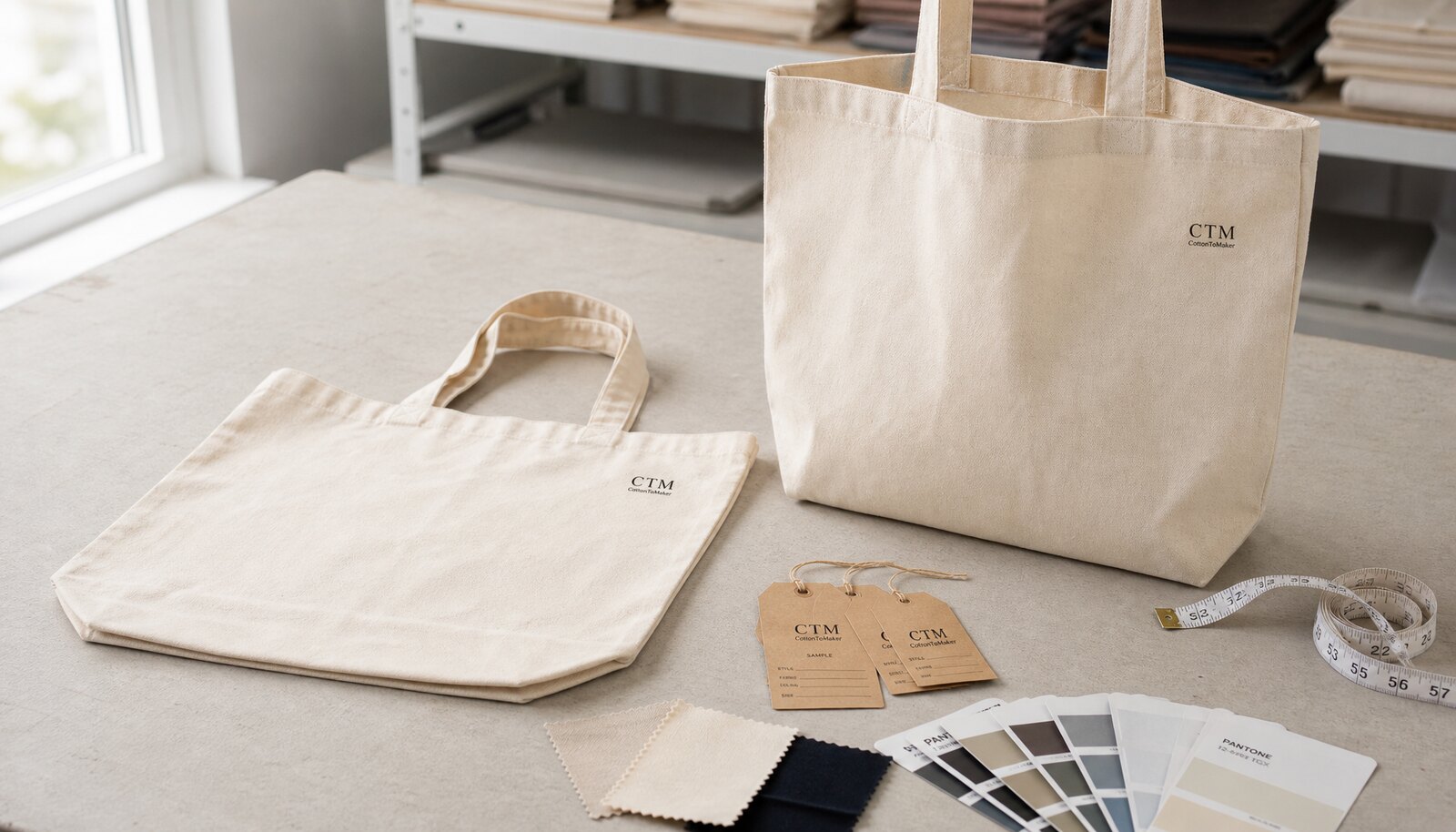
What buyers really mean by no minimum order
When buyers search for printed cotton bags no minimum order, they usually do not mean the factory can produce one piece at standard bulk pricing. They mean the supplier will accept a very small run without forcing a large fabric commitment, a high carton MOQ, or a design-level minimum that makes the quote unusable. The real buying job is to find out where the supplier is flexible and where the cost floor still exists.
For procurement, that distinction matters. A supplier may accept 50 pieces, but still charge a screen setup fee, a print-position fee, and a handling fee that make the landed unit cost look nothing like the first email quote. The right RFQ should separate the bag, the decoration, the packing, and the delivery method so you can compare quotes on the same basis.
- Small orders are usually priced by setup effort, not by fabric cost alone.
- No minimum order often means flexible quantity, not free customization.
- The cheapest quote is often the one that leaves out printing or packing details.
Choose the bag spec before you ask for printing
Do not start with artwork. Start with the bag structure, because that is what controls handle strength, print flatness, and the usable area for your logo. For most buyers, the practical starting point is a natural cotton tote in the 120-140 gsm range for simple promotional use, or 180 gsm if the bag needs more body, better shelf feel, and less show-through under print.
The bag size should match the use case. A common shopping or giveaway tote is around 35 x 40 cm with a 60-70 cm total handle length, but your product, catalog, or gift pack may require a taller body or longer shoulder drop. Ask the supplier to quote the same print on two or three fabric weights so you can see how the bag behaves before you commit to a larger repeat order.
- 120-140 gsm works for light promo use and lower landed cost.
- 180 gsm is easier to present as a retail or brand-merchandise item.
- Reinforced handles and a stable bottom seam matter more than buyers expect on small runs.
Print method drives both price and risk
For short runs, screen print is usually the default because it is cheap per unit once the artwork is fixed, and it handles solid logos well. The tradeoff is setup: each color, location, and size change can add cost, and fine detail can break down on coarse cotton weave. If your logo is bold, one or two colors, and you want predictable repeatability, screen print is usually the cleanest option.
If the artwork uses many colors, small type, or a full-color illustration, you may need heat transfer or digital decoration depending on the factory's equipment. Those methods can be better for tiny quantities, but they also introduce different failure modes: cracking, edge lift, poor wash durability, or visible film edges. The buyer should ask for a sample of the exact method on the exact fabric, not a generic decoration sample on a different bag.
- Limit the artwork to large shapes and readable line weights for the lowest-risk short run.
- If you need fine text, keep it larger than the supplier's minimum readable size.
- Ask for print placement marks on the sample so you can judge centering and scale.
How MOQ logic actually works in small runs
A no-minimum offer is usually built from one of four sourcing routes: factory direct with leftover fabric or stock bodies, a decorator that prints third-party blanks, a trading company that combines orders, or a local supplier that holds ready-made stock. Each route solves a different problem. Factory direct gives better control over fabric and sewing, while decorator-led sourcing can be faster for one-off artwork on existing blanks.
The buyer risk is that each route hides a different cost floor. Factory direct may need a minimum by fabric color or print screen. A decorator may charge high handling on blank bags that were not designed for your decoration method. A trading company may be convenient for coordination, but you should ask who actually owns the fabric, who prints it, and who is responsible if the logo shifts or the seams fail. Use the comparison below to choose the route that matches your volume and risk tolerance.
- Small quantities are easiest when the supplier already has the right body in stock.
- A factory quote is only comparable if the same fabric, size, and packing are used.
- Route choice should follow your timeline, artwork complexity, and control requirements.
Supplier routes compared for printed cotton bags
The best supplier is not always the cheapest one. For a short run, the right route is the one that gives you the fewest hidden assumptions: the exact fabric, the exact print method, and the exact packing standard. When those are unclear, the order tends to drift into re-quoting, sample revisions, and missed ship dates.
Use supplier evidence as part of the quote comparison. A credible factory should be able to show a recent sample image, a clear spec sheet, the method used for the sample, and a straightforward explanation of what changes when the order size doubles. If the answer is vague, the risk usually appears later as a price increase, a print mismatch, or a sewing variation.
- Factory direct: best for control, better for repeat orders, slower if the sample room is busy.
- Decorator on stock blanks: fastest for very small runs, but fabric choice is fixed.
- Trading company: useful for coordination, but only if the final production route is named in writing.
- Local supplier: good for emergency timing, but verify whether the bag is actually cotton canvas or a lighter cotton weave.
Quote structure: read beyond the unit price
On a small order, the unit price is only one line in the commercial picture. A quote for printed cotton bags should separate blank bag cost, print setup, decoration per color, sample charge, packing, carton cost, and freight term. If the supplier collapses everything into one number, you may not discover a hidden surcharge until the artwork is already approved. That is where buyers lose time and margin.
Ask for a stepped quote so you can compare the economics of 50, 100, 300, and 1,000 pieces. In many cases, the unit price falls sharply once the print setup is spread across a larger quantity, but the real landed-cost difference may be smaller after freight and carton charges. If the supplier can quote multiple gsm options, you can see whether a slightly heavier bag gives better perceived value without a major cost jump.
- Compare quotes on the same basis: size, gsm, print colors, and packing.
- Separate sample cost from production cost.
- If a quote is unusually low, look for missing setup, packing, or freight assumptions.
Sample approval should be practical, not theoretical
For a no-minimum order, the sample is not a formality. It is the only chance to confirm that the cotton accepts the print cleanly, that the bag sits flat enough for placement, and that the handle stitching can survive use. A good sample review includes the actual artwork file, the actual fabric weight, and the intended packing method, because all three affect the final result.
The approval note should be specific. Record the approved bag size, print size, print position measured from the top edge and side seam, and any accepted variation in color tone. If the supplier sends a revised sample after comments, compare it against the previous version and not against memory. That simple discipline avoids production arguments when the bulk order arrives and everyone remembers the sample differently.
- Measure print placement from the same reference points every time.
- Reject samples that only look good in photos if the print edges or seam quality are unclear.
- Approve the sample in writing before fabric cutting or screen preparation begins.
Packing, labeling, and export details matter more on small orders
Small orders often fail in the boring parts: packing count, carton dimensions, and label accuracy. If the buyer needs retailer-ready bags, the factory may have to fold each bag to a fixed size, insert a card, add a barcode sticker, or use a specific polybag thickness. Those steps take labor, and they should be quoted explicitly so the production team does not improvise on the floor.
For export, ask the supplier to state the inner pack count and the master carton count in the quote. Cotton bags are light but bulky, so carton size affects freight cost and warehouse handling. If the order is going through fulfillment or retail distribution, ask for the carton specification before production starts so the packaging standard matches the downstream receiving process.
- State whether the bags should be bulk packed, individually polybagged, or retail folded.
- Ask for carton dimensions and gross weight, not just piece count.
- Labeling requirements should include SKU, country of origin, and buyer-specific carton marks if needed.
Lead time risk is usually approval risk
A small order can move quickly only if the artwork and sample approvals stay tight. The supplier may quote seven to fourteen days for a sample-based run, but that timeline usually assumes fast feedback, no changes to the logo file, and no delay in confirming packing. The actual schedule should be counted from artwork approval and deposit receipt, not from the first inquiry email.
Build in a buffer for the most common delay points: artwork revision, color confirmation, print screen preparation, and carton label changes. If your launch date is fixed, send the supplier the deadline in calendar terms and ask them to mark the latest safe approval date. That gives you a usable production window instead of a vague promise that turns into expedited freight later.
- Treat sample approval and bulk approval as separate milestones.
- Ask whether lead time includes fabric sourcing or only sewing and print.
- If timing is tight, choose fewer colors and a simpler print layout.
When a no-minimum order should turn into a planned repeat program
A no-minimum order is often the entry point, not the final buying model. If the design performs well, the next order should move toward a planned repeat program with locked fabric weight, confirmed print method, and a stable packing spec. At that stage, the supplier can usually reduce setup waste, and you can compare year-over-year pricing with less noise from one-off charges.
The commercial goal is not to keep buying at tiny quantities forever. It is to use the small run to validate material feel, print clarity, and customer acceptance, then turn the approved spec into a repeatable procurement item. That is the point where you can negotiate more cleanly on fabric lot consistency, lead time priority, and carton efficiency without re-litigating the basic product definition.
- Use the first order to prove the spec, not to chase the lowest possible sticker price.
- If sales velocity is strong, lock the approved sample as the reference for repeat buying.
- A good short run should create a cleaner RFQ for the next order, not a new design discussion.
Specification comparison for buyers
| Spec decision | Recommended option | When it fits | Buyer risk to check |
|---|---|---|---|
| Fabric weight | 120-140 gsm for budget promos; 180 gsm if the bag must feel retail-ready | Low-unit orders where price matters but the bag still needs enough body for printing and shelf appeal | Thin fabric can show ink strike-through, seam distortion, and poor shape after packing |
| Print method | 1-2 color screen print for the lowest unit cost; heat transfer or digital print for multicolor short runs | Small orders, logo-only artwork, or test-market launches with limited SKU count | Setup charges can erase the value of a small order if artwork changes later |
| Bag construction | Simple stitched tote with self-fabric handles and single-bottom seam for promo use; reinforced stress points for reorders | Sampling, events, influencer kits, and first-time market tests | Weak handle attachment is the most common failure when buyers focus only on print and ignore sewing spec |
| Supplier route | Factory direct for repeatable samples; trading company or local decorator for very small emergency runs | When the order is tiny and the buyer needs fewer internal steps | Middlemen can hide the real fabric weight, sewing method, or print subcontracting risk |
| MOQ structure | No minimum on total order value, but expect a minimum by print color, design, or fabric lot | When you want flexibility across designs or regions | A supplier may say no MOQ but still require a setup fee or charge a high short-run premium |
| Artwork complexity | Flat logo, bold lines, limited halftones, one print location | Short runs where you need predictable yield and fast approval | Fine text, gradients, or edge-to-edge coverage fail more often on cotton weave |
| Packing style | Bulk packed by count in polybag/carton unless retail folding is required | B2B promotional supply and distributor replenishment | Retail-ready folding, insert cards, and barcode labels add labor that should be priced separately |
| Lead time | 7-14 days for sample or stock-based small runs; 15-30 days if fabric, print, or labeling is custom | Launches with firm but realistic timelines | Rush promises often exclude artwork approval time, fabric sourcing, or reprint risk |
Buyer checklist before sampling
- Confirm fabric weight in gsm, bag size, handle length, seam type, and whether the cotton is bleached, natural, or dyed.
- Specify print method, number of colors, print area, and whether the logo needs front, back, or gusset placement.
- Request a sample or pre-production photo of the exact fabric and print method before production starts.
- Ask for unit price, setup fee, sample fee, carton fee, and any surcharge for mixed designs or color changes.
- State packing requirements, carton quantity, barcodes, carton marks, and whether polybags are required.
- Verify lead time from artwork approval, not from inquiry date, and separate sample lead time from mass production lead time.
Factory quote questions to send
- What is the exact fabric weight in gsm, and can you confirm whether it is measured before or after finishing?
- Is the price based on blank stock, printed production, or a decorated subcontracted process?
- What is the minimum charge for one design, one print color, and one size?
- Can you quote the same bag in 120 gsm, 140 gsm, and 180 gsm so we can compare landed cost?
- What print method do you recommend for this artwork, and what line thickness or font size is safe?
- What is included in the quote: sample, plate, screen, setup, packing, and carton labeling?
- What is the expected shrinkage after washing or steaming, if the bag will be cleaned by the end user?
- How many pieces per carton, what is the carton size, and what is the gross weight for export planning?
Quality-control points to confirm
- Fabric weight tolerance should stay within the agreed gsm range, with no obvious thin spots or yarn slubs in the print area.
- Logo position should match the approved artwork placement with a practical tolerance, especially when the bag is folded or gusseted.
- Print should be even, opaque enough for the fabric color, and free from smudging, pinholes, or misregistration.
- Handle stitching should be reinforced and symmetrical, with no skipped stitches, loose threads, or puckering at the attachment point.
- Seams should be straight and secure, with acceptable seam allowance and no open ends at the side or bottom.
- Cartons should match the declared count, preserve the bags from dust and moisture, and carry the correct marks and SKU labels.
- If polybags are used, they should not wrinkle the print, trap moisture, or create scuffing during transit.
- Approved sample and bulk production should match on fabric handfeel, print sharpness, and overall bag shape.