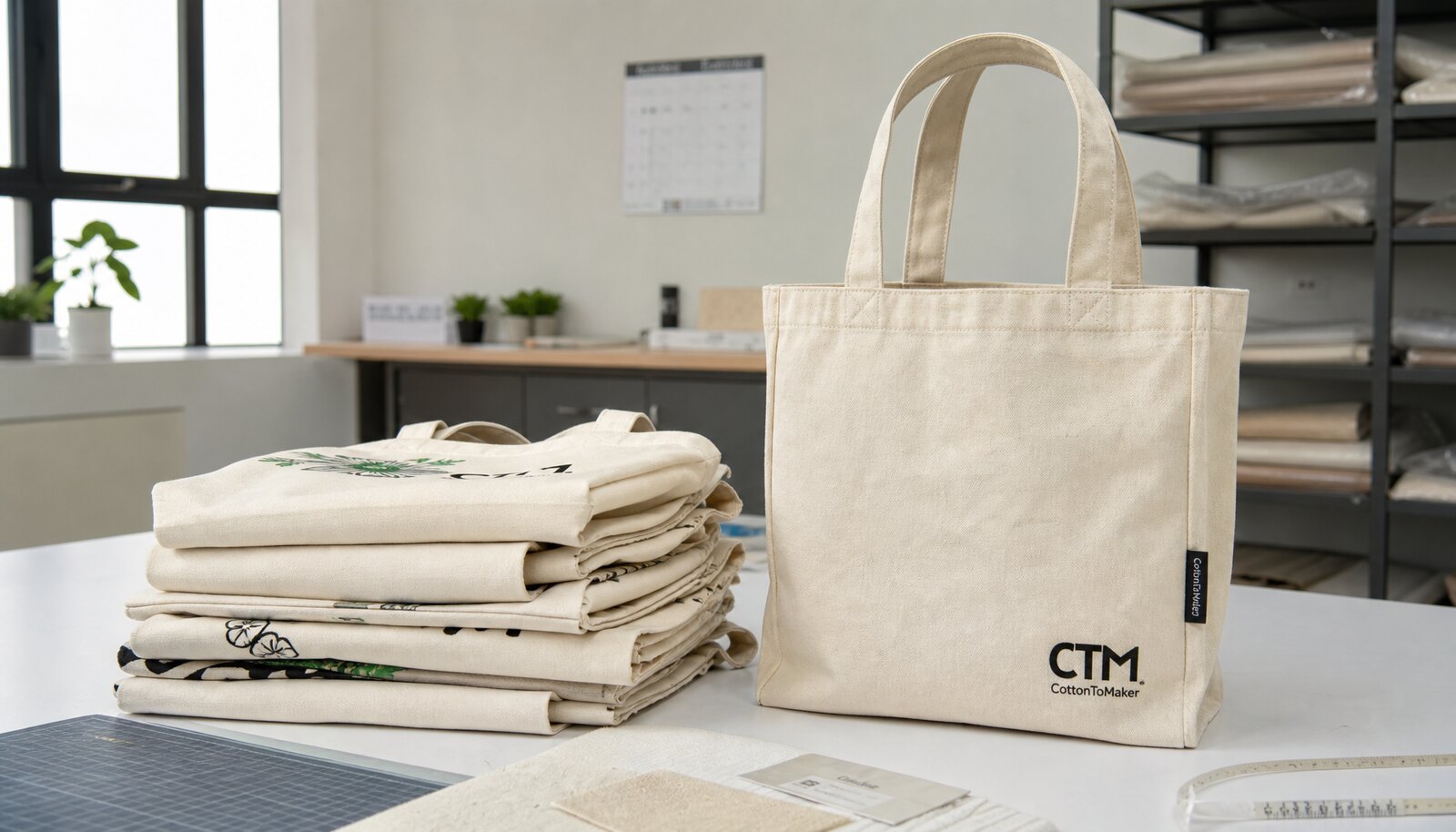
Why wellness brands need a tighter sample approval process
Wellness buyers usually want a tote that feels clean, natural, and retail-ready, but the first sample often hides the real production risk. A bag that looks fine in a photo can still fail on fabric hand feel, print sharpness, stitching strength, or packing efficiency once it moves into bulk. If the tote will carry supplements, skincare sets, yoga items, or membership kits, the sample has to prove that it can hold shape, present the logo clearly, and survive repeated handling.
For printed canvas shopping bags for wellness brands, sample approval is not only about visual approval. It is the point where procurement locks the bag structure, print method, fabric weight, and packing method that determine the landed cost and the actual retail quality. A weak approval process usually creates one of two problems: the bulk order arrives looking cheaper than the brand intended, or the factory has to rework approved details later and pushes the shipment date.
- Treat the sample as a production contract, not a showroom piece.
- Approve the exact fabric, print process, and trim combination that will run in bulk.
- Tie the sample sign-off to a written PO line so there is no ambiguity later.
Start with the right bag spec, not just the logo
Most quote problems begin with a vague spec. A wellness buyer may say “premium cotton tote with printed logo,” while the factory quotes a basic 8 oz canvas bag, a low-cost screen print, and standard short handles. That may be acceptable for a giveaway, but it will not support a retail wellness launch or a higher-end membership kit. The sample stage should force the team to confirm the finished bag size, gusset depth, handle length, and fabric weight before anyone talks about decoration details.
For this category, the common working range is 10–12 oz canvas, or roughly 340–420 GSM. That range gives enough body for daily use without making the tote too stiff or expensive to sew. If the bag needs a more premium feel, a slightly heavier fabric can help the print sit better and reduce wrinkling. If your target is a lighter promotional bag, stay aware that lower GSM often means more crease visibility, less structure, and a lower perceived value on shelf.
- Use finished dimensions in the RFQ, not only flat size.
- State whether you need self-fabric handles, cotton webbing, or reinforced straps.
- Decide early whether the tote should stand upright or remain soft and foldable.
Choose the print method based on art complexity and volume
Wellness branding often uses simple typography, line art, botanical marks, or a short slogan. That makes screen print the default choice for many bulk orders because it is repeatable and cost-efficient on simple one- to three-color artwork. If the art file has tight registration or a small logo, the factory needs to show a sample with the real ink density and edge detail before approval. A logo that looks crisp on screen can still bleed if the mesh count, squeegee pressure, or curing temperature are not right.
Heat transfer can help when the artwork has gradients, fine detail, or too many colors for an economical screen setup. It also works for lower-volume testing when the brand wants to move quickly. The tradeoff is durability and feel. Some transfers sit more on top of the fabric and can feel less integrated than a direct screen print. For a wellness brand that wants a natural retail look, a soft-hand screen print or water-based ink is often the better sample benchmark, provided the factory can hold the color and opacity required.
- For 1–3 spot colors, screen print usually gives the best cost-to-quality balance.
- For complex art or short runs, ask whether transfer is a temporary route or the final production method.
- Approve the same Pantone references and artwork scale that will be used in bulk.
Use a source-to-cost comparison before approving the sample
Not every factory is quoting the same product, even when the unit price looks similar. One supplier may quote a standard canvas tote with a basic print, another may include heavier fabric, stitched handles, and a retail pack-out, and a third may omit setup charges until later. That is why a buyer should compare sourcing routes, not just supplier names. The right sample approval decision depends on whether you are buying from a direct factory, a trading company, or a local decorator who outsources production.
The table below shows the practical tradeoffs a procurement team should compare before green-lighting the sample. The goal is not to choose the cheapest number on paper, but to see which route gives the most control over fabric, print quality, and delivery risk for printed canvas shopping bags for wellness brands.
Comparison table: supplier routes for wellness tote programs
Use the comparison below to judge where the sample and bulk order should be placed. The key is to match the sourcing route to your volume, art complexity, and deadline.
The sample record for printed canvas shopping bags for wellness brands sample approval checklist should include front, back, side, seam, logo, label, inside, and packed-carton photos. For important programs, keep one signed physical sample and record the sample version in the approval file.
- Write decisions in measurable language, not only descriptive wording.
- Ask for sample photos plus one physical approval sample for important orders.
- Keep quotation, sample approval, and inspection notes tied to the same spec version.
What to inspect on the physical sample
A useful sample approval process reads like a production audit. Start with the fabric itself: weight, weave density, hand feel, and whether the color is consistent across front, back, and gusset. Then move to print placement, edge sharpness, ink opacity, and whether small text remains legible. After that, test the stitching and handles. A premium tote can fail a basic pull test if the handle join is weak or the seam allowance is too narrow.
The sample should also tell you how the bag behaves in use. Open and close it, check whether the mouth stays open enough for packing, and see how the tote folds after handling. If the bag is meant to sit in a retail display, the bottom panel and side seams need to hold shape. If it is meant as a wellness kit carrier, the inside should be clean, free from loose threads, and packed in a way that does not make the bag look wrinkled or distorted when the customer opens it.
- Verify print size against the intended front panel, not against the artwork file.
- Check seam symmetry, handle alignment, and reinforcement stitching at stress points.
- Reject samples with oil marks, broken yarns, print smear, or obvious color mismatch.
Set acceptance criteria before the sample is signed off
Sample approval becomes much easier when the buyer sets tolerances in advance. Size deviation on standard canvas totes is usually acceptable within a practical range, often around ±1 cm, but the same leniency should not apply to print placement or visible branding. If the logo is meant to sit centered or a fixed distance from the bottom seam, that measurement should be written into the approval sheet. The same applies to handle length and gusset depth, because a few centimeters can change how the bag carries or looks on shelf.
For wellness buyers, cleanliness is part of quality. The tote should not arrive with loose lint, surface staining, or uneven ink curing. If the bag is intended for retail or repeated use, a basic rub test, fold test, and inspection of ink transfer are worth doing before approval. If the product is destined for a promotional launch, then packed presentation matters just as much as the bag body itself. A good sample can still lose the order if the packing looks messy or inconsistent.
- Put numeric tolerances on size, print placement, and handle length.
- Use a written pass/fail standard for ink coverage, seam quality, and cleanliness.
- Link sample approval to the final packing configuration, not only to the bag construction.
Packing details that change both cost and shelf readiness
Packing is one of the easiest places to miss hidden cost. A factory quote may look competitive until the buyer adds individual polybags, barcode labels, tissue inserts, carton marks, and export cartons of a specific size. For wellness brands, packing often needs to feel neat because the bags may be sold through retail channels, bundled into kits, or distributed to franchise locations. If the packing spec is not set early, the factory may default to a cheaper loose pack that creates extra receiving work later.
The sample should be approved in the same pack format you expect in bulk. If the tote is sold as a retail item, an inner polybag can protect the surface from dust and scuffing. If the bag is part of a larger wellness set, the packing may need to support kitting or bulk carton loading instead. In either case, the carton count, carton dimensions, and label format should be aligned with the destination warehouse so the buyer can compare freight and storage cost accurately.
- Decide whether the unit ships loose, in polybag, or with retail inserts.
- Match carton size to warehouse handling and freight efficiency.
- Make barcode or SKU labeling part of the quote if the goods enter a distribution center.
Lead time, MOQ logic, and schedule risk
For standard printed canvas totes, a reasonable planning model is often 5–10 days for sampling and about 20–35 days for bulk after sample approval, assuming the artwork is final and the factory has the base fabric in stock. Custom fabric dyeing, special wash effects, laminated inserts, or more complex trim can extend that schedule. If the launch date is fixed, the buyer should treat sample turnaround as part of the critical path, not a side task that can be handled later.
MOQ should be read in context. A factory may offer a lower MOQ if you use its standard tote body and change only the print and label. If you ask for custom size, custom color, special handles, or upgraded packing, the MOQ and setup cost usually rise together. That is normal. The better sourcing decision is to align the order structure with the first commercial run: test smaller quantities with a standard body, then move to a more customized version once the market response is proven.
- Use standard body styles to keep sample approval and MOQ under control.
- Treat extra print colors, special trims, and custom packs as separate cost items.
- Build buffer time for revisions, not just for production.
How to read a factory quote without missing the hidden items
A good quote for printed canvas shopping bags for wellness brands should break out the main drivers: fabric weight, finished size, print colors, handle type, packing method, MOQ, sample charge, and freight basis. If these items are bundled into a single number with no detail, it becomes difficult to compare suppliers fairly. The buyer may think one supplier is cheaper when the quote actually excludes printing setup, packing labor, or the carton spec required by the destination warehouse.
The cleanest way to compare quotes is to normalize them to the same spec. Put the same artwork, same fabric weight, same handle length, same packing, and same destination on every request. Then compare not only the unit price but the true landed cost. A slightly higher ex-factory quote can still win if the supplier includes clearer pack-out, fewer rework risks, and a shorter approval loop.
- Ask whether the quote is ex-factory, FOB, or includes delivery to your forwarder.
- Compare setup fees, sample charges, and packing charges line by line.
- Use the same artwork file and the same pack spec across all suppliers.
Specification comparison for buyers
| Spec decision | Recommended option | When it fits | Buyer risk to check |
|---|---|---|---|
| Canvas weight | 10–12 oz unbleached or dyed canvas, roughly 340–420 GSM | Main retail bags for wellness brands, studio shops, and premium event resale | Too-light fabric can distort after print and make the bag look cheap; too-heavy fabric raises freight and sewing cost |
| Print method | Screen print for 1–3 spot colors; heat transfer only for short runs or complex art | Simple logos, clean brand marks, and repeatable bulk production | Fine lines, gradients, and small type may fill in or crack if the factory screens are not tuned correctly |
| Handle construction | Self-fabric handles or 25–30 mm cotton webbing with reinforced X-box stitching | Reusable shopping bags meant to carry heavier retail items or wellness kits | Short handles or weak stitch density lead to returns and failed load tests |
| Bag size | Medium retail tote around 38 x 42 cm with 10–12 cm gusset | General wellness retail, gift sets, and product bundling | A small artwork file can look too tiny on a large front panel; confirm print area against finished size |
| MOQ route | Use a factory standard base bag with custom print and label | When you need lower MOQ and faster lead time | A fully custom pattern, zipper, or lining can raise MOQ and sample charges significantly |
| Sample type | Pre-production sample made with final fabric, final print method, and final trims | Before bulk approval on any branded retail program | Sales samples or blank specimens can hide color shift, shrinkage, or stitch issues |
| Packing method | Individual polybag with carton pack count and barcode label if needed | E-commerce, wholesale distribution, and retail-ready inbound receiving | Poor carton pack planning causes warehouse repacking cost and carton damage in transit |
| Lead time structure | Sample 5–10 days, bulk 20–35 days after approval for standard canvas totes | Seasonal wellness launches and promotional windows with a fixed ship date | Artwork revisions, lab dips, or missing trim approvals can push production beyond the planned window |
| Quote basis | Quote by fabric weight, print colors, bag size, handle spec, packing, and destination | When comparing suppliers on true landed cost | A low unit price may exclude freight packaging, setup fees, or oversize carton charges |
Buyer checklist before sampling
- Final bag size, gusset depth, handle length, and finished seam allowance are stated in the sample approval sheet.
- Fabric weight is confirmed in GSM or oz, with the same fabric used on the sample and intended for bulk production.
- Print artwork is approved in the actual print method, color count, Pantone references, and print placement dimensions.
- Stitching is checked at handle joins, side seams, bottom corners, and any stress points with a clear load expectation.
- Fabric shrinkage, color consistency, and logo registration are acceptable after a wash or dry rub test if your product requires it.
- Packing method, carton count, carton size, barcode labels, and inner polybag or tissue requirements are written into the order.
- The factory has sent a sample approval photo set or physical sample with revisions marked before bulk starts.
- The quote includes setup charges, sample charges, packaging costs, and freight basis so the landed cost can be compared fairly.
Factory quote questions to send
- What is the exact fabric weight in GSM or oz, and can you confirm the same fabric roll will be used for bulk production?
- Which print method is included in the quote, how many colors are covered, and what is the setup charge per color or per screen?
- What finished bag size, gusset, handle length, and stitch reinforcement are priced in the quote?
- Is the quoted MOQ for the base bag, the print design, or the full order with packaging requirements included?
- What sample is included before bulk: blank sample, sales sample, or pre-production sample made with final materials?
- What packing is included per unit and per carton, and does the price change if we need barcode labels or hangtags?
- What is the lead time from sample approval to bulk completion, and what conditions can extend it?
- Which costs are excluded from the unit price, such as freight, customs, cartons, artwork changes, or extra color matching?
Quality-control points to confirm
- Artwork placement should stay within a ±5 mm tolerance unless the design is intentionally oversized or wraparound.
- Logo color should match the approved standard closely enough that it does not shift visibly against the bag color in retail lighting.
- Handle stitch density and reinforcement should be consistent and secure, with no skipped stitches or loose thread knots at stress points.
- Finished dimensions should remain within a practical tolerance, typically about ±1 cm on standard tote dimensions.
- Fabric should be clean, evenly woven, and free from holes, oil stains, broken yarns, or obvious slubs in the print area.
- The bag should stand or hold shape as intended for its market position; a premium wellness tote should not collapse like a flimsy promo bag.
- If the bag is washable or intended for repeated use, the print should not crack or peel excessively after the agreed test cycle.
- Cartons should protect the corners and handles, and carton labeling must match the packing list and PO exactly.