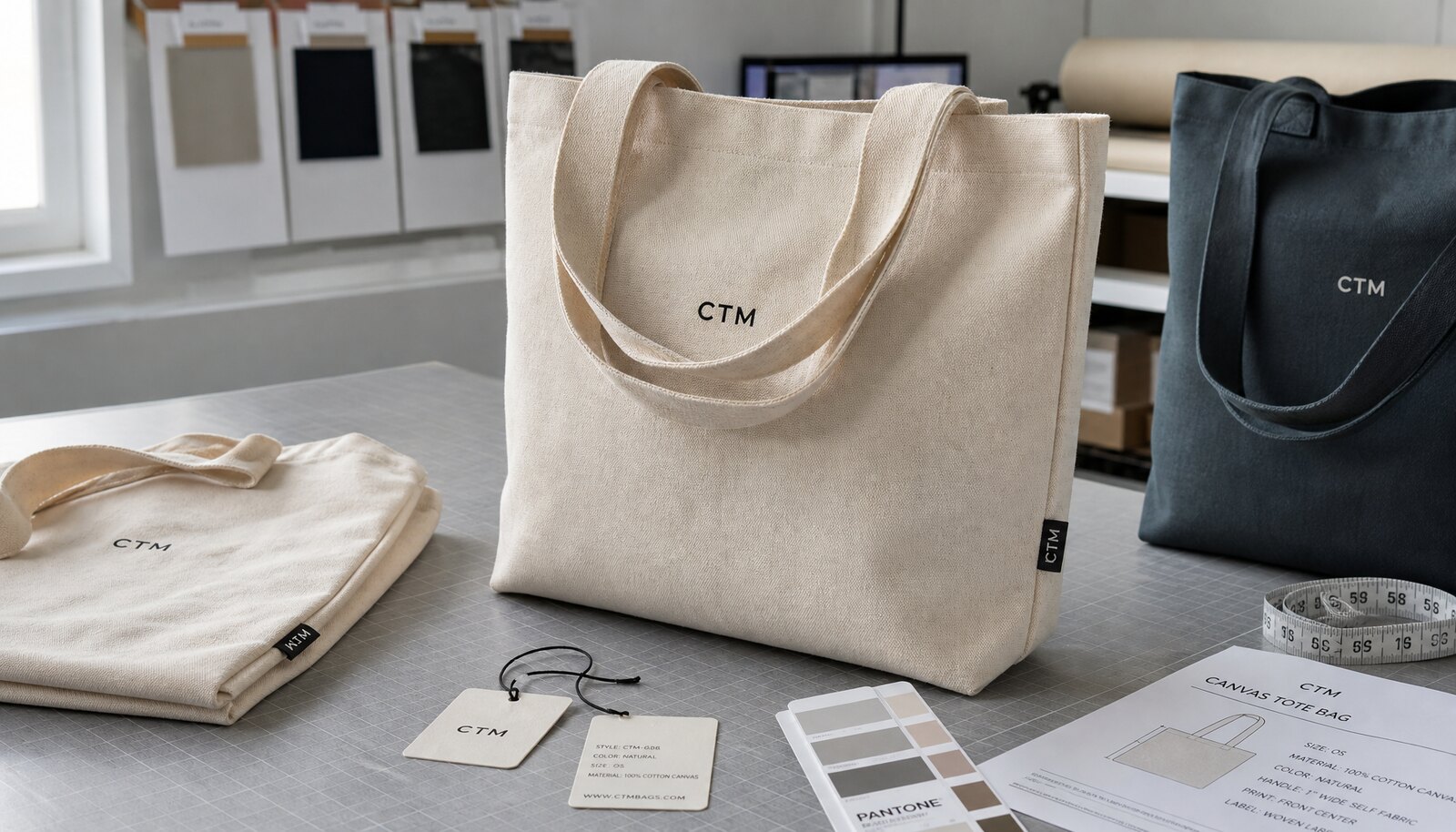
Why trade show canvas bag quotes go wrong
Printed canvas shopping bags for trade shows look simple on paper, which is exactly why quote mistakes happen. Many buyers compare only unit price and artwork proof, then discover the real difference later in fabric weight, print setup, handle sewing, and packing. For trade shows, those details matter more than a small price gap because the bags are handed out in bulk, carried all day, and judged by how they feel in the hand. A tote that feels soft, crooked, or flimsy can undercut a booth program that otherwise spent heavily on design and inventory.
The safer way to read a factory quote is to treat it as a production document, not a sales sheet. A quote that says 'canvas bag, print logo, good quality' does not tell you whether the bag is 8 oz or 12 oz, whether the print is one-color screen print or heat transfer, or whether the handles are stitched with a reinforcement box. If the event date is fixed, every missing detail becomes schedule risk. If the order is for a repeat show, every missing detail becomes reorder risk as well.
Procurement teams also run into route confusion. A direct factory quote, a trading company quote, and a stock blank decorator quote can all describe a similar-looking tote, but they do not carry the same control points. A factory can usually control fabric, sewing, and print in-house or within a known production line. A trader may be able to bundle mixed SKUs, but the buyer has less visibility into who is actually sewing the bag. Stock blank sellers can shorten lead times, but the tradeoff is tighter limits on size, trim, and exact packing. If you do not identify the route up front, the quote comparison becomes apples-to-oranges and unit price loses meaning.
- A low quote can hide thin fabric, smaller size, or a cheaper print method.
- The wrong assumption about packing can increase freight more than the bag cost itself.
- Trade show bags often need repeatability, not one-off decoration.
- Verify who is actually manufacturing the bag before comparing two offers.
- Use the same spec version across quote, sample, and inspection notes.
Start with the right bag spec, not the artwork
The first decision is the base bag construction. For most printed canvas shopping bags for trade shows, 10 oz to 12 oz canvas is the practical range. That weight is heavy enough to feel substantial, print cleanly, and hold catalogs, sample packs, or a notebook without collapsing. If the bag will carry heavier items or become a retail-grade reusable tote, 14 oz is worth quoting separately because the hand feel and freight profile change quickly. In procurement terms, the fabric weight sets the tone for everything else: sewing thread, handle reinforcement, carton density, and even how the print dries after application.
Size should follow what the visitor actually carries. A standard 38 x 42 cm tote works for light handouts, but once brochures, product cards, or boxed samples enter the picture, a gusseted bag around 40 x 45 cm or 45 x 50 cm reduces customer frustration. Handle length also matters: shoulder carry needs about 60 to 70 cm total drop, while a shorter handle is only suitable for hand carry and should be used intentionally, not by accident. Buyers often focus on the front-panel logo and forget that a bag can be visually on-brand yet functionally awkward at the booth.
Here is a useful working spec block for RFQs: canvas at 10 oz to 12 oz, finished size measured after sewing, 8 to 12 cm gusset if literature or boxed items must fit, cotton webbing or self-fabric handles depending on brand position, and open-top construction unless the contents justify a closure. If you already know the tote will live beyond the trade show floor, note that too. A bag that will be reused in retail, distributor outreach, or internal client kits deserves a stronger construction note than a one-day giveaway bag.
One practical detail many buyers skip is seam allowance. Ask the factory how they measure size and where they allow shrinkage after sewing and pressing. Two suppliers can both say '40 x 45 cm,' yet one measures before finishing and the other after. That difference can be enough to affect literature fit, box fit, or the number of bags that fit per carton.
- State finished size in cm and clarify whether the measurement is flat, sewn, or including gusset.
- If the event kit includes catalogs, request gusset depth in the quote.
- Ask for handle width and thread color if the bag is meant to look premium.
- Specify whether the bag is for one-time giveaway use or repeat retail-level use.
- Confirm whether the quoted dimension is from the prototype or the production pattern.
Choose the print method by artwork complexity and repeat volume
For most trade show bags, screen print remains the most cost-effective choice because it gives sharp coverage and repeatable color on canvas. One-color logos and simple two-color brand marks usually produce the cleanest factory result. If the logo has gradients, fine lines, or multiple shades, digital print or heat transfer can work, but the buyer should expect higher setup sensitivity and a more exacting approval process. In other words, the right print method is a consequence of the artwork, not a preference stated after the quote arrives.
The mistake to avoid is buying the print method before reviewing the art file. Canvas is not a flat poster surface; its weave absorbs ink and can slightly distort fine detail. A logo that looks fine on a monitor may need line thickening, color simplification, or a larger minimum stroke width before it can print well on 10 oz canvas. The best factory quotes identify not just the method, but also the number of colors, print area, ink type, and whether a white underbase is needed on dark fabric. Those details affect both quality and cost.
For procurement teams, the key question is not 'Can you print my logo?' but 'Can you print this logo repeatedly at the same color density on this fabric?' That question forces the supplier to think beyond artwork and into process control. If the order is for a recurring conference series, ask how the factory stores screens, color references, or digital profiles for repeat production. A supplier that cannot explain repeatability is not yet giving you a dependable procurement offer.
For more brand-sensitive programs, a strike-off on the actual canvas is worth the extra time. The sample should show ink absorption, edge sharpness, and how the design sits relative to the seam lines. If the logo is large and extends close to the bag edge, the sample should prove that the print remains straight after the bag is sewn and pressed. That is more useful than a polished PDF proof because the PDF cannot reveal fabric movement or seam distortion.
- Use screen print for flat logos, sponsor marks, and event names.
- Use digital or transfer only when the design cannot be simplified without losing brand value.
- Require a print strike-off on the actual fabric, not only a PDF proof.
- Confirm whether the quote includes one color, two colors, or a multicolor allowance.
- If the design is close to a seam, require a positioning reference on the sample.
Read the MOQ logic before comparing prices
MOQ is not just a factory preference; it is usually the result of setup cost, fabric cutting efficiency, print screen preparation, and packing labor. A direct factory may quote 1,000 to 3,000 pieces for a custom canvas tote because the print and sewing line need stable throughput. If a supplier offers much lower MOQ, the buyer should identify how they are doing it: stock blanks, mixed production, or trading company sourcing. Each route has a different cost and control profile, and the lowest MOQ is not always the most useful route for procurement.
For buyers, the useful question is not 'Can you do lower MOQ?' but 'What changes when MOQ drops?' Lower MOQ can be acceptable for market testing or a one-time show, but the quote should show what gets simplified. Common tradeoffs include fewer print colors, limited handle color options, no custom woven label, or standard packing only. If those tradeoffs are not listed, the buyer is likely under-specifying the order. In practice, a lower MOQ may also narrow your date flexibility because the supplier will wait for a full production slot or merge your order into a different run.
This is where route verification matters. A stock blank route can be ideal if you need speed and only want a logo on an existing bag shape. But if you need exact size, exact canvas weight, custom label placement, or a precise carton count for a trade show shipment, stock blank flexibility can become a hidden compromise. A trading company can help manage mixed products and communication, especially when the tote is one element in a larger event kit, but the buyer should still request the underlying bag spec and production photos. Factory-direct sourcing is usually the best route when repeatability, reorders, and QC traceability are the priority.
A practical procurement move is to request three numbers in the quote: MOQ by design, MOQ by color, and MOQ by packed shipment. That simple split prevents confusion when a supplier says the bag MOQ is low but the print-color MOQ is higher. It also helps you see whether the low MOQ is genuine or just a quote structure that changes after sample approval.
- Compare MOQ per design, per color, and per size separately.
- If mixed artwork is needed, ask whether MOQ resets per artwork or per order line.
- For a first-time program, test the supplier with a smaller run only if sample and bulk control are clear.
- Verify whether the quote comes from a maker, trader, or stock blank channel.
- Ask what is removed or simplified when the MOQ drops.
Use this comparison table to separate real supplier options
The same tote can be quoted through different sourcing routes, and the route changes the real risk. A factory-direct quote usually gives better control on fabric and sewing details, while a trading company may help when you need several items consolidated for a trade show. Stock blank decorators can be faster, but you lose some control over size, fabric feel, and exact print placement. If you are buying printed canvas shopping bags for trade shows, the right route depends on whether the tote is a simple giveaway or part of a branded event kit that must match other packaging.
Use the table below to compare options by buyer outcome, not just by price per piece. The most useful comparison is not 'Which supplier is cheapest?' but 'Which route gives me enough control for this deadline, this design, and this shipment?' A buyer who needs precise repeat orders should usually weight QC and spec control more heavily than a buyer who only needs a one-time event handout.
Two things to verify in practice are sample path and proof of manufacturing route. For direct factory sourcing, ask for the sample to come from the same workshop or production line that will make the bulk order. For trading company sourcing, ask whether they will arrange a pre-production sample from the actual maker and whether the packaging sample will match the bulk route. For stock blank sourcing, request a photo of the blank tote before printing so you can see the real base product rather than a marketing image. That one step helps prevent false comparisons across quotes.
If the supplier is reluctant to explain the route, that is a signal to slow down. Procurement buyers do not need perfect transparency from day one, but they do need enough visibility to compare material, setup, and shipment risk. The best way to keep the comparison fair is to force every supplier to quote the same canvas weight, the same bag size, the same print method, and the same packing basis. Once those inputs are aligned, the route differences become easier to price and manage.
- Write decisions in measurable language, not only descriptive wording.
- Ask for sample photos plus one physical approval sample for important orders.
- Keep quotation, sample approval, and inspection notes tied to the same spec version.
- Ask the supplier to identify the production route explicitly.
- Normalize every quote to the same packing and freight assumption before comparing.
Sample approval should test materials, not just logo placement
A useful sample is a mini production trial. It should use the actual canvas weight, the same ink system, the same handle attachment, and the same folding or packing method planned for the bulk order. If the factory sends a random blank tote with a printed logo on top, the sample can hide shrinkage, seam alignment issues, or color shift after sewing and pressing. For trade show procurement, a pretty sample that does not mirror the real production line is almost worse than no sample at all because it can create false confidence.
Buyers often focus only on the front-panel print. That is not enough for canvas totes used at shows. The sample should be opened, measured, weighed, folded, and handled like a real shipment. If the bag is meant to fit brochures or catalogues, place the actual contents inside the sample and confirm the mouth opening, gusset, and handle drop in use. If the tote is part of a branded kit, place the whole kit inside. That simple act reveals whether the bag looks elegant once full or whether the print disappears into folds and seam tension.
A stronger sample review also includes material proof points. Ask the supplier to note the fabric composition if known, the fabric weight source, the thread type, and whether the print ink is water-based, plastisol, or another system. You do not need a lab report for every order, but you do need enough traceability to know what was approved. For repeat programs, keep the approved sample, a tagged swatch, and a photo record with the date. That makes future reorders easier to compare against the original production run.
If the event is date-critical, add a small approval gate: first a sewn sample, then a print-checked sample, then bulk release. It may feel slower on paper, but it is often the fastest way to avoid rework. One early correction on size or print density is cheaper than fixing 5,000 bags after production starts.
- Check size tolerance on width, height, and gusset after finishing.
- Rub the print once and fold the bag to test ink behavior.
- Inspect handle stitching, seam alignment, and loose threads before approving bulk.
- Place the real event contents in the sample if fit matters.
- Keep a dated approved sample for reorders and claim reference.
Packing and carton data affect landed cost more than many buyers expect
Canvas bags are light individually but bulky in cartons. That means the quote can look competitive until packing expands the shipment volume. For trade show orders, bulk folding with a clear carton count is usually the best value. Individual polybags make sense only when the bags are sold at retail or must stay pristine for long storage. If the supplier adds a paper insert or hangtag, confirm whether those materials increase carton compression or transfer ink during transit. Packing is not an afterthought; it is one of the main drivers of landed cost for tote programs.
Ask for the carton dimensions and estimated CBM before approval. This is one of the easiest ways to compare supplier quotes correctly. Two factories can offer the same unit price, yet the one with tighter folding and more efficient carton loading may save meaningful freight cost. The reverse is also true: a supplier with a low unit price but oversized cartons can create an expensive landed-cost surprise. When freight is volatile, volume control can matter more than a small unit-price difference.
A useful cartoning question is how many bags fit per carton at the approved folding method, not just how many bags fit in theory. Carton math should show the bag count per inner pack if relevant, the outer carton count, the carton size, and the gross weight. For example, if 100 bags are split into 10 cartons of 10, the buyer can estimate handling and inspection more easily than if the factory only states a total quantity. If the shipment must pass through a consolidator, carton regularity matters even more because irregular cartons complicate pallet stacking and container loading.
Finally, confirm whether the print surface needs protection during packing. Fresh ink can mark adjacent fabric if the bags are compressed too soon or stored in humid conditions. A small packaging detail—like interleaving sheet paper or adjusting the fold direction—can prevent a much bigger quality complaint later.
- Request outer carton quantity, gross weight, and CBM in writing.
- Confirm whether cartons are kraft, double-wall, or export-grade based on the route.
- For humid transit, ask whether inner packaging protects the print from transfer or smudging.
- Request a simple carton math example before approving the shipment.
- If print is fresh, confirm the drying and stacking procedure before packing.
Lead time risk sits in three places: sample, materials, and print approval
For trade show programs, schedule risk usually starts earlier than buyers expect. The first delay is sample approval, especially when the artwork needs color adjustment or the fabric shade is not fixed. The second delay is material availability if the canvas weight, thread color, or custom label is not in stock. The third delay happens on the press line when a sample looks right in proofs but needs rework on the actual fabric roll. When the event date is fixed, these are not minor details; they are the difference between shipping on time and shipping by air at the last minute.
A realistic factory quote should separate sample lead time from bulk lead time. The sample may be ready in a week or less, but bulk timing starts only after approval and material confirmation. If your event date is firm, leave room for one correction cycle. That buffer is especially important when the bag is part of a larger event kit, because a tote delay can force a full kit split shipment. For procurement buyers, split shipments create extra handling, extra reconciliation, and a higher risk of missing the booth setup deadline.
One useful practice is to ask the supplier to state the critical path in writing. Which step waits on artwork? Which step waits on material? Which step waits on drying or curing time? Which step depends on your sign-off? That simple timeline makes the quote easier to compare and reduces the chance of a supplier hiding a bottleneck in vague language. It also shows whether the supplier has real scheduling discipline or just a hopeful calendar.
If you need a rush order, ask where the supplier can safely compress time and where they cannot. A factory can sometimes shorten sample preparation or use stock canvas, but it should not pretend the print cure, seam finishing, and carton cooling time can all be compressed without risk. Reliable suppliers will be specific about what can be accelerated and what cannot.
- Do not treat a PDF proof as approval for bulk printing.
- Ask whether the quoted lead time starts from order deposit, sample approval, or artwork finalization.
- Build schedule buffer if the order includes custom labels, zippers, or special packing.
- Require the supplier to map the critical path in writing.
- If the date is firm, reserve time for one correction cycle.
Build the quote around acceptance criteria, not promises
The best procurement quotes define acceptance criteria. That means the factory knows what 'good' means before production starts. For canvas bags, the acceptance standard should cover fabric weight tolerance, print clarity, handle strength, seam finish, stain level, and carton count accuracy. A vague promise of good quality does not help the buyer reject defects or compare suppliers fairly. If you only buy on promises, then every shipment becomes a conversation instead of a controlled process.
Use practical thresholds. For example, if the logo sits near the center of the front panel, the allowable offset should be stated. If the print is one color, the ink should not appear patchy or heavily transparent. If the bag is meant to carry brochures, test the strap and top seam after loading the contents the event actually uses. These are the controls that prevent complaints after the show. A bag that looks fine on a workbench but fails once it is stuffed and carried is not a successful procurement outcome.
For B2B buyers, it helps to write acceptance in three layers: appearance, function, and shipment. Appearance covers print position, color, and stain control. Function covers seam integrity, handle strength, and bag fit. Shipment covers carton count, label accuracy, and packing consistency. That structure is more useful than a generic QC note because it mirrors what actually goes wrong in real trade show deliveries. It also gives your warehouse or inspector a clearer checklist.
If you manage multiple suppliers, keep the same acceptance structure across all orders. That consistency makes comparison easier when one supplier offers a lower quote and another claims higher quality. The goal is not perfection; it is predictable quality at the right event date.
- Set a defect definition for visible stains, broken stitches, and off-center logos.
- Include bag weight, size, and print area in the approval form.
- Tie final approval to the actual packed sample, not just to artwork sign-off.
- Separate acceptance into appearance, function, and shipment.
- Use the same QC structure across repeat orders for cleaner supplier comparison.
How to compare two factory quotes without getting fooled by unit price
The easiest way to compare quotes is to normalize what each quote includes. One factory may quote a low bag price but exclude plate charges, sample shipping, carton packing, or freight-ready packing. Another may look more expensive but include better canvas, tighter stitching, and more efficient carton loading. Buyers who only compare the line item often choose the wrong supplier for trade show bags. This is especially common when the sales email is polished but the spec is thin.
A simple landed-cost view works better. Start with the ex-factory bag price, add artwork setup, add packaging, add inland handling if relevant, then estimate freight by CBM or carton weight. After that, add the cost of risk: delayed approval, reprint probability, and any chance that the bag feels too cheap for the event. For a branded giveaway, the cheapest quote is not the best if the bag weakens the brand impression at the booth. In procurement terms, a poor-looking tote can be a hidden marketing cost.
A deeper comparison should also separate one-time charges from repeat costs. Screen setup, digital file prep, and sample shipping may be one-time or sporadic. Fabric and sewing are recurring. If you expect a second show or a re-order, the quote that is slightly higher on day one may become cheaper over time because its repeat pricing is lower and its spec is easier to replicate. Ask the supplier to show both first-order and reorder pricing if the bag is likely to become an annual item.
For a quick internal review, create a one-page quote matrix with the same columns across vendors: fabric oz/GSM, finished size, print method, MOQ, sample route, carton count, CBM, lead time, and exclusions. That one page makes procurement decisions much faster than rereading individual sales emails. It also creates a clean audit trail for finance and marketing alignment.
- Normalize all quotes to the same canvas weight, size, print method, and packing.
- Separate one-time setup fees from recurring unit costs.
- Use freight volume, not only weight, to compare shipped cost.
- Compare first-order pricing and reorder pricing if the bag may repeat annually.
- Build a one-page matrix so finance and marketing can review the same assumptions.
Specification comparison for buyers
| Spec decision | Recommended option | When it fits | Buyer risk to check | Factory-route tradeoff |
|---|---|---|---|---|
| Fabric weight | 10 oz to 12 oz canvas for most trade show totes; 14 oz if the bag must carry heavier catalogs or sample kits | Standard giveaway bags, conference kits, retail event handouts, and reusable shopping use | Too-light fabric looks thin in hand and can distort print registration; too-heavy fabric raises freight and unit cost | Direct factory can lock exact oz/GSM more reliably; stock blank decorators may only offer a narrow fabric range |
| Print method | 1-color or 2-color screen print for simple logos; heat transfer or digital print only when artwork has gradients or many colors | Brand logos, sponsor marks, event messaging, and names that need sharp repeatability | Complex artwork can add setup cost, slower approval cycles, and color shift between sample and bulk | Direct factory usually gives lower recurring print cost; trading companies may bundle print but have less process visibility |
| Bag size | Approx. 38 x 42 cm to 45 x 50 cm with 8 to 12 cm gusset if catalogs or brochures must fit flat | Trade shows with literature, product samples, or media kits | A too-small tote creates customer complaints; oversized bags raise fabric consumption and carton volume | Stock blanks may force a near-fit size instead of the exact footprint needed for your event kit |
| Handle length | 60 to 70 cm total drop for shoulder carry; 50 to 55 cm for hand carry only | Visitor takeaway bags used while walking the exhibition floor | Short handles feel cheap and reduce use; overly long handles can drag and tangle in cartons | Factory-direct is better for consistent stitch positioning; trading routes can hide handle construction variance |
| Closure style | Open top for giveaways; zipper or snap only when contents are higher value or carried through transit | Media kits, sample packs, premium brand activations | Closures increase sewing labor and can slow production; poor zipper quality causes claims after the event | Trading companies may source closures faster across suppliers, but QC on hardware becomes harder to audit |
| MOQ route | Direct factory MOQ around 1,000 to 3,000 pcs per print/color; lower only if using stock blanks or a trading model | New programs, test events, and first-time brand orders | Very low MOQ usually raises unit cost, limits customization, or hides small-batch inconsistency | Stock blanks can reduce MOQ and lead time, but factory-direct gives stronger control over exact fabric, trim, and repeat orders |
| Sampling route | Pre-production sample with actual fabric, ink, handle stitch, and packed carton trial | Any order with deadline risk, color match requirements, or repeated reorders | Artwork approval alone is not enough; fabric shrinkage and print density may change after sewing and pressing | Factories usually provide more faithful pre-production samples; trading companies may send a near-match sample that is not a true line trial |
| Packing method | Bulk polybag or folded stack with carton count label; individual retail fold only if the bag is sold as a product | Conference giveaways, internal brand events, and distributor stock | Overpacking increases labor and carton size; underpacking can crease print and create dust or moisture issues | Factory-direct often gives better carton density planning; trading companies may standardize packing but not optimize it for freight |
| Supplier route | Factory-direct for repeatable specs; trading company only when you need mixed products, consolidation, or faster communication | Importers, distributors, and multi-item event sourcing | Factory-direct can save cost but requires tighter spec control; trading can add margin and reduce visibility into production | Verify whether the quote is from a maker, a middleman, or a stock blank channel before comparing prices |
Buyer checklist before sampling
- Confirm finished bag size, seam allowance, and whether the quoted size is before or after sewing.
- Lock fabric weight in oz or GSM and state whether it is bleached, natural, dyed, or washed canvas.
- Specify print method, logo size, Pantone references, print positions, and whether one side or both sides are included.
- State handle width, handle length, attachment method, and stitch count at stress points.
- Define target packing: bulk pack, folded flat, individual polybag, insert card, or carton assortment.
- Request a sample that matches bulk materials, not a generic sample from another order.
- Ask for carton dimensions, carton quantity, gross weight, and estimated CBM before approving the quote.
- Confirm production lead time separately from sample lead time and ask where calendar risk sits before your event date.
- Request quality acceptance criteria for print alignment, sewing defects, stains, and measurement tolerance.
- Compare landed cost, not just unit price, including freight, duty, local handling, and rework risk.
Factory quote questions to send
- Is the quoted fabric weight based on finished fabric or greige fabric, and what is the equivalent GSM or oz?
- Does the price include print setup, plate charge, color matching, and both sample and bulk ink costs?
- What is the exact MOQ per color, per artwork, and per order if I need mixed sizes or mixed prints?
- Can you confirm whether the bag size is measured flat or after gusset expansion and sewing shrinkage?
- What stitch count and thread type are used at the handle attachment and side seams?
- Will the pre-production sample use the same canvas, thread, print method, and packing as the bulk order?
- What is the expected production lead time after sample approval, and what is the contingency if the press test fails?
- How are bags packed per carton, what are the carton dimensions, and what is the estimated CBM for my order quantity?
- What defect level do you accept for print smudge, off-register, loose thread, and stain points?
- If I compare your quote with another factory, which cost items are included here and which are excluded?
Quality-control points to confirm
- Fabric weight tolerance should be defined before production; for example, keep canvas within an agreed oz or GSM range instead of accepting a vague 'heavy canvas' description. A practical buyer note is to set the tolerance in writing, such as ±5% for standard canvas or a tighter band if the bag must match a prior reorder.
- Print alignment should be within a visible but acceptable tolerance; logos near center lines need a clear left-right and top-bottom reference. If the logo is intentionally off-center for design reasons, note the reference point so the factory does not measure from the wrong seam.
- Ink coverage should not crack when the bag is folded once or lightly rubbed; light coverage may pass visually but fail after distribution. For event bags, the issue is not only appearance on the table but how the print behaves when folded into cartons and reopened at the booth.
- Handle attachment must show even stitching, no skipped stitches, and no loose thread tails at the stress point. A simple pull test on the sample is useful: load the tote with a few kilograms of literature or equivalent weight and inspect the handle bar tack after lifting.
- Seam allowance should be consistent so the bag holds its stated size after sewing and pressing. If the tote is meant to fit a notebook or A4 brochure, a 1 to 1.5 cm shrink in finished width can matter more than buyers expect.
- Stains, oil marks, and needle damage should be rejected on the front panel and handle top area. For natural canvas, buyers should also separate acceptable fiber flecks from true contamination so inspection teams do not reject normal cloth variation.
- Carton count must match the packing list, with a sample count verified from at least one outer carton before final shipment. If the bag count per carton is not exact, freight math and event distribution planning both become unreliable.
- If the bag includes inserts or paper cards, confirm they do not print-transfer onto canvas during humid transit. This is worth checking on samples by stacking folded bags with inserts under light pressure for a short period before approval.
- If your brand uses a specific Pantone, request a strike-off on the actual canvas and keep the approved swatch with the order file. Reorders often drift when the reference is only a screen image.
- For direct factory sourcing, ask for the first production batch to be held for buyer approval on size, color, and print density before the rest of the run continues. That small gate can prevent a full-run error.