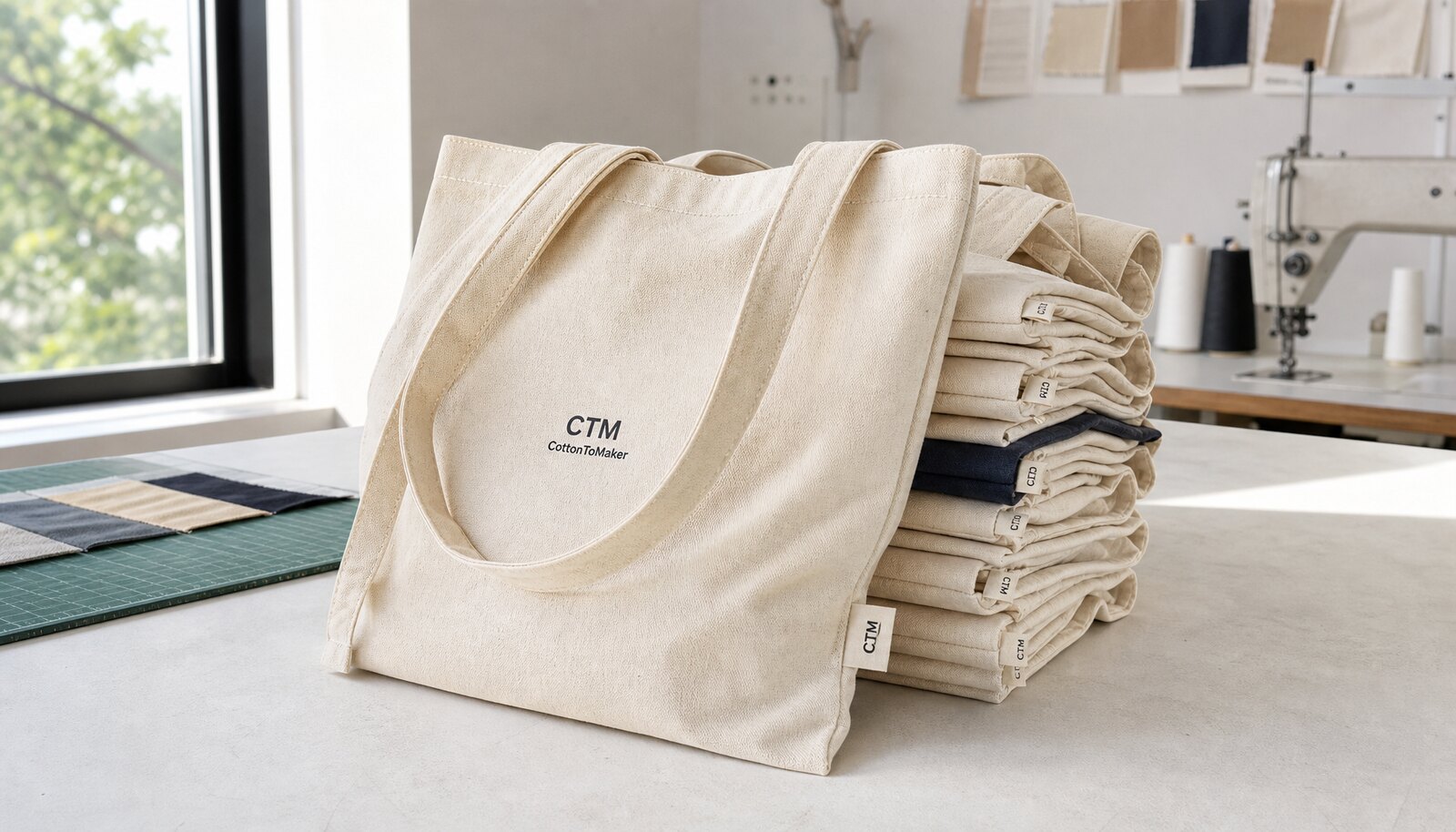
1. Start with the bag’s job, not the artwork
Printed canvas shopping bags for trade shows look like a simple branded item, but procurement buyers know they are really a functional logistics product. The bag has to carry brochures, samples, catalogs, or a product kit; it has to survive the event floor; and it has to reach the booth looking crisp enough that the logo still does its job. That is why the first question is not 'What logo do we print?' but 'What will this tote carry, how often will it be reused, and how visible must the brand remain after folding and transport?'
A one-day handout bag and a repeat-use conference tote are different products even if they share the same artwork. The giveaway version can be lighter and cheaper if it still holds the intended load without seam distortion. A premium event bag needs stronger canvas, cleaner finishing, and a print process that does not crack or soften into the weave after handling. Buyers should write the use case into the spec sheet before asking for any quote. That single step removes a lot of vague vendor answers.
For trade shows, the most common failure is not dramatic breakage. It is a bag that underperforms in small ways: the handles pull the top edge inward, the bag sags once brochures are added, the print sits too close to a seam and gets lost when the tote is folded, or the canvas feels so thin that the booth team stops handing it out. Those are buying errors, not decoration issues. They happen when the spec is written around appearance rather than function.
- Define the primary load: brochures only, sample kit, apparel, or mixed event materials.
- Decide whether the bag must be reused after the show or can remain a one-time giveaway.
- Write down the minimum acceptable look-and-feel so the tote does not read as throwaway merchandise.
- Separate load strength, print visibility, and packability as three different requirements.
2. Choose canvas weight and construction before comparing quotes
Canvas weight is the biggest driver of handfeel, structure, sewing behavior, and freight. For most event programs, 10oz to 12oz cotton canvas is the practical starting point. It gives enough body for brochures and basic product inserts while keeping the unit cost and carton weight manageable. If the bag has to look more premium or carry a heavier assortment, 12oz to 14oz is often a better commercial choice than trying to make a lighter cloth behave like a heavy tote.
Buyers should ask for GSM or ounce weight, plus the weave description if the factory can provide it. A loose weave can feel thicker in hand but still distort under load, and a tightly woven lighter cloth can outperform a sloppier heavier one. Ask whether the fabric is pre-shrunk, washed, or untreated. If the material can shrink after print or sewing, the supplier should define what that means for the finished size tolerance. That detail matters when the logo must sit a specific distance from the top edge or seam.
Handle construction is just as important as body cloth. A bag may pass a visual check and still fail on the show floor if the handles are too narrow, the seam allowance is inconsistent, or the bartacks are weak. For heavier inserts, buyers should specify handle width, attachment method, and whether the handle joins are reinforced with cross-stitch or bartack reinforcement. A good tote spec is a combination of fabric weight and stress-point engineering, not just a canvas headline.
- Use 10oz to 12oz for standard handout bags with moderate cost pressure.
- Use 12oz to 14oz when you need better structure without moving into heavyweight freight.
- Ask for pre-shrunk or treatment status so finished dimensions do not drift after production.
- Require handle reinforcement language in the spec, not just a handle length number.
3. Pick the print method based on artwork complexity and event handling
For simple branded totes, screen printing is still the default method because it gives strong color, durable coverage, and good economics once the order volume justifies setup. It is especially effective when the logo uses one or two spot colors and the buyer wants a crisp mark on natural canvas. The risk is that buyers sometimes stop at 'screen print' as if that alone solves everything. It does not. The supplier still needs a clear spec on print size, print position, ink type, and whether the artwork includes thin strokes or small text that may fill in on woven fabric.
When the artwork has gradients, multiple colors, small lettering, or photo-like detail, DTF or heat transfer may be more practical for a shorter run. Those methods can handle detail better, but they introduce another set of checks: edge lift, feel on the surface, and resistance to folding, rubbing, or stacking. If the tote is going to be handed out immediately at a trade show, buyers should care less about theoretical print resolution and more about whether the graphic survives a week of booth handling and transport.
Embroidery is usually a niche choice for canvas trade-show bags. It can look premium, but it is not the best answer for large branding areas or art that must remain lightweight and flexible. Embroidery adds stiffness and can create a raised area that rubs against inner contents. It is best reserved for smaller marks where the buyer wants a refined finish and accepts the extra cost and stitching time.
- Use screen print for bold logos and repeat bulk orders.
- Use DTF or heat transfer when art complexity outweighs unit-cost pressure.
- Avoid oversized solid fills unless the supplier can show a production-like print proof.
- Check the smallest text in the logo; many failures start with typography, not color.
4. Build the commercial spec around measurable dimensions
A procurement-grade tote spec has to be measurable. If the supplier only sees 'canvas shopping bag with logo,' the quote will vary too much to compare. Buyers should define the finished body width, height, and gusset depth, then state handle length, handle width, and the exact logo placement. That makes the quote comparable across factories and gives QC a way to reject material drift. Without those numbers, a supplier can substitute a different pattern size and still claim the bag is 'the same.'
For trade-show orders, the dimensions should be written with a tolerance that reflects the bag’s purpose. For small totes, ±5 mm on body dimensions is a reasonable starting point if the bag is meant to look uniform in distribution. For larger totes, ±10 mm may be acceptable depending on the packaging method and fabric behavior. Buyers should also specify the seam allowance if the supplier is willing to document it, especially when the logo must clear the side seam or sit a fixed distance below the top edge. If the print is too close to a seam, the artwork can bend or disappear when the bag is filled.
Another commercial detail often missed is the print safe zone. The artwork should not be placed where folding, gusset turning, or handle stitching will distort it. If the bag will be given out flat from a carton, a center-front logo might be fine. If it will be stuffed with catalogs or folded for mail-out, the buyer should ask the factory to mark the print location on a pre-production sample and verify it against the actual fold line. That is a simple way to prevent a costly look issue at the booth.
- State finished body size in millimeters or inches, not only a general bag style.
- Add a tolerance for body dimensions, handle length, and logo placement.
- Request a print safe zone around seams, folds, and bartacks.
- Require the factory to measure from the same reference points every time.
5. Compare supplier routes by control, not only by unit price
The same bag can come from different buying routes, and each route has a different risk profile. A direct factory can be the best commercial choice when you need control over fabric, print, sewing, and packing, especially on repeat programs. But direct buying only works if the buyer can manage the technical details and get honest answers about who prints, who inspects, and who handles export packing. A low unit price from a factory does not help if the sample pathway is weak or if the production line quietly changes fabric lot or print process mid-order.
A trading company or merchandiser can be useful when the program has multiple items, mixed packaging, or several destinations. The tradeoff is that you need to understand where the mark-up sits and who is actually making the bag. The supplier should identify the production factory, not hide behind a generic office address. If the buyer cannot get the real factory name, QC contact, or packing photos, the quote may look simple while the execution risk rises.
A local converter can make sense when the event date is close and the buyer values speed over fabric choice. The unit price may be higher, but if the alternative is missing the show, the premium can be justified. The important procurement question is whether the supplier’s strengths match the order. There is no universal winner; there is only the supplier route that best matches the risk profile of that specific trade-show shipment.
- Ask who owns fabric booking, print setup, sewing, QC, and carton labeling.
- Request the real factory name and the production site address before award.
- Compare suppliers on process control and lead-time reliability, not just on base unit price.
- Use one written specification sheet so every quote is answering the same request.
6. Use an RFQ that forces comparable quotes
A good RFQ for printed canvas shopping bags for trade shows custom logo order guide work should read like a production brief, not a general inquiry. The supplier needs fabric weight, finished size, handle dimensions, print method, print size, artwork file format, packing format, and the event deadline. If the buyer leaves out one of those elements, the supplier will fill the gap with an assumption. That is how one quote turns into a bag-only price while another includes packing, labeling, and carton work. The result is a false comparison.
To keep the quote useful, ask for separated line items. The supplier should show fabric cost, print setup, unit print cost, sewing, packing, and any outer carton or inner polybag charge. If the order includes multiple colors or artwork variants, require a price break by version. This makes it easier to see where the real delta comes from. It also helps during negotiation because the buyer can ask whether a higher price is caused by fabric, print complexity, or packaging labor rather than assuming the supplier is simply inflating the quote.
The RFQ should also include the commercial terms that affect landed cost. If the bags are shipping to a distribution center, specify the delivery point and whether the supplier must quote freight or ex-works only. If a packed carton count matters to the receiving team, say so. This is especially important when bags are being shipped to a trade show contractor or 3PL. The factory needs to know whether the carton mark should be generic, event-specific, or retail-ready. In procurement terms, the RFQ should eliminate avoidable ambiguity rather than simply gather prices.
- Attach final artwork and say whether scale changes are allowed.
- Request a line-item quote for fabric, print, sewing, packing, and carton work.
- State the destination and incoterm so freight assumptions are consistent.
- Ask the supplier to identify all assumptions that could change the price.
7. Approve samples like a buyer who expects production drift
A sample is useful only if it is close enough to the bulk order to reveal real risks. The best practice is to request a pre-production sample or a production-like sample built from the actual fabric and the same print method planned for the order. If the supplier sends a look-alike sample made from different cloth or a different print process, the approval has limited value. Buyers should not approve based solely on a clean photo if the finish, weight, and stitching are still unknown.
During sample review, measure the finished size, check logo placement, inspect handle symmetry, and examine the bag under natural light. Natural light reveals shade differences and print quality more honestly than a screen image or a dim office. Then test the tote with the real load. A brochure-only bag might pass with no issue, but a sample kit may pull the top edge, twist the handles, or stress the side seam. Those load tests are cheap compared with redoing a full shipment.
Watch for the sample traps that cost buyers the most. One common issue is a 'presentation sample' that looks better than production because the factory hand-finishes it, uses a different drying time, or selects a premium piece of cloth. Another trap is approving a sample without confirming the fold method; the bulk bag can arrive with a print crease or a flattened body shape that was never visible during approval. The sample file should show what was approved, who approved it, and exactly which features must remain unchanged in bulk production.
- Approve only after confirming fabric, thread, ink, and packing match the planned bulk order.
- Record the approved sample with date, owner, and any agreed exceptions in writing.
- Test the bag with the actual event load, not a light placeholder weight.
- Reject sample substitutions that change cloth, print process, or fold method without notice.
8. Set measurable QC acceptance criteria before mass production starts
Procurement buyers need more than a bullet list of quality checks. For canvas tote sourcing, the acceptance criteria should be written in measurable language before the first bulk unit is made. That means the PO or spec sheet should define the allowed tolerance on size, stitch quality, print position, ink performance, carton counts, and packaging appearance. If the supplier cannot measure it, the supplier cannot consistently hold it.
Below is a practical QC matrix that buyers can use as a starting point. It is not a substitute for an internal quality standard, but it gives the factory something concrete to inspect against. The key is to keep tolerances realistic for a sewn textile product while still tight enough to catch visible defects. A tote bag is not machined metal, so the standard should focus on what the customer sees and what the event team handles: dimensions, print alignment, strength, and packing consistency.
The biggest quality failures on printed canvas bags are usually obvious once buyers know what to look for: off-center logos, crushed or fuzzy ink edges, crooked handles, seam puckering near the top edge, missing bartacks, mixed carton counts, and bags that differ in shade across cartons. In a trade-show context, those defects matter because bags are distributed in public and often photographed. A tote with one weak defect can undermine the campaign image just as surely as a bad booth banner.
- Write tolerances into the PO instead of relying on 'good quality' language.
- Require an in-line inspection at first run or first article stage if the event is time sensitive.
- Use the same acceptance rules for all suppliers to avoid quote-to-quote ambiguity.
- Treat carton count and SKU separation as zero-tolerance items.
9. Inspect packing, carton labeling, and transport details
Packing may seem secondary, but it often determines how the bags arrive at the venue. If the buyer ships to a warehouse or 3PL, flat packing usually makes the most commercial sense because it reduces carton volume and freight cost. But if the trade-show team needs to hand bags out quickly from on-site cartons, the fold orientation, label format, and carton count become part of the product spec. A well-printed tote can still become a logistical nuisance if the cartons are unlabeled or the bags are folded in a way that hides the logo crease on opening.
Ask the supplier to confirm carton dimensions, gross weight, and count per carton before production starts. Those details affect warehouse receiving, pallet stacking, and air or ocean freight costing. A carton that is only slightly larger than expected can push the shipment into a less efficient rate band. If the bags are going to multiple events or regions, carton marks should make sorting easy: campaign code, color, size, quantity, and destination, all visible without opening the carton.
Another practical detail is moisture and compression. Canvas is less fragile than paper, but it still wrinkles, takes odor, and can crush in transit if cartons are overpacked or exposed to damp storage. For long freight moves, buyers should ask whether a polybag, desiccant, or stronger outer carton is needed. The answer depends on route and climate, but the decision should be explicit. If the tote arrives at the booth with a musty odor or severe fold marks, the issue is usually packing control, not just transport.
- Confirm carton count, carton dimensions, and gross weight before booking freight.
- State whether the bags should be flat packed, event-folded, or individually bagged.
- Label cartons by campaign, size, color, and destination for easy receiving.
- Ask whether the route needs moisture protection or stronger outer cartons.
10. Audit the supplier with documents, not just promises
The advice to 'verify who actually prints' is directionally correct, but it is too vague to help a buyer win a procurement review. A better supplier audit asks for document evidence. Start with the factory name, site address, and the contact person responsible for production, not only sales. Ask for business registration details if your internal file requires them. Then ask who performs printing in-house, which steps are outsourced, and whether the factory can provide photos of the production line or a current site shot. If the supplier is a trader, that is fine; the issue is transparency, not the business model.
Document checks should match the risk of the order. For a standard event tote, the buyer may only need basic factory identification, sample traceability, and a signed spec sheet. For a larger program, add audit items such as social compliance, quality management, and environmental documentation if your company requires them. Useful documents can include factory ISO certificates if available, test reports on inks or fabric if claimed, and a packing or inspection record from a recent order. The point is not to collect paperwork for its own sake; it is to know whether the supplier can prove control over the process.
A practical audit also includes a 'proof of production' request: a photo of the first sewn bag, a photo of print setup, and a photo of carton labeling before ship. Those pictures should show your actual artwork or an approved production reference, not a generic tote from another customer. If the supplier resists that level of visibility, the buyer should treat it as a signal. Good factories expect process questions. What matters is how quickly and clearly they answer them.
- Request the factory name, site address, and production contact before award.
- Ask which steps are in-house and which are outsourced.
- Request recent production photos tied to your artwork, not generic samples.
- Keep the audit proportionate to the order value and risk, but do not skip identity verification.
Specification comparison for buyers
| Decision point | Recommended option | When it fits | Buyer risk to check | Typical price / lead-time impact |
|---|---|---|---|---|
| Supplier route | Direct factory with in-house printing | You need control over fabric, print, stitching, and export packing on repeat orders | Verify who actually prints, who inspects, and whether the quote includes sewing, printing, curing, and carton work | Lowest unit cost at volume; usually 1–2 weeks faster than layered sourcing if the spec is standard |
| Supplier route | Trading company or merchandiser | You want one contact for mixed trims, multi-item kits, or multi-site programs | Confirm the real factory, margin layer, and whether the approved sample is passed through unchanged | Unit price often 5–20% higher; lead time can be similar, but changes take longer |
| Supplier route | Local converter for urgent event inventory | You have a short event timeline and can accept fewer fabric choices | Check whether the quote hides limited stock fabric, simplified print, or non-optimized carton packing | Higher unit price, but fastest for rush reorders; often 3–7 days quicker on domestic handoff |
| Fabric weight | 10oz canvas | Standard trade-show giveaway bag with controlled cost and enough structure for brochures | Make sure the quote states GSM or oz and not just 'canvas' | Usually the cheapest fabric option; faster sewing, lower freight weight |
| Fabric weight | 12oz canvas | Most balanced choice for a branded trade-show bag that needs better shape retention | Check seam puckering and whether the handles need reinforcement at load points | Moderate price increase; can add a small freight penalty due to weight |
| Fabric weight | 14oz–16oz heavy canvas | Premium brand use, product kits, or repeat-use event bags | Check handle bartacks, seam allowance, and carton gross weight before approval | Higher fabric cost and slower sewing; freight and carton handling costs rise |
| Print method | 1–2 color screen print | Simple logo, bold branding, and repeat bulk orders | Confirm screen charges, ink density, and the minimum text size that will hold on canvas | Best unit economics at volume; setup adds a few days, but production is efficient |
| Print method | DTF or heat transfer | Detailed artwork, gradients, or short runs with multiple colors | Check edge lift, hand feel, and rub resistance after folding | Often higher per bag than screen print; can be faster for short runs and complex art |
| Print method | Embroidery | Small premium mark, retail-oriented tote, or gift program with a refined look | Check thread density, puckering, and whether embroidery creates a stiff hotspot on thin canvas | Higher unit cost and longer sew time; suitable only when the logo area is small |
Buyer checklist before sampling
- State exact fabric weight in oz or GSM, plus whether the canvas is bleached, natural, or dyed.
- Specify bag dimensions, gusset depth, handle length, handle width, and the seam reinforcement style.
- Identify the print method, number of colors, print size, print placement, and the allowed registration tolerance.
- Ask for a pre-production sample or a production-like sample using the exact bulk fabric and ink system.
- Confirm MOQ by fabric, print method, and packing format, not just by the finished bag.
- Request carton count, carton dimensions, gross weight, pallet pattern, and carton drop orientation if it will ship via distribution center.
- Set the event date backward into sample approval, production start, and ship date milestones.
- Ask the supplier to separate fabric, printing, sewing, packing, and freight assumptions in the quote.
- Require photos of the first finished units during bulk production if the lead time is tight or the artwork is sensitive.
Factory quote questions to send
- What is the exact fabric spec in GSM or oz, and is the canvas pre-shrunk, washed, or standard loom width?
- What is the finished bag size tolerance you can hold, and what dimensions do you measure from edge to edge?
- How many print colors are included, what is the setup charge, and what exact print area is quoted?
- What is the minimum text size or minimum line thickness you recommend for this canvas and print method?
- What is the MOQ for this fabric, print method, and packaging format?
- Can you show a pre-production sample, production sample, or current reference sample using the same process?
- What is included in the unit price: sewing, print, packing, inner polybag, hangtag, and carton export mark?
- What carton count and carton dimensions do you recommend for trade-show distribution or warehouse receiving?
- What is the lead time after sample approval, and which step is most likely to delay the order?
- What QC standard do you use for print registration, stitch strength, shade tolerance, and carton count?
Quality-control points to confirm
- Fabric weight matches the approved spec within a controlled supplier tolerance, typically ±5% unless a stricter contract is agreed.
- Finished length, width, and gusset stay within the approved dimension tolerance, typically ±5 mm for small bags or ±10 mm for larger totes.
- Handle length and symmetry stay within ±5 mm, and both handles sit at the same height on the bag body.
- Logo placement stays within ±5 mm of the signed artwork position on visible faces.
- Print registration stays within ±1.5 mm for simple one- to two-color art; fine detail should be reviewed by actual proof, not only by eye.
- Ink coverage has no major pinholes, streaking, ghosting, edge blur, or show-through that weakens the logo.
- Rub test: dry rub should not leave visible heavy smear on clean white cloth after 10 moderate passes; wet rub should be checked if the ink claims water resistance.
- Stitching has no skipped stitches, broken thread, or loose knots; bartacks should be visible and secure at stress points.
- Seam allowance is consistent and no seam opens or distorts when the bag is loaded with the agreed test weight.
- Carton pack count matches the PO exactly, with a count tolerance of zero tolerance on mixed SKUs.